Showing posts with label Hampshire College. Show all posts

Friday, December 16, 2016

Rally Against Veterans' Flag Convoy and in Support of Hampshire College.

As noted in the previous post, Hampshire College's decision to resume flying the American flag in the wake of the protest by a veterans' group led the organizers to cancel the  second demonstration scheduled for a week later. However, another group, the "American Flag and Thin Blue Line Convoy," decided to go ahead with their showing of the flag along a route running from UMass via Amherst College to Hampshire. In the meantime, a group of leftist Pioneer Valley activists hurriedly organized a counter-demonstration on the Amherst Common.


Raise our struggle! (We have markers)

Both events were small. The Convoy claimed just over 200 participants. The counter-demonstration was even smaller. When I arrived fewer than 10 minutes before the announced start time of 10:00, there were only three people there, just starting to make signs. "We have magic markers if you want to help," one of them told me ("and glitter," another helpfully added). Even when the event got going, between 10:15 and 10:30, there were only between about two and three dozen people present. By the end, the total was over 100, and perhaps around 150 by my count--still a far cry from the 1500 that the organizers claimed for their veterans' protest at Hampshire a week earlier.


Whereas the veterans' protest was sharply focused on a single issue and a  clear outcome --"Raise the Flag!"--the program of the present event, called "Raise Our Struggle," might best be called eclectic: a counter-demonstration against the convoy, combined with wide-ranging demands for social justice and denunciation of the bigotry and racism associated with the election campaign of Donald Trump, as well as a call for "hands off Hampshire College," in response to the abuse that the latter was suffering for its flag policy.

The event announcement epitomized the grab-bag approach and generalized, flailing, post-election anguish:
A rally and gathering in defense of our plural and diverse communities in Amherst and beyond.

In Amherst and communities across Western Massachusetts, some of us are proud of our country and the flag, and others are not, but all of us recognize that Hampshire College has been subject to an unprecedented attack on their community's autonomy and character as a progressive and critical space. Reactionary nationalist forces have invaded their community with direct racist and xenophobic threats to impose a political vision that erases the experiences, voices, and history of immigrants, people of color, women, LGBTQ communities, youth, Muslims, indigenous people, Jews, other marginalized and oppressed communities, and the working class. Elected officials and politicians, from local Democrats to Donald Trump have spurred on and defended this assault, more concerned about the American flag than the proliferation of hate crimes and open bigotry in our communities.

This is not about any symbol. This is about human beings. The assault will not stop at Hampshire College. The same forces want to lay siege to communities of color, college campuses, and progressive institutions of the marginalized and the working class. They fly the thin blue line and celebrate the police, not for their own safety or peace, but to shield police and the state from scrutiny, from checks on the violence daily inflicted on black, brown, and working class neighborhoods. Forces of reaction wish to wrench apart our communities , not in the name of freedom, liberty, or patriotism, but dominance, blind authority, vulgar power, and profit.

We humbly recognize that we are on stolen land, and we need to respond with stewardship in solidarity with indigenous peoples, not to reclaim territory for nationalism and imperialism. We must do our part in Amherst, but free our hearts, minds, and bodies to support the struggles of frontline communities across this country and the world. We will not forget our past, our history, our struggles for liberation and freedom.

An Injury to one is an injury to all!
The first remarks by a Springfield activist addressed the theme of social justice in the age of Trump.


"What do we want? Free speech!"


About 20 minutes later, demonstrators took up positions along the sidewalk and in the crosswalk at the intersection of Pleasant and Spring Streets as the convoy approached.


The convoy organizers had asked "that there only be american flags, thin blue line pro police flags, gadsen [sic] flags, or flags pertaining to any branch of military. No confederate flags."

Blocking the street (a violation of the law) in order to stop the convoy, they shouted, "What do we want? Free speech!" (Other chants included: "No Trump, no KKK, no fascist USA.")


A sheriff's car accompanying the convoy (a service the convoy organizers paid for) halted and prudently allowed the protest to go on for a few moments. Frustrated, the convoy participants made u-turns and found an alternate route. A moment later, an Amherst police vehicle arrived. The officer advised the demonstrators that they were not allowed to block a public way, and they returned to the Common.


"We're badass!"

Jubilantly proclaiming that they were "badass" for having briefly interrupted the progress of convoy, they continued with their program.

School Committee member Vira Douangmany Cage, the only Amherst elected official to participate (though in a private capacity), spoke of social justice, denounced the outside politicians who had taken part at the Hampshire College protest last week, and criticized Amherst's government for not intervening.

(The Business Improvement District had nothing to do with the rally.
The sign was presumably left over from the "Merry Maple" celebration.)


"Hands off Hampshire College"


Hampshire College professor Uditi Sen (my colleague in history) defended the institution's decision to remove the flag, offering what might be characterized as the predominant view among the faculty and administration.


Few outside the academy may share this view (or even understand the argument that she was trying to make), and that is their right--but the nature of that disagreement makes all the difference.

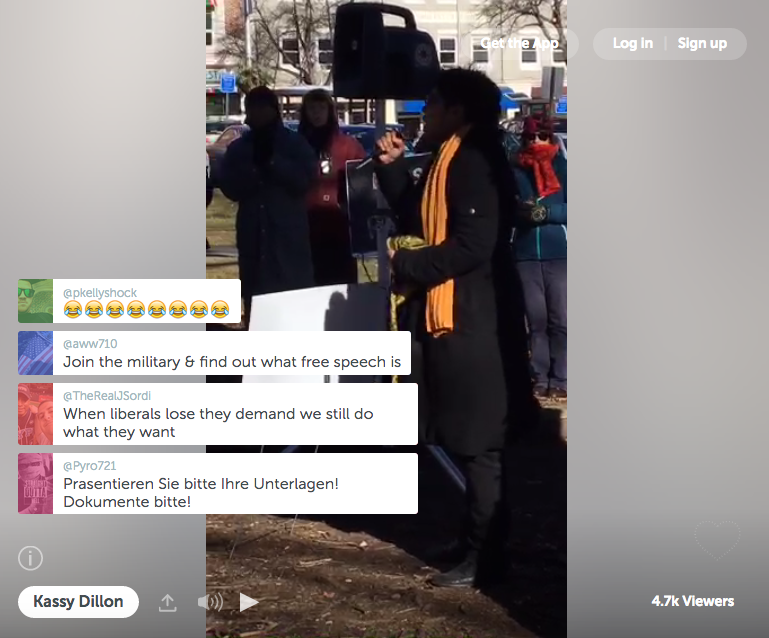
Mount Holyoke student and conservative activist Kassy Dillon covered the convoy and the demonstration on the Common on social media, mocking the College and the protesters. That, of course, is her right, as well. Part of her coverage included live commentary of the rally via Periscope.


Unfortunately, some of the respondents to the feed chose to offer particularly hateful responses (for which, it should be stressed, one cannot hold Ms. Dillon responsible). They ranged from the childish to the racist and full-blown neo-Nazi.


It was a perfect illustration of the toxic political landscape at the intersection of internet journalism and social media. Often it's not even so much the actual reports as the unmoderated responses and "talkbacks" that are the problem. Here, the problem is all too evident.

And 2017 is not even upon us.

* * *

Press coverage

In contrast to the brief and bland report on WLLP Channel 22, the Springfield Republican's Mary Serreze (@maryserreze) did a notably thorough job of covering the event from the standpoint of both parties.


From the Protest Rally Against the Hampshire College Flag Policy


In response to students' anger and fear in the wake of the presidential election and their protests that the American flag represented racism and oppression, Hampshire College controversially decided on a temporary removal of the national symbol in hopes of calming the situation and fostering dialogue.


The public reaction surprised the College (but hardly anyone else): incredulity and outrage.


"Peaceful Demonstration of Freedom--Stand With Old Glory"

Amherst’s Veterans of Foreign Wars Post 754 organized a mass protest on the Hampshire College campus for the Sunday after Thanksgiving (November 27). A large crowd from around New England--particularly but not exclusively veterans and their families--gathered at the entrance to the College on Route 116. Although the press put the size of the crowd at around 400, the organizers, who issued over 5,000 invitations via social media, estimated attendance at 1,500 to 2,000: which is to say, greater than the annual enrollment at the College.

I was present, along with a few other members of the faculty and student body.


 Veterans represented multiple generations and wars.


Not exactly the alt-right

In the wake of the presidential election and the tensions that it engendered, many in the Hampshire and wider Amherst community (who did not bother to attend or were scared to do so) leaped to the conclusion that the event was a gathering of right-wing extremists and hatemongers. On the contrary, the organizers took care to avoid giving the formal program any particular political slant. In fact, the most prominent speakers were centrist or left-liberal Democratic politicians: State Rep. John Velis (Westfield), Springfield Mayor Domenic Sarno and Councillor Kateri Walsh, and Northwestern District Attorney David Sullivan. Several of the speakers were non-white and immigrants. A member of the local veterans' color guard was transgender.

not exactly the "alt-right"

Outside interference?


The presence of the regional political figures caused no little consternation among the Hampshire faculty, who complained in high dudgeon that outsiders were interfering in our internal affairs and attempting to intimidate the College. It is an ironic argument. The politicians were simply exercising the same right of free speech about an issue of deep concern as the students who burned the flag and the President who banned it. (And, for the record: in my many years of working here, I had never known the College to bow to the wishes of any outside force, least of all, provincial politicos.)

Still, even neutral outsiders remarked on the unusual presence of these visitors. (Most expressions of surprise focused on the presence of Mayor Sarno, who, as a friend of mine from beyond the walls of the academy drily observed, "has never even come to pee in Amherst.") The most parsimonious explanation is, however, generally the most plausible. (It is possible to overthink an issue.) The cynical consensus among outside observers was that the aim was grandstanding rather than intimidation. Seeking to score easy points with their base is, after all, what politicians do. But politicians also have convictions. The idea that the flag had powerful emotional meaning for them, and that they therefore cared sincerely and deeply about its presence or absence, is a difficult one for the academic mind to grasp.

Rep. Velis is not just a politician from the Pioneer Valley, but also an Afghanistan veteran. As for DA Sullivan, he is a frequent attendee at events in Amherst, and he moreover has extensive professional experience in military affairs, having served as a civilian lawyer for service personnel and most recently, working to establish a new veterans' court providing treatment for trauma disorders and substance abuse. Mayor Sarno, too, paid tribute to the veterans, but he explained that the flag had further personal significance for him.


The flag of a nation of immigrants

Sarno was one of several speakers who highlighted the role of immigrants. The flag had special meaning for him as the son of Italian immigrants who had experienced Fascism and survived the Nazi occupation of Italy in hiding. To them it had been a symbol of hope and freedom.


Event organizer Victor A. Nunez Ortiz came to the United States when his family fled the Salvadoran civil war. He served in the Marines even before becoming a US citizen. He refers to this experience when introducing the next speaker.


Another veteran who had served in the US military as an immigrant non-citizen was Veasna Roeun of Connecticut: a survivor of the Cambodian genocide.


A Progressive Speaks


Here, well known local civic and political figure Bonnie MacCracken speaks. She read a poem about Blue Star Mothers. Bonnie, a candidate in the recent Democratic primary election for state representative from the third Hampshire district, is a member of the Democratic State Committee and has long been active on behalf of progressive social causes, among them racial and economic justice (especially housing issues) and early education.


And the right?


The red meat right-wing exception in this program was the brief address by Mount Holyoke student and conservative activist Kassy Dillon, who focused her remarks on a critique of the College and its students. She explained, "I wrote the first story" about the flag flap, adding that the Hampshire student who had passed on the news to her was now "being bullied by other students."


Racism and extremism?

Despite repeated assertions that Confederate flags and other racist symbols were on display, neither I nor anyone I subsequently spoke with saw them--and no one has to date produced any photographic proof. It does not seem unreasonable to conclude--given the nature of the controversy, and what I saw--that many in the crowd were to the right of center, but that is not the same thing as "alt-right" "white supremacists."

To be sure, there were a few displays that I could I could have done without: this anti-UN flag, for example (though without talking to the owner, it was impossible to tell whether it represented standard arch-conservative gripes about "anti-American" multilateralism or something notably more rancid).


I also spotted several "Don't Tread On Me" flags. The right-wing "Tea Party" movement adopted the Gadsden Flag (as it is more properly called) in 2010, though as everyone should know (and Mount Holyoke historian Joseph Ellis explains), it is a venerable emblem of the American Revolutionary era, appropriated in the meantime by various groups as a symbol of protest.


On the whole, the tone was respectful of the College. Of course, the organizers could not regulate who showed up, and a few of the signs were obnoxious and juvenile. One placard (referring to Vladimir Putin or just left over from the Cold War?) advised Hampshire students: if you don't like it here, go get an education in Russia. Another, in what the creators no doubt considered a masterpiece of wit, relied on hackneyed scatological imagery.


By contrast, this sign, playing on the Hampshire College motto, took a lighter approach, and was perhaps marginally more effective.


The organizers had stressed the need for civility prior to the event:
this a PEACEFUL DEMONSTRATION OF FREEDOM as citizens of our United States of America. . . Families will be present and order is to be expected.
At the rally itself, they reiterated this request and moreover made a point of thanking the College for allowing them to meet on campus property. Here, veteran and Purple Heart recipient Micah Welintukonis of Connecticut, who presided over much of the event, offers to provide microphone time to the President or any other administrators who might be present (none were) and then leads the crowd in the chant, "Raise that flag!"


A confrontation

At one point, though, one saw how things might have taken a more dangerous turn. Toward the end of the event, the organizers wanted the participants to assemble near the large Hampshire College sign for a group photo that they hoped would go viral. As they asked people to move away from the sign so that the wording would be visible, we saw a young man sitting on the ledge in front of it, giving people the finger with both hands. The organizers, at first thinking he was one of their own, mocking Hampshire College, chided him for his vulgarity. It turned out, however, that he was a Hampshire student flipping off the demonstrators rather than the College and seeking to spoil their photo op. The crowd became more agitated. Several people seemed prepared to remove him by force and others tried holding a flag in front of him to block him from view but the speaker urged them to remain peaceful and let the campus police provide order. The speaker engaged in some mild taunting of the hapless student but also offered him the microphone. After a few minutes of this standoff, things quieted down. Subsequent press reports described some uglier aspects of the confrontation, but from where I was standing at the time, near the podium, I could see and hear none of that.


Coming to a close

As the rally wound down, attendees sang "God Bless America."


In the low-key conclusion to the event, the speaker reminded attendees that "we are all Americans" and urged them to tell the College: "raise our flag!"


Postscript


The veterans had planned to return a week later for a second rally, but when the College suddenly announced on December 2 that the flag was going back up, they canceled the event as what they called an "act of faith":


Indeed, the best outcome of this sorry mess would be a dialogue between veterans and campus community, and there are some signs that this may in fact occur.

Hampshire Flag Watch: Going, going, . . .gone?! and . . . now back?


By now practically everyone in the country has heard the story, regardless of whether you read the New York Times or watch Fox News. It was with a mixture of fascination and horror that I watched the slow-motion political train wreck that was the Hampshire College flag controversy unfold over more than a month. 

Another metaphor that we use for a self-inflicted, completely avoidable disaster is: own goal.


For anyone who has been in a coma or perhaps just shell-shocked by the Trump victory and therefore unable to read a newspaper, watch TV, or surf the web, here's the elevator-speech version.


Take Down the Flag!

Hampshire student chalk protest: Take Down the Flag
The election of Donald Trump as President on November 8 prompted some Hampshire College students to express their opposition to the institution’s flying the US flag, which they denounced as a symbol of racism and oppression. College President Jonathan Lash listened politely but did not act on their demand. The next night, a group of students lowered the US flag to half-staff. On the night of 10 November, parties unknown burned the flag. It was the eve of Veterans Day. On November 12, the Trustees, having restored the flag, announced that they would fly it again at half-staff in deference to student concerns: “both to acknowledge the grief and pain experienced by so many and to enable the full complexity of voices and experiences to be heard.”

It was immediately clear to me it was an untenable policy: it simply could not last. I decided to watch what happened, for the historical record.

Day 3 (14 November)


For Day 4, the middle of the first week, I thought three shots were in order: 
general, close-up and night-time


Day 5 (16 November)


Day 6 (17 November)


Day 7 (18 November)


This is the only "dialogue" or "conversation" about the flag that I personally witnessed. (Evidently, the promised process happened in a series of "focus groups," but the vast majority of us were not involved. I certainly heard nothing.)


Negative space

Well, that didn't take long. The only thing more peculiar than the decision to fly the flag at half-staff for an extended period was the policy that soon replaced it. After only a week, on 18 November, the College announced, “we will not fly the U.S. flag or any other flags at Hampshire for the time being.” This, we were told, was so that we could discuss the meaning of the flag without the disturbing presence of (wait for it . . . ): the flag.


19 November: naked and alone


Raise the Flag!

A few days later, the press descended on the College.

November 22: filming an absence


When the outside world learned of the decision, the most common reaction was one of anger and incomprehension. The only surprising thing was that the College, with all its intellectual wattage, was, well . . . surprised. Any ordinary person would have seen this coming.

Amherst’s Veterans of Foreign Wars Post 754 organized a mass protest on the Hampshire College campus on 27 November, the Sunday after Thanksgiving. People from around New England--particularly but not exclusively veterans--gathered at the entrance to the College on Route 116. The organizers estimated attendance at over 1,500 to 2,000: which is to say, greater than the typical annual enrollment at the College.

The event was nonpartisan in intention (and largely in practice) and the speakers included several left-liberal Democrats. I attended the rally to observe for myself. Although some subsequent press reports described at least one confrontation involving aggressive or offensive behavior, what I saw was by and large respectful and disciplined. The organizers stressed the need for civility and made a point of thanking the College for allowing them to meet on campus property. They offered to provide microphone time to the President or any other administrators who might be present (none were).


Press coverage, both local and national, was heavy.


The College soon faced a torrent of abuse in the form of angry phone calls and emails, as well as far harsher talk on social media--much like what the Town itself has experienced in the wake of controversies over flying the 9-11 commemorative flags or other contentious debates.


November 29: I have no idea what these temporary fences near the flag were intended to accomplish.


Back to normal?

On 2 December, the the College suddenly announced that the flag was being returned to its customary position on the main campus flagpole. Crisis over, but no problems solved.


After I took my pictures, a woman passing by said, "a lot of people doing that today."


There is a well known political dictum: when you're explaining, you're losing. The College has created a dedicated web page to explain its recent flag policy to the public.


* * *


Coming attractions 

- photos of the protest rally against the College
- a more detailed look at the controversy


Friday, September 11, 2015

The Other 9-11 (s)

Since we have so many flag controversies here in Amherst, let me make clear that Hampshire College, like other major institutions in town, lowers the flag to half-staff on the anniversary of the September 11 attacks.


That said, the main commemorative event in recent years actually memorializes something totally different: what the organizers call "the other September 11," namely the coup that toppled the socialist regime of Salvador Allende in Chile on that date in 1971.


The organizers generally issue a disclaimer explaining that the purpose is not to minimize the tragedy of the September 11 attacks of 2001, although the juxtaposition certainly serves to contradict the simplistic notion of an "exceptionalist" United States as unalloyed force for good--and, on 9-11, innocent victim. In any case, on a practical level, the programs serve as a way of getting students interested in Latin American studies as the fall semester begins.

I mention all this because it underscores the fact that a given date is often the occasion for many anniversaries, which one momentous event tends to eclipse.

A few years ago, I posted a list of these other 9-11's, and they include some events that were arguably of equal or greater world-historical significance: from the victory of William Wallace at Stirling Bridge (1297), and the opening of the battle in which the Turks were stopped at the gates of Vienna (1683), to the British victory at Brandywine in the American Revolution (1777) and the American victory at Plattsburgh (Lake Champlain) over the British in the War of 1812 (1814).

How many do you recognize?

Friday, November 7, 2014

Even Scarier Than Halloween Bad History: Everyday Ignorance

Both kidding and serious concerns about bad documentaries notwithstanding: I know that, were I to lay out the reasons that "The Burning Times" is an atrocious travesty of history, I could have an intelligent discussion with my Hampshire College classes.

Sometimes we forget how lucky we here in the Five College Consortium are, privileged to work with students who are on the whole smart and well educated or at least educable.

Not everyone is as lucky.

Consider, for example, this footage from Texas Tech.

Sure, sure, these things have a sensationalistic "gotcha" quality about them and may well not be representative. Still, can you imagine how any American claiming to be educated could not know who won the Civil War? or even what the two sides were? See for yourself.


(h.t. wj)

Pandering ghost tours and bad witchcraft documentaries pale in comparison.

Be afraid. Be very afraid.


Thursday, November 6, 2014

And You Thought Halloween Was Scary? How About Teaching Bad History About Witchcraft??


Often as not it's bad history rather than scary costumes that forces historians to turn away and scream in terror every Halloween.

I was dismayed to see that Hampshire College--admittedly, the Spiritual Life Center and Community Partnerships for Social Change, rather than an academic class--was sponsoring a screening of one of the worst pseudohistorical documentaries for the occasion.

"The Burning Times" is a 1990 piece in the National Film Board of Canada's "Women and Spirituality" series. It has developed a popular following for all wrong reasons, which will become immediately obvious:
This documentary takes an in-depth look at the witch hunts that swept through Europe. False accusations and trials led to massive torture and burnings at the stake, and ultimately to the destruction of an organic way of life. The film questions whether the widespread violence against women and the destruction of the environment today can be traced back to those times. 
The intention of my Hampshire colleagues was good, I am sure: to add some intellectual content to a holiday long known here for its substance- and sex-related excesses, to highlight the historical oppression of women, and to acknowledge neo-paganism within the scope of spiritualities in the college community.

Unfortunately, the film is a slick and sloppy New Age compilation of errors, half-truths, omissions, and exaggerations.

Given that "The Burning Times" describes the city of Trier as "French" even though all the signs on the buildings shown are in German and it belonged to France only briefly--from 1794 to 1815, never during the Middle Ages--an attentive viewer might think to question the film's larger claims such as the characterization of the witch hunts as "the women's Holocaust" (at 14:19).

I remember one colleague here in the Five College Consortium lamenting to me that whenever students saw "The Burning Times," it took him at least half a semester to unteach the idiocy they had absorbed. Some years ago, when I saw that WGBY, the local Public Television station, was showing this sorry film during a pledge drive (adding insult to injury), I went so far as to call them up and explain that I was therefore not going to donate any money that year.

Yes, it's that bad.


The work of any professional historian will suggest how much more complex the reality was.

Even a glance at David Hall's appropriately titled essay on "Witchcraft and the Limits of Interpretation" (New England Quarterly, 1985) should make anyone pause before making sweeping generalizations covering many centuries and countries.  But his piece is rather heavy going.


For those seeking the bird's eye view, Brian Pavlac, author of Witch Hunts in the Western World, helpfully lists:
Ten Common Errors and Myths about the Witch Hunts, Corrected and Commented
  1. The Witch Hunts were an example of medieval cruelty and barbarism.
  2. The Church was to blame for the Witch Hunts.
  3. The Witch Hunts specifically targeted women.
  4. The Witch Hunts were an attempt at "femicide" or "gendercide," meaning the persecution of the female sex, equivalent to genocide.
  5. The Witch Hunts were all alike.
  6. Millions of people died because of the Witch Hunts.
  7. People condemned during the Witch Hunts were burned at the stake.
  8. During the time of the Witch Hunts, witches actually existed and worked magic.
  9. In modern usage, the term "Witch Hunt" can be applied to any persecution of a group of people.
  10. Modern witchcraft/magick/wicca is a direct descendent of those practices done by people during the Witch Hunts of 1400-1800.
(detailed explanation of each here on his Women's History Resource Site).

Ontario Consultants on Religious Tolerance deal specifically with the film:

Overview:

We are not going to win many friends in the Neopagan communities with the following essay. However, we believe it to be accurate. It is a story that needs to be told.

The facts are that almost all of the information that is generally accepted as truth by the Neopagan community about the "burning times" is wrong:
  • The total number of victims was probably between 50,000 and 100,000 -- not 9 million as many believe. 
  • Although alleged witches were burned alive or hung over a five century interval -- from the 14th to the 18th century -- the vast majority were tried from 1550 to 1650. 
  • Some of the victims worshiped Pagan deities, and thus could be considered to be indirectly linked to today's Neopagans. However most apparently did not. 
  • Some of the victims were midwives and native healers; however most were not. 
  • Most of the victims were tried executed by local, community courts, not by the Church. 
  • A substantial minority of victims -- about 25% -- were male. 
  • Many countries in Europe largely escaped the burning times: Ireland executed only four "Witches;" Russia only ten. The craze affected mostly Switzerland, Germany and France. 
  • Eastern Orthodox countries had few Witch trials.[....]
  • Most of the deaths seem to have taken place in Western Europe in the times and areas where Protestant - Roman Catholic conflict -- and thus social turmoil -- was at its maximum.


Any questions?

If there's a lesson to be learned, it's that changing historical facts is no way to redress historical injustice or bring about historic change. Even would-be radicals need to do their homework.