A German regional court, considering a case involving a Muslim family, ruled that circumcision, as a form of grievous "bodily injury," violated the physical "integrity" of the child, and was thus a punishable offense. A legal expert expressed the hope that the verdict might now lead Islam and Judaism to reform their atavistic rituals. As attempts to extend the ruling throughout Germany and even other nations increased, Muslims and Jews came together to protest what they saw as an assault on their fundamental religious liberties and identities. (And they did so peacefully: no buildings were burned, no death threats issued.)
You want me to cut off my what?
Now, circumcision is indeed a peculiar custom, certainly worth considering from the detached standpoint of modern science and human rights. My former colleague, Len Glick, has written a provocative book detailing the history of the practice and arguing for its abolition (1, 2, 3).
Still, for better or worse, the reality is that our society accords non-rational religious beliefs and practices a deference that it would never extend even to less peculiar or problematic ones in the secular realm. Witness the daily and cretinous assaults on established scientific truths by powerful politicians. On a purely pragmatic level, religious beliefs are the subject of great sensitivity on the part of adherents, and the conflicts that arise from "offenses" against them at times threaten the social peace. (Just look at the reaction by outraged believers to the vulgar anti-Muhammad film, and the rush of western religious and political leaders to condemn it as well as the resultant violence.) Above and beyond that, the objective right to free debate of ideas may be tempered by the awareness of historical prejudice and risk of misappropriation of legitimate criticism by contemporary bigots (1, 2).
Even if some reactions to the circumcision verdict were intemperate, you therefore just knew it could not be a good thing when Muslims and Jews charged that it was becoming impossible for them to live in Germany and the Chancellor had to declare, "I do not want Germany to be the only country in the world in which Jews cannot practise their rites." Talk about a public-relations disaster.
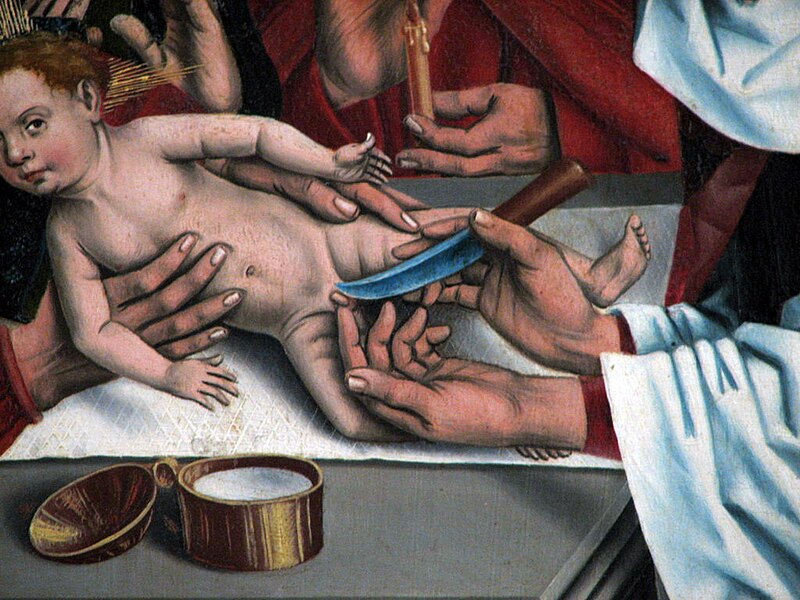 |
| Circumcision of Christ (1466) |
[source: Wikimedia Commons]
I followed the unfolding controversy for several months. Finally, when a Norwegian children's ombudsman helpfully suggested that Muslims and Jews just devise a new nonsurgical ritual (damn! now why didn't Moses and Muhammad think of that?), I decided to share a few thoughts on the topic in my Times of Israel column: "The most unkindest cut of all? A modest proposal for the circumcision crisis."
Every possible angle of the question had already been thoroughly debated, so, rather than going again into the details of law and human rights, or the medical arguments for or against the practice (though new studies tip the balance in favor), I thought I would merely contemplate the wisdom of the secular authorities' precipitous and quixotic attempt to correct the centuries-old doctrines of religious communities, especially communities that are or have been the object of discrimination.
Basically, I just wanted to ask what would happen if we pursued the reasoning of the zealous secular reformers to its ultimate conclusion (maybe even ad absurdum) and applied it across the board.
Not Too Swift
Judging by the talkbacks and other responses, most people understood the piece in the spirit in which it was intended and found it reasonably amusing. The notable exception was one British dullard who accused me of engaging in an illogical argument, and above all, of attacking Christianity.
As anyone who knows me can tell you, this is ludicrous. I spend a good deal of time in the classroom attempting to teach students to take religion—and Christianity, in particular—seriously as intellectual traditions and forces in the history of world civilization rather than condemning them out of hand according to modern standards of intellectual sophistication and political correctness.
In any case, this otherwise amiable fellow must be "as thick as a whale omelette" not to have seen that the piece was intended humorously and satirically. The words, "a modest proposal," should have been a dead giveaway to the culturally literate. (I was freshly returned from a conference in Dublin, where I had made a pilgrimage to Jonathan Swift's cathedral and grave, so the phrase just came to naturally to mind.)
As for logic, that was exactly my point, and one that would presumably have been sympathetic to my critic: seen from the outside, many religious doctrines and practices seem (or can be made to appear) ridiculous or harmful. Taking seriously the charge that they are not compatible with our modern values, where would that lead? Those who applauded the outcome in the case of circumcision might not be so sanguine in others.
Still, could it be that the fault of these zealous reformers lay not in having gone too far, and rather, in not having gone far enough?
Anyway, you can see for yourself where I ended up.
Updates
Of course, the story just keeps growing.
• Even before the appearance of the latest reports supporting claims for the hygienic advantages of circumcision—especially in the fight against AIDS in the Third World: it is said to cut the risk by fully 70%—fringe opponents of the practice vented their ire on a book about HIV prevention that essentially blamed European imperialism for the problem (the discussion of circumcision accounted for only 10% of the content) and "launched a smear campaign to discredit the book and its authors by spreading misinformation on Amazon." Namely, in a concerted effort, they posted ultra-negative reviews and then rated one another's reviews as "helpful" in order to drive down the book's ratings.
Joya Banerjee, "Amazon Warfare: How an anti-circumcision fringe group waged an ideological attack against AIDS scholarship." Slate, 24 Sept. 2012. (hat tip: Evgeny Morozov)
• And, as chance would have it, we appear to be ahead of the game. Writing on the eve of the first great matchup of the Presidential election, journalist and pop culture critic Virginia Heffernan's provocative and witty piece declares: "Obama and Romney should get a circumcision question at he debate. Really." (Yahoo! News, 2 Oct. 2012). Citing the aforementioned pieces on the foreskin controversy, she says,
For starters, neither candidate will mention it—ever. As long as he’s in politics. As long as he lives.and
Circumcision is repressed as a subject because, at this very moment, it’s that hot to the touch.
What a tangled psychosexual web we weave. As with abortion, transvaginal this and that, or the dozen issues surrounding sexual orientation, what seems natural to one side horrifies the other. Religion and ethnicity come into play, and ancient rivalries, and lizard-brain subjects involving physicality and sex and death and what disgusts you and what makes you feel freeShe moreover legitimately asks whether it is a right- or left-wing issue, a feminist or religious or human-rights issue, an ethnic or anti-ethnic issue, and so forth (even manages to work in Ron Paul and crypto-Nazi hostility to the pricks of the Federal Reserve).
Curiously, she has nothing to say about the European controversy that is the subject of this post. (I'll give her a pass on that one. We all have our areas of particular interest.) Still, she has a rather narrow view of what should be an expansive topic. It is therefore perhaps more curious that she frames the question as: "is circumcision a religious and ethnic issue, one that divides Jews and Americans from the rest of the world . . . ?"
Kudos and all that, but I guess an English literature degree gets you only so far. It is, as they say, a teachable moment, and not only regarding quantitative skills. There are approximately 14-15 million Jews in the world, and nearly 312 million Americans (though their circumcision rate has dropped considerably in recent years.) There are in addition, however, some 2.1 billion Muslims, whose religion also mandates circumcision.
A little multiculturalism, anyone?