Showing posts with label Blogosphere Context and Comparison. Show all posts

Friday, July 4, 2014

Season of Blooms--and Blogging?

The advent of summer, marking a transition of some sort--whether the beginning of new ways or the return to old ones--seems an appropriate time to get back to writing here. For that matter, Independence Day could be appropriate, as well. In any case, it's been much longer than I expected.

* * *


An appropriate metaphor?
Traditional or old garden roses (=pre-1867) generally had fragrant, double-blossomed flowers (white, pink, red), which bloomed briefly only once in a season, on old wood. In the course of the nineteenth century, breeders sought to develop cultivars with multiple desirable attributes, able to bloom on new growth throughout the season. One result, alas, was the insipid (not colorless, but usually odorless and sometimes tasteless) and ubiquitous hybrid tea rose that we give to our lovers on Valentine's Day and other special occasions. Go to a garden of old roses in June, and then tell me why we should waste big bucks on a bouquet of American Beauty.

Above: the Rose de Rescht, one of my stalwarts (though not recently sold around here), with the best virtues of an old rose and the new: ancient variety, strong fragrance, repeat (but not constant modern) blooming. A Damask, it was purportedly introduced to France in 1807, and to England circa 1880. Although the specifics of hybridization are unclear, it is generally said to have been reintroduced to England and Europe from Iran by Miss Lindsay, circa late 1940s.

* * *

Lots of things--mostly work (a.k.a. the "day job"), but also sundry civic and family obligations--got in the way. Scribbling here just did not seem to be the highest priority (not that it ever was).

In the intervening period, I've also been changing my writing habits and outlets:  focusing more on a few important "longform" pieces (they used to be called: "essays," or "articles") for other venues (though I may sometimes link to them here), while more frequently sharing links and brief observations on Twitter (@CitizenWald), and images or other brief posts on Tumblr. Look to the latter in particular for images with short text, though generally cross-referenced to this site.

As for this page, I have a few new summary rubrics as well as individual posts in mind.

In the meantime, here are some "coming attractions" (though without guarantee of when any individual piece will appear):
  • Leni Riefenstahl goes grocery shopping
  • Mrs. Chamberlain defends appeasement
  • Best. Course. Title. Ever.
  • How I got quoted by the AP.
  • Proof that you can fool some of the people all of the time.
  • And of course material for the World War I centenary.

Sunday, May 13, 2012

I've Got a New Journalistic Gig

This business of writing for the web and using other new and social media is an intriguing one: one makes new contacts (even friends) and wins new readers in ways that one cannot anticipate.

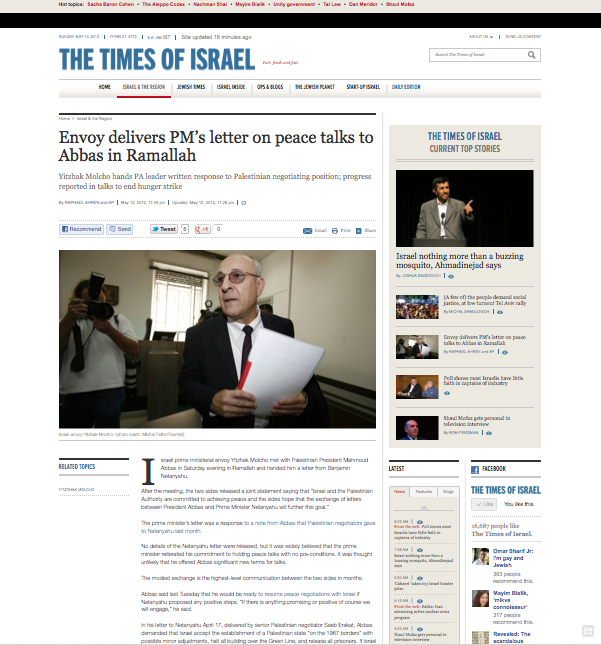
At the start of the year, I was therefore delighted to be invited to participate in the launching one of the most exciting new journalistic enterprises in the Middle East, The Times of Israel.

Why yet another publication in that region, print or digital?

As founding editor David Horovitz, late of the Jerusalem Post, explains, the ideal was to create a born-digital paper that would be lively but non-partisan in its politics, comprehensive in its coverage of the broader cultural realm, and technologically and graphically absolutely up-to-date and user-friendly (and free of obnoxiously intrusive advertising):
Fair-minded journalism, based in Israel, and read both here in Israel and among those who care for the Jewish nation around the world, has a vital, even noble role to play in enabling informed debate over the challenges and the choices that face the Jewish state. Informing that debate is one of the prime goals of The Times of Israel.

In support of this goal, our reporters, including many of the most respected names in the field, will be writing rich and enthralling original content. Our “breaking news” editors will be keeping readers up to speed on latest developments. We’ll constantly draw our readers’ attention to other compelling material elsewhere on the web. We’ll also be carrying a daily Hebrew media review and a daily Arabic media review – a guided tour around the headlines and most interesting content in the Hebrew and Arabic press. The aim again, quite simply, is to contribute to a well-rounded picture of our fast-changing, unpredictable regional environment.

Our Ops & Blogs section – our “marketplace of ideas” – is already attracting a colorful cast of writers on a remarkable range of themes – from flip to existential. Diversity is the key. Access to a diverse range of argument is critical to the understanding of Israel’s challenges and choices. And given our aim of fostering constructive debate, we will not host anonymous reader comments that can reduce discussion to toxic lows. We absolutely want our readers to debate the content on our site, but they – you — can post comments only via your Facebook identity, in your own name.

The Times of Israel will also showcase a richer, livelier mix of content than the traditional default focus on the politi, medini, bit’honi – politics, diplomacy and security. Obviously, often, those issues must dominate our headlines. But often, indeed always, there are extraordinary stories to be told from other spheres — of the people, the brainpower, the culture and lifestyle of this land. And we’ll tell them – high on the site, too, not relegated deep in inside pages.
(read the full manifesto)
The offer was enticing in all regards.

Since the paper launched this winter, it has more than fulfilled those expectations. I regularly happen across stories that I would not have encountered anywhere else or that were not covered as thoroughly elsewhere, and I find myself bookmarking and sharing them. To me, that is the clearest evidence of success in the necessary filling of a gap.

And the born-digital technological and graphic modernism are no little attraction either. One need simply compare the cluttered look of the Jerusalem Post with the clean new look and interface of the Times of Israel.


I was recruited for the Ops and Blogs section and I've been given a free hand to write about pretty much whatever I choose (hoping I'm "colorful"; still trying to decide whether the posts will be "flip" or "existential"). I will probably focus on cultural and historical issues. I have no particular interest in writing about politics, as such (others can do it better, anyway), except to the extent that it intersects with the preceding.

Because of the various obligations of the proverbial day job, town business, and other distractions, I wasn't able to contribute to the inaugural issue. I have now begun to write for the paper, it feels good to be underway, and I'm excited at the prospects.

More to come. L'hitra'ot, as we say: I'll be seeing you.

Saturday, August 27, 2011

August 21: Rebels Enter Tripoli. CNN Yawns (in which I attempt to intervene in the course of world affairs—or at least, journalism)

A week ago, I, like most politically engaged (or even just curious) people, was trying to follow the drama of the Libyan revolution. It had been a complex series of events and choices: had NATO intervened too late? would an essentially directionless US policy lead to that worst of all possible worlds: a prolonged intervention that nonetheless failed to remove Gadhafi? Then, suddenly, things seemed to change, and our hopes rose again: the rebels were advancing rapidly, as Gadhafi's forces fell back or melted away, much as in Iraq nearly a decade earlier.

I was following events on Twitter, which I generally find the most convenient means of keeping track of breaking news (we all were pretty sure that Osama bin Laden was dead some 45 minutes before President Obama went on the air to announce that fact). Twitter via Tweetdeck is convenient because I can either focus on it or let in run in the background and watch the pop-up notifications in order to see what deserves more urgent attention. Some of the Tweeps I was following were in Libya or neighboring countries. Others were simply following live coverage via Sky News or Al Jazeera (English or Arabic).

I kept looking for similarly current coverage from US news sources. No luck.  I then left my desk, walked to the other room, and turned on the tv to CNN. Surely, the first 24-hour-a-day international news station would have something to report. Wait, what? They were running features on Washington, DC's local "go-go" music style and Casey Anthony's probation appearance for check fraud. In my desperation, I even clicked down one channel to Fox, which, it turned out, was doing a sensationalistic (or was it: human interest?) story about the baby stroller in the back of the pickup truck.

I finally lost it. In a controlled rage (sort of like a low boil), I decided to use CNN's "iReport" hotline.

Got the automated menu and pressed "1."
An anodyne female voice welcomed and thanked me at once, and asked how she could direct my call.

I said, with as straight a face and serious a voice as possible, that, while they were showing junk segments about DC music and Casey Anthony, something important seemed to be going on in Libya.

No reaction. Was she as clueless as she appeared (what? me, follow the news?) or consummately professional? You be the judge. At any rate, without skipping a beat, she thanked me again in her Stepford-wife voice and said she would transfer my call to the appropriate extension.

I got another one of those menus. I was warned that this call was only for serious breaking news stories, and that obscenity was forbidden or discouraged (I forget which), etc. etc.

Again, mustering straightest face and most serious but deadpan voice, I said: Uh, there seems to be some kind of revolution going on in Libya—and you know, you might want to start covering it.

There. I had done my duty (and prevented a possible heart attack).

Perhaps it was probably only coincidence, but moments later, CNN switched to dedicated coverage of the rebel entry into Tripoli and the taking of Green Square.

Oh: If you ever get the urge: "Please contact 404.827.1500 and select option 1, or text CNN (space) and your news tip to 772937"

Sunday, August 21, 2011

I Have Become a Propagandist


Thought that might get your attention.

Now that I've got it: No, of course not propaganda in the style of the era of the World Wars and  Cold War, or even that of the ultra-extremist organization by that name in the French Revolution.

Rather, I've started to write for The Propagandist, an iconoclastic, feisty, and quirky online magazine for, as the editors put it, "political junkies, thinking conservatives and the anti-fascist left"/(in another variant:) "brass-knuckles socialists."

It's a broad-based progressive alliance of people dedicated to using lively writing and new media to advance the cause of rationalism, modernism, and secularism:
against a takeover of the public space by political extremists and an unholy alliance of unrepentant Stalinists, 9/11 Truthers and thuggish religious fanatics.
They take their task seriously enough. Themselves? not so much. (Their first, self-deprecating podcast was entitled, "Political Pundits or Douchebags?")

I had followed and been in touch with the Propagandists for quite some time, just never got around to contributing myself until now. (Ironically, a former student happened upon one of my references to the magazine and, in the meantime, became their contributor on China and South Asian affairs.)

Check it out. It may cause you to nod your head in agreement or shake it in puzzlement. It may amuse or provoke. Preferably both. That's the whole point.

As the Propagandist motto goes, "Confusion to our enemies!"

Friday, August 12, 2011

Walking the Walk and Tweeting the Talk (Digital Humanities and the New-Old World of the Book)


I recently and ever so gently chided the Jones Library for being not quite up to date in the digital domain (1, 2)—all benevolently and in good fun, of course ("Alles in Güte und Liebe, werter Herr Erbförster, gar nicht böse gemeint!"). It's only appropriate, then, to share some further reflections on the appropriate role of "new" and "social" media in the world of the book, based on my own experience.

Specifically, I would like to speak about Twitter: Is it, as so many acquaintances dismissively say, a faddish and foolish exercise in narcissism—a sort of metaphorical modern mashup of the twentieth-century "pet rock" and vanity license plate—or, as others maintain, a valuable social, intellectual, and marketing tool? As an inveterate tweeter, I of course incline toward the latter view.

We, on the Executive Council of the Society for the History of Authorship, Reading, and Publishing (SHARP), the leading international organization dedicated to the study of all aspects of the history of the book, agreed. Many of us had, by chance, tweeted individually at our last annual conference, in Helsinki in 2010. Buoyed by the results of that experiment, we decided to formalize that endeavor this year in Washington by officially promoting it and rewarding the best practitioners with a prize: in in the form of a book, of course, and in print format (though the National Book Awards finally acknowledged the onset of a new century and a new era by including, for the first time, a digital candidate; for us, the format is not important: it all depends on the content).

George Williams, a member of our governing Board, who co-edits the ProfHacker blog over at the Chronicle of Higher Education, invited several of us to contribute brief observations on our use, experience, and perception of Twitter in the context of a scholarly conference on the history and nature of the book.

Here's the beginning of my contribution:
To tweet or not to tweet? If I do not tweet for myself, who will tweet for me? If I tweet only for myself, what am I? Twitter, as one of my non-SHARP “tweeps” says, is the most misunderstood of social media. To wary outsiders, for whom it represents an exercise in egotism, I gently explain that it all depends on what you are looking for and whom you choose to follow. In the 4 years I’ve been on Twitter, it has become one of my most valuable research and networking tools. Frankly, I am much more interested in what total strangers on Twitter are reading than what my Facebook friends had for lunch or their kids did at the birthday party. . . .
Read the full post here, on the book blog.


Here Today, Gone Tomorrow

In yesterday's blogpost on the selection of a new Director for the Jones Library, I took the opportunity to note an irony: Although the topic assigned for the candidate talks was the library in the age of the internet and new media, the Jones Library has generally been rather remiss in taking advantage of the rapidly evolving digital culture.

Its web presence has not been very up to date in either form or content—as evidenced by the fact that it didn't even announce the choice of a new Director.

In fact, the page for public comment on the candidates was still up—and even accepting submissions—last night.


Well, no more.


Do you think they saw the blog?

Here today, gone tomorrow—or rather: there yesterday, gone today. And, as Martha Stewart would say: it's a good thing.

Of course, the homepage and Facebook page are unchanged, but: one step at a time.

Wednesday, August 10, 2011

Update: New Director at the Jones Library (and some advice on new media needs)


August 10

As noted in last night's brief update, the Jones Library has a new Director. Scott Merzbach of the Gazette has now provided a thorough run-down of the deliberations, which corresponds to the sense that I was getting throughout the process: Christopher Lindquist enjoyed strong support from those whose focus was on professional librarianship, financial issues, and management skills. Sharon Sharry, by contrast, was more popular among those who placed a premium on personal style and presumed ability to connect with employees and patrons.

The Library’s interim management team thus unanimously supported Lindquist, while a preponderance of staff favored Sharry. Among those with formal votes, the Search Committee favored Lindquist by 3-2, and the Trustees split 3-3 on the first ballot, but unanimously chose Sharry on the second.
Recommendation of the Search Committee in favor of Lindquist, by a vote of 3-2:

for Lindquist 
  •  Trustee President Sarah McKee
  •  Trustee Austin Sarat
  •  Head of Information Services Matthew Berube
for Sharry
  • Chamber of Commerce Executive Director Tony Maroulis 
  • President of Jones Library Friends Lucy McMurrer 
Among the Trustees, President Sarah McKee, Austin Sarat, and Michael Wolff supported Lindquist on the first ballot, while Chris Hoffmann, Emily Lewis, and Carol Gray supported Sharry. On the second ballot, the vote was unanimous for Sharry.

Thus, McKee praised Lindquist for his attention to (as Scott summarized), “budgeting, long-term action planning and Town Meeting processes”—what she called “the sorts of things I want a director to know about.” Carol Gray, by contrast, was more drawn to (again, in the Gazette’s wording) “Sharry's monthly reports to trustees in Greenfield and her responses to questions about how to deal with boisterous teens and homeless people in the library.” Gray, recently returned from her studies (and adventures) in Egypt, declared Lindquist unacceptable and said she could not have voted for him: "I would have grave reservations about hiring someone like that." (not clear what "that" means)


Tough Choices

Clearly, it was a complex choice, and I’m glad I didn’t have to make it. It’s a tall order at the best of times, all the more so under straitened financial circumstances and when coming out of a period of great internal discord. In the first place, it’s a question of how one defines qualifications. In the second place, it’s a more subjective matter of personal “fit.” Comments by Trustees Emily Lewis and Austin Sarat nicely summarized the contrasting approaches to the task and the candidates:
Trustee Emily Lewis . . . was extraordinarily impressed with both candidates, but [said] that Sharry's ability to attract library patrons was evident during her public interview. "She won the hearts and minds of the community and the staff, the businesses, and the schools," Lewis said. 
Sarat said Sharry is articulate, passionate and compassionate as well as engaging. But her weaknesses were more evident in specific questions by the search committee focused on financial planning and budget numbers. Even if Lindquist did not connect with the public or staff, this was not a concern, Sarat said. "We're not hiring an interviewee, we're hiring a director, and the interview is one part of the search process," he added. 
The choice then, is both a practical and a philosophical one: a matter not just of how one views the internal and external role of the director, but also of whether to go instinctively to one’s comfort zone or to make a choice that may require more adjustment and entail some risk but offer the prospect of bolder action and long-term gains. I know that, in academe, administrators and search committees occasionally (but not often enough) worry about a tendency “to keep replicating ourselves” by safely hiring people whose profile is “just like us” rather than opening themselves to the challenging possibility of the new and different. Clearly, the Search Committee and Trustees had to grapple with precisely this issue. There is no single “right” answer, and much depends on both personalities and circumstances.

What is clear is that there were two good choices, and that both the participants and the public seem satisfied with the ultimate choice and inspired at the prospect of new permanent leadership.


Encomium

In a formal announcement of the choice to the Select Board this morning, Trustee President Sarah McKee declared, "We thus embark on a new chapter in our common, but surely uncommon, history." Repeating the analogy of the voyage two sentences later but switching images from tomes to time, she commended to us Frank Prentice Rand's history of the Jones Library (1919-1969), and observed, "As we embark on a new era, I think its opening Apologia worth our recalling":
Every library is entitled to publish its history. For a library is something more than a repository and exchange center of printed matter. It is an incarnation of the wisdom within a community, and an embodiment of the communal personality as well. Its card catalog is an index to the dominant interests of the citizenry. Thus the widely known and highly regarded Jones Library is a manifestation of the widely known and highly regarded village of Amherst, Massachusetts -- a physical revealing of the men and women, living and dead, local and distant, who by their utterances and influence have made the little town what it is today. President Calvin Plimpton of Amherst College has said: "Good libraries are the extension of great people." So this library is in various ways the extension of people of varying degrees and kinds of greatness, all the way from the Medici to Samuel Minot Jones, from Thucydides to "Tip" Tyler. Its annals are short, but not simple. 
She concluded:
Now, you will probably have to google "Tip" Tyler. But I invite you to glance back, for a moment, at the long and noble history that you all have kept alive and thriving in Amherst during the past year, day in and day out, in spite of stresses of a sort that the Jones has probably never before seen. 

My two cents' worth of advice

Now I'm sure that Ms. Sharry has more than enough to do, but at the risk of adding to her burdens, I'll mention just one pressing task: Take prompt and firm charge of the Library's digital presence. In its current state, it is both primitive and chaotic.

Money is tight, and the taxpayer is not going to pay for the glorious geothermal heating and cooling system you mentioned (I crave it, too, but Amherst College can afford that; the Town of Amherst cannot). Fundraising from private donors will be crucial for any big projects, including capital ones. Of course, before you can persuade either public or private parties to make major new investments in your undertakings, you will have to start by demonstrating that you have, at long last, put your own house in order: implement effective long-range planning (quite overdue), and finally start budgeting fully for maintenance as well as operating expenses. (The Community Preservation Act Committee, for example, is not a piggy bank. Lack of planning on your part does not constitute an emergency need, as far as the Town is concerned.) Recent practices have not been sustainable. They need to change now.

By contrast, investment in digital media is a relatively modest expense and, if done right, gets you a lot of bang for the buck. Especially given that you were selected because of your ability to connect with current patrons and other residents, this is your real opportunity to sell the Jones—and make the public buy in. The more you publicize what the Library gives to the Town, the more its residents will be eager to use it and willing to give back.

For example, hire a good web designer. The Jones Library homepage has long been a mess: clunky, old-fashioned, badly laid out, hard to navigate. It communicates an antiquated air as well as indifference to both the taste and the convenience of the user. It's at least a decade out of date. One need but compare this throwback with the updated sites of the Town of Amherst (public) and Amherst History Museum next door (a private institution whose resources, by the way, are but a fraction of those of the Jones, which enjoys support from both a public budget of $ 2.19 million and an endowment worth nearly $ 8 million). They're not perfect or pioneering, but they are modern in look and functionality. If they can do it, why can't you?

The Library web page is an embarrassment. The only exception is the award-winning Digital Amherst, which shows what one can do—and it's an instructive example. That took luck and energy, but relatively little money because it was the work of a dedicated and creative visiting employee funded by an outside grant (acting on the ideas and with the guidance of head of Special Collections Tevis Kimball, of course). Take a lesson there.

First of all, though, make sure your current new/social media presence is up to date. It is ironic that the topic assigned to the director candidates was the library in the age of the internet and digital media—and yet, the news that the Jones has hired a new director is nowhere to be found on its web presence.

• The Library homepage is its homely self. A visitor would have no clue that the search had been successfully completed (or even taken place).


• A visitor who knew the URL of the page for feedback on candidates would be no better served: That page informs us that it was last updated on July 19, before either candidate spoke, not to mention, before the feedback deadline was extended to August 3. And there is of course no indication that the search is now over.

[Update:] In fact, I just visited the page again, and was able to submit feedback even though that deadline passed more than a week ago and the new director was chosen yesterday. Ouch.


The Facebook page is not much better: It is now a week out of date. Thankfully, this one (but why not the candidate feedback page?!) does tell us that the time for public comment on the search has been extended to August 3. However, the last entry, from August 4, deals only with a staff reading recommendation about cancer survival (uplifting, I am sure). Nothing more about the search, the final meeting, or the outcome.


The Library should have led with and controlled the story of the hiring of its first new director in 30 years. That it somehow failed to do speaks volumes (to use a metaphor drawn from the era of print) about its strategic reasoning and positioning in the modern world.

The news of the hiring of a new director should have been trumpeted to the public via all new media as well as old: Library web page, Facebook updates, Twitter. As we've seen, the Library does not pay proper attention to the former two and apparently does not yet use the latter tool, though almost everyone else in the field of public humanities and cultural tourism now does. In fact, Twitter is ideally suited to quick communication of breaking news: a few moments and 140 characters, and your story is out there.

One might take as a counterexample the Springfield Library, a reasonably typical midsized New England small urban library: Its web page, though not a model of design or execution, is at least clear and contemporary—not revolutionary, but not antediluvian, either. Above all, you can actually use it easily. And its Facebook page is not only up to date (revised 10 hours ago, last I checked): It reports news of general literary-cultural interest, not merely local happenings, e.g., the appointment of the new Poet Laureate, Philip Levine (Jones Library, take note). In fact, it's even got a special teen page (a model that would interest Trustee Carol Gray, I assume), and a lively Twitter account, which I gladly follow.

The thing about modern digital media is that, once one starts to employ them, one has to do so regularly and consistently. We expect these resources to be up to date, and when they are not, users become frustrated or lose interest, or both. Even if one does not rush headlong into use of Facebook, Twitter, and other social networking tools (after all, the activity has to be purposeful, not mindless), one can at least keep the website up to date. (Example: at least take down the public feedback page after the candidate has been hired.)

It is a rather revealing state of affairs when our public library lags behind the Amherst Brewing Company in its use of new/social media. The latter, an almost equally beloved institution, has a rigorously maintained website, Facebook page, and Twitter account. Why should residents of Amherst be able to get day-by-updates of the move of a private microbrewing enterprise from North Pleasant Street to University Drive—but not of the search for the Director of a publicly funded cultural institution? It's really an irony and a disappointment.

Fortunately, that's easy to remedy. In any case, that's in the past, and we should look to the future.

Let's combine the best of both topics: raise a foamy glass in toast to the library, with best wishes for a successful partnership between the new director, her staff, patrons, and the town.


Recent Posts

Initial report on the choice of Sharon Sharry as Director
• Report on candidate presentation by Sharon Sharry
Report on candidate presentation by Christopher Lindquist

[11.VIII. update: new screen shot]

Updated news coverage:

• Diane Lederman covers the story here: "Amherst trustees offer Jones position to Greenfield Library Director Sharon Sharry," Springfield Republican, 11 Aug. (posted Wednesday evening on masslive.com)

• Scott Merzbach offers further coverage in the current issue of the Amherst Bulletin (12 August) as "New Jones director impresses staff, public." This version contains a few additional quotations.

Monday, August 1, 2011

Moby-Dick Aboard the "Morgan"

August 1

Speaking of the "Charles W. Morgan," it was time again for the annual Moby Dick Marathon at Mystic Seaport, which took place from noon yesterday to noon today—today being Herman Melville's birthday. This was a special year for the event, for not only is 2011 the 170th anniversary of the launching of the "Morgan" and the 70th of its arrival in Mystic: It is also the 160th anniversary of the publication of Moby Dick—which a reviewer of the new film version for today's Daily News rather perversely described as "Sometimes called the greatest of all American novels (though we Fitzgerald fans, among others, would argue that point)." Well, I'm sure that Twain and Hawthorne fans, too, "would argue that point." For that matter, so would Danielle Steele fans, but that doesn't make them right. But I digress.

A distinguishing and welcome feature of the event this year was the new embrace of social media. Not only was there a live video feed. In an addition, and in particular, Mystic made use of Twitter:
"Twitter is an innovative way for us to share this special event with a global audience," said Museum president Stephen C. White. "Nowhere else does 'Moby-Dick' come alive the way it does on the decks of the Morgan, the sole surviving ship of the fleet that inspired Melville."
I've followed Mystic Seaport on Twitter for quite  some time. For this occasion, however, staff not only live-tweeted the readings, but also tweeted on three related themes: Melville's novel in popular culture, images from Mystic Seaport collections, and scientific information related to the novel. They created a special hashtag for the event (#MDM2011), as will as separate accounts for each of the three supplementary themes:
http://www.twitter.com/MbyDickMarathon
http://www.twitter.com/MS_Collections
http://www.twitter.com/MS_PopCulture
http://www.twitter.com/MSeaportScience
This is all to the good.

There is a lot of debate (and consternation) concerning the use and abuse of social media in the museum, preservation, and scholarly worlds, and I'll have more to say about that in the near future. I recently returned from a conference on the history of the book in art and science, at which participants not only tweeted, but were officially encouraged to tweet. As I have noted, some participants were put off by the typing at the panels (though this really should be no different than taking notes on a laptop, which is already common practice). Others, made of heartier stuff, nonetheless questioned the validity of the endeavor. Like any other social-networking technology, Twitter is only as good as the purpose to which it is put.
Most participants judged it a great benefit and success: it allowed us to expand the conversation at the conference, it allowed those unable to attend in person to take part vicariously, and it provided a record of both the events and the evolving reactions to themes.

I'd like to think that Melville would have understood. The narrator in Typee recounts how the news of an incoming boat was circulated on his tropical island by shouts from person to person:
This was the vocal telegraph of the islanders; by means of which condensed items of information could be carried in a very few minutes from the sea to their remotest habitation. . . . one piece of information following another with inconceivable rapidity.

Thursday, July 7, 2011

6 July 1415: Death of Jan Hus (would he have used Google+ and Twitter?)

On 5 July, 1415, the Council of Constance (Konstanz) condemned the Bohemian religious reformer and past rector of Prague University, Jan Hus, to death for heresy. On 6 July, refusing to recant, he went to the stake. (Here, his final declaration.)

A follower of John Wyclif, Hus had challenged both papal authority and traditional doctrine, calling for more democracy in the Church, questioning the existence of Purgatory, and condemning priestly abuses and sale of indulgences alike. In part because of the emphasis on preaching in the vernacular, Hus also took up the reform of the Czech language and was responsible for the introduction of modern diacritical marks.

In the years after Hus's death, his followers' continued quest for reform led to open and successful revolt against the Papacy and Empire. Hus came to be seen—condemned by some, claimed by others—as a forerunner of the Reformation. Luther claimed to walk in Hus's footsteps. By contrast, the entry in the 1556 edition of Sebastian Münster's Cosmography portrays Hus as intelligent and eloquent ("Er het ein scharpffe vernunfft vn[d] wz wol beredt") but a divisive figure, whose preaching to the common people against the Papacy and monks sowed dissension ("vil zwytracht") and heresy ("eytel ketzerey") in the land:


For Czechs in the modern era, he also became the founder or at least symbol of a national movement. Generally speaking, the Czech nationalists came to celebrate Hus and the Hussites in both national and universal terms, seeing in them moral exemplars whose ideals the nation sought to embody.

Tomáš Garrigue Masaryk, then a parliamentarian in the Austro-Hungarian empire and not yet the head or even advocate of an independent Czech state, was typical in that regard. Interestingly, he also likened the popular oral culture of the late medieval period to the press of the modern era. Today, the analogy would be to the blogosphere and social media. Speaking at a commemorative event in 1910, he urged listeners:
  Let us recall that Hus and his forerunners began as moral reformers. . . .In Prague, the predecessors of Hus delivered moralistic sermons from the pulpits. In those days, pulpits played the role of today's newspapers and books in disseminating ideas. The sermons were directed at the improvement of morality in the towns and at the reformation of the wealthy classes and rich clergy.
[in his: The Meaning of Czech History, ed. René Wellek, trans. Peter Kussi (Chapel Hill: University of North Carolina Press, 1974), 5]
Masaryk, who had little interest in the minutiae of theology, portrayed the Reformation as a temperate and "predominantly non-mystical" spiritual movement devoted to "reason," in which "great emphasis was placed on political and social justice" (11, 10):
From the leaders of our reformation we get a desire for clarity, reasonableness. Morality must be the decisive element in religion, Morality means the establishment of fraternal ties with one's fellows, it means energetic work for one's fellows; today, we would express it in terms of coming to grips with the social question. Further, we see that our religious striving was democratic, nonaristocratic; we see the anti-clerical emphasis of our reformation. (11)
Masaryk was well aware that the Reformation was a religious and not merely political movement, but he saw the two as intimately connected, both causally and intrinsically. He argued:
The American Constitution, imitated in Europe, grew directly out of the Reformation and the movement for religious freedom. A person who is free spiritually, a person enjoying religious freedom, will find his true political way. And conversely, political freedom facilitates religious freedom. As soon as we reach political liberty, our first act will be to separate church and state. Religion must be—as it was to Hus—a matter of conscience and not of politics. (14)
He summarized:
I can think of no better conclusion to these remarks than the well-known prayer of Hus. Let us heed it, let us heed it well: "Seek truth, listen to the truth, learn the truth, love the truth, speak the truth, keep the truth, defend the truth with your very life!" (14)
As Erazim Kohák observes,
  For Masaryk, shared commitment to that ideal of humanity with its concomitants, democracy and social justice—basically respect and love for one's neighbor—is what made a Czech nation out of the ethnically Czech population of the Czech lands. In anticipation, Czechs first turned to it in their struggle for freedom of faith within the Church in the Reformation. In the name of that ideal they entered upon modern national identity in their nineteenth century rebirth. In the name of the same ideal they triumphed in the creation of the free Czechoslovak state.  However imperfectly, that state embodied the ideal of humanity in its commitment, as a token of a future humankind committed to human dignity and mutual respect, to freedom and social justice.
[Hearth and Horizon: Cultural Identity and Global Identity in Czech Philosophy (Prague: Filosofia, 2008), 141]
In the Czech Republic, 6 July is now a holiday honoring Hus (Den upálení mistra Jana Husa). Here, a discussion of Hus's legacy from Radio Prague on that date in 2010.

I'll soon have a little piece on the impact of the Reformation in the Czech lands for The Public Humanist.


Resources

Letters of John Hus

David Binder, "On the Trail of Jan Hus," New York Times, 16 Nov. 1997

[restored from draft; updated w. new image]

Saturday, October 23, 2010

Fall Colors at the North Amherst Library

The autumnal oranges, browns, and yellows were visible at the North Amherst Library this past week—on the walls of the building—as repainting got underway. This refreshing of the exterior (restored to these original colors over a decade ago) is being financed with funds from the Community Preservation Act.


Related articles
Enhanced by Zemanta

Saturday, August 7, 2010

New Amherst Select Board Election Slogan? "Vote for Us: We're Not the Wing-Nuttiest!"

All of a sudden, a lot of people here (with obvious exceptions, not to mention residents of the surrounding region) are feeling rather good about the Select Board.  It is a strange and disconcerting feeling.  Not bad—just strange.  (People say that our meetings are boring.  I tell them: "that's the way we like 'em!")

Why this should be the case is something of a mystery.  If I were a mystical or superstitious person, I would posit a new natural law according to which the focus of turmoil and acrimony periodically migrates from one town board or committee to another, a sort of mischievous demonic counterpart to Hegel's famous "world spirit."

That's certainly the way it looks.  The Select Board, in the more distant past often either a site of dissension or subject of scorn and ridicule (sometimes both) has in recent years functioned as a collegial and efficient body.  When I contemplated running for office, all the then-serving members assured me that it was a good group of people who, although not agreeing on everything, got along well with and respected one another. I sensed that at the little ceremony honoring outgoing former Select Board member and Chair Gerry Weiss in March.  When he and current Select Board Chair Stephanie O'Keeffe paid tribute to one another—this, despite their different personalities and political styles—one felt that they really meant it.

Perhaps this is what is behind some recent comments.

Over on Larry Kelley's popular and sometimes rambunctious blog, the famed "anonymous" commenters paid (backhanded) tribute to us twice in the space of a few days.  One said:
It's time to Amherst voters to grasp that the wing-nuttiest board or committee in town right now is not Select Board (not by a long shot), not even School Committee, and not Planning Board. It is, and has been for some time now, our Library Trustees.

Now our library employees are paying the price. It's time to wake up and smell the lunacy.
Another put it this way.
maybe Amherst will wake up. Our school committee/regional school committee is quite dysfunctional. Now our library trustees seem to be equally at each other's throats. Thank goodness for the Select Board which seems oddly content and functional.
Granted, someone else responded to that comment about the Select Board with "LOL." Still, I think "content and functional" is actually a very accurate description. I'll own that.

(Our intrepid School Committee bloggers, Catherine Sanderson and Rick Hood, presumably have their hands full with their own town body, and don't need to comment on ours.)

And just this week, writing more formally and at far greater length in the Amherst Bulletin, former Marks Meadow Principal Michael Greenebaum observes:
Perhaps it is time to think a bit about boards and administration, about governing and managing, and about an etiquette of controversy in the age of the Internet.
We read this week about tension among the Jones Library trustees and the director of the Jones Library. The Amherst School Committee has recently seen itself as policymaker, manager, consultant (and lobbyist) and has positioned itself as antagonistic to the superintendent of schools. And while it now seems like ancient history, it was not that long ago that the Select Board was embroiled in its own epic controversies. This is all relatively new. Amherst had long prided itself on the ethic of volunteerism that permeated both our elected and appointed committees. We had been grateful to our friends and neighbors who undertook the time-consuming and stressful work of governing our town, schools and libraries. And we were relieved to have competent and resourceful managers to administer these three institutions. Until recently boards and managers worked closely together, saw themselves on the same team, as it were. But those days are gone, at least for now.
Continuing, he notes that undeniably fuzzy boundaries between such tasks as governance and management become more dangerous when the Open Meeting law and blogosphere allow or force us to air our differences in public and all the time.

He asks:
I wonder if we can agree about this: When the boards make the news the situation is not healthy. Recently, the School Committee has been publicly taking credit for a series of decisions. Regardless of the decisions themselves, this is bad news. When we read about the library trustees instead of about the libraries, this is bad news. It is worth remarking that, unlike previous years, there is little bad news about the Select Board. This is not because its members always agree with each other; they do not. It is not because the Select Board always agrees with the town manager. It is because the current Select Board and town manager have adhered to an etiquette of controversy. This etiquette has little to do with politeness, with saying "please" or smiling. It has to do with stating clear positions, acknowledging that other positions are held as sincerely as one's own and avoiding sectarianism. Symptoms of trouble are excessive use of "I" and "we," and assertions of authority. We have seen a lot of both recently.
I'm glad he said the answer is not banal or hypocritical "politeness" and "smiling."  "Etiquette of controversy" nicely describes a situation in which we pull no punches but "fight fair" and respect those who do likewise.

I of course wish that all of us on all Town boards and committees could get along better, but one step—I mean: board—at a time.

Anyway, I'll leave it at that. The topic bears on history to the extent that we are talking about the evolution of Amherst politics, but I won't belabor the story.  Too much else to cover.  (And who knows what will happen next?)
Enhanced by Zemanta

Thursday, July 22, 2010

Tongue-Tied

Writing about the great journalist Egon Erwin Kisch in passing a few days ago brought up this anecdote:
Kisch's visit to Australia as a delegate to an anti-fascist conference in 1934 was later chronicled in his book Australian Landfall (1937). The right-wing Australian government repeatedly refused Kisch entry because of his previous exclusion from the UK. Under the Immigration Restriction Act 1901, visitors could be refused entry if they failed a dictation test in any European language. This law was used to enforce the White Australia policy by ensuring that potential Asian immigrants were given an impossibly hard test. Kisch was one of the very few Europeans to be given the test; he passed the test in various languages but finally failed when he was tested in Scottish Gaelic. The officer who tested him had grown up in northern Scotland, and did not have a particularly good grasp of Scottish Gaelic himself. Kisch then took matters into his own hands. He jumped five meters from the deck of his ship onto the quayside at Melbourne, breaking his leg in the process. This dramatic action mobilised the Australian left in support of Kisch. In the High Court case of R v Wilson; ex parte Kisch the court found that Scottish Gaelic was not within the fair meaning of the Act, and overturned Kisch's convictions for being an illegal immigrant.
And we think we have problems with our immigration law.

Saturday, July 17, 2010

17 July 1793: Execution of Charlotte Corday for the Assassination of Jean-Paul Marat


Charlotte Corday, assassin of Marat: aquatint portrait by Levachez; 
underneath: the scene of the assassination, copper engraving by 
Jean Duplessis-Bertaux, from Collection Complète
des Tableaux Historiques de la Révolution Française (Paris, 1798)

On this day in 1793, the young Charlotte Corday, who had assassinated the radical French journalist and orator Jean-Paul Marat four days earlier, went to her death. Seized at the scene of the crime, she was sent to the Abbaye for trial and then, at the order of the National Convention, transferred to the Conciergerie to await her encounter with the guillotine.

Although the dead Marat became the object of an extensive cult among radical revolutionaries, Corday, too, developed a following, among adherents of moderate and royalist groupings.  She became the epitome of female virtue, though it was of a complex sort, uneasily posed between the more passive traditional role model of domesticity and the dangerous, unfeminine revolutionary harpy.  She herself carefully framed her own quest for martyrdom.  A descendant of the great dramatist Corneille—a major theme of whose oeuvre was the tragic conflict between duty and passion, invariably resolved in favor of the former (that's one reason they're tragedies)—she was raised on the reading of the classics, for she claimed to have been inspired by the twin ideals of Plutarch and the Bible. When her room in her hometown of Caen was searched after the crime, her Bible was found opened to the underlined account of Judith's assassination of the general Holofernes.  Her life was one of stoicism, in a female register, to be sure, mixing quiet strength with kindness..  The brief account of her life beneath the images by Levachez and Duplessis-Bertaux explains, "nourished by the reading of the ancient and modern philosophers, her taste for independence went so far as repeatedly refusing the homage of her suitors." When under arrest, noticing that someone was sketching her, she considerately turned toward him.  It was her empathy for the unfortunate and outrage at injustice, we are told, that moved her to violence.  She was impassive upon learning her sentence and at her execution. Still, in revolutionary France, even after the return to centrism had caused her victim to fall from favor, there was nonetheless a certain uneasiness about Corday and her actions. The commentary concluded didactically, "Her memory will pass into posterity like those of all the great guilty persons; because one can never excuse assassination, even that of Marat." (no doubt, music to the ears of any political regime)

Many portraits, especially, as the distance from the event increased, presented an ever more idealized image of an attractive and demure girl, not unlike what one expects of pictures of virtuous colonial maids in America (maybe there's even a resemblance to our image of our own Betsy Ross). Varying details in the description or portrayal of her appearance—particularly her coiffure and hair color—may represent, as Nina Rattner Gelbart has argued in a provocative and complex essay, different political interpretations of her persona as well as discrepancies in the eyewitness accounts themselves.

lithograph by Delpech, from Iconographie des Contemporains
depuis 1789 jusqu'à 1829 (Paris:  Delpech, 1833)

As Gelbart observes,
As it is easy to imagine, at the time of Marat's murder there was a huge, insatiable appetite, a deep desire, a veritable public need for images of Corday, for a likeness to attach to the dramatic story. . . . The engravers of the day, the closest thing to our paparazzi, scrambled to capture her likeness on paper and sell their wares."
What is certain is that we have an authentic image from the last days of her life.  Corday requested that a portrait of her be made for her friends, and the President of the Tribunal allowed Jean-Jacques Hauer, the man described in the aforementioned caption to the image by Levachez, to create it.  Hauer eventually made two authenticated surviving paintings. The first depicts her at the scene of the crime, wearing a tall hat. The second depicts her in her cell, wearing a simple mobcap that, we are told, she made there for herself. This latter painting would seem to have furnished the model for most of the standard images and their variants, such as the two above.

The former, or rather a detail of same, showing her with the dagger, but in somewhat altered stance and without Marat, was the subject of an engraving (below) announced already on 20 July. The subject of a detailed contract drawn up on the following day, it was advertised for sale a week later (delivery expected within the month) for the price of 5 livres, described as done in "the English style" (that is: the then-fashionable stippled manner) by "Tal" [sic; for Tassaert] under the direction of Anselin.

The first advertisement explained,
Citizen Hauer, painter, sketched, from nature, the portrait of Marie-Charlotte Corday. He was admitted to her presence in the interval between her sentencing and her execution. It was there that he perfected the drawing that he had made at the court session.  This portrait is in addition of the greatest possible resemblance and depicts perfectly the extraordinary calm that this woman did not fail to display in the most terrible of moments.
The second advertisement filled in the narrative background:
Citizen Hauer, painter, was noticed at the Tribunal by Charlotte de Corday, drawing her portrait; she asked him to come into the criminal chamber while she awaited the results of the deliberations. She asked to see the portrait, found it well executed and a good likeness, and offered to pose for him again while she was being sentenced.  He accepted with pleasure, and she posed with a tranquility and a cheerfulness that one can scarcely conceive.
The result is that this portrait is of a striking resemblance to all who have seen it.


Already by the middle of the nineteenth century, the engraving was described as rare.


Sidelights on history:

The famous photographer Henri Cartier-Bresson was a proud descendant of Corday's extended family on his maternal side.

It is perhaps even less well known that Winston Churchill took a particular interest in the figure of Corday. In July 1941, John Colville observed in his diary, "The PM said that one of the most striking things about this age was 'the lamentable lack of Charlotte Cordays.'"

In fact, Corday apparently became quite important to Churchill's worldview. According to one of my contacts, he kept Hauer's engraving on display in his home, so that, when dealing with Charles de Gaulle, he could point out what happened to arrogant Frenchmen who did not mend their ways.

Another nice example of the use or abuse of history (you can decide which is which).


For Cartier-Bresson, Corday was a heroine. Gelbart quotes him as saying,  "What a wonderful figure, what an admirable character!"

Personally, I find the verdict of "the Raging Reporter" Egon Erwin Kisch more congenial.  Introducing a piece by Marat in his anthology, Klassischer Journalismus (Berlin, 1923), he explains, "the agitated hysteric, Charlotte Corday, a stupid person, stabbed him to death."

World War II: and now, for something completely different

I've been posting a lot on serious matters and Nazis, but even World War II can be an appropriate subject for humor, tastefully handled.  On a lighter note, then, this attempt (from a few months back) to imagine the epic conflict as it might have been reflected in our modern social media.

Matthew Leeb
OMG WWII on FACEBOOK!
a modern adaptation of world war II for the american teenager.


(full item on the original site)

I usually try to keep up with the College Humor site. In this case, however, a fellow historian brought the item to my attention first (h.t.:  BB):

Wednesday, July 14, 2010

13 July 1793: Assassination of Jean-Paul Marat by Charlotte Corday (and why he's still relevant to the blogosphere and much else)

On the evening of 13 July 1793, twenty-four-year old Charlotte Corday (more on her in a few days) assassinated radical journalist and politician Jean-Paul Marat, age 50, stabbing him to death in the medicinal bath in which an excruciating skin disease forced him to work.  Distraught over the purging of the moderate Girondins and raging civil war in France, she held him responsible for the increasingly violent direction of the Revolution, and explained to her captors, "I preferred to make the sacrifice of my life in order to serve my country."


{Jacques-Louis David's painting of the dead Marat alone in his bath—portraying him as a martyred secular saint—has become iconic, but most contemporary depictions chose the moment of or immediately before or after the crime itself. Here: an engraving from a Spanish history of the Revolution published in the early nineteenth century.}

Marat is remembered as one of the most popular orators and leaders of the French Revolution, though his reputation in fact fluctuated widely during his own lifetime.  Frequently threatened with arrest or closure of his publication—most famous in its incarnation as l'Ami du Peuple (The People's Friend)—he periodically had to go into hiding.  His increasingly radical calls for violence and dictatorship, conveyed in his speeches and journalism, made him both persecuted and fêted, as the course of the Revolution fluctuated.  He played no small role in shaping that course, particularly by mobilizing the popular classes for direct action, from the largely peaceful Women's March on Versailles in 1789 to the storming of he Tuileries Palace and September Massacres in 1792 (though his role in the latter now seems to have been that of advocate rather than instigator).

As Louis R. Gottschalk put it long ago,
what distinguished Marat from these others [Mounier, Mirabeau, Danton, Robespierre] was not so much his inordinate ambition as his lack of conventional restraint upon it; not so much his political philosophy (like theirs, it was borrowed largely from Rousseau and Montesquieu) as the violence and candor of the language in which it was propounded. To understand the reason for this, it must be remembered that the change of mind that Marat underwent was in itself a severe mental struggle such as few revolutionary figures had been called upon to undergo—a change from perfectly bourgeois notions at the beginning of his career to the ideals of an aspirant for a dictatorship over the Paris populace, brought about through 'despair at seeing the normal plan of the Revolution disrupted by the stupidity of the moderate bourgeoisie.'
[Jean Paul Marat: A Study in Radicalism (1927; rpt. Chicago and London:  University of Chicago Press, 1967), 137]
Marat's summary of his political career, written during his struggle with the Girondins in March 1793, conveys his self-importance, persecution mania, and earnest populism alike:
At the outbreak of the Revolution, wearied by the persecutions that I had experienced for so long a time at the hands of the Academy of Sciences, I eagerly embraced the occasion that presented itself of defeating my oppressors and attaining my proper position. I came to the Revolution with my ideas already formed, and I was so familiar with the principles of high politics that they had become commonplaces for me. Having had greater confidence in the mock patriots of the Constituent Assembly than they deserved, I was surprised at their pettiness, their lack of virtue. Believing that they needed light, I entered into correspondence with the most famous deputies, notably with Chapelier, Mirabeau, and Barnave. Their stubborn silence on all my letters soon proved to me that though they needed light, they cared little to be enlightened. I adopted the course of publishing my ideas by means of the press. I founded the Ami du Peuple. I began it with a severe but honest tone, that of a man who wishes to tell the truth without breaking the conventions of society. I maintained that tone for two whole months. Disappointed in finding that it did not produce the entire effect that I had expected, and indignant that the boldness of the unfaithful representatives of the people and of the lying public officials was steadily increasing, I felt that it was necessary to renounce moderation and to substitute satire and irony for simple censure. The bitterness of the satire increased with the number of mismanagements, the iniquity of their projects and the public misfortunes. Strongly convinced of the absolute perversity of the supporters of the old regime and the enemies of liberty, I felt that nothing could be obtained from them except by force. Revolted by their attempts, by their ever-recurrent plots, I realized that no end would be put to these except by exterminating the ones guilty of them. Outraged at seeing the representatives of the nation in league with its deadliest enemies and the laws serving only to tyrannize over the innocent whom they ought to have protected, I recalled to the sovereign people that since they had nothing more to expect from their representatives, it behooved them to mete out justice for themselves. This was done several times. (cited in Gottschalk, 52-53)
The document is invaluable in several regards.  Most generally, it illustrates the rise of a "public sphere" of criticism, debate, and accountability between citizenry and government.  More specifically, it also vividly gives voice to the resentments of the frustrated intellectuals of what Robert Darnton famously described as the "Grub Street" style of literary and political journalism in eighteenth-century France.  Viewed from today's perspective, however, it nonetheless appears strikingly modern:  it could as well summarize the complaints and ambitions, strengths and foibles of the modern blogosphere, above all in its radical populism, its belief that all authority requires constant scrutiny, and its skepticism and resentment toward what we would nowadays call "the mainstream media."

One is almost tempted to say that Marat's assassination was the best thing that ever happened to him.  By that time he was politically as well as physically in sharp decline.  Far from stopping the radical drift of the Revolution, as the naive Corday had hoped, the murder helped to accelerate it—though numerous other factors played a larger role in the general movement toward the "Terror" that began at this time.  As for Marat himself, his death in effect gave him a second life.

The state sponsored a grand public funeral.


He was idolized by the increasingly dominant radical forces, who instantly created a veritable cult of secular sainthood.  Montmartre became Montmarat. His heart was embalmed and placed in a former church.  At times, the cult verged on the blasphemous as citizens spoke of the "sacre coeur de Marat." His image appeared in popular prints and on medals.  His statue graced the chamber of the National Convention, and busts were displayed in numerous public places.


At the rather late date of September 1794—that is, well after the fall of Robespierre and the onset of the Thermidorean Reaction—Marat was interred in the Pantheon, moreover replacing the corrupt early revolutionary Mirabeau.

Inauguration of Monument to Marat at the Louvre, Year II

Less than half a year later, however, when the political pendulum remained stuck on the right, he was removed from the Pantheon and reinterred in Cemetery of the Clercs de Sainte Genéviève.


What is fascinating is that the Marat cult eerily recapitulated the pattern of his own life, going underground and then flaring up in rhythm with the outbursts of radicalism and revolution throughout the next century.

Unfortunately, Marat's complex political legacy is largely forgotten outside the realm of academe.  To the extent that he is seen as more than en emblem of bloodthirstiness, he is known to the average person only at several removes, and via the arts:  David's iconic painting and Peter Weiss's pathbreaking play, Die Verfolgung und Ermordung Jean Paul Marats dargestellt durch die Schauspielgruppe des Hospizes zu Charenton unter Anleitung des Herrn de Sade (The Persecution and Assassination of Jean-Paul Marat as Performed by the Inmates of the Asylum of Charenton Under the Direction of the Marquis de Sade), the latter in turn as mediated by Peter Brook's 1967 film.


Resources

• Marat Archive (from marxists.org)


[updated images]

Tuesday, June 22, 2010

June 21, 1768: Future Massachusetts Revolutionary Trash-Talks the (British) Government

From back in the time when people could take politics and political discourse seriously.

In today's "Mass Moment," the Massachusetts Foundation for the Humanities tells us:
...in 1768, James Otis, Jr. gave a characteristically fiery speech to his fellow legislators in Boston. He referred to the British House of Commons as a gathering of "button-makers, horse jockey gamesters, pensioners, pimps, and whore-masters." The colony's royal governor denounced Otis's tirade as the most "insolent. . . treasonable declamation that perhaps was ever delivered." Otis's speech in June 1768 was one of many that attacked Parliament for its efforts to squeeze more revenue from the American colonies. His insistence that "a man's house is his castle" and later that there be "no taxation without representation" remain etched in our collective memory long after his name, and his role in the events leading up to the Revolution, have been forgotten. (read the rest)

Those who worry so much about the level of "civility" in politics today could put their minds at ease if they gained a bit of historical perspective—or just watched today's sessions of the same British Parliament that Otis attacked.  In any case, it's the intellectual quality of the discourse that we should worry about.