Showing posts with label United States. Show all posts

Friday, December 16, 2016

From the Protest Rally Against the Hampshire College Flag Policy


In response to students' anger and fear in the wake of the presidential election and their protests that the American flag represented racism and oppression, Hampshire College controversially decided on a temporary removal of the national symbol in hopes of calming the situation and fostering dialogue.


The public reaction surprised the College (but hardly anyone else): incredulity and outrage.


"Peaceful Demonstration of Freedom--Stand With Old Glory"

Amherst’s Veterans of Foreign Wars Post 754 organized a mass protest on the Hampshire College campus for the Sunday after Thanksgiving (November 27). A large crowd from around New England--particularly but not exclusively veterans and their families--gathered at the entrance to the College on Route 116. Although the press put the size of the crowd at around 400, the organizers, who issued over 5,000 invitations via social media, estimated attendance at 1,500 to 2,000: which is to say, greater than the annual enrollment at the College.

I was present, along with a few other members of the faculty and student body.


 Veterans represented multiple generations and wars.


Not exactly the alt-right

In the wake of the presidential election and the tensions that it engendered, many in the Hampshire and wider Amherst community (who did not bother to attend or were scared to do so) leaped to the conclusion that the event was a gathering of right-wing extremists and hatemongers. On the contrary, the organizers took care to avoid giving the formal program any particular political slant. In fact, the most prominent speakers were centrist or left-liberal Democratic politicians: State Rep. John Velis (Westfield), Springfield Mayor Domenic Sarno and Councillor Kateri Walsh, and Northwestern District Attorney David Sullivan. Several of the speakers were non-white and immigrants. A member of the local veterans' color guard was transgender.

not exactly the "alt-right"

Outside interference?


The presence of the regional political figures caused no little consternation among the Hampshire faculty, who complained in high dudgeon that outsiders were interfering in our internal affairs and attempting to intimidate the College. It is an ironic argument. The politicians were simply exercising the same right of free speech about an issue of deep concern as the students who burned the flag and the President who banned it. (And, for the record: in my many years of working here, I had never known the College to bow to the wishes of any outside force, least of all, provincial politicos.)

Still, even neutral outsiders remarked on the unusual presence of these visitors. (Most expressions of surprise focused on the presence of Mayor Sarno, who, as a friend of mine from beyond the walls of the academy drily observed, "has never even come to pee in Amherst.") The most parsimonious explanation is, however, generally the most plausible. (It is possible to overthink an issue.) The cynical consensus among outside observers was that the aim was grandstanding rather than intimidation. Seeking to score easy points with their base is, after all, what politicians do. But politicians also have convictions. The idea that the flag had powerful emotional meaning for them, and that they therefore cared sincerely and deeply about its presence or absence, is a difficult one for the academic mind to grasp.

Rep. Velis is not just a politician from the Pioneer Valley, but also an Afghanistan veteran. As for DA Sullivan, he is a frequent attendee at events in Amherst, and he moreover has extensive professional experience in military affairs, having served as a civilian lawyer for service personnel and most recently, working to establish a new veterans' court providing treatment for trauma disorders and substance abuse. Mayor Sarno, too, paid tribute to the veterans, but he explained that the flag had further personal significance for him.


The flag of a nation of immigrants

Sarno was one of several speakers who highlighted the role of immigrants. The flag had special meaning for him as the son of Italian immigrants who had experienced Fascism and survived the Nazi occupation of Italy in hiding. To them it had been a symbol of hope and freedom.


Event organizer Victor A. Nunez Ortiz came to the United States when his family fled the Salvadoran civil war. He served in the Marines even before becoming a US citizen. He refers to this experience when introducing the next speaker.


Another veteran who had served in the US military as an immigrant non-citizen was Veasna Roeun of Connecticut: a survivor of the Cambodian genocide.


A Progressive Speaks


Here, well known local civic and political figure Bonnie MacCracken speaks. She read a poem about Blue Star Mothers. Bonnie, a candidate in the recent Democratic primary election for state representative from the third Hampshire district, is a member of the Democratic State Committee and has long been active on behalf of progressive social causes, among them racial and economic justice (especially housing issues) and early education.


And the right?


The red meat right-wing exception in this program was the brief address by Mount Holyoke student and conservative activist Kassy Dillon, who focused her remarks on a critique of the College and its students. She explained, "I wrote the first story" about the flag flap, adding that the Hampshire student who had passed on the news to her was now "being bullied by other students."


Racism and extremism?

Despite repeated assertions that Confederate flags and other racist symbols were on display, neither I nor anyone I subsequently spoke with saw them--and no one has to date produced any photographic proof. It does not seem unreasonable to conclude--given the nature of the controversy, and what I saw--that many in the crowd were to the right of center, but that is not the same thing as "alt-right" "white supremacists."

To be sure, there were a few displays that I could I could have done without: this anti-UN flag, for example (though without talking to the owner, it was impossible to tell whether it represented standard arch-conservative gripes about "anti-American" multilateralism or something notably more rancid).


I also spotted several "Don't Tread On Me" flags. The right-wing "Tea Party" movement adopted the Gadsden Flag (as it is more properly called) in 2010, though as everyone should know (and Mount Holyoke historian Joseph Ellis explains), it is a venerable emblem of the American Revolutionary era, appropriated in the meantime by various groups as a symbol of protest.


On the whole, the tone was respectful of the College. Of course, the organizers could not regulate who showed up, and a few of the signs were obnoxious and juvenile. One placard (referring to Vladimir Putin or just left over from the Cold War?) advised Hampshire students: if you don't like it here, go get an education in Russia. Another, in what the creators no doubt considered a masterpiece of wit, relied on hackneyed scatological imagery.


By contrast, this sign, playing on the Hampshire College motto, took a lighter approach, and was perhaps marginally more effective.


The organizers had stressed the need for civility prior to the event:
this a PEACEFUL DEMONSTRATION OF FREEDOM as citizens of our United States of America. . . Families will be present and order is to be expected.
At the rally itself, they reiterated this request and moreover made a point of thanking the College for allowing them to meet on campus property. Here, veteran and Purple Heart recipient Micah Welintukonis of Connecticut, who presided over much of the event, offers to provide microphone time to the President or any other administrators who might be present (none were) and then leads the crowd in the chant, "Raise that flag!"


A confrontation

At one point, though, one saw how things might have taken a more dangerous turn. Toward the end of the event, the organizers wanted the participants to assemble near the large Hampshire College sign for a group photo that they hoped would go viral. As they asked people to move away from the sign so that the wording would be visible, we saw a young man sitting on the ledge in front of it, giving people the finger with both hands. The organizers, at first thinking he was one of their own, mocking Hampshire College, chided him for his vulgarity. It turned out, however, that he was a Hampshire student flipping off the demonstrators rather than the College and seeking to spoil their photo op. The crowd became more agitated. Several people seemed prepared to remove him by force and others tried holding a flag in front of him to block him from view but the speaker urged them to remain peaceful and let the campus police provide order. The speaker engaged in some mild taunting of the hapless student but also offered him the microphone. After a few minutes of this standoff, things quieted down. Subsequent press reports described some uglier aspects of the confrontation, but from where I was standing at the time, near the podium, I could see and hear none of that.


Coming to a close

As the rally wound down, attendees sang "God Bless America."


In the low-key conclusion to the event, the speaker reminded attendees that "we are all Americans" and urged them to tell the College: "raise our flag!"


Postscript


The veterans had planned to return a week later for a second rally, but when the College suddenly announced on December 2 that the flag was going back up, they canceled the event as what they called an "act of faith":


Indeed, the best outcome of this sorry mess would be a dialogue between veterans and campus community, and there are some signs that this may in fact occur.

Thursday, October 20, 2016

October 20, 1803: Ratification of Louisiana Purchase

The Library of Congress explains:

On October 20, 1803, the Senate ratified the Louisiana Purchase Treaty by a vote of twenty-four to seven. The agreement, which provided for the purchase of the western half of the Mississippi River basin from France at a price of $15 million, or approximately four cents per acre, doubled the size of the country and paved the way for westward expansion beyond the Mississippi.

Spain had controlled Louisiana and the strategic port of New Orleans with a relatively free hand since 1762. However, Spain signed the Treaty of San Ildefonso in 1800 under pressure from Napoleon Bonaparte, a secret agreement retroceding the territory of Louisiana to France.

News of the agreement eventually reached the U.S. government. President Thomas Jefferson feared that if Louisiana came under French control, American settlers living in the Mississippi River Valley would lose free access to the port of New Orleans. On April 18, 1802, Jefferson wrote a letter to Robert Livingston, the U.S. minister to France, warning that, “There is on the globe one single spot, the possessor of which is our natural and habitual enemy. It is New Orleans…”

Napoleon, faced with a shortage of cash, a recent military defeat in Santo Domingo (present-day Haiti), and the threat of a war with Great Britain, decided to cut his losses and abandon his plans for an empire in the New World. In 1803, he offered to sell the entire territory of Louisiana to the United States for $15 million.

Robert Livingston and James Monroe, whom Jefferson had sent to Paris earlier that year, had only been authorized to spend up to $10 million to purchase New Orleans and West Florida. Although the proposal for the entire territory exceeded their official instructions, they agreed to the deal. The Louisiana Purchase Treaty was dated April 30 and formally signed on May 2, 1803.

This souvenir card issued by the Bureau of Engraving and Printing for the New Orleans Philatelic Exhibition (NOPEX) of 1972 shows, at top, the 150th anniversary commemorative stamp issued of 1953 (depicting negotiators Monroe, Livingston, and Barbe-Marbois), and in the background, the centennial stamps of 1904.


Sunday, October 16, 2016

15 October 1817: Death of Revolutionary Tadeusz Kościuszko

199 years ago, on 15 October 1817, Tadeusz Kościuszko, hero of the American and Polish Revolutions, died in exile in Switzerland.

This substantial piece from the newsletter of the Mickiewicz Institute nicely delineates the high points and significance of his career: he arrived in the new United States in 1776, and during the war, he designed the fortifications at West Point and was responsible for the American campaign at Saratoga, which was decisive for the success of the Revolution, not least because it moved the French to lend their full backing to the new nation's struggle. In Poland, he famously led his nation's forces in the revolutionary struggles of 1791 and 1794. Although Kościuszko is celebrated for his dedication to the rights of peasants and Jews, his equally passionate commitment to the rights of enslaved Africans and Native Americans in the new United States is less well known. (more on the latter topic here)

In Philadephia, the house where he resided has been preserved and turned into the Thaddeus Kosciuszko National Memorial, operated by the National Park Service.
He is commemorated at West Point with a monument by John Latrobe (1828; incorrectly labeled a tomb in the engraving below), to which a statue was added in 1913.


Kościuszko became an international hero and a cult figure for Polish patriots, celebrated in images and on monuments, whenever political conditions permitted.


Marker in the main square in Kraków, at the spot from which Kościuszko announced the revolution in 1794.


Kościuszko monument by Leonard Marconi and Antoni Popiel (1900) outside the Wawel royal castle, Kraków. The Austro-Hungarian monarchy forbade such commemorations, so it was erected only during the interwar years. The Nazi occupiers, who located their headquarters in the castle, destroyed the statue. The 1960 reproduction now on the site was a gift of reconciliation from Dresden, East Germany.


Kościuszko's tomb, in the crypt of the cathedral, Wawel royal castle, Kraków. His body was moved from Switzerland a year after his death.


Tuesday, June 14, 2016

Flag Day 2016: Three Flags

On Flag Day, 2016, three flags:

The first thirteen-star "Stars and Stripes," from the American Revolution: postage stamp issued 4 July, 1968 (Scott # 1350)


* * *

The small 48-star flag my father received when he became a citizen after World War II.


(Interesting to think about what immigration controversies were in the news when I wrote the post versus today.)

* * *

The newest, large, ceremonial flag on the north end of the Common in front of Amherst Town Hall, at half-staff in tribute to the victims of the Orlando massacre.


 * * *


Monday, May 30, 2016

For Memorial Day: Patriotic Accessories from the Civil War Era

An advertisement from The Press, 29 July 1863. Founded by John Weiss Forney in 1857, the paper was published in Philadelphia until 1920. In 1894, it serialized Stephen Crane's Civil War novel, The Red Badge of Courage.


Flags, pennants, bunting, streamers. Hats, too. What more could one want?

Oh, burgees? Although the term dates to 1750, it did not appear in Noah Webster's 1828 dictionary, but as his successors at today's Merriam-Webster firm in Springfield explain, this is "a swallow-tailed flag used especially by ships for signals or identification."

Friday, February 19, 2016

Save the Fort: a textbook illustration of how historic preservation can link past and present

It was a distinctive sight: early nineteenth-century fortifications overlooking the Mississippi and Minnesota rivers on what was once the frontier. The greatest and most iconic remnant was the great Round Tower, said to be the oldest surviving building in Minnesota. It was moreover a sight I saw every week as a child, when my parents drove from suburban Bloomington to Saint Paul.


The Tower was so iconic in part because it was one of the few well-preserved parts of the original Fort. Added to and used continuously through World War II, the site deteriorated thereafter. Although designated a National Landmark, the Upper Post was, as I noted some years ago, placed on the list of "most endangered" historic sites in 2006.

There is a new call to restore and rehabilitate the Fort in time for its bicentennial in 2020, and the reasons are powerful. The editors of Minneapolis Star Tribune this week made a good case for this major effort and expenditure, citing, as I did several years ago, the striking range of historical episodes that the site witnessed, though these associations are unfortunately anything but common knowledge. It is logical for preservationists and public historians to concentrate on early history--the firsts--but if we do so at the expense of all that came afterward, we do both history and the present an injustice:
But representation of what came before and after the fort’s first decade would be added. There’s a rich story to tell: the long Dakota ties to the spot and the tragedy of the 1862 Dakota War; the fur trade of the 17th century; the fort’s significance to U.S. westward expansion; the presence of African-American slaves, including Dred Scott, and the contributions to two world wars. Attention would be paid to the fort’s role in diversifying Minnesota’s population, society CEO Stephen Elliott promises. For example, the fort’s use as an intelligence training center for Japanese-American troops during World War II led to the state’s first sizable Japanese-American settlement.

Telling more of Fort Snelling’s story should allow more people to see themselves in Minnesota’s past. That in turn should deepen their connection to this state and its future. The Legislature must act this year to make that vision a reality in time for the fort’s 2020 bicentennial. They shouldn’t let that chance slip away
This is exactly what historic preservation should be about.

What first prompted me to write about the Fort back in 2010 and 2011 was another childhood memory--or rather, a romantic legend. I had learned that Count Zeppelin made his first balloon ascent from Fort Snelling's Round Tower while serving as an observer with the Union troops during the Civil War. According to that scenario, he was hooked on aeronautics and the rest, as they say, is history. Or was it? Read on.

h.t. National Trust for Historic Preservation.


Wednesday, December 9, 2015

Trump and Perverse Pearl Harbor Analogies

Normally, I would reserve the time around the anniversary of Pearl Harbor for posting about the attack itself, rather than the dismaying consequences for US domestic history (there is plenty of time for that at other times of year, especially the Japanese American Day of Remembrance).

However, I'll bend that rule this year.

In the wake of Donald Trump's demand that the government "shut down" entry to the US by Muslims (see previous post), some of his enthusiastic supporters helpfully sought to justify the proposal by likening it to the internment of Japanese-Americans during World War II. Pressed on the matter, Trump, who usually doubles down on every claim, only half-owned this position, citing FDR's anti-naturalization proclamations against German and Italian as well as Japanese aliens. Pressed still further, Trump waffled. When asked whether he was praising the World War II internment camps for Japanese Americans, he told both Joe Scarborough and George Stephanopoulos that he was not, but he was less definitive in replying to the question from Time:  "I certainly hate the concept of it. But I would have had to be there at the time to give you a proper answer."

In point of fact, of course, the issue turns less on the treatment of enemy aliens than of American citizens whose ethnicity was their only link to the Axis powers. And here, our citizens were treated very differently. Although the large German and Italian American populations had significant elements sympathetic to fascism, whereas--in the words of the Japanese American Relocation Digital Archives--"No Japanese American or Japanese national was ever found guilty of sabotage or espionage," it was the latter who were singled out for collective internment.

That didn't turn out very well.

Whether you are familiar with the story or need a refresher, here's a little piece from the vaults, discussing the climate of fear that led to the internment order and caused many Americans to applaud or at least acquiesce in it.


* * *

Other posts on the Japanese American internment camps and related topics.

Tuesday, December 8, 2015

Donald Trump vs. George Washington on Muslim Immigrants

"Religious Freedom in America" canceled?
stamp commemorating the
Flushing Remonstrance, 1957

The bizarre political candidacy of billionaire developer Donald Trump continues to generate amazement: After each outrageous statement, pundits declare him politically dead, only to see his popularity continue to grow. If his mocking of Vietnam War hero John McCain did not do him in, what could?

A gaffe too far?

It was bad enough when Trump assented to a reporter's goading suggestion to establish a database to register Muslims. And his comment about Syrian migrants as potential "great Trojan horses" was among the flood of nationwide anti-refugee sentiment that prompted the US Holocaust Memorial Museum to make a rare entry into the political sphere and issue a sharp warning. This week, commentators are wondering whether he has finally gone too far.

Yesterday's call for "a total and complete shutdown of Muslims entering the United States" provoked outrage across the political and cultural spectrum. Fellow Republican candidates Christie, Graham, Rubio, Kasich, and Bush castigated the remarks as "ridiculous," "dangerous," "offensive and outlandish," "outrageous," and "unhinged." Democratic candidate Martin O'Malley for the second time branded Trump's ideas as "fascist." (1, 2Jewish groups joined in the condemnation. Former Vice President Dick Cheney, not known for being squishy on issues of national security, said, "this whole notion . . . goes against everything we stand for and believe in. I mean, religious freedom has been a very important part of our history and where we came from." This morning, Republican House Speaker Paul Ryan made an unusual intervention, saying Trump's plan "is not conservatism . . . is not what the party stands for and more importantly is not what the country stands for."


"to bigotry no sanction"

What else need one add? Perhaps it will suffice to contrast Mr. Trump's views with those of the first man to hold the office he seeks.

George Washington, though a slaveholder, to be sure, was celebrated for his commitment to both Enlightenment values and democracy. In 1790, as the states were debating the amendments that would constitute the Bill of Rights, he received a letter of greeting from the Jewish congregation of Newport. The new President responded:
It is now no more that toleration is spoken of as if it were the indulgence of one class of people that another enjoyed the exercise of their inherent natural rights, for, happily, the Government of the United States, which gives to bigotry no sanction, to persecution no assistance, requires only that they who live under its protection should demean themselves as good citizens in giving it on all occasions their effectual support. . . .

May the children of the stock of Abraham who dwell in this land continue to merit and enjoy the good will of the other inhabitants—while every one shall sit in safety under his own vine and fig tree and there shall be none to make him afraid.
The letter is today an iconic document of pluralism: oft-cited, and ceremoniously read from the pulpit of Newport's Touro Synagogue each year.


"They may be Mahometans, Jews or Christian of an Sect, or they may be Athiests"

By contrast, Washington's attitudes toward Islam and Muslims are less familiar. There were no large formal Muslim American congregations akin to the Touro synagogue, but there were Muslims aplenty among the captive African workers of the South, a fact now coming to be recognized in the interpretation of historic sites such as Mount Vernon, but only gradually making its way into popular consciousness. Diversified agricultural enterprises such as Mount Vernon depended upon a large labor force, free as well as slave, and Washington, for whom this property was his life's work, was ever on the lookout for skilled artisans. Upon learning that German immigrants ("Palatines") were arriving, he wrote to Tench Tilghman in 1784:
I am informed that a Ship with Palatines is gone up to Baltimore, among whom are a number of Trademen. I am a good deal in want of a House Joiner and Bricklayer, (who really understand their profession) and you would do me a favor by purchasing [=hire on contract; JW] one of each, for me. I would not confine you to Palatines. If they are good workmen, they may be of Asia, Africa, or Europe. They may be Mahometans, Jews or Christian of any Sect, or they may be Athiests. I would however prefer middle aged, to young men.
Washington may have been exaggerating in order to make the point that he judged a man only by his skills, but it was clear that the principle of toleration would extend to free Muslims including voluntary immigrants. When Washington wrote his letter to the Newport congregation, the United States was unique in guaranteeing full civil and political rights to citizens of all faiths (even the French revolutionaries were still grappling with the issue). Traditional New Englanders had worried that religious "toleration" "opened a door for Jews Turks & infidels" as citizens, but that was exactly the point. Richard Henry Lee, though an advocate of tax-supported religion, wrote to James Madison in 1784: "True freedom embraces the Mahomitan and the Gentoo (Hindu) as well as the Christian religion." And, addressing Irish immigrants the previous year, Washington declared, "The bosom of America is open to receive not only the Opulent and respectable Stranger, but the oppressed and persecuted of all Nations And Religions."

Now, which attitude seems more presidential, more American?


Monday, October 12, 2015

The Best Columbus Bio You Never Read (and it's German)

Every year, as Columbus Day rolls around, it seems that the critique of the explorer and reluctance to celebrate his holiday grow. Nothing necessarily wrong with that, though if carried to an extreme, it can lead to a rather impoverished understanding of what is in fact a very complex history. It's a complex historiography, too: appraisals of Columbus's actions and importance have fluctuated. His elevation to true heroic status is a relatively recent development. What is more, even in that phase, not all biographies were hagiographies.

A mid-century modern German Columbus bio

It therefore seems a good moment to recall one of the more intriguing books on Columbus, today largely forgotten. In 1929, German novelist and journalist Jakob Wassermann (1873-1934) published his Christopher Columbus: the Don Quixote of the Seas [thus, the English translation; the German original uses: Ocean], the result of more than two decades of attempting to penetrate the mind and character of the explorer.


In developing his portrait, Wassermann assiduously studied all the contemporaneous published sources. The opening of the book is a subtle meditation on the challenge of taking the historical past on its own terms. As he explains, our natural instinct is to impute to the character all the traits and accomplishments that become visible only in retrospect, when he has achieved fame--whereas he can in fact only be understood through the constraints of his own time and existence. Fame, Wassermann said, is "a process of crystallization," in which much "dross" is necessarily removed. He also likened judgments on historical persons and epochs to badly worn old coins, whose value we only rarely pause to investigate.

The age is revealed to the reader in all its splendor and horror

In a review of multiple authors, under the heading, "Imaginative Biography from Germany," the New York Times wrote:
Jakob Wassermann frequently stresses the fact that we of today are quite unable to conceive how great the Genoan's imagination must have been, how enormous the courage which enabled this man and his companions to venture out into dreadfully mysterious wastes of the sea with a few ships and inadequate instruments. Whether his character study of that extraordinary man, a study based on modern psychological methods, is even approximately accurate, Wassermann modestly points out, it is impossible to determine. But from the description given by this expert prober of souls the reader gains a clear picture of Columbus. He must have borne a close relation to Don Quixote -- a magnificently imaginative dreamer and yet narrow-minded, stubborn and quarrelsome, absolutely unshakeable in his pursuit of his life's aim, but often losing in a moment because of the disagreeable traits of his character, everything he had gained. Thus Jakob Wassermann describes him, not as an unsullied hero and a martyr to his great idea, but as a human being with all the failings of humankind, with all the narrowness and lack of understanding of his age; and this, coupled with his immortal deeds, brings him closer to us. The age is revealed to the reader in all its splendor and horror, in its mad desire for gold, in its childlike piety and the terrible but also childish cruelty which enabled its people to massacre a nation as a boy pulls off the legs of a frog.
Not so dumb, then, after all.

The book does not seem to be in print or available online in the 1930 English translation, so you'll have to inquire at a good library. If you read German, it's not only in print, but also available online via Spiegel. Check it out.


Resources


Past posts on Columbus Day:

Removing Columbus from the Calendar (2014)
My Two Cents' Worth for Columbus Day. A Postage Stamp as Metaphor (2012)

Tuesday, July 7, 2015

Surprised that people think the Confederate flag is not a symbol of racism? Listen to what they think about slavery.

Southerners can continue to honor their ancestors, but doing so does not necessitate embracing the vile cause for which they fought — just as Germans can honor their ancestors without embracing Nazism and Japanese without embracing militarism.
--Max Boot, Commentary


many Americans don't seem to think slavery was much of a problem in the first place

In the wake of the horrendous massacre at the Charleston African American church by the racist fanatic Dylan Roof, there has been a startling, salutary, and long overdue willingness to challenge the perversely enduring presence of the so-called "Confederate flag" (actually a version of the battle flag) as ensign and emblem. Where else but in the US today--or until today--would the public display of a symbol of treason be not only tolerated but celebrated? And that's not even taking the question of racism and slavery into account.

Some have expressed surprise that otherwise well-meaning people could insist that the flag is simply a symbol of regional and historical pride, which has nothing to do with slavery and should not be seen as an offense and a provocation. That becomes much less surprising when one realizes that a good many Americans don't seem to think slavery was all that much of a problem in the first place.

Yesterday, the South Carolina Senate voted to remove the offending "Confederate flag" from the grounds of the Statehouse, although subsequent necessary approval from the House was far from certain, and even if successful, the measure might just result in replacement of the battle flag by another Confederate flag. Meanwhile, in Texas, schools are preparing to use textbooks "based," in the words of the Washington Post, "on state academic standards that barely address racial segregation" and "also do not mention the Ku Klux Klan or Jim Crow laws." A Republican Board of Education member was quoted as having called slavery a "side issue to the Civil War.”


"earnest but deep misunderstandings about the nature of American slavery"

I tend to use Twitter more for professional than personal purposes, to keep up with news from and network with colleagues in various historical fields, including historic preservation and history museums. One of the accounts that I follow is @AfAmHistFail. The author, Margaret Biser, who for six years gave tours of a historic southern plantation on which the captive Africans outnumbered the whites by three to one, was dumbfounded when visitors "reacted with hostility to hearing a presentation that focused more on the slaves than on the owner." She began to tweet some of their choicest remarks, which range from the offensive and mindboggling to those reflecting "earnest but deep misunderstandings about the nature of American slavery."

Last month, she offered a summary of what she had heard:
  1. People think slaveholders "took care" of their slaves out of the goodness of their hearts, rather than out of economic interest
  2. People know that field slavery was bad but think household slavery was pretty all right, if not an outright sweet deal
  3. People think slavery and poverty are interchangeable
  4. People don't understand how prejudice influenced slaveholders' actions beyond mere economic interest
  5. People think "loyalty" is a fair term to apply to people held in bondage
As she notes, in many cases, it is probably not so much about an intentional desire to defend slavery as such, and rather, more about the need to defend one's individual or collective national ancestors. (We all saw how Ben Affleck forced PBS to censor the presentation of his ancestry on "Finding Your Roots" because he discovered he had slave-owning forebears--even though no one would seek to visit their sins upon the quintessentially liberal actor.)


How do public historians teach the population about the legacy of slavery and the contributions of African Americans to our collective heritage?

Two African American public historians (among others) are doing brilliant work to teach about the history of slavery and foster understanding by emphasizing a common but not unproblematic American heritage.

Historic preservationist Joseph McGill (@slavedwelling) hit upon the simple but radically original idea of traveling the country to visit every former slave dwelling and, by spending the night in them, calling attention to this lost history and these lost-from-memory historic structures.

The immediate purpose of his Slave Dwelling Project "is to become a clearinghouse for the identification of resources to document and preserve these slave dwellings," but there is also a larger mission:
Now that I have the attention of the public by sleeping in extant slave dwellings, it is time to wake up and deliver the message that the people who lived in these structures were not a footnote in American history.
His work is among the most exciting and innovative efforts of the National Trust for Historic Preservation. It has provoked considerable conversation and now inspired two national conferences. Clearly, it no longer suffices simply to mark sites of memory with a sign. We need new ways to engage the public, so that it can understand the place of history as not only the past and memory but also an active contributor to the world that we have inherited.


In a related realm, Michael Twitty (@koshersoul) travels the country to explain our fascinating and tangled foodways. His afroculinaria.com presents his work as "a food writer, independent scholar, culinary historian , and historical interpreter personally charged with preparing, preserving and promoting African American foodways and its parent traditions in Africa and her Diaspora and its legacy in the food culture of the American South." His work is multifaceted, focused on three fronts:


Antebellum Chef emphasizes "the vast number of unknown Black cooks across the Americas that were essential in the creation of the creole cuisines of Atlantic world" and their contribtion to the overall "Southern food heritage. A corollary is the need for “culinary justice” in contemporary African American communities suffering from poor health, food deserts, and other symptoms of inequality.

Kosher Soul explains: "Identity cooking isn’t about fusion; rather its how we construct complex identities and then express them through how we eat.  Very few people in the modern West eat one cuisine or live within one culinary construct."


Finally, The Cooking Gene seeks "to document the connection between food history and family history from Africa to America, from slavery to freedom" as Michael "visits sites of cultural memory, does presentations on his journey, and visits places critical to his family history while conducting genealogical and genetic research to discover his roots and food heritage." It is not only an attempt to recover the Black heritage, but also "a proving ground for racial reconciliation and healing and dialogue" which thus "seeks to connect the whole of the Southern food family."

The nation's history, good and bad, black and white, is our collective history. The sooner we recognize that, the better off we will all be. As the foregoing examples show, historic preservation and public history have a crucial role to play here--and the individual with a vision can make difference.


Friday, November 7, 2014

What Would You Put On a New Historic Preservation Stamp?


October 29 is the anniversary of the US Historic Preservation Stamps. What Does Historic Preservation Mean to You Today?


On 15 October 1966, President Lyndon Johnson signed into law the National Historic Preservation Act,  (NHPA; Public Law 89-665; 16 U.S.C. 470 et seq.), the landmark legislation that, in the words of the National ParkService, “established the framework that focused local, state, and national efforts on a common goal – preserving the historic fabric of our nation."

Among the results was the creation of the Advisory Council on Historic Preservation, the National Register of Historic Places, and enabling legislation for preservation funding, as well as measures that facilitated the creation of local historic districts.

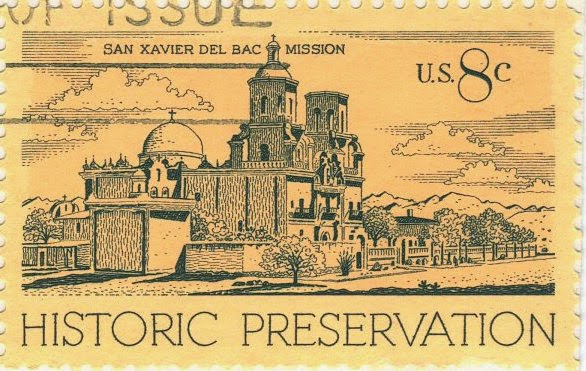
To mark the fifth anniversary, the US Postal Service issued a set of four postage stamps on October 29, 1971.


Designer: Melbourne Brindle
Printing: 150 million in sheets of 32
Decatur House (Washington, DC)

The 1818 building was a fitting choice in several ways. A private domicile, built for the famed American naval hero in the new national “Federal” style in the nation’s capital, it is one of only 3 extant houses by Benjamin Henry Latrobe, architect of the US Capitol. It may have been a more fitting choice than the designers realized: Given to the National Trust in 1956, it acquired landmark status in 1976. Today, as the National Center for White House History, it includes event space for rental as well as commemoration of the enslaved African-Americans who worked and lived here. We thus find here on one site the evolving spectrum of US preservation concerns: historical and architectural significance, cultural diversity and difficult histories, and adaptive reuse.


The last surviving wooden whaling ship, and a highlight of the historic ensemble of Mystic, CT. An icon of American economic development and technological achievement.

The iconic local transportation system, which began in 1873 as a creative response to the uniquely hilly terrain. After World War II, the city planned to eliminate them when the bus emerged as a more efficient alternative. Citizen activism saved them from destruction on the grounds of charm and historic resonance in 1947.


Reflecting a distinctive blend of aesthetic influences from Spain, New Spain, and indigenous traditions, it is the oldest preserved European structure (1783-97) in Arizona, granted landmark status in 1963. Today, we are more willing to acknowledge the exploitative nature and destructive consequences of the Spanish missionary work among the Native Americans (1, 2). More generally, we realize that our image of the old Spanish west derives more from the romanticzing impulses of the late nineteenth and early twentieth century than from history itself.


I always show these images at the start of my historic preservation class—not only as an ice-breaker or eye candy, but with a further purpose. I ask students to imagine why these images might have been chosen. That is: what do they tell us about what was valued then?

I have always been intrigued by the possible logic.  There are two sites each from the east and west coast—though nothing in between (not barn or a Sullivan skyscraper or a Prairie School house from my native Midwest). The inclusion of the mission broadens the customary scope of preservation concerns to include the Spanish Colonial heritage and moreover adds a religious structure to the mix. I have always found it noteworthy that, despite the common tendency to associate historic preservation with architecture, half of the images are not of buildings.

Preservation in the United States, as is well known, began with sites of historical importance to our civic-national narrative and grew to embrace exemplars of architectural distinction. The NHPA formalized the beginning of a greatly expanded, long-overdue notion of preservation going beyond major landmarks. As the amended law and practice have evolved, we have come to take a much broader view of resources and our mission. We preserve vernacular as well as exalted architecture, we preserve whole neighborhoods as well as individual structures. We preserve cultural landscapes as well as buildings. We save not only Civil War battlefields, but also once-“futuristic” 1960s gas stations and an early McDonald’s restaurant.

Sometimes (as in the past, no doubt), our efforts seem to outpace public understanding. We have begun to consider 1950s asphalt parking lots as cultural landscapes. Preservation of a chain link fence in Alexandria, VA became a source of outrage and the butt of jokes not long ago.

Indeed, as I noted in one of my earliest posts here, the preservation of the modern has become the most complex and controversial field. Traditionally, preservation regulations come into effect when a resource is at least 50 years old. However, given that the middle of the twentieth century witnessed a building boom and the proliferation of new architectural styles, a vast stock of modernist structures was or remains unprotected. The fact that many of these styles lack a popular constituency and that the structures themselves are anything but energy-efficient puts them in particular jeopardy. The National Park Service decided that restoration of the landscape of Gettysburg Battlefield trumped preservation of Richard Neutra’s modernist Cyclorama visitor center.  Protests of architects notwithstanding, the idiosyncratic Prentice Women’s Hospital in Chicago, too, came down.

On the other hand, whereas concerns over energy efficiency at times feed the urge for demolition, they now also contribute to a countervailing trend, as preservationists ally themselves with environmentalists and sustainability advocates under the mantra, “the greenest building is one that has already been built.” We have risen up to defend the much-maligned traditional window against the onslaught of the replacement window industry. The notion of “adaptive reuse” is saving many a building that might otherwise have fallen to the wrecking ball, even as it prompts us to let go of purist or absolutist notions of preservation and allow greater changes to structures. (One might perhaps discern a resemblance to the notion of "letting go" and "shared authority" now in vogue in the world of museums and public history.) Often as not, we now speak of “sustainable preservation" as well as “historic" preservation.

So here’s my question. The fortieth anniversary of the NHPA was cause for both celebration and deliberation. 2016 will mark the fiftieth anniversary. If we were to issue new preservation stamps two years from now, what iconic American subjects would you have them depict?


or ….?

Please post your answers in the comment section below. I’m eager to see what, collectively, we come up with.

Even Scarier Than Halloween Bad History: Everyday Ignorance

Both kidding and serious concerns about bad documentaries notwithstanding: I know that, were I to lay out the reasons that "The Burning Times" is an atrocious travesty of history, I could have an intelligent discussion with my Hampshire College classes.

Sometimes we forget how lucky we here in the Five College Consortium are, privileged to work with students who are on the whole smart and well educated or at least educable.

Not everyone is as lucky.

Consider, for example, this footage from Texas Tech.

Sure, sure, these things have a sensationalistic "gotcha" quality about them and may well not be representative. Still, can you imagine how any American claiming to be educated could not know who won the Civil War? or even what the two sides were? See for yourself.


(h.t. wj)

Pandering ghost tours and bad witchcraft documentaries pale in comparison.

Be afraid. Be very afraid.


Sunday, October 26, 2014

October anniversaries: Happy Birthday, USS "Constitution"

October 21 is the anniversary of the launching of the USS "Constitution," which earned the nickname "Old Ironsides" during the War of 1812, whose bicentennial we are still marking. The "Constitution," as Mass Moments reminds us, is the "oldest commissioned warship in the world." (basic story here)


• Date of issue: Oct. 21, 1947
• Place of issue: on the deck of the Constitution, Boston Naval Yard
• Printing: 131,488,000


The average person would never guess from looking at it that this rather understated stamp could give rise to controversy, but that's just what happened when some naval aficionados and historical enthusiasts first laid eyes on it. As Arago, the online resource site of the US Postal Museum, explains, experienced Boston Naval architect Andrew Hepburn "designed the stamp after considerable historical research." And yet:
The stamp received criticism for ignoring the ship's grandeur and thereby under-representing the role it played in building America. While many stamp designs have been challenged and criticized over the years, the uproar over Old Ironsides was one of the loudest ever. Typical of the very strong criticisms was that of Elmer C. Pratt, the stamp columnist for Camden, New Jersey's Courier-Post. "The idea of showing that great fighting hero as a mimbly-pimbly boat sailing along in a light wind . . . when all her life she was a fighting ship full of fight. She should have been shown in a heavy wind, with full sails set, in a heavy sea, going someplace where she should be going, often did and as a rule won the day-into a well fought and victorious battle."
The controversy notwithstanding, the stamp was quite popular with the public. Arago tells us that first-day sales amounted to "An unusually high" figure of 4,700,000, including almost 700,000 first-day covers.

The storm over the stamp was of course a tempest in a teacup compared, as an earlier post shows, with the competition between New England cities to claim the title of birthplace of the US Navy. In addition, the ship itself poses some interesting problems of historic preservation. On that subject: more in the next post.

Previous and related stories:

• (2010) 21 October 1797: Launching of USS Constitution; the need for preservation and interpretation continues
• (2011) July Anniversaries: Wooden Whaling Ship "Charles W. Morgan" Celebrates 170th Birthday, 21 July