Of course, having noted the assassination of Jean Paul Marat by Charlotte Corday and her subsequent execution (1, 2) it would be unseemly not to devote at least a small amount of space to her victim, the radical revolutionary journalist.
For some reason (well, I guess it's not that hard to figure out), I seem to have a respectable stock of Marat memorabilia. Here is one of the most modest items: a small (dia.: 22-3 mm.) uniface copper medal depicting a bust of Marat (with characteristic kerchief on head because of his skin disease) facing left.
The legend reads, "To Marat, The Friend of the People [both the appellation by which he was known and the title of his journal], 1793." There are remains of an attachment loop (bélière). The Stanford University/Bibliothèque Nationale de France collaboration describes this item as from 1793, though other sources suggest that there was also a recast during the Revolution of 1848, when this iconography became fashionable again. (The uniface form and toning of this piece might indeed suggest the latter.)
In any case, pause for a moment to recall one radical journalist who was murdered by an extremist at the opposite end of the political spectrum. You need not share his views in order to condemn her act. And perhaps the case speaks to our situation today.
"In fiction, the principles are given, to find
the facts: in history, the facts are given,
to find the principles; and the writer
who does not explain the phenomena
as well as state them performs
only one half of his office."
Thomas Babington Macaulay,
"History," Edinburgh Review, 1828
Saturday, August 8, 2015
23 July 1793: Fall of the Mainz Republic (you haven't heard of it?)
You haven't heard of this? Neither had I, at first.
When I was a student at the University of Wisconsin, I was a history major, but I had the de facto equivalent of minors in French and German literature, with undergraduate and later graduate course work in both.
I was--although I considered myself reasonably well-educated for a midwestern yokel--struck by the title of a book by one of my German professors, Jost Hermand: Von Mainz nach Weimar (1793-1919) Studien zur deutschen Literatur (From Mainz to Weimar (1793-1919) Studies on German Literature). I of course understood the reference to the founding of the Weimar Republic. But Mainz? What was it doing in a history of German literature and democracy? As far as I knew it: the site of some great medieval edifices and home to Gutenberg. What was it doing here?
As I soon learned, it was the "first republic on German soil," proclaimed by local revolutionaries (under the auspices of French forces) on March 18, 1793, and extinguished in the summer of 1793. (And I don't think I would have learned that even if I had taken a formal course on the French Revolution rather than just "read around" in that literature on my own.) The fall of Mainz, along with the assassination of Marat and other setbacks, was one of the factors that prompted the introduction of the so-called "Terror."
Here, a depiction of the Liberty Tree erected by German revolutionaries:
Rituals and symbols were important, and the new iconography of the Revolution appeared even in the more mundane domain of the economy. Prussian Coalition forces besieged the city beginning on 31 March, and in early May, when it became clear that the crisis was going to continue, the French created special siege money:
Some examples of coins and currency over on the tumblr.
More on the Mainz Republic and its significance.
When I was a student at the University of Wisconsin, I was a history major, but I had the de facto equivalent of minors in French and German literature, with undergraduate and later graduate course work in both.
I was--although I considered myself reasonably well-educated for a midwestern yokel--struck by the title of a book by one of my German professors, Jost Hermand: Von Mainz nach Weimar (1793-1919) Studien zur deutschen Literatur (From Mainz to Weimar (1793-1919) Studies on German Literature). I of course understood the reference to the founding of the Weimar Republic. But Mainz? What was it doing in a history of German literature and democracy? As far as I knew it: the site of some great medieval edifices and home to Gutenberg. What was it doing here?
As I soon learned, it was the "first republic on German soil," proclaimed by local revolutionaries (under the auspices of French forces) on March 18, 1793, and extinguished in the summer of 1793. (And I don't think I would have learned that even if I had taken a formal course on the French Revolution rather than just "read around" in that literature on my own.) The fall of Mainz, along with the assassination of Marat and other setbacks, was one of the factors that prompted the introduction of the so-called "Terror."
Here, a depiction of the Liberty Tree erected by German revolutionaries:
![]() |
| Hand-colored engraving: "Depiction of the Liberty Tree and the pikes, planted at Mainz on 13 January 1793. [at left:] Scale: 1 inch to 6 feet." Actual size of image: 3 x 5 inches) |
Some examples of coins and currency over on the tumblr.
More on the Mainz Republic and its significance.
Monday, July 27, 2015
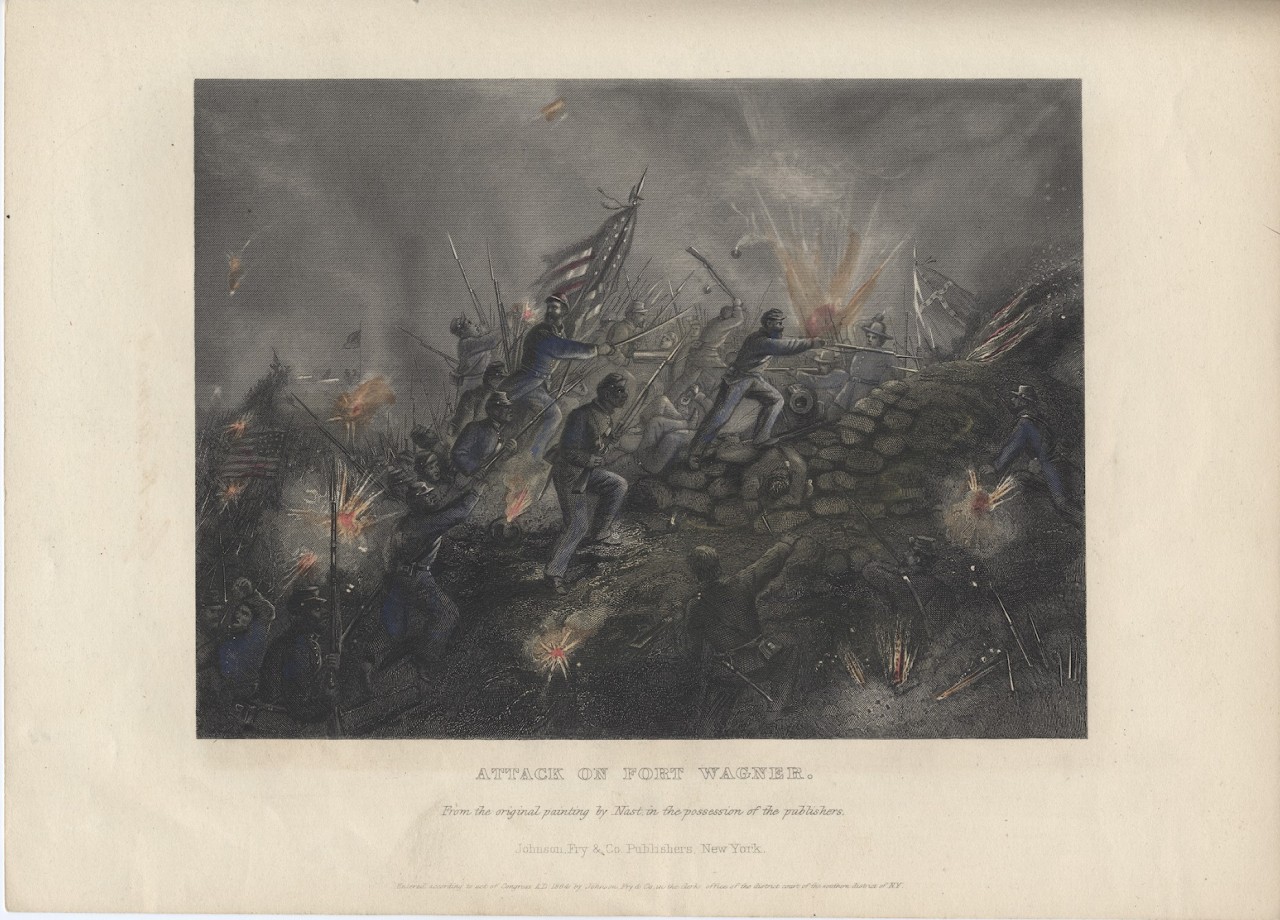
18 July 1863: Union Attack on Fort Wagner by Massachusetts 54th Infantry
18 July marks the anniversary of the assault on Fort Wagner by African-American troops of the 54th Massachusetts Volunteer Infantry, made famous to the present generation by the film, "Glory."
This year, instead of posting about it on that day, I earlier wrote about the changing reactions to the "Shaw Memorial" in Boston, which commemorates Col. Robert Gould Shaw and the troops that he commanded.
For today, several engraved representations of the battle over on the tumblr:
Note the difference: Although both depict the assault, including a heroic bearer of the Union flag (the first bearer was hit, and then Sgt. William Harvey Carney seized it, the first Black to be awarded the Congressional Medal of Honor), the first was produced by a British reporter "embedded" with the Confederate troops, and thus views the attack from the inside. The second, based on a painting by Thomas Nast, presents the (to us) more familiar view of the assault seen from the perspective of the Union attackers.
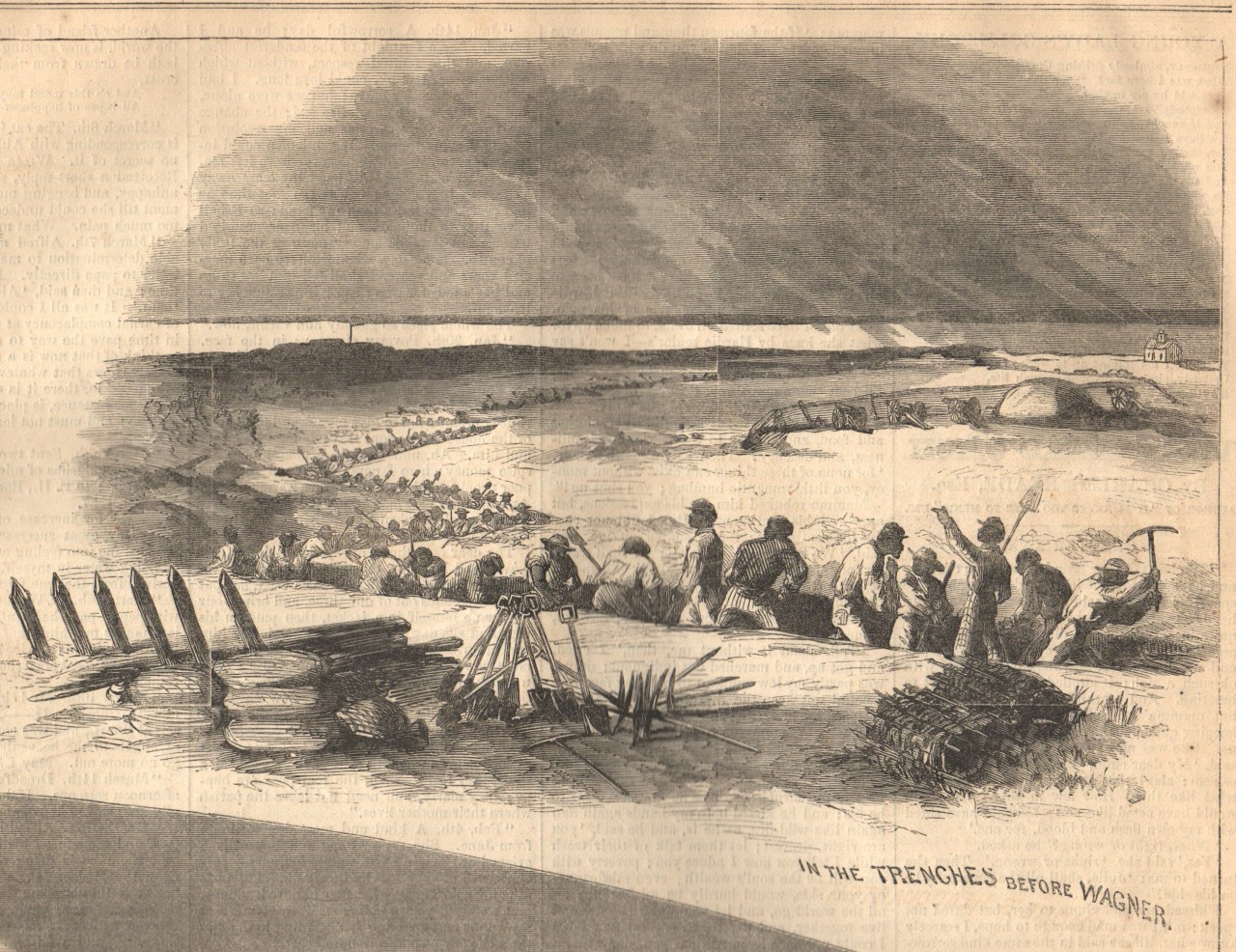
This piece, from an August 1863 issue of Harper's Weekly, depicts African-American troops digging fortifications as the siege of Fort Wagner continued
See all posts relating to the Mass 54th regiment (including the soldiers who came from Amherst).
This year, instead of posting about it on that day, I earlier wrote about the changing reactions to the "Shaw Memorial" in Boston, which commemorates Col. Robert Gould Shaw and the troops that he commanded.
For today, several engraved representations of the battle over on the tumblr:
(details here)
(details here)
Note the difference: Although both depict the assault, including a heroic bearer of the Union flag (the first bearer was hit, and then Sgt. William Harvey Carney seized it, the first Black to be awarded the Congressional Medal of Honor), the first was produced by a British reporter "embedded" with the Confederate troops, and thus views the attack from the inside. The second, based on a painting by Thomas Nast, presents the (to us) more familiar view of the assault seen from the perspective of the Union attackers.
This piece, from an August 1863 issue of Harper's Weekly, depicts African-American troops digging fortifications as the siege of Fort Wagner continued
(details here)
See all posts relating to the Mass 54th regiment (including the soldiers who came from Amherst).
Sunday, July 26, 2015
Charlotte Corday Medal: Well Deserved?
In contrast to the portrait prints in the previous post, numismatic commemorations of Charlotte Corday, assassin of Jean-Paul Marat, are fairly rare.
Here is one of the more refined of those exceptions:
Attributed (1, 2) to the Swedish medallist Carl Carlsson Enhörning (1745-1821), it is made of gilded bronze, with a diameter of 29 mm.
I don't know the source of the likeness, but it certainly seems to be an idealized generic representation. (I myself do not know of a single depiction in profile--so it is likely that Enhörning would not have, either--though it is possible that this one is based on the artist's interpretation of one of the full-face portraits.)
In any case, the inscription on the reverse suggests closeness to the event, at which time, presumably, few accurate representations of Corday would have been available.
The words, "bien méritée,"--well earned, or well deserved--make Enhörning's political sympathies clear, lest there was any doubt. In choosing this form, the artist also implicitly echoes the standard type of medal that governments, schools, academies, and other institutions issued for commendable achievement. For example, this small silver medal of the eighteenth-century Kingdom of Poland under Stanisław II August given to cadets:
Whether her act was justified is a matter that we can continue to debate. I keep the medal in my collection because I feel her fate rather than the act was "well deserved." Marat was a radical revolutionary leader--not unproblematic in his politics and personal views, yet also hardly the demon that his enemies claimed he was.
Bien méritée? As I said in the previous post, the verdict of "the Raging Reporter" Egon Erwin Kisch seems the most congenial. Introducing a piece by Marat in his anthology, Klassischer Journalismus (Berlin, 1923), he explains, "the agitated hysteric, Charlotte Corday, a stupid person, stabbed him to death."
Here is one of the more refined of those exceptions:
Attributed (1, 2) to the Swedish medallist Carl Carlsson Enhörning (1745-1821), it is made of gilded bronze, with a diameter of 29 mm.
![]() |
| obverse |
In any case, the inscription on the reverse suggests closeness to the event, at which time, presumably, few accurate representations of Corday would have been available.
The words, "bien méritée,"--well earned, or well deserved--make Enhörning's political sympathies clear, lest there was any doubt. In choosing this form, the artist also implicitly echoes the standard type of medal that governments, schools, academies, and other institutions issued for commendable achievement. For example, this small silver medal of the eighteenth-century Kingdom of Poland under Stanisław II August given to cadets:
Whether her act was justified is a matter that we can continue to debate. I keep the medal in my collection because I feel her fate rather than the act was "well deserved." Marat was a radical revolutionary leader--not unproblematic in his politics and personal views, yet also hardly the demon that his enemies claimed he was.
Bien méritée? As I said in the previous post, the verdict of "the Raging Reporter" Egon Erwin Kisch seems the most congenial. Introducing a piece by Marat in his anthology, Klassischer Journalismus (Berlin, 1923), he explains, "the agitated hysteric, Charlotte Corday, a stupid person, stabbed him to death."
Portraits of Charlotte Corday: From Counter-revolutionary Soft Porn to the Picture that Churchill Used to Chide DeGaulle
On 13 July 1793, Charlotte Corday stabbed the French Revolutionary Jean-Paul Marat to death in his bathtub. On July 17, she went to the guillotine.
For counterrevolutionaries, she was a great heroine and tyrannicide. Even many French and foreign supporters of a moderate Revolution viewed her with some sympathy, though the issue of assassination remained a moral and political dilemma that they did their best to finesse. Personally, I've always favored the terse characterization of the episode by the great radical journalist Egon Erwin Kisch (1923): "the agitated hysteric, Charlotte Corday, a stupid person, stabbed him to death."
counter-revolutionary soft porn
Portraits of Corday issued soon after the event, and especially in the nineteenth century, tended to romanticize or infantilize her, as this selection from an earlier post will show.

I described one of them as "Victorian counter-revolutionary soft porn: a little bondage, a little rain and wind—Joan of Arc in a wet t-shirt."
By contrast, this engraving, based on a sketch that the artist Jean-Jacques Hauer made while she was in prison, is the most distinctive if not most attractive. Both she and her contemporaries regarded as the most accurate.
And the best thing about it is that it had a strange second life. Winston Churchill had this engraving on display in his home in order, when dealing with de Gaulle, to remind him of the fate of arrogant Frenchmen.
Tuesday, July 21, 2015
Q: Once the rockets are up, who cares where they come down? A: Often, near Samoa
And before that? Those of us of a certain age can probably remember both ends of the launch cycle very well. When we were kids, before these things became routine, they were broadcast live on the major television networks (nowadays, only on CNN and the like). In fact, teachers would wheel a portable television into classrooms so that students could watch history being made. Again, the blastoff was probably the main attraction.
And the landings? From the Mercury through the Apollo program, they took place on water, giving rise to the term, "splashdown." For a variety of complicated, partly contingent reasons, the USSR always opted for recovery of its space vehicles on land, whereas the US chose water landings.
So here are some philatelic artifacts of the Apollo program.
The splashdown of Apollo 11, like other Apollo landings, took place in the Pacific Ocean, most near American Samoa. This stamp from Western Samoa commemorates the moon landings. (The depiction of the space suit is not accurate.) [kickstarter project to restore and display Neil Armstrong's space suit]
Another Western Samoa stamp with the same image but a higher denomination is used on this commemorative cover marking the safe return of Apollo 16, the second-to-last manned moon mission.
For those of you not around at the time, here's what these splashdowns looked like:
As for the title of this post? It, too, is a historical artifact:
- (a) either something someone of a certain age knows and fondly recalls, or
- (b) something one picked up while exploring retro culture, or
- (c) something one does not know but really should.
It's a great satirical song by the great Tom Lehrer, bitterly poking fun at Wernher von Braun. Again, those of us of a certain age remember the latter as a perennial talking head whenever the US space program was in the news (including Walt Disney productions, before my time). Snapped up at the end of World War II by "Operation Paperclip," in which the US sought to grab German rocket scientists before the Soviets could do so, von Braun went from designing Nazi V-2 rockets used in terror attacks against London to becoming the father of the US space program without skipping a beat. Hence this little ditty. And so, without further ado:
[restored video]
The Moon Landing in the Service of Advertising, Anno 1969
I always thought this was a very clever advertising strategy.
Back
in 1969, when the Apollo 11 moon landing took place, Spoo & Son, a
well-established Madison, Wisconsin clothing store on Capitol Square,
had the clever idea of purchasing a whole load of first-day-of-issue
covers of the commemorative stamp for use in promoting its big fall
sale. The custom cachet, with the words, “in celebration of a great event,”
in white against the image of the moon, thus appropriated the glory of the
technological achievement in the service of commerce.
It had a sufficiently light touch to be amusing, and the prospective customer got a nice keepsake.
![]() |
| (enlarge) |
It had a sufficiently light touch to be amusing, and the prospective customer got a nice keepsake.
Moon Landing Anniversary (and animation, space toilets, and cheese)
If it's July 20, it's time to haul out my old post, which combines lunar exploration, zero-gravity toilets, animation humor, and the Jeffersonian politics of cheese.
But I also realized that the old posts did not include any images directly related to the moon landing, so I will redress that omission with the Apollo moon landing stamp.
Thursday, July 16, 2015
A Tale of Interfaith Cooperation and Historic Preservation from Old Jerusalem
The seventh-century Dome of the Rock in Jerusalem is arguably the archetypical emblem of the city. And because it stands on the Temple Mount, it has since medieval times served as a representation of the Temple of Solomon in Christian art.
Scottish artist David Roberts depicts its dominant place on the skyline in "Jerusalem From the Mount of Olives" (color lithograph; London: Day & Son, 1855).
Because the month of Ramadan is traditionally a time of introspection and charity, it seems appropriate to relate an interesting tale of interfaith cooperation on the Temple Mount in the service of what we would nowadays call historic preservation or restoration.
Some years ago, Yehuda Litani recounted a fascinating discovery made in 1992-93, when a team of artisans from Northern Ireland was refurbishing the dome in a project funded by King Hussein of Jordan:
Of course, not every story has a perfect happy ending. When Litani returned to make a photograph, as he had requested, the foreman explained that the Waqf (Islamic trust that administers the holy sites) had taken the panel. When he went to the officials of the Waqf, they denied knowing anything about it.
As for the experience of visiting the site today: physician, scholar, and Muslim feminist activist Qanta Ahmed has written a moving four-part account of her pilgrimage:
The Dome of the Rock: A Muslim’s requiem
Part 2: Reaching the Dome
Part 3: Inside the Dome
Part 4: The farthest Muslims
Scottish artist David Roberts depicts its dominant place on the skyline in "Jerusalem From the Mount of Olives" (color lithograph; London: Day & Son, 1855).
![]() |
| (late 19th-century engraving) |
Because the month of Ramadan is traditionally a time of introspection and charity, it seems appropriate to relate an interesting tale of interfaith cooperation on the Temple Mount in the service of what we would nowadays call historic preservation or restoration.
Some years ago, Yehuda Litani recounted a fascinating discovery made in 1992-93, when a team of artisans from Northern Ireland was refurbishing the dome in a project funded by King Hussein of Jordan:
On a visit to the site during those renovations I discovered a story that wasn’t known until then, regarding the Jewish-Ottoman-Palestinian connection to the mosques on Temple Mount.
Story of the iron panel
The Dome of the Rock was surrounded with scaffolding, and before ascending one of them a friend of mine drew my attention to an iron panel that lay on the floor and was inscribed in French. The foreman of the Irish construction company said the panel had been found between the two halves of the crescents at on top of the mosque, and was temporarily dismantled so that the dome could be coated in gold.
The words in French revealed that the Mosque had been renovated in 1899 during Turkish rule, and that the works had been assisted by the Jewish community in Jerusalem led by a public figure called Avraham (Albert) Entebbe, who among his numerous other activities was also the principal of the city's "Kol Israel Haverim" school.
Entebbe, who was the undersigned on the French inscription, was known for his courageous ties with the heads of the Ottoman rule, and the inscription noted that for the purpose of renovating the mosques on the Temple Mount five acclaimed Jewish artists had been invited to Jerusalem. The Jewish stone carvers, wood carvers and iron mongers from various cities in the Mediterranean basin, shared their skills with their Muslim brothers during months of work.
Zenith of Jewish-Muslim cooperation
The inscription also noted that all the students at Entebbe's school were given a three-month leave in order to assist their Muslim brothers in the renovations works on Temple Mount. In the last lines of the inscription, Entebbe described the ideal cooperation and understanding that prevailed between Jews and Muslims in the Holy City, which reached its zenith when the Jews undertook renovations of the Temple Mount mosques in 1899.
Of course, not every story has a perfect happy ending. When Litani returned to make a photograph, as he had requested, the foreman explained that the Waqf (Islamic trust that administers the holy sites) had taken the panel. When he went to the officials of the Waqf, they denied knowing anything about it.
As for the experience of visiting the site today: physician, scholar, and Muslim feminist activist Qanta Ahmed has written a moving four-part account of her pilgrimage:
The Dome of the Rock: A Muslim’s requiem
Part 2: Reaching the Dome
Part 3: Inside the Dome
Part 4: The farthest Muslims
Labels:
Architecture,
Art,
Historic Preservation,
Islam,
Israel,
Jewish Studies,
Middle East,
Ramadan
Cairo Minarets and Mosque
Colored lithograph by the great David Roberts, whom the Metropolitan Museum of Art calls "the first professional artist to visit the Near East without a patron or a connection to a military expedition or missionary group." Roberts's meticulous depictions of Middle Eastern scenes are among his most famous works.
"The Minarets at the Bab Zuweyleh, and entrance to the Mosque of the Metwalis, Cairo," Plate 218 of The Holy Land, with historical notes by William Brockedon (London: Day & Son, 1856), vol. 6, Egypt and Nubia.
Quarto edition, sheet size: 295 x 205 mm (11 5/8 x 8 1/16 in.)
"The Minarets at the Bab Zuweyleh, and entrance to the Mosque of the Metwalis, Cairo," Plate 218 of The Holy Land, with historical notes by William Brockedon (London: Day & Son, 1856), vol. 6, Egypt and Nubia.
Quarto edition, sheet size: 295 x 205 mm (11 5/8 x 8 1/16 in.)
Labels:
Art,
Historic Preservation,
Islam,
Middle East,
Ramadan
Subscribe to:
Posts (Atom)