Showing posts with label Philately. Show all posts

Thursday, October 20, 2016

October 20, 1803: Ratification of Louisiana Purchase

The Library of Congress explains:

On October 20, 1803, the Senate ratified the Louisiana Purchase Treaty by a vote of twenty-four to seven. The agreement, which provided for the purchase of the western half of the Mississippi River basin from France at a price of $15 million, or approximately four cents per acre, doubled the size of the country and paved the way for westward expansion beyond the Mississippi.

Spain had controlled Louisiana and the strategic port of New Orleans with a relatively free hand since 1762. However, Spain signed the Treaty of San Ildefonso in 1800 under pressure from Napoleon Bonaparte, a secret agreement retroceding the territory of Louisiana to France.

News of the agreement eventually reached the U.S. government. President Thomas Jefferson feared that if Louisiana came under French control, American settlers living in the Mississippi River Valley would lose free access to the port of New Orleans. On April 18, 1802, Jefferson wrote a letter to Robert Livingston, the U.S. minister to France, warning that, “There is on the globe one single spot, the possessor of which is our natural and habitual enemy. It is New Orleans…”

Napoleon, faced with a shortage of cash, a recent military defeat in Santo Domingo (present-day Haiti), and the threat of a war with Great Britain, decided to cut his losses and abandon his plans for an empire in the New World. In 1803, he offered to sell the entire territory of Louisiana to the United States for $15 million.

Robert Livingston and James Monroe, whom Jefferson had sent to Paris earlier that year, had only been authorized to spend up to $10 million to purchase New Orleans and West Florida. Although the proposal for the entire territory exceeded their official instructions, they agreed to the deal. The Louisiana Purchase Treaty was dated April 30 and formally signed on May 2, 1803.

This souvenir card issued by the Bureau of Engraving and Printing for the New Orleans Philatelic Exhibition (NOPEX) of 1972 shows, at top, the 150th anniversary commemorative stamp issued of 1953 (depicting negotiators Monroe, Livingston, and Barbe-Marbois), and in the background, the centennial stamps of 1904.


Friday, June 10, 2016

Lidice Shall Live: Anniversary Postal Covers Commemorating the 1942 Massacre.

One of the most notorious of the many Nazi crimes of World War II was the liquidation of the (innocent) village of Lidice, on 9-10 1942, in retaliation for the assassination of the "Reichsprotektor" of Bohemia and Moravia, Reinhard Heydrich, by Czechoslovak paratroopers.

(Main post and background)

After the war, the Czechoslovak government decided to rebuild the village, which has also become a memorial and a center for peace and reconciliation. The massacre has been commemorated in the philatelic and numismatic realm. In particular, for example, the government issued special stamps on the major anniversaries of the tragedy. Here are commemorative covers from the fifth and fifteenth anniversaries.


Fifth anniversary, 1942-1947


The cachet at left combines local and national motifs: the miner's lamp, representing the occupation of many of the residents, illuminates both the village at left and the Czech patriotic symbol of the linden leaf, at right with the message, "Lidice Shall Live." The stamp is one of three, in different denominations, issued for the occasion. The first two, identical in design except for the denomination, represent a weeping mother. This one, the highest denomination, signifies hope and rebuilding. The special cancellation echoes one of the iconic memorials, with its wreath of barbed wire (like a crown of thorns) on a cross symbolizing both death and resurrection--but here with the addition of the national linden leaves.


Fifteenth anniversary, 1957


Since 1955, when British group, "Lidice Shall Live," realized the dream of creating a Garden of Peace and Friendship, the rose has been a special symbol for Lidice.


Older posts on the Heydrich assassination and reprisals, and Lidice.

Monday, February 22, 2016

Schiller and Lotte: postcard commemorating a poetic marriage, 1905

Authors' marriages deserve to be a subject of study in their own right, if only because they tended to loom so large in the bourgeois literary histories and biographies of the nineteenth and early twentieth centuries.

The German equivalent to the marriages of Percy Shelley and Mary Wollstonecraft Godwin or Nathaniel Hawthorne and Sophia Peabody is arguably that of Friedrich Schiller and Charlotte von Lengenfeld, often held up (and sentimentalized) as the ideal literary union and model of domesticity.


The third in a series of six postcards depicting the Schiller's life, issued on the centennial of his death in 1905, this one is entitled, "Own Home."
• At right, we see a portrait of "Friedrich Schiller, Professor of History in Jena 1789-1799."
 • At left, "Schiller's spouse Charlotte, née von Lengenfeld. Born 22 Nov. 1766, died 9 July 1826."
The center vignettes depict, respectively, the church in which they were married and their first house:
• Church in Wenigenjena*) Schiller married here 22 February 1790.
• Schiller-house in Bad Lauchstädt*) Betrothal in Lauchstädt 3 August 1789

*) after drawings by Schiller's spouse
It is of course indicative of the time and place that Charlotte is here generally referred to  only as Schiller's wife, and indeed, that the description of the wedding mentions only "Schiller" getting married. Times were indeed different.


Chronicle of a wedding

As for the wedding itself, Gero von Wilpert's Schiller-Chronik, issued in anticipation of the Schiller bicentennial (Stuttgart, 1958) provides a convenient summary of the big day:
February 22. Wedding day. Early with Charlotte and Karoline to Kahla, where the mother-in-law is picked up around 10-11; from there around 2 directly to Wenigenjena (arrival around 5), where around 5:30 the wedding quietly took place under the direction of the Kantian theologian Adjunct G. L. Schmid in the presence of only the mother- and brother-in-law, so as to foil all the attempted surprises on the part of students and professors. Following this, return to Jena, where the evening is spent in tea-drinking and conversation. _-- Frau von Lengenfeld gives the couple a space of their own, but it is not yet an independent household, and rather, just a few additional rented rooms, and they still take their midday meal with Frau Schramm, Lotte employs a maid, Schiller, a manservant. -- The mother-in-law stays another 8 days, Karoline approximately 5 weeks in Jena with Fräulein von Seegner. Apart from that a solitary life, closer association only with Prof. Paulus.

Undivided attention

Because the card dates from 1905 and was thus produced before the major change of 1907, it has no divided back in the fashion to which we are accustomed, i.e. space for the address at right and message at left. The reverse side informs the purchaser, "This side for the address only." People either sent cards without messages--the image alone serving as the greeting--or scrawled them on or around the illustration on the front, as best they could, for example, on this card celebrating Schiller's birthplace of Marbach am Neckar, from 1896:


If you're curious about the postal rates for the wedding card, they were even provided for the writer: "U S, Canada and Mexico 1 c. Foreign 2 c."

That the language is English and currency is American raises another issue: Although most of the Schiller anniversary cards were of course produced in Germany for Germans, not a few emanated from the United States. The publisher's imprint on this one reads, "A. Selige. Pub. Souv. Post Cards. St. Louis." Missouri was one of several centers of German settlement. The firm of Adolph Selige, active from 1900 to 1920, produced mainly cards on western or midwestern themes, so this one was intended for a more specialized audience, thanks to the large population of German immigrants or citizens of German origin. A useful reminder of the ever-evolving definitions of "American" identity and multicultural politics, among other things.


Tuesday, July 21, 2015

The Moon Landing in the Service of Advertising, Anno 1969

I always thought this was a very clever advertising strategy.

(enlarge)
Back in 1969, when the Apollo 11 moon landing took place, Spoo & Son, a well-established Madison, Wisconsin clothing store on Capitol Square, had the clever idea of purchasing a whole load of first-day-of-issue covers of the commemorative stamp for use in promoting its big fall sale. The custom cachet, with the words, “in celebration of a great event,” in white against the image of the moon, thus appropriated the glory of the technological achievement in the service of commerce.

It had a sufficiently light touch to be amusing, and the prospective customer got a nice keepsake.


Saturday, July 4, 2015

Commemorations of Lidice on Medals and Stamps

The previous post described the Nazi massacre of the inhabitants of the Czech village of Lidice and the powerful emotional and historical echo of the crime.

In Czechoslovakia, the memory of the crime became a regular part of national rituals and identity. Over on the Tumblr, I posted a few of the numismatic and philatelic commemorations.

This medal, depicting some of the victims--echoing a monument to the murdered children at the site--is the first installment. Just click on to the subsequent posts (or look for Lidice using the search bar at the upper left of the page) for the rest.

Monday, April 20, 2015

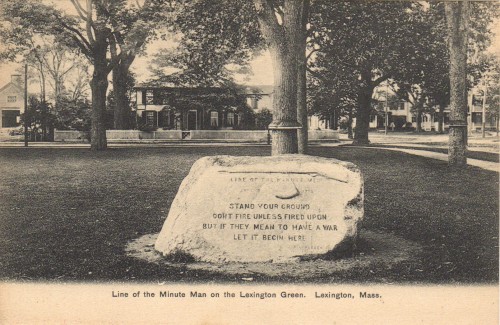
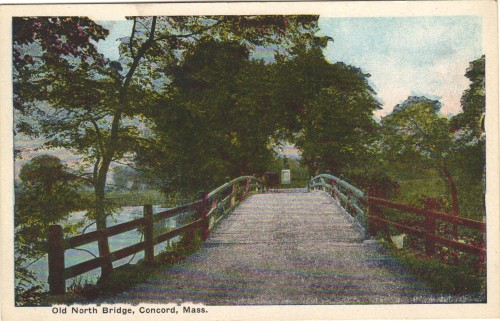
For Patriots' Day: Historic Postcards of Lexington and Concord


In honor of Patriots' Day, I'm putting up a series of historical images of Lexington and Concord, where the Revolution began in April, 1775.


Enjoy.


From the tumblr:


more old postcards of Lexington


 The Hancock-Clarke House in Lexington


full description


more old postcards of Concord


I may add related images after the anniversary date, but don't hold me to that.

Tuesday, January 13, 2015

#JeSuisCharlie #JeSuisAhmed #JeSuisJuif

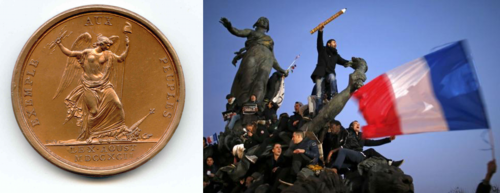
Watching the nonstop news coverage of the jihadi terrorist attacks on Charlie Hebdo and the Kosher market as well as the extraordinary demonstrations of French crosscultural solidarity and international support for free speech and secular democracy, I was reminded of a few images from French history, which I posted on the tumblr.


France: All Are Equal Before The Law


France: An Example to the Peoples of the World


France: Over Two Centuries of Jewish Emancipation


Friday, November 7, 2014

What Would You Put On a New Historic Preservation Stamp?


October 29 is the anniversary of the US Historic Preservation Stamps. What Does Historic Preservation Mean to You Today?


On 15 October 1966, President Lyndon Johnson signed into law the National Historic Preservation Act,  (NHPA; Public Law 89-665; 16 U.S.C. 470 et seq.), the landmark legislation that, in the words of the National ParkService, “established the framework that focused local, state, and national efforts on a common goal – preserving the historic fabric of our nation."

Among the results was the creation of the Advisory Council on Historic Preservation, the National Register of Historic Places, and enabling legislation for preservation funding, as well as measures that facilitated the creation of local historic districts.

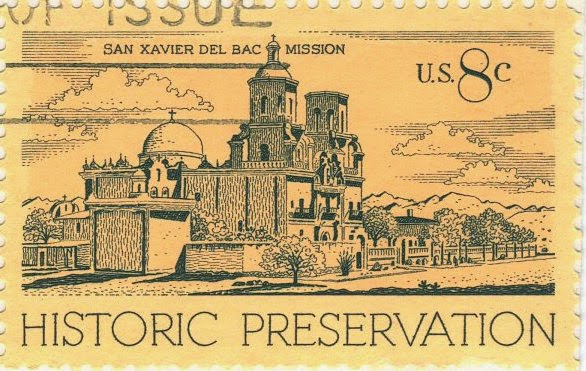
To mark the fifth anniversary, the US Postal Service issued a set of four postage stamps on October 29, 1971.


Designer: Melbourne Brindle
Printing: 150 million in sheets of 32
Decatur House (Washington, DC)

The 1818 building was a fitting choice in several ways. A private domicile, built for the famed American naval hero in the new national “Federal” style in the nation’s capital, it is one of only 3 extant houses by Benjamin Henry Latrobe, architect of the US Capitol. It may have been a more fitting choice than the designers realized: Given to the National Trust in 1956, it acquired landmark status in 1976. Today, as the National Center for White House History, it includes event space for rental as well as commemoration of the enslaved African-Americans who worked and lived here. We thus find here on one site the evolving spectrum of US preservation concerns: historical and architectural significance, cultural diversity and difficult histories, and adaptive reuse.


The last surviving wooden whaling ship, and a highlight of the historic ensemble of Mystic, CT. An icon of American economic development and technological achievement.

The iconic local transportation system, which began in 1873 as a creative response to the uniquely hilly terrain. After World War II, the city planned to eliminate them when the bus emerged as a more efficient alternative. Citizen activism saved them from destruction on the grounds of charm and historic resonance in 1947.


Reflecting a distinctive blend of aesthetic influences from Spain, New Spain, and indigenous traditions, it is the oldest preserved European structure (1783-97) in Arizona, granted landmark status in 1963. Today, we are more willing to acknowledge the exploitative nature and destructive consequences of the Spanish missionary work among the Native Americans (1, 2). More generally, we realize that our image of the old Spanish west derives more from the romanticzing impulses of the late nineteenth and early twentieth century than from history itself.


I always show these images at the start of my historic preservation class—not only as an ice-breaker or eye candy, but with a further purpose. I ask students to imagine why these images might have been chosen. That is: what do they tell us about what was valued then?

I have always been intrigued by the possible logic.  There are two sites each from the east and west coast—though nothing in between (not barn or a Sullivan skyscraper or a Prairie School house from my native Midwest). The inclusion of the mission broadens the customary scope of preservation concerns to include the Spanish Colonial heritage and moreover adds a religious structure to the mix. I have always found it noteworthy that, despite the common tendency to associate historic preservation with architecture, half of the images are not of buildings.

Preservation in the United States, as is well known, began with sites of historical importance to our civic-national narrative and grew to embrace exemplars of architectural distinction. The NHPA formalized the beginning of a greatly expanded, long-overdue notion of preservation going beyond major landmarks. As the amended law and practice have evolved, we have come to take a much broader view of resources and our mission. We preserve vernacular as well as exalted architecture, we preserve whole neighborhoods as well as individual structures. We preserve cultural landscapes as well as buildings. We save not only Civil War battlefields, but also once-“futuristic” 1960s gas stations and an early McDonald’s restaurant.

Sometimes (as in the past, no doubt), our efforts seem to outpace public understanding. We have begun to consider 1950s asphalt parking lots as cultural landscapes. Preservation of a chain link fence in Alexandria, VA became a source of outrage and the butt of jokes not long ago.

Indeed, as I noted in one of my earliest posts here, the preservation of the modern has become the most complex and controversial field. Traditionally, preservation regulations come into effect when a resource is at least 50 years old. However, given that the middle of the twentieth century witnessed a building boom and the proliferation of new architectural styles, a vast stock of modernist structures was or remains unprotected. The fact that many of these styles lack a popular constituency and that the structures themselves are anything but energy-efficient puts them in particular jeopardy. The National Park Service decided that restoration of the landscape of Gettysburg Battlefield trumped preservation of Richard Neutra’s modernist Cyclorama visitor center.  Protests of architects notwithstanding, the idiosyncratic Prentice Women’s Hospital in Chicago, too, came down.

On the other hand, whereas concerns over energy efficiency at times feed the urge for demolition, they now also contribute to a countervailing trend, as preservationists ally themselves with environmentalists and sustainability advocates under the mantra, “the greenest building is one that has already been built.” We have risen up to defend the much-maligned traditional window against the onslaught of the replacement window industry. The notion of “adaptive reuse” is saving many a building that might otherwise have fallen to the wrecking ball, even as it prompts us to let go of purist or absolutist notions of preservation and allow greater changes to structures. (One might perhaps discern a resemblance to the notion of "letting go" and "shared authority" now in vogue in the world of museums and public history.) Often as not, we now speak of “sustainable preservation" as well as “historic" preservation.

So here’s my question. The fortieth anniversary of the NHPA was cause for both celebration and deliberation. 2016 will mark the fiftieth anniversary. If we were to issue new preservation stamps two years from now, what iconic American subjects would you have them depict?


or ….?

Please post your answers in the comment section below. I’m eager to see what, collectively, we come up with.

Tuesday, November 4, 2014

Women in Massachusetts Elections Then and Now: What a Difference a Century Makes

Women's votes: from our house to the State House

If you don't keep up with the Massachusetts past, you at least learned this at the Amherst Educational Foundation Trivia Bee last week:

In 1879, Massachusetts made it legal for women to vote in school committee elections. In 1880, Louisa May Alcott was the first to register to vote in Concord. As Mass Moments recounts, "When the day came, a group of 20 women, "mostly with husbands, fathers or brothers" appeared, "all in good spirits and not in the least daunted by the awful deed about to be done." When the votes were cast, she later reported, "No bolt fell on our audacious heads, no earthquake shook the town." 


 Orchard House, home of the Alcott family in Concord from 1858 to 1877.
In the latter year, Louisa May Alcott and her father Bronson joined her sister
Anna in a house on Main Street.
Postcard from the Valentine-Souvenir Co., NY (active 1914-1923)

Flash forward a generation: Still no votes for women in the larger electoral landscape.

On November 2, 1915, Massachusetts voters failed to pass a referendum that would have given women the ballot across the board. Oddest of all, as Mass Moments explains, some women played an active role in that defeat:
In spite of its leading role in the nineteenth-century woman's rights movement, Massachusetts was the first state to organize an association of women opposed to suffrage. Known as the "Antis," these women believed that they could be better, more effective citizens without the ballot. Many of the "Antis" were active in Progressive era causes; they feared that involvement in electoral politics would erode their influence. For over 30 years, they and their male allies succeeded in keeping Massachusetts women out of the voting booth. But ultimately they lost the fight. On this same day in 1920, Massachusetts women cast their votes in a federal election for the first time. 

Flash forward 99 years:

Today, on November 4, 2014, two women are contenders for the top positions in the state:  Martha Coakley for Governor, and Maura Healey for Attorney General.

Coakley was widely criticized for running a poor and ultimately unsuccessful Senate campaign against Scott Brown (who is today running for Senate in New Hampshire--got that?). Although listed in some polls as trailing opponent Charlie Baker, she insists she is "absolutely not" the underdog, claiming "This race is essentially tied."

The Boston Globe endorsed Baker for Governor and Healey for Attorney General. In western Masachusetts, the Daily Hampshire Gazette and Berkshire Eagle endorsed both Coakley (1, 2) and Healey. (1, 2)


Update Tuesday afternoon: just heard Tom Bevan and Washington Bureau Chief Carl Cannon discussing Coakley and the Massachusetts election on "Real Clear Politics" (Sirius XM Satellite Radio):
Q: Should she be looking for a different line of work?
A: I don't think that will be up to her.
One of the hosts, speaking as an avowed Democrat, called her terrible campaigner lacking in warmth, and said he'd rather have a beer with Baker than lunch with Coakley. Ouch.

By tonight, we'll know what her career plans will or will not include.


Monday, October 13, 2014

Removing Columbus from the Calendar


Ironically, as I noted in an old post, the cancellation on this stamp honoring Christopher Columbus and


the "discovery" of America obscures the figure of the putative hero. It could serve as a metaphor for his fate in recent years.

The reaction against the glorification of Columbus advances a bit further this fall as the government of the city of Seattle today--on the federal holiday of "Columbus Day"--signs a measure mandating the celebration of the second Monday in October as Indigenous Peoples' Day.

Nothing of the sort planned in Amherst yet. (Select Board signed the fall Town Meeting warrant a week ago.)

My 2012 roundup of stories on changing attitudes toward the explorer and his holiday. covered a lot of ground, so I won't try to do the equivalent here again. (I think there was some pretty good stuff there: check it out.)

Instead, I'll just note that the Harvard Crimson got into the game this year with the brief and light-hearted Even People in the 1400s Agreed Columbus Was An Asshole.


Update, Oct. 27: belatedly came across this from John Patrick Leary's Tumblr, which chronicles and dissects the language of inequality. In this one, he describes the anachronistic appropriation of Columbus:
Happy Imperialist #Leadership Day from the Keywords #Team!

This Columbus Day offers some of the less historically (to say nothing of morally) inclined out there to draw fatuous links between the contemporary cult of entrepeneurship and the legacy of Christopher Columbus’ conquest—err, acquisition—of America some 500 years ago. (read the rest)

Tuesday, July 29, 2014

Going Postal in Gaza


Artifact of the Moment:

Not necessarily what you think. An arcane and quotidian piece of history. Over on the Tumblr: