"In fiction, the principles are given, to find the facts: in history, the facts are given, to find the principles; and the writer who does not explain the phenomena as well as state them performs only one half of his office."
Thomas Babington Macaulay, "History," Edinburgh Review, 1828
The coin, the eighth in the annual series, depicts a menorah from eighteenth-century "Babylon[ia]" (Iraq) from the Israel Museum.
The choice might at first seem surprising to Americans, accustomed as we are (because of immigration patterns and cultural assumptions) to associate Judaism almost exclusively with eastern Europe. In fact, as late as the fifteenth century, the majority of Jews lived in the Middle East and North Africa (MENA).
That situation changed as a result of improvements in social and political conditions in Europe. By 1880, fully 75 percent of world Jewry lived in eastern Europe alone, and only 8 percent in the Near East. Those 8 percent comprised some 620,000 Jews.
A century later, the picture had radically changed again. By 1992, MENA accounted for over a third of the world total. The Holocaust had murdered some 72 percent of European Jews, and immigration to Mandatory Palestine and then the new State of Israel had shifted the balance. Although we instinctively think of Holocaust survivors, that group and immigrants from MENA in fact each accounted for roughly 48 percent of the total in the first three years of statehood.
The middle of the twentieth century thus witnessed the destruction of both traditional cores of the world Jewish population, and all that they had contributed to the nations in which they had lived. The depiction of the menorah on the coin was, in the words of the Israel Coins and Medals Corporation, intended as a tribute to the legacy of one of those lost cultures and its descendants:
It has been chosen as being symbolic of the spiritual strength and belief of Jews, in Arab countries, in their return to Zion and in our days of their leaving "the rivers of Babylon", from dark to light, from oppression to prosperity and from bondage to redemption in the Land of Israel.
* * *
A footnote about food:
Fun facts about food: Not just populations, but also Hanukkah culinary traditions vary from region to region. Although Americans think of latkes (potato pancakes) when they think of Hanukkah food: well, . . . think about it.
1) The origin of the festival derives from the supposed miracle of the oil. Therefore, the essence of the festival foods is not their basic substance, and rather, the fact that they are fried in: oil.
2) In any case, the potato could not have been part of that tradition because it is indigenous to the Americas, reached Europe only after the Spanish and Portuguese voyages of discovery as part of what Alfred Crosby famously called "The Columbian Exchange," and did not become popularized until much later. It is therefore a nineteenth-century addition to the menu (however welcome).
In the Near East and premodern Europe, the festival food was thus fried dough (in some cases: cheese), typically, a kind of proto-doughnut known as sufganiyot. In the Sephardic tradition: fried batter with syrup (bimuelos in Spanish: [recipe]); in modern Israel: jelly doughnuts (recipe).
The seventh-century Dome of the Rock in Jerusalem is arguably the archetypical emblem of the city. And because it stands on the Temple Mount, it has since medieval times served as a representation of the Temple of Solomon in Christian art.
Scottish artist David Roberts depicts its dominant place on the skyline in "Jerusalem From the Mount of Olives" (color lithograph; London: Day & Son, 1855).
(late 19th-century engraving)
Because the month of Ramadan is traditionally a time of introspection and charity, it seems appropriate to relate an interesting tale of interfaith cooperation on the Temple Mount in the service of what we would nowadays call historic preservation or restoration.
Some years ago, Yehuda Litani recounted a fascinating discovery made in 1992-93, when a team of artisans from Northern Ireland was refurbishing the dome in a project funded by King Hussein of Jordan:
On a visit to the site during those renovations I discovered a story that wasn’t known until then, regarding the Jewish-Ottoman-Palestinian connection to the mosques on Temple Mount.
Story of the iron panel
The Dome of the Rock was surrounded with scaffolding, and before ascending one of them a friend of mine drew my attention to an iron panel that lay on the floor and was inscribed in French. The foreman of the Irish construction company said the panel had been found between the two halves of the crescents at on top of the mosque, and was temporarily dismantled so that the dome could be coated in gold.
The words in French revealed that the Mosque had been renovated in 1899 during Turkish rule, and that the works had been assisted by the Jewish community in Jerusalem led by a public figure called Avraham (Albert) Entebbe, who among his numerous other activities was also the principal of the city's "Kol Israel Haverim" school.
Entebbe, who was the undersigned on the French inscription, was known for his courageous ties with the heads of the Ottoman rule, and the inscription noted that for the purpose of renovating the mosques on the Temple Mount five acclaimed Jewish artists had been invited to Jerusalem. The Jewish stone carvers, wood carvers and iron mongers from various cities in the Mediterranean basin, shared their skills with their Muslim brothers during months of work.
Zenith of Jewish-Muslim cooperation
The inscription also noted that all the students at Entebbe's school were given a three-month leave in order to assist their Muslim brothers in the renovations works on Temple Mount. In the last lines of the inscription, Entebbe described the ideal cooperation and understanding that prevailed between Jews and Muslims in the Holy City, which reached its zenith when the Jews undertook renovations of the Temple Mount mosques in 1899.
Of course, not every story has a perfect happy ending. When Litani returned to make a photograph, as he had requested, the foreman explained that the Waqf (Islamic trust that administers the holy sites) had taken the panel. When he went to the officials of the Waqf, they denied knowing anything about it.
As for the experience of visiting the site today: physician, scholar, and Muslim feminist activist Qanta Ahmed has written a moving four-part account of her pilgrimage:
Colored lithograph by the great David Roberts, whom the Metropolitan Museum of Art calls "the first professional artist to visit the Near East without a patron or a connection to a military expedition or missionary group." Roberts's meticulous depictions of Middle Eastern scenes are among his most famous works.
"The Minarets at the Bab Zuweyleh, and entrance to the Mosque of the Metwalis, Cairo," Plate 218 of The Holy Land, with historical notes by William Brockedon (London: Day & Son, 1856), vol. 6, Egypt and Nubia.
Quarto edition, sheet size: 295 x 205 mm (11 5/8 x 8 1/16 in.)
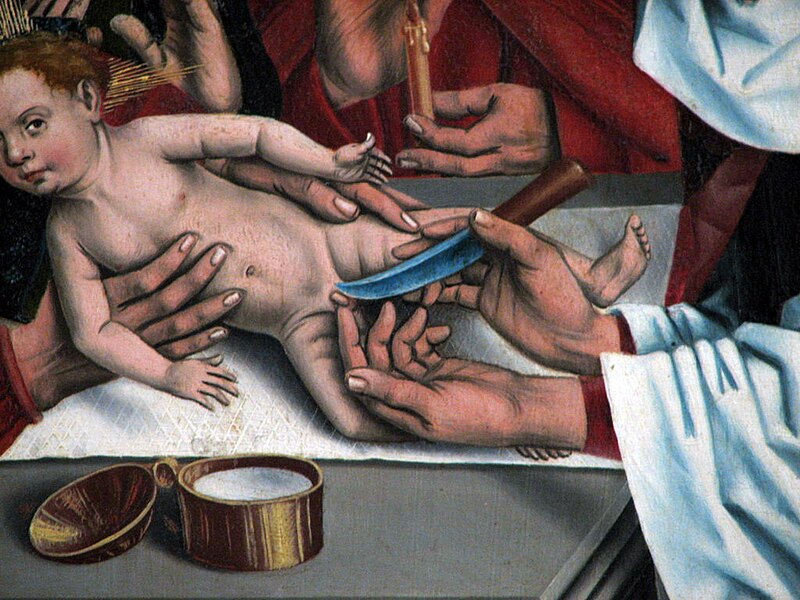
Those of you who were focused on the Olympics or the presidential campaign over the summer may be excused for having missed the other dramatic contest of the season: the great circumcision controversy.
A German regional court, considering a case involving a Muslim family, ruled that circumcision, as a form of grievous "bodily injury," violated the physical "integrity" of the child, and was thus a punishable offense. A legal expert expressed the hope that the verdict might now lead Islam and Judaism to reform their atavistic rituals. As attempts to extend the ruling throughout Germany and even other nations increased, Muslims and Jews came together to protest what they saw as an assault on their fundamental religious liberties and identities. (And they did so peacefully: no buildings were burned, no death threats issued.)
You want me to cut off my what?
Now, circumcision is indeed a peculiar custom, certainly worth considering from the detached standpoint of modern science and human rights. My former colleague, Len Glick, has written a provocative book detailing the history of the practice and arguing for its abolition (1, 2, 3).
Still, for better or worse, the reality is that our society accords non-rational religious beliefs and practices a deference that it would never extend even to less peculiar or problematic ones in the secular realm. Witness the daily and cretinous assaults on established scientific truths by powerful politicians. On a purely pragmatic level, religious beliefs are the subject of great sensitivity on the part of adherents, and
the conflicts that arise from "offenses" against them at times threaten
the social peace. (Just look at the reaction by outraged believers to
the vulgar anti-Muhammad film, and the rush of western religious and political leaders to condemn it as well as the resultant violence.) Above and beyond that, the objective right to free debate of ideas may be tempered by the awareness of historical prejudice and risk of misappropriation of legitimate criticism by contemporary bigots (1, 2).
I followed the unfolding controversy for several months. Finally, when a Norwegian children's ombudsman helpfully suggested that Muslims and Jews just devise a new nonsurgical ritual (damn! now why didn't Moses and Muhammad think of that?), I decided to share a few thoughts on the topic in my Times of Israel column: "The most unkindest cut of all? A modest proposal for the circumcision crisis."
Every possible angle of the question had already been thoroughly debated, so, rather than going again into the details of law and human rights, or the medical arguments for or against the practice (though new studies tip the balance in favor), I thought I would merely contemplate the wisdom of the secular authorities' precipitous and quixotic attempt to correct the centuries-old doctrines of religious communities, especially communities that are or have been the object of discrimination.
Basically, I just wanted to ask what would happen if we pursued the reasoning of the zealous secular reformers to its ultimate conclusion (maybe even ad absurdum) and applied it across the board.
Not Too Swift
Judging by the talkbacks and other responses, most people understood the piece in the spirit in which it was intended and found it reasonably amusing. The notable exception was one British dullard who accused me of engaging in an illogical argument, and above all, of attacking Christianity.
As anyone who knows me can tell you, this is ludicrous. I spend a good deal of time in the classroom attempting to teach students to take religion—and Christianity, in particular—seriously as intellectual traditions and forces in the history of world civilization rather than condemning them out of hand according to modern standards of intellectual sophistication and political correctness.
In any case, this otherwise amiable fellow must be "as thick as a whale omelette" not to have seen that the piece was intended humorously and satirically. The words, "a modest proposal," should have been a dead giveaway to the culturally literate. (I was freshly returned from a conference in Dublin, where I had made a pilgrimage to Jonathan Swift's cathedral and grave, so the phrase just came to naturally to mind.)
As for logic, that was exactly my point, and one that would presumably have been sympathetic to my critic: seen from the outside, many religious doctrines and practices seem (or can be made to appear) ridiculous or harmful. Taking seriously the charge that they are not compatible with our modern values, where would that lead? Those who applauded the outcome in the case of circumcision might not be so sanguine in others.
Still, could it be that the fault of these zealous reformers lay not in having gone too far, and rather, in not having gone far enough?
• Even before the appearance of the latest reports supporting claims for the hygienic advantages of circumcision—especially in the fight against AIDS in the Third World: it is said to cut the risk by fully 70%—fringe opponents of the practice vented their ire on a book about HIV prevention that essentially blamed European imperialism for the problem (the discussion of circumcision accounted for only 10% of the content) and "launched a smear campaign to discredit the book and its authors by spreading misinformation on Amazon." Namely, in a concerted effort, they posted ultra-negative reviews and then rated one another's reviews as "helpful" in order to drive down the book's ratings.
• And, as chance would have it, we appear to be ahead of the game. Writing on the eve of the first great matchup of the Presidential election, journalist and pop culture critic Virginia Heffernan's provocative and witty piece declares: "Obama and Romney should get a circumcision question at he debate. Really." (Yahoo! News, 2 Oct. 2012). Citing the aforementioned pieces on the foreskin controversy, she says,
For starters, neither candidate will mention it—ever. As long as he’s in politics. As long as he lives.
Circumcision is repressed as a subject because, at this very moment, it’s that hot to the touch.
and
What a tangled psychosexual web we weave. As with abortion, transvaginal
this and that, or the dozen issues surrounding sexual orientation, what
seems natural to one side horrifies the other. Religion and ethnicity
come into play, and ancient rivalries, and lizard-brain subjects
involving physicality and sex and death and what disgusts you and what
makes you feel free
She moreover legitimately asks whether it is a right- or left-wing issue, a feminist or religious or human-rights issue, an ethnic or anti-ethnic issue, and so forth (even manages to work in Ron Paul and crypto-Nazi hostility to the pricks of the Federal Reserve).
Curiously, she has nothing to say about the European controversy that is the subject of this post. (I'll give her a pass on that one. We all have our areas of particular interest.) Still, she has a rather narrow view of what should be an expansive topic. It is therefore perhaps more curious that she frames the question as: "is circumcision a religious and ethnic issue, one that divides Jews and Americans from the rest of the world . . . ?"
Kudos and all that, but I guess an English literature degree gets you only so far. It is, as they say, a teachable moment, and not only regarding quantitative skills. There are approximately 14-15 million Jews in the world, and nearly 312 million Americans (though their circumcision rate has dropped considerably in recent years.) There are in addition, however, some 2.1 billion Muslims, whose religion also mandates circumcision.
It's Jewish year 5772, and all day I've been writing 5771 on my checks. That's the 30th consecutive year I've told that joke.
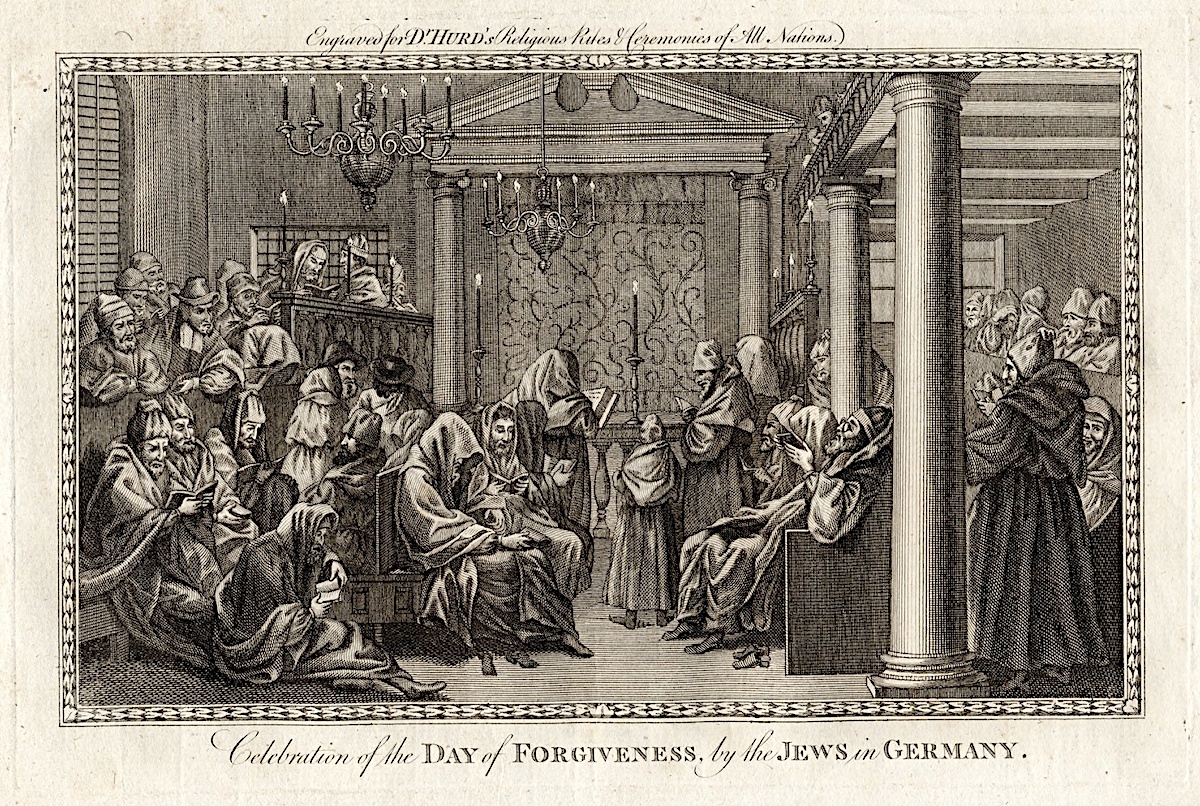
Rosh Hashanah, or the Jewish New Year (literally: head of the year), is an intriguing holiday for a number of reasons. To begin with (no pun intended), it falls not in the first month of the year, but the seventh, and is seen as the "birthday of the world": just one of four types of new years in the calendar. The name Rosh Hashanah as such does not occur in the Torah, which instead describes the day as "a solemn rest unto you, a memorial proclaimed with the blast of horns, a holy convocation." It is thus akin to the Sabbath, in addition marked by sacrifice and the blowing of the shofar, or ram's horn (1, 2) . (Many other customs and rituals evolved in the intervening centuries.) In addition, though, it constitutes the beginning of a period of introspection, repentance, and charity culminating in Yom Kippur, the Day of Atonement. These ten days are referred to as the "Days of Awe" and thus bear a certain resemblance to Ramadan, which is in a sense historically derived from them.
German Jews at prayer on Yom Kippur in the 18th century
The image of the divine particular to this season (and especially
interesting from the standpoint of book history) is that of God as
scribe or bookkeeper, keeping records and rendering judgment on the
lives of individuals in various heavenly ledgers and archives.
According to the rabbinic interpretation, he records the judgment for
the preceding year on Rosh Hashanah, but the verdict is not final until
it is "sealed" on Yom Kippur. Thus, the emphasis is on constant
repentance during the ten days. Prayer, repentance, and good deeds, it
is said, can still avert a negative judgment up to the moment that the
gates of judgment close at the end of the Day of Atonement.
Accordingly, the traditional greetings for the New Year and Days of Awe are:
From Rosh Hashahah through Yom Kippur:
Shana tova: a good year
L'shanah tova tikatevu v'tichatemu: May you be inscribed and sealed [in the Book of Life] for a good year
Leading up to/through Yom Kippur:
G'mar chatima tova: roughly, May you be sealed [in the Book of Life] for a good year [literally just: a good sealing]
As has been the custom, Palestinian Authority President Mahmoud Abbas sent greetings to Israel's President Shimon Peres: "Happy holiday and a Happy New Year to you and the entire Israeli nation." He also expressed the desire of the Palestinian people for peace, and the hope that the new year might bring steps in that direction. Peres, for his part, replied, "I know the past year has been a difficult year, but we mustn't give up… we must continue to strive for peace." In a separate Facebook message to the wider public, he said, “Peace is the greatest blessing to our children,” and warned against intolerance: “Don’t put up with racism or violence of any kind, with religious or
political extremism, or discrimination based on race or gender.”
As chance would have it, such holiday greetings, personal as well as political, were the subject of several good articles in recent days.
In the cards
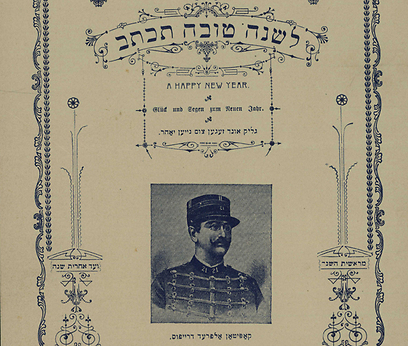
Hezi Amior, Israel Collection Curator at the National Library of Israel, traces the history of the Rosh Hashanah greeting. The first documented instance dates to fourteenth-century Germany. By the eighteenth century, the custom had spread to the new center of gravity of Ashkenazi Jewry in Eastern Europe. The development of the modern postal service coupled with new technologies of graphic reproduction in the late nineteenth century brought about the triumph of the greeting card in the age of mass print culture. In fact, he says, during the two decades before the end of World War I, "the vast majority of the mail sent by Jews in Europe and
America consisted of New Year cards." They loomed large in the volume of mail in Mandatory Palestine and the new State of Israel, too, until the rise of the residential telephone and mass media in the 1970s finally led to the decline of the century-old practice and print genre.
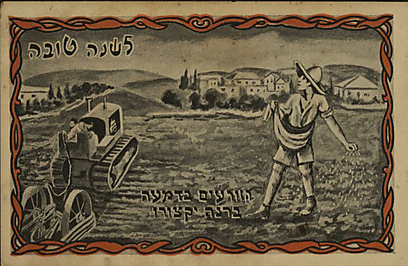
Not surprisingly, as in other cases, the content of the cards reflected the very contemporary concerns of the societies in which they were produced. There were of course traditional religious and historical motifs. With the rise of political Zionism, the cards, around the world and particularly in the Land of Israel:
feature central Zionist
values, such as agricultural labor, a return to Biblical paradigms, the
local landscape, cultural and economic undertakings, milestones in
reclaiming the land and founding of state institutions, the immigration
struggle, the Haganah ("The Defense"), the settlement movement, and so
forth.
Captain Alfred Dreyfus, famed victim of antisemitism at the turn of the century
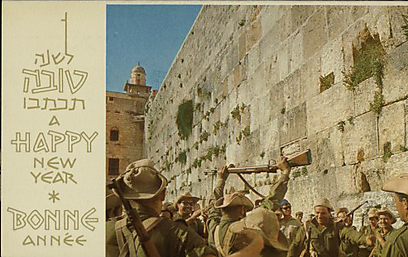
Following the War of Independence, and "especially between the Six-day War and the Yom Kippur War," the IDF (Israel Defense Forces) featured prominently in such greetings, often depicted at holy sites. In this 1967 example: victorious soldiers rejoicing at the Western Wall in Jerusalem (which Jews had been forbidden to visit since 1949 under the Jordanian occupation):
As Amior observes, "these greeting cards recall a time of ideological unity and naïve and uninhibited national pride" in a nation still under construction.
Sacred, secular, and socialist Matti Friedman, one of my favorite journalists over at The Times of Israel (full disclosure: I write for that publication, too), has a fine piece on a subset of this cultural tradition: "Bialik and Kipling, but no God: How kibbutz pioneers marked Rosh Hashanah." Few concepts cause more confusion than the notion of a "Jewish state." The typical American or other outsider, unfamiliar with an identity that comprises an ethnicity as well as a religion, mistakenly tends to assume that it either cannot dispense with or involves only the latter. Many of the early Zionists were not religiously observant, but they often drew upon elements of tradition in their efforts to create a "secular Judaism," a concept that is therefore perfectly logical in this context but may sound strange in others (it's virtually impossible to imagine a "secular Christian" culture).
Matti's article tells the story of these efforts by "the deeply spiritual socialists who were responsible, more than any
other single group of people, for creating the state of Israel." He focuses on The Kibbutz Institute for Holidays and Jewish Culture at Kibbutz Beit Hashita, whose archives "cover the better part of a century of Jewish holiday celebrations but are entirely uninterested in God, rabbis or law."
“For the first pioneers Judaism was very
important, in addition to the ideology of returning to the land of the
Bible, working the fields, agriculture, socialism, and humanistic
values,” said Mordy Stein, one of the teachers at the institute. “In
essence, they were creating the new Jew – the old Jew, the Diaspora Jew,
was what they were rejecting, and they rejected Diaspora religion
because it represented the old Jew.
“They didn’t want rabbinic Judaism, because
they identified it almost mathematically with Exile. They wanted new
ways of expressing Jewish values and holidays according to their new
understandings about the new Jew, so they started to create traditions
that were much closer to the biblical concept, the agricultural concept,
the natural feeling of a Jew living in the land of Israel on the land,
which had been forgotten over 2,000 years,” Stein said.
As Institute founder Aryeh Ben-Gurion (nephew of the first prime minister) characterized Rosh Hashanah: "These are borderline days between the end of summer, the season of
death in the universe, and a new birth, the beginning of a new life
cycle in nature and agriculture and new relations between the sky and
the earth, between rain and soil." One of the typical cards from the pre-statehood 1940s thus emphasizes the synthesis of nature and culture: the sun of the seasons, bringing forth crops and heralding a national rebirth as it shines down upon a new agricultural commune protected by characteristic fence and watchtower.
As is often the case, perspectives change, and the Institute in the meantime includes some traditional prayer in its contemporary liturgies and educational materials. As Matti puts it, "God is no longer taboo." He also suggests that the Institute's program and vision are not passé. He concludes by noting that, although the pure socialism of the kibbutz movement now seems a historic artifact, its approach to the holidays just might have a future among the many people who value ritual and tradition and crave community but are unwilling to cede the definition and practice of religion to the Orthodox.
The solemn day of Yom Kippur is, or used to be, the one holiday that most Jews, however, lax or secular in their practice, tend to observe in some fashion. In fact, it has been said, this was one reason it was relatively easy to launch an emergency call-up of Israel's reserves when Arab armies launched their surprise attack in 1973: one knew where to find the troops. Had the attack come on Rosh Hashanah, they would have been dispersed around the country on picnics and other outings. (New revelations about the intelligence and communications failures on the eve of the war came from the archives just this past week.)
Still, as a story in today's Times of Israel notes, even those who mark the holiday in some form or fashion may not do so in traditional ways. Many secular Israelis may attend the opening evening service and then go cycling the next day rather than attend hours of services with which they are not familiar or comfortable. The article describes various organizations that, akin to the Kibbutz Institute, are attempting to craft meaningful forms of engagement with the holiday for the non-observant: including secular study of religious texts, liturgy drawing upon contemporary literature and music, confessional services "focusing on community and nation," and commemorations of the 1973 war.
As author Ben Sales notes, "Yom Kippur lacks an element of national heroism central to such holidays
as Chanukah and Purim, which many secular Israelis observe," but "the ideas of self-improvement and forgiveness should resonate with everyone." In other ways, it is therefore easy to integrate the observance of Yom Kippur into modern secular sensibilities and lifestyles. "Green Prophet," an environmental organization that calls itself a "sustainable voice for green news on the Middle East" from all peoples and faiths in the region, offers tips to "Make Yom Kippur Your Day to Help Green the World."
Eventually, the standoff in the years after the Yom Kippur War led to the breakthrough that began the long, torturous, and still incomplete "peace process." As the example of Presidents Abbas and Peres reminds us, political leaders as well as individuals often exchange holiday greetings. The excellent new Israel Archives blog of State Archivist Yaakov Lozowick has been releasing a steady stream of new material. Last week, it shared exchanges of New Year greetings between Presidents Carter and Reagan and Prime Minister Menachem Begin. Responding to Carter's holiday wishes in 1979, Begin wrote:
In accordance with the ancient calendar the year 5739 had ended and, in ushering in the New Year 5740 we pray that it may, indeed, be blessed. The twelve months gone by will be remembered as the year in which the Camp David agreement was concluded and the treaty of peace between Israel and Egypt was signed. And as you rightly state, Mr. President: 'This new year finds the ties between our two countries stronger than ever.'
What a difference three decades make. But on to lighter topics.
Several cultural organizations, including the National Yiddish Book Center on the campus of Hampshire College here in Amherst and the Magnes Museum in Berkeley, have resurrected and updated the old traditions by allowing web visitors to send e-greetings of vintage cards. A few examples from the Magnes:
Still, my favorite, which perfectly captures the combination of spiritual and secular, observance and irreverence, has to be this one. As a window into a cultural mindset, it just says it all.
Let's just get a couple of misconceptions out of the way. Contrary to what has been reported in the press and widely believed (mainly, though not exclusively outside the borders of our quaint hamlet):
1) Amherst does not refuse to fly the American flag. It flies every day from the pole on the Common in front of our Town Hall, as well as from police and fire stations. Here's a picture from this afternoon.
Of late, we have also restored the small holder for the flags of the United States and the Commonwealth on the face of the Town Hall's west stair tower.
2) Amherst also marks the anniversary of the 9-11 jihadi terrorist attacks every year:
a) by lowering all flags on major public buildings to half-staff. Here's a photo of the Police Station from last year.
b) with a ceremony at the central Fire Station.
Last year, on the tenth anniversary, there was a larger official commemoration, involving police and firefighters as well as Town officials, on the Common.
Tomorrow, we solemnly mark the occasion at the Fire Station, as usual.
Those are the facts, and no one here denies them.
So why all the lies and misconceptions?
Although the local press for some reason basically ignored the 9-11 ceremony last year, every debate and deliberation about just how to mark the anniversary does seem to get covered. These are then sometimes picked up and distorted by the outside media. . . and thereby hangs a tale. For 11 years now, the question of 9-11 and flags has been the ugly scab that everyone likes to pick at.
The ugly scab that is never allowed to heal
Those who follow Amherst politics are all too familiar with the sequence of events, but to recap in brief:
Over a decade ago, the veterans' agent purchased a set of commemorative flags and proposed to fly them from downtown utility poles at the end of the summer, after the last of the holidays normally marked in this manner. Because, under our Town Government Act, the Select Board has control over the public ways (streets, in common parlance), the issue came before that august body one fine September evening.
Public comment turned not just on the question at hand, but also on attitudes toward "the flag" in general. Some residents spoke favorably of the flag. Some made some rather unfortunate remarks about their view of America and what the flag stood for. The Select Board, as was its right, voted against the additional display of flags. What was most unfortunate was that all this just happened to occur on the evening of September 10, 2001. In the coming days, the media were filled with stories not just about the terrorist attacks, but also about Amherst's alleged refusal to fly the flag, as such—this, at a time when flags became ubiquitous symbols of community and social solidarity.
In response to the catastrophe, residents put up the flags themselves. In fact, in October, the Select Board unanimously voted to leave the flags up till Veterans' Day and then return to the existing policy. Thereafter, the display became the subject of debate. (summary of flag policy, 2001-3) Fifth-generation Amherst native (as he describes himself) and blogger Larry Kelley has made commemoration of 9-11—in particular, through the flying of these flags—his cause célèbre. In 2007, Town Meeting voted down, by a margin of more than 2:1, his article proposing that the Town eternally mark the anniversary in this manner. In 2008, the Select Board approved a compromise policy of flying the flags only every third year, reflecting the split Town Meeting vote. Undaunted, Mr. Kelley has kept his promise to bring the issue up year after year.
Fast-forward to 2010 and the present Select Board, none of whose members, it should be stressed, was in office at the time of the 2001 controversy. Some of us were satisfied with the existing policy as a compromise reflecting the town's divided political opinion, some members found it illogical, and some found the raising of additional flags an inappropriate symbol of mourning. In the end, the only motion seconded and passed was one mandating the flying of the additional flags only on "milestone" anniversaries, that is, every five years. When Mr. Kelley again asked us to take up the issue last month, we held a sustained discussion, in the course of which it became clear that there was not enough support for a revision. No motion was made, so the existing policy remained in place.
Ironically, this year's calm and brief conversation, which simply allowed the previous policy to stand and did not even result in a debate or a vote, got much more attention than the policy under discussion when it was voted in.
It's hard to say exactly why this non-event became such big news, but it doesn't take much to start an avalanche of this sort once the snowball is rolling.
Full press court
Some people legitimately disagreed with the policy (as is their right), while others clearly misread the articles or read too much into what they saw, simply projecting all of their poison and prejudices onto Amherst, and its residents, and above all, its government (thanks; you have a nice day, too). Frankly, poor judgment and wording on the part of the press played a role in the debacle.
For example, local reporter Scott Merzbach's typically careful and balanced story in the Hampshire Gazette began with the accurate statement, "The anniversary of the terrorist attacks of Sept. 11, 2001, will be
marked in Amherst with a solemn ceremony at the central fire station and
the lowering of town flags," before turning to the latest deliberation on the additional flags. The equally careful Diane Lederman of the Springfield Republican offered a similarly nuanced piece.
But a casual reader who looked only at the titles of those pieces (usually the creation of the paper or editor, not the reporter)—"Amherst select board rejects September 11 flag display" and "Amherst officials offer perspectives on decision not to fly American flags on 9/11"—might easily leap to the wrong conclusion. And leap mightily many did.
Conor Berry's report in the Springfield Republicangave them a veritable springboard for just such a leap of logic. Taking the "inverted pyramid" model of journalism to its extreme conclusion, it led with the current deliberations (only fair), but left the explanation that Amherst did indeed commemorate 9-11 until the very last sentence. The in principle accurate but in practice entirely misleading headline was like a red flag to a bull (or a right-winger): "Amherst says 'No' to annual downtown flag display to commemorate 9/11 terrorist attacks on America."
It was downhill from there. A turning point was probably Mr. Kelley's interview on Fox News. Although he calmly presented his passionately held views, the interview revived the subject of the rather rancid comments about the American flag from 2001, which have nothing to with the current controversy or the current Select Board, none of whom held office at that time and none of whom holds those views. And the network, which boasts of its "fair and balanced" coverage, fanned the flames of popular anger with the (as Mr. Kelley, to his credit, acknowledged) misleading title, "Town won't fly American flags on 9/11," and equally manipulative subtitle, "Amherst: flags fly only 6 days of the year."
Further distortions followed, including a hopelessly addled piece of what passes for reporting by Anaridis Rodriguez of WWLP-TV. Although she proudly describes herself as a practitioner of "multi-platform journalism," she only managed, in the space of a very few lines, to make multiple errors, for example, claiming that Town Meeting rather than Select Board had crafted the current flag policy, and above all, quoting Mr. Kelley as impugning the patriotism of the Town Manager and Select Board (which he never did). The story has since been taken down and replaced with a cleaned-up version (though it still contains bizarrely irrelevant emphases in its coverage of the 2010 debate). In both cases, again, an inflammatory headline did neither the Town nor the truth a service: "Amherst won't fly flags this 9/11."
So, let's recap. Look at a sample of those headings:
• "Amherst select board rejects September 11 flag display"
• "Amherst says 'No' to annual downtown flag display to commemorate 9/11 terrorist attacks on America"
• "Amherst officials offer perspectives on decision not to fly American flags on 9/11"
• "Town won't fly American flags on 9/11"
• "Amherst: flags fly only 6 days of the year"
• "Amherst won't fly flags this 9/11"
Is it any wonder that people hate us? that so much of the commentary was hostile, even vicious?
To be sure, Select Board Chair Stephanie O'Keeffe issued a thorough explanation of the Town policy and moreover responded personally to every complaint or query that we received.
"Never mind!"
Surprisingly, perhaps, some of the outraged epistolarians, upon learning the truth, suddenly became more contrite versions of Gilda Radner's famed "Saturday Night Live" character Emily Litella, who would go off on a total rant based upon a complete misunderstanding, and upon being corrected, simply said: "Never mind." Others continued to disagree with the current policy (as is their right), but admitted that they now understood it better and had been hoodwinked by bad reporting or succumbed to sloppy reading.
For example:
Thank you for your kind attention to my “epistle” of the other day. I want to apologize to you and the Select Board, I very obviously “jumped the gun” on reading a report from a “rabble rouser” . Sadly, there are lots of so-called “journalists” who are taking advantage of our present tumultuous time, in order to sway the public’s opinion (and sell newspapers)
and
OMG!!! Stephanie I am so sorry I wrote that letter to you. Word was that you were not flying the American flag. After some research of which I should have done in the first place I now find that not to be the case.
Yep, same instructions I give to my students: do the careful research and reading in the first place—then tell me your opinion.
Clearly, the town remains divided over the issue of the—how many: 25? 26? 28? 29?—commemorative flags (the press can't even agree on the number). Yet I think almost all of us would agree with Larry Kelley's recent statement:
Now this flying-the-25-commemorative-flags-on-9/11-once-every-five-years
story has taken on a life of its own. And the real loser is the town.
Rushing around in August, I somehow omitted mention of a nice little story relevant to my post about Melville and Hawthorne. The fateful meeting of those two men in the Berkshires in 1850 was the beginning of a fertile friendship, as Melville set to work on Moby-Dick, which he dedicated to Hawthorne.
Now, as we all know, Moby Dick, although one of the greatest American novels, was a commercial failure. It is with this fact that David Sugarman begins his essay on Melville in Tablet Magazine:
Herman Melville, the popular writer of adventure stories, all but lost his readership with the publication of Moby-Dick; or The Whale. “Mr. Melville has survived his reputation,” one critic wrote in 1851 of the “imposing” novel, with its diatribes, tangents, and verbosity. “If he had been contented with writing one or two books, he might have been famous, but his vanity has destroyed all his chances for immortality, or even of a good name with his own generation.” While some reviewers recognized the greatness of Moby-Dick, it failed to achieve the success Melville had hoped for, selling only a scant 3,100 copies during his lifetime. “Though I wrote the Gospels in this century,” he lamented to his friend Nathaniel Hawthorne, “I shall die in the gutter.”
However, the "failure" of the novel is just the point of departure (no pun intended) for the real subject of the piece: the resultant trip that Melville took to the Middle East in 1857 as a sort of spiritual and psychological compensation. (And in the process, Sugarman gets to talk about Pittsfield and the Berkshires and the present-day Call Me Melville celebrations.)
There is quite a tradition of such trips to the "Holy Land" in the nineteenth century. Mark Twain undertook one, too, and didn't like it much better. As the subtitle of the essay puts it, "The Moby-Dick author sought spiritual connection on an 1857 Holy Land trip. He found dust and rocks instead." Sugarman sees Melville's frustration as a reaction to both the objective decrepitude of the scene and the particular disappointment that he felt as someone who, although neither observant nor orthodox in belief, nonetheless intellectually and psychologically identified with the Christian tradition.
Worth a read. And a look, just for the whimsical image of the white whale's tail by Rockwell Kent superimposed on a historic photograph of the Ottoman-era walls built by Emperor Suleiman the Magnificent.
"A blessed festival" and conclusion to Ramadan to all my Muslim friends.
I put up my main Ramadan post for this year a few days ago, but here are a few stories for the end of the month of prayer, fasting, and charity.
Noting that mobile apps can now inform users of fasting times, mosque locations, and sellers of halal goods, The Economist marked the end of the holiday with a piece on Muslims' use of digital technology as a whole, observing that they "have embraced the internet and smartphones just as the rest of the world has—and, in some ways, even more." It's part of a trio of pieces on Islam, the others of which deal with religious observance and changing attitudes toward alcohol.
Michelle and I extend our warmest wishes to Muslim communities in the
United States and around the world as they celebrate Eid-al-Fitr. For
Muslims, Ramadan has been a time of fasting, prayer and spiritual
renewal. These past four weeks have also been a time to serve the less
fortunate -- a reminder of the obligations that people of all faiths
have to each other.
In the United States, Eid-al-Fitr speaks to the truth that communities
of faith -- including Muslim Americans -- enrich our national life,
strengthen our democracy and uphold our freedoms, including the freedom
of religion. That is why the we stand with people of all faiths, in the
United States and around the world, in protecting and advancing this
universal human right.
On behalf of the American people, we congratulate Muslim Americans and
Muslims around the world on this joyous day. Eid Mubarak.
In the Palestinian Authority, residents of Ramallah filled the streets
to shop and relax, taking advantage of the calm and their relative
prosperity despite general concerns over economic and political
stagnation. Meanwhile, in the neighboring territories still under Israeli control, "Activists in 'Land of Peace', a movement of settlers and Palestinians acting for
good neighborly relations," offered candy and holiday greetings to Muslim shoppers and construction workers. As one participant said, "Who knows, maybe hope will come from this." It won't solve the problem, but it is certainly a sentiment in the spirit of the holiday.
As Voice of America News reports, the London stadium was moreover constructed in an area with a large Muslim population:
In East London's York Hall, the United Kingdom's largest civil society organization, Citizens UK,
organized an Iftar, the evening meal following a day of fasting during
Ramadan. The group has been involved with the London Olympics
Organizing Committee and came in part to celebrate the impact the
Olympics are having on the community where the main stadiums have been
constructed.
The group successfully advocated for a living wage of at least $12 an
hour for everyone working at London Olympics jobs, as well as Olympic
funding for local schools, hospitals and new affordable housing.
Neil Jameson, the director of Citizens UK says the involvement of the
East London Mosque was essential in ensuring the economic development of
this ethnically diverse area of the city.
"The East London Mosque is the largest civil society organization in
London, 10,000 people worship there. So we are them, effectively, and
tonight we break the fast - non-Muslims and Muslims together - because
that makes for a peaceful world and a peaceful Olympics," said Jameson. (full text and video here)
Ramadan moreover posed a special challenge for the 3000 Muslim athletes, who had to decide whether to observe the fast in part or in full. Going without food and drink during the day can make athletic performance more difficult, and the resultant dehydration may complicate drug tests.
Supposedly for health reasons, though apparently for political ones, the Chinese government ordered Uighurs to ignore the holiday: "It is forbidden for Communist Party cadres, civil officials (including
those who have retired) and students to participate in Ramadan religious
activities." Elsewhere, the dilemmas of dissent are different. For instance, in Saudi Arabia and Malaysia, observance is compelled rather than prevented. And in many other places, such as Jerusalem and the Palestinian Authority, there is at the least strong social pressure to conform to tradition. As a result, the secular, the self-indulgent, and nicotine-addicted generally keep their backsliding secret. (1, 2). As Diaa Hadid of the Associated Press reports, "a minority in the community goes underground
each year during the holy month, sneaking sandwiches and cigarettes
when no one is looking."
In the United States the holiday was marked, if not overshadowed, by new debate over religious intolerance, notably the horrific murders in a Sikh temple in a Milwaukee suburb by a white supremacist, and the burning of a mosque in Joplin, Missouri—though, in a hopeful sign, a fund drive for reconstruction exceeded its goal in just three days, thanks in part to donations from non-Muslims.
Ramadan interfaith meals have become increasingly common in recent years. (I
have had the privilege of attending the one for Amherst residents,
sponsored by the Muslim student organization at the University of
Massachusetts.) At a White House Iftar dinner yesterday evening, President Obama speculated that the first such gathering held there might have occurred when President Jefferson entertained an envoy from Tunisia. And, with Jefferson's personal Qur'an on display (a loan from the Library of Congress), he pointed out "that Islam -- like so many faiths -- is part of our national story." After citing the contributions of Muslim Americans, he took the opportunity to condemn not only the murders of the Sikhs, but also all "instances of mosques and synagogues, churches and temples being targeted."
So tonight, we declare with one voice that such violence has no place
in the United States of America. The attack on Americans of any faith
is an attack on the freedom of all Americans. (Applause.) No American
should ever have to fear for their safety in their place of worship.
And every American has the right to practice their faith both openly and
freely, and as they choose.
That is not just an American right; it is a universal human right. And
we will defend the freedom of religion, here at home and around the
world. And as we do, we’ll draw on the strength and example of our
interfaith community, including the leaders who are here tonight.
Some years ago, when Representative Keith Ellison took the oath of office on that same Jefferson Qur'an, the late journalist and atheist Christopher Hitchens, with typical mischievousness, pointed out that Jefferson, though the staunchest defender of religious freedom, was no friend of Judeo-Christian revelation, and thus would not have thought much of Islam, either. Drawing an obvious parallel to conflicts in our own day, he noted that Jefferson went to war against the Barbary states of North Africa, who had justified piracy and the enslaving of captives to him on Qur'anic grounds. In fact, Hitchens said, because Jefferson had produced his now-famous New Testament expurgated of all miracles and "superstition," one should extend that principle to its logical conclusion: "Is it not time to apply the razor and produce a reasonable Quran as well?" Not exactly the kind of thing that President Obama would have wanted to call attention to at the dinner. But then, that is not the purpose of such gatherings.
Is there a connection between American wars abroad and intolerance at home? My colleague, philosopher Falguni Sheth, takes on the question and provocatively asserts that there is an intimate relation, in a piece that was also cited nationally. How does one weigh the danger that some may succumb to bigotry against the objective right or need to speak critically about another belief system or culture or aspects of it? Here, as in other cases, the boundary between legitimate criticism and bigotry can itself become a war zone. Philosopher Russell Blackford takes up that challenge with subtlety but firmness in a post on "Islam, racists, and legitimate debate."
Among the international guests at the Iftar dinner was Israel's Ambassador Michael Oren. The choice may have struck some as unusual, but as someone pointed out in the web conversation last night, he represents a state, 20 percent of whose population is Muslim (80 percent Sunni). When Oren hosted his embassy's Iftar dinner last year, he said:
It is a world grounded in our holy books. Tonight, of course, is
Laylat al-Qadr, the night of the Holy Quran’s revelation. As a student, I
spent an entire year reading the Quran and vividly remember how it
referred to the Jews as Ahlu al-Kitab—the People of the Book. It says in
Sura 29, “Our God and your God is one, and to Him do we submit.” And in
Sura 3, the Jews are invited to, “Come to a word that is just between
us and you, that we worship none but God, and that we associate no
partners with Him, and that none of us shall take others as lords
besides God.”
Similarly, the Bible tells us, in the Book of Psalms, “Behold, how
good and pleasant it is when brothers dwell in unity.” And the Book of
Proverbs says, fittingly for this Ramadan feast, “Better a dry crust
with peace than a house full of feasting, with strife.”
Although the sharing of Muslim and Jewish traditions may strike some outsiders as strange, it is in fact entirely natural, above and beyond the probable connection between Ramadan and Yom Kippur (1, 2). Both religions share a similarly austere and pure monotheism as well as similar dietary regulations. A recent article on a Muslim website usefully surveyed the practices of Halal and Kosher slaughter and found more common points than differences. This year, joint Muslim-Jewish celebrations were perhaps more common because the Jewish fast day of Tisha B'Av (marking, by tradition, the date on which both the First and Second Temples were destroyed) fell during Ramadan. In one case, Israelis shared their break-fast with Muslim refugees from Sudan. The most unusual celebration involved Israelis and Palestinians meeting in Tekoa, an Israeli town created near the site of the ancient one of that name in historic Judea, nowadays more commonly known as the West Bank. Jerusalem Online reported:
Amongst the diners, [Israeli] shimon, whose brother Asher and Asher’s young son were killed in a terror attack not far from Tekoa. Their car was hit by stones thrown by Palestinians and overturned, killing them both. Shimon says there is no reason they should not gather together. It is strange, he says, that they have grown used to living apart.[Palestinian] Ziad explains that at the beginning of history, one brother killed another, referring to the biblical story of cain and able [sic]. But, he says, here they are extending a hand to peace. Shimon said this endless cycle of violence [sic] and that he believes things should be different.
Rabbi Fruman said he hopes that all around the world, peoples will sit together and break bread like they are doing here and that people will fight together to defeat those obstacles we all have to being human beings.
As I recently noted, I was recruited to write for the new born-digital newspaper, The Times of Israel, a comprehensive, non-partisan publication covering all aspects of that area of the Middle East and much beyond.
Many modern states have an ethno-national origin and character but multiethnic populations. How do they deal with the complex cocktail of political symbolism and social reality? And what is the true nature of patriotism?
I took the occasion of Israel's Independence Day to reflect on a controversy that had occurred a few months earlier, not long after the Times of Israel began publication.
Should an Arab justice on the Israel Supreme Court be required to sing the national anthem ("Hatikvah")? I don't think so. Here's why. (And you might be surprised at who agrees.)
As chance would have it, several other publications (on their own, not responding to my piece) returned to the story at the same time: