"In fiction, the principles are given, to find the facts: in history, the facts are given, to find the principles; and the writer who does not explain the phenomena as well as state them performs only one half of his office."
Thomas Babington Macaulay, "History," Edinburgh Review, 1828
The Battle of Verdun, which had begun on 21 February 1916, at last came to an end on 18 December. The meat-grinder, as it came to be known, occasioned some 700,000 to 900,000 French and German casualties--among them at least 300,000 dead.
The medal below was issued by the city to the defenders. As historian and security expert John Schindler notes in a piece written on this week's centennial: because of the French system of rotating units in and out of Verdun, "virtually every division in the French army fought at Verdun at some point in 1916."
John Schindler (@20committee) places the Battle of Verdun in the context of other bloody operations of 1916, including the Somme (intended to relieve the pressure on France arising from Verdun), and the lesser known battles in other theaters: Isonzo, on the Italian Alpine front, and Russia's Brusilov offensive against Austria-Hungary.
In response to students' anger and fear in the wake of the presidential election and their protests that the American flag represented racism and oppression, Hampshire College controversially decided on a temporary removal of the national symbol in hopes of calming the situation and fostering dialogue.
The public reaction surprised the College (but hardly anyone else): incredulity and outrage.
Amherst’s Veterans of Foreign Wars Post 754 organized a mass protest on the Hampshire College campus for the Sunday after Thanksgiving (November 27). A large crowd from around New England--particularly but not
exclusively veterans and their families--gathered at the entrance to the College on Route 116. Although the press put the size of the crowd at around 400, the organizers, who issued over 5,000 invitations via social media, estimated
attendance at 1,500 to 2,000: which is to say, greater than the annual enrollment at the College.
I was present, along with a few other members of the faculty and student body.
Veterans represented multiple generations and wars.
Not exactly the alt-right
In the wake of the presidential election and the tensions that it engendered, many in the Hampshire and wider Amherst community (who did not bother to attend or were scared to do so) leaped to the
conclusion that the event was a gathering of right-wing extremists
and hatemongers. On the contrary, the organizers took care to avoid giving the formal program any particular political slant. In fact, the
most prominent speakers were centrist or
left-liberal Democratic politicians: State Rep. John Velis (Westfield), Springfield
Mayor Domenic Sarno and Councillor Kateri Walsh, and Northwestern
District Attorney David Sullivan. Several of the speakers were non-white and immigrants. A member of the local veterans' color guard was transgender.
not exactly the "alt-right"
Outside interference?
The presence of the regional political figures caused no little consternation among the
Hampshire faculty, who complained in high dudgeon that outsiders were interfering in our internal affairs and attempting to intimidate the College. It is an ironic argument. The politicians were simply exercising the same right of free speech about an issue of deep concern as the students who burned the flag and the President who banned it. (And, for the record: in my many years of working here, I had never known the College to bow to the wishes of any outside force, least of all, provincial politicos.)
Still, even neutral outsiders remarked on
the unusual presence of these visitors. (Most
expressions of surprise focused on the presence of Mayor Sarno, who, as a
friend of mine from beyond the walls of the academy drily observed, "has never even
come to pee in Amherst.") The most parsimonious explanation is, however, generally the most plausible. (It is possible to overthink an issue.) The cynical consensus among outside observers was
that the aim was grandstanding rather than intimidation. Seeking to score easy points with their base is, after all, what politicians do. But politicians also have convictions. The idea that the flag had powerful emotional meaning for them, and that they therefore cared sincerely and deeply about its presence or absence, is a difficult one for the academic mind to grasp.
Rep. Velis is not
just a politician from the Pioneer Valley, but also an Afghanistan
veteran. As for DA Sullivan, he is a frequent attendee at events in
Amherst, and he moreover has extensive professional experience in
military affairs, having served as a civilian lawyer for service personnel and most recently, working to establish a new veterans' court providing treatment for trauma disorders and substance abuse. Mayor Sarno, too, paid tribute to the veterans, but he explained that the flag had further personal significance for him.
The flag of a nation of immigrants
Sarno was one of several speakers who highlighted the role of immigrants. The flag had special meaning for him as the son of Italian immigrants who had experienced Fascism and survived the Nazi occupation of Italy in hiding. To them it had been a symbol of hope and freedom.
Event organizer Victor A. Nunez Ortiz came to the United States when his family fled the Salvadoran civil war. He served in the Marines even before becoming a US citizen. He refers to this experience when introducing the next speaker.
Another veteran who had served in the US military as an immigrant non-citizen was Veasna Roeun of Connecticut: a survivor of the Cambodian genocide.
A Progressive Speaks
Here, well known local civic and political figure Bonnie MacCracken speaks. She read a poem about Blue Star Mothers. Bonnie, a candidate in the recent Democratic primary election for state representative from the third Hampshire district, is a member of the Democratic State Committee and has long been active on behalf of progressive social causes, among them racial and economic justice (especially housing issues) and early education.
And the right?
The red meat right-wing exception in this program was the brief address by Mount Holyoke student and conservative activist Kassy Dillon, who focused her remarks on a critique of the College and its students. She explained, "I wrote the first story" about the flag flap, adding that the Hampshire student who had passed on the news to her was now "being bullied by other students."
Racism and extremism?
Despite repeated assertions that Confederate flags and other racist symbols were on display, neither I nor anyone I subsequently spoke with saw them--and no one has to date produced any photographic proof. It does not seem unreasonable to conclude--given the nature of the controversy, and what I saw--that many in the crowd were to the right of center, but that is not the same thing as "alt-right" "white supremacists."
To be sure, there were a few displays that I could I could have done without: this anti-UN flag, for example (though without talking to the owner, it was impossible to tell whether it represented standard arch-conservative gripes about "anti-American" multilateralism or something notably more rancid).
I also spotted several "Don't Tread On Me" flags. The right-wing "Tea Party" movement adopted the Gadsden Flag (as it is more properly called) in 2010, though as everyone should know (and Mount Holyoke historian Joseph Ellis explains), it is a venerable emblem of the American Revolutionary era, appropriated in the meantime by various groups as a symbol of protest.
On the whole, the tone was respectful of the College. Of course, the organizers could not regulate who showed up, and a few of the signs were obnoxious and juvenile. One placard (referring to Vladimir Putin or just left over from the Cold War?) advised Hampshire students: if you don't like it here, go get an education in Russia. Another, in what the creators no doubt considered a masterpiece of wit, relied on hackneyed scatological imagery.
By contrast, this sign, playing on the Hampshire College motto, took a lighter approach, and was perhaps marginally more effective.
this a PEACEFUL DEMONSTRATION OF FREEDOM as citizens of our United States of America. . . Families will be present and order is to be expected.
At the rally itself, they reiterated this request and moreover made a point of thanking
the College for allowing them to meet on campus property. Here, veteran
and Purple Heart recipient Micah Welintukonis of Connecticut, who presided over much of
the event, offers
to provide microphone time to the President or any other administrators
who might be present (none were) and then leads the crowd in the chant,
"Raise that flag!"
A confrontation
At one point, though, one saw how things might have taken a more dangerous turn. Toward the end of the event, the organizers wanted the participants to assemble near the large Hampshire College sign for a group photo that they hoped would go viral. As they asked people to move away from the sign so that the wording would be visible, we saw a young man sitting on the ledge in front of it, giving people the finger with both hands. The organizers, at first thinking he was one of their own, mocking Hampshire College, chided him for his vulgarity. It turned out, however, that he was a Hampshire student flipping off the demonstrators rather than the College and seeking to spoil their photo op. The crowd became more agitated. Several people seemed prepared to remove him by force and others tried holding a flag in front of him to block him from view but the speaker urged them to remain peaceful and let the campus police provide order. The speaker engaged in some mild taunting of the hapless student but also offered him the microphone. After a few minutes of this standoff, things quieted down. Subsequent press reports
described some uglier aspects of the confrontation, but from where I was standing at the time, near the podium, I could see and hear none of that.
Coming to a close
As the rally wound down, attendees sang "God Bless America."
In the low-key conclusion to the event, the speaker reminded attendees that "we are all Americans" and urged them to tell the College: "raise our flag!"
Postscript
The veterans had planned to return a week later for a second rally, but when the College suddenly announced on December 2 that the flag was going back up, they canceled the event as what they called an "act of faith":
Indeed, the best outcome of this sorry mess would be a dialogue between veterans and campus community, and there are some signs that this may in fact occur.
On the first anniversary of the creation of the Empire, Napoleon won "the greatest battle of [his] career" when he defeated the forces of Austria and Russia at Austerlitz (Slavkov) near Brünn (Brno) in Moravia. The triumph was so decisive that it ended the War of the Third Coalition and forced Austria to sue for peace.
The Emperor's encampment at Austerlitz after a drawing made on the scene the morning of the battle
Battle of Austerlitz: The Emperor gives his orders to the Marshals
General Rapp brings the Emperor news of the victory at Austerlitz
Pictured here are pieces of ammunition recovered from the battlefield.
• Iron canister shot: a tin of 112 balls (61 for a four-pounder gun) could be used with devastating effectiveness against infantry at a range of some 300-500 meters
One has to pause to remind oneself of the terrible damage that such large but low-velocity projectiles did, especially in the absence of modern medicine and sanitation.
Casualties amounted to one eighth of the French forces and one third of the Austro-Russian.
The Battle of Hohenlinden east of Munich in 1800 was in some sense the predecessor of the later battle of Austerlitz (1805). The great victory at the latter ended the War of the Third Coalition by forcing Russia to withdraw its forces and Austria to sue for peace, leaving England to fight alone.
In the campaign of 1800, Napoleon's victory at Marengo (June 14) stands out as the stuff of legend but, despite the initiation of peace talks with Austria, the war continued. It was in fact the great victory by General Moreau at Hohenlinden near Munich half a year later that turned the tide of the war. His subsequent advance threatened Vienna, which signed an armistice on Christmas Day. Subsequent French gains in Italy led to the defeat of the Second Coalition and the Peace of Lunéville in February of the following year.
There is another connection between Marengo and Hohenlinden. The former was Bonaparte's first major victory after assuming power, and he was determined to aggrandize his role--even to the point of rewriting history--at the expense of the commanders who actually saved the day. He therefore resented Moreau's fame after the German battle, viewing the general as a potential rival. The latter was foolish enough to contemplate such a role for himself and became embroiled in a royalist plot that led to his imprisonment and then exile in the United States in 1804. Historical opinion today is more inclined to affirm Moreau's essentially republican sentiments but fault him for his bad judgment and political ambition (the latter driven in part by his wife). He fell at the Battle of Dresden, fighting with the Russian forces in the Wars of Liberation against Napoleon.
Veterans Day is one of those quiet but pleasant holidays in Amherst. Attendance at our modest commemoration is small: far lower than on Memorial Day, which entails a much larger celebration and occurs in generally more pleasant weather, as befits the de facto beginning of the summer vacation season.
Perhaps for that reason, it seems more intimate: not just that the group is smaller, but that it is composed of people who feel a personal or family connection to the holiday, especially veterans and their families. The attendees also seem more representative of the real diversity of Amherst.
A few photos from this year's event, which I attended with other Town officials, including fellow Select Board members Alisa Brewer and Doug Slaughter, Assistant Town Manager David Ziomek, Planning Director Christine Brestrup.
Rev. Anita Morris, chaplain for the Amherst Veterans of Foreign Wars, gives the invocation as Veterans' Agent Steve Connor (who organizes the event each year) holds down her papers in the breeze.
Select Board Chair Alisa Brewer offers greetings on behalf of the Town of Amherst
Victor A. Núñez Ortiz, Salvadoran immigrant, Iraq veteran, and Vice President and Chief Operation Officer of Veterans Advocacy Services.
Amherst native and veteran (Marines; Air Force Reserve) Charles Thompson
(service in the Iraq and Afghanistan theaters as well as Europe, Asia) delivers the keynote
The mass slaughter of the Great War prompted contemporaries to find new ways to remember and mourn. The fact that many of the millions of fallen remained unidentified led to the suggestion one of their number be honored at a national commemorative site. The tombs of both the British and French Unknowns were dedicated on the anniversary of the Armistice in 1920, the former at Westminster Abbey (pointedly placing the commoner alongside the kings), the latter at the Arc de Triomphe. (The US Unknown was interred in Arlington Cemetery a year later.)
This card dates from the dedication of the British tomb.
The Christian symbolism so often associated with national memory is evident on the exterior, which seems to feature forget-me-nots and/or violas rather than the poppy, which acquired its iconic commemorative status (reproduced in silk) the following year.
Pictured at left of the interior is the Cenotaph (commemorating the war dead but containing no body) in Whitehall by Sir Edwin Luytens, dedicated on the same occasion. It replaced a temporary structure that he had designed for the Victory (Peace) Parade in 1919. The Poetry Library lists the poem among its "lost quotations," whose source remains to be identified.
The anniversary of the end of the war, originally called Armistice Day, became Remembrance Day (the closest Sunday to November 12; since 1945) in the Commonwealth and Veterans Day (1954) in the US.
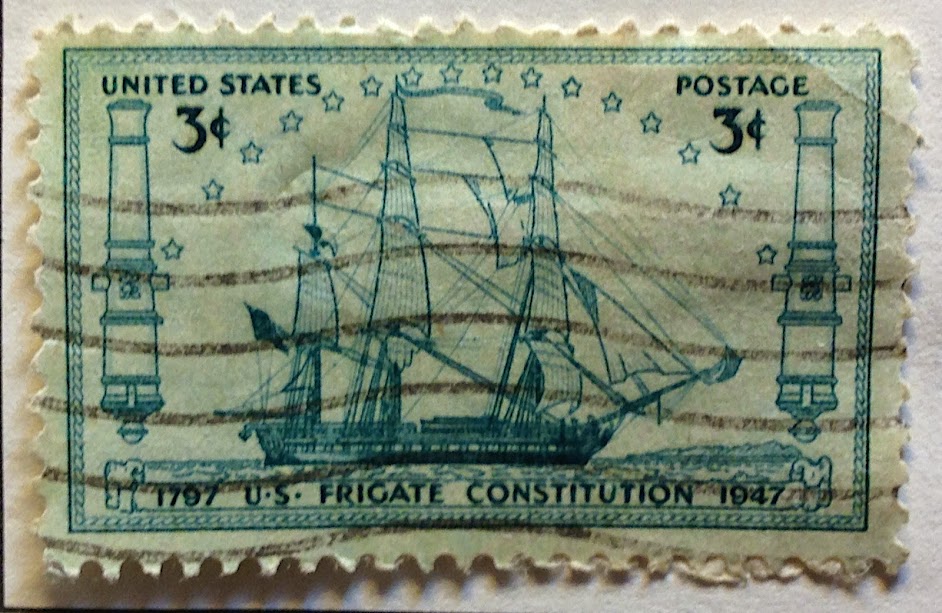
Here she is, depicted on the 150th anniversary commemorative stamp, which proved to be both very popular and unexpectedly controversial (naval aficionados did not think the depiction was sufficiently active and heroic).
As I noted in my recent post on the fiftieth anniversary of the National Historic Preservation Act (October 1966-2016), it was an innovative decision on the part of the US Postal Service to depict historic resources other than buildings on the stamps issued for the fifth anniversary of the law: a San Francisco cable car, and the whaling ship Charles W. Morgan of Mystic Seaport.
The inclusion of ships raises intriguing question about, first, what should be preserved, and second, what "preservation" means in the case of resources such as ships, whose material is constantly being replaced. The "Constitution" has undergone a number of major restorations, but the latest (2007-10) was intended not only to preserve the ship, and also to bring it back to the state of 1812, when it achieved its greatest fame (context and overview; individual aspects of the project).
* * *
from the vaults (2010): backgrounder and summary on the "Constitution" and challenges of maritime historic preservation:
Realizing that the terror might be having the opposite of the intended effect, the more shrewd among the authorities made a final offer, guaranteeing immunity for anyone who came forward by a final deadline of 18 June. A flood of statements came in, including one that identified the assassins by name. The anonymous author was one of the paratroopers, Karel Čurda. Still the Nazis could not find the killers. On 16 June, Čurda went in person to Gestapo headquarters and turned himself in. Although he did not know the hiding place of the assassins, he did reveal the existence of safe houses that had aided the paratroopers. Under torture, the confessions of one of the adolescent residents mentioned the Orthodox cathedral of Saints Cyril and Methodius in downtown Prague. Early on the morning of the 18th, the Nazis surrounded the church. In the course of a lengthy battle, all seven paratroopers there fell in combat or committed suicide. (details in an archived post here)
Since the fall of communism, the cathedral has officially and publicly commemorated the terrible events. In 2002, the Memorial to the Victims of the Heydrich Terror became "A National Memorial to the Heroes of the Heydrich Terror--a Place of Reconciliation." Each year, on the anniversary of the battle, a national commemoration takes place on the street in front of a memorial plaque on the bullet-pocked wall.
To the accompaniment of martial music and the Czech and Slovak national anthems, soldiers lay wreaths dedicated by a succession of persons, from major political figures and dignitaries to veterans and their families or ordinary citizens.
Here, Czech soldiers practice wreath-laying gestures before the ceremony, 2011.
Here, an honor guard of Czech soldiers lines up in preparation for the ceremony, 2011.
By the end of the ceremony, the sidewalk is covered with flowers and inscribed ribbons.
The event concludes with a brief mass in the church, after which the exhibit hall and the memorial in the crypt, are opened to the public, free of charge. Despite the awkward location, in a narrow and busy urban space, it is
one of the simplest but most moving memorial ceremonies that it has been
my privilege to attend.
On May 27, 1942, Czechoslovak paratroopers Jan Kubiš and Jozef
Gabčík, trained by the British Special Operations Executive (SOE),
assassinated Reinhard Heydrich, Nazi "Reichsprotektor" of Bohemia and Moravia, on his way into Prague. Heydrich died of his
wounds on June 4. The paratroopers were betrayed and killed two weeks
later.
The vicious reprisals took some 5000 lives, most
notoriously, the murder of the villagers of Lidice and razing of the
entire town, which aroused international outage.
Czechoslovak postage stamp (part of a series commemorating World War II), issued on the fiftieth anniversary of the assassination:
A century ago began one of the fiercest battles of a war that has come to stand for unprecedented slaughter. When the fighting on the western front during the Great War changed from the anticipated war of movement to the unexpected war of position, military leaders on both sides in vain sought a way out of the stalemate.
Operation Judgment
As 1915 drew to a close, German Chief of Staff Erich von Falkenhayn presented a plan to the Kaiser:
The strain on France has reached breaking point--though it is certainly borne with the most remarkable devotion. If we succeed in opening the eyes of her people to the fact that in a military sense they have nothing more to hope for, that breaking point would be reached and England's best sword knocked out of her hand.
A massive assault against the right target would "compel the French to throw in every man they have. If they do so the forces of France will bleed to death."
That target was the fortified area around the Verdun, a city with great symbolic resonance in French history. An ancient Roman fortress, it also lent its name to the treaty that in 843 divided the empire of Charlemagne among his successors. The fall of the fortress during the French Revolutionary Wars in 1792 had exposed Paris to the threat of capture. By contrast, in 1870, it was the last fort to fall to the Germans in the Franco-Prussian War. Despite the presence of new outlying fortifications built in the wake of that defeat, it was weakly defended in 1916: the garrison was small, and its guns had been removed for use on other fronts.
The Germans assembled overwhelming force and began "Operation Gericht" (Judgment) on 21 February with a massive assault. In the words of John Keegan:
Among the 542 heavy guns were thirteen of the 420mm and seventeen of the 305mm howitzers that had devastated the Belgian forts eighteen months earlier, and to supply them and the medium artillery a stock of two and a half million shells had been accumulated. The whole of the French defensive zone on a front of eight miles--one German division and 150 guns to each mile--was to be deluged with preparatory fire, so that 'no line is to remain unbombarded, no possibilities of supply unmolested, nowhere should the enemy feel himself safe.' Falkenhayn's plan was brutally simple. The French, forced to fight in a crucial but narrowly constricted corner of the Western Front, would be compelled to feed reinforcements into a battle of attrition where the material circumstances so favored the Germans that defeat was inevitable. If the French gave up the struggle, they would lose Verdun; if they persisted, they would lose their army.
After early German gains, the French rallied to the defense, desperately resupplying the city via what became known as the "sacred road" (Voie sacrée) and subjecting the German attackers to devastating artillery fire. The fight thus ground on for nearly a year, bleeding both armies rather than merely the defenders. Combined casualty estimates for the two sides range from around 714,000 to 936,000. Finally, in late October, the French recaptured the key fortress of Douaumount, and by mid-December, they completed the counter-offensive.
To "The heroes, known and unknown, both dead and living"
In November, the municipal council of Verdun (meeting in Paris) ordered a medal struck to honor the heroic defenders. Each 37-mm bronze medal came in a small leather pouch stamped with the name of the city and holding a certificate.
The certificate, which depicted the medal and bore the hand-stamped seal of the city, read:
TO THE HIGH CHIEFS,
OFFICERS, SOLDIERS,
TO ALL,
The heroes, known and
unknown, both dead and living,
who have triumphed over the
barbarians' onslaught and im-
mortalised her nam[e] throughout
the world and for ages to come,
the Town of Verdun, inviolate
and standing on her ruins, dedi-
cates this medal in token of her
gratitude.
The obverse of 37-millimeter bronze medal designed by Émile Vernier (1852-1927) depicts a defiant Marianne (symbol of the Republic) wearing a military uniform and the new army helmet, one fist clenched in defiance, the other holding a sword, poised for the offensive. Around the rim is the watchword of the defenders, "They shall not pass."
The obverse depicts the Porte Chaussée of Verdun between palms, with the word "Verdun" above and the starting date of the battle, 21 February 1916, below.
This unofficial medal was eventually issued in a variety of forms and sizes for all who had fought in the Verdun sector, broadly defined, at any point during the war.
"sacrifices . . . made in a most promising cause"?
Falkenhayn summarized his achievements:
The enemy nowhere secured any permanent advantages; nowhere could he free himself from the German pressure. On the other hand, the losses he sustained were very severe. They were carefully noted and compared with our own which, unhappily, were not light.
The result was that the comparison worked out at something like two and a half to one: that is to say, for two Germans put out of action five Frenchmen had to shed their blood. But deplorable as were the German sacrifices, they were certainly made in a most promising cause.
History has begged to differ. Falkenhayn had to relinquish his position as Chief of Staff, replaced by Paul von Hindenburg, the hero of Tannenberg who would go on to become President of Germany under the Weimar Republic and reluctantly appoint Hitler as Chancellor. And that is not the end of the ironies. Among the French soldiers captured in the battle was a young Charles de Gaulle. His commander was Philippe Pétain, who achieved fame for his defense of Verdun. In 1940, following the fall of Dunkirk, they briefly served together in the war cabinet before becoming archenemies, as Pétain took the reins of the collaborationist Vichy regime, while de Gaulle led the Free French from London.
* * *
Source of quotations: John Keegan, The First World War (NY: Vintage Books, 1998), 277-86
It was a distinctive sight: early nineteenth-century fortifications overlooking the Mississippi and Minnesota rivers on what was once the frontier. The greatest and most iconic remnant was the great Round Tower, said to be the oldest surviving building in Minnesota. It was moreover a sight I saw every week as a child, when my parents drove from suburban Bloomington to Saint Paul.
The Tower was so iconic in part because it was one of the few well-preserved parts of the original Fort. Added to and used continuously through World War II, the site deteriorated thereafter. Although designated a National Landmark, the Upper Post was, as I noted some years ago, placed on the list of "most endangered" historic sites in 2006.
There is a new call to restore and rehabilitate the Fort in time for its bicentennial in 2020, and the reasons are powerful. The editors of Minneapolis Star Tribune this week made a good case for this major effort and expenditure, citing, as I did several years ago, the striking range of historical episodes that the site witnessed, though these associations are unfortunately anything but common knowledge. It is logical for preservationists and public historians to concentrate on early history--the firsts--but if we do so at the expense of all that came afterward, we do both history and the present an injustice:
But representation of what came before and after the fort’s first decade would be added. There’s a rich story to tell: the long Dakota ties to the spot and the tragedy of the 1862 Dakota War; the fur trade of the 17th century; the fort’s significance to U.S. westward expansion; the presence of African-American slaves, including Dred Scott, and the contributions to two world wars. Attention would be paid to the fort’s role in diversifying Minnesota’s population, society CEO Stephen Elliott promises. For example, the fort’s use as an intelligence training center for Japanese-American troops during World War II led to the state’s first sizable Japanese-American settlement.
Telling more of Fort Snelling’s story should allow more people to see themselves in Minnesota’s past. That in turn should deepen their connection to this state and its future. The Legislature must act this year to make that vision a reality in time for the fort’s 2020 bicentennial. They shouldn’t let that chance slip away
This is exactly what historic preservation should be about.
What first prompted me to write about the Fort back in 2010 and 2011 was another childhood memory--or rather, a romantic legend. I had learned that Count Zeppelin made his first balloon ascent from Fort Snelling's Round Tower while serving as an observer with the Union troops during the Civil War. According to that scenario, he was hooked on aeronautics and the rest, as they say, is history. Or was it? Read on.
Not the least of the many strengths of the National Museum of American History in Washington is that its scale allows it to house and display some immense objects from its collection of some three million items--from the Star Spangled Banner (originally 30 x 42 feet; now 30 x 34) to an entire Ipswich, Massachusetts house.
Another of the largest was just a temporary guest: the great garrison flag that hung from the façade of the Pentagon from September 12 to October 11, 2001. Fittingly, the installation was in Flag Hall, where the Star Spangled Banner was formerly displayed.
It was a striking sight whose power the photo can barely convey, though the visitor's head and top of the Christmas tree at lower right give you some sense of the scale.
It is now back home in storage at the U.S. Army Center of Military History at Fort McNair.
As the anniversary of the start of World War II draws near, time to squeeze in one more piece on the endgame. Recently, it was Okinawa and Hiroshima in the spring and summer of 1945.
This time: the liberation of Paris, August 25, 1944.
Dia.: 40 mm. Rim dia: 61 mm. Length: 311mm
It is a British brass shell casing, decorated and inscribed, "Souvenir de la Liberation." I bought it from an English antique dealer couple who were visiting a colleague here in the US and had brought a few items to sell during their trip. I haven't researched is as thoroughly as I would like, but unless I am way wide of the mark, it is a shell from a 40 mm Bofors L60 gun (1 , 2) which was widely used by both sides.
Many would term it "trench art," which Paul Cornish's photo essay on the Imperial War Museum website defines as "objects made from the debris and by-products of modern warfare": originally applied to works by soldiers of the First World War, but now even beyond that period. He further notes, "Many examples of trench art were also made by local civilians for sale to soldiers" and "after the war. . . for sale as souvenirs to the visitors to battlefields and cemeteries." Given that this one is French, and taking the inscription into account, I would assume that it falls into that latter category of works made by civilians for the general market. That said, the fact that the word, "Liberation" lacks the appropriate accent aigu on the "e" (é) could perhaps (though probably not?) suggest a foreign origin.
a flower
the dove and dawn of peace
Although it was sold as a topical item tied to the events of the day, it has somehow survived for over 70 years, thus indeed preserving the memory of a moment that seemed to herald the dawn of a new world.
Naive, we may think. Barbarism and intolerance have not disappeared. Europe was powerless in the face of the genocide committed against Bosnian Muslims and has also failed in the face of subsequent horrors. And yet, as this stamp issued for the 50th anniversary of the end of the war reminds us, something of that hopeful moment did become a reality.
Lest one conclude, from recent
posts, that the emphasis here should be exclusively on Japanese atrocities and fanaticism: on the contrary. The intensity of the animosities and combat also elicited behaviors from US forces that we nowadays find hard to contemplate.
For example, the previous post dealt with the rescue of civilians--including a child--from mass suicide attempts that the Japanese military either encouraged or compelled. But as combat dragged on and intensified, US forces became less cautious in the application of force. The Wikipedia entry for the battle of Okinawa--a site from which a great many Americans will presumably get their information--cites this recollection by a soldier:
There was some return fire from a few of the houses, but the others were probably occupied by civilians – and we didn't care. It was a terrible thing not to distinguish between the enemy and women and children. Americans always had great compassion, especially for children. Now we fired indiscriminately.
The Bloodiest Battlefield Mementos: Even the “Good War” Had Its Bad Side
Although all war is
terrible and we may recoil at the scenes that we see on our televisions
and computer screens, the shock is the result of both greater moral
sensitivity and continual and less inhibited flow of information
(including that from nongovernmental and nonprofessional sources). As I
noted in the previous post,
we therefore find it all the more difficult to imagine the wars of the
past, which were often both more bloody and less explicitly reported.
Even
during World War II–the so-called “Good War”–US troops at times engaged
in behavior that would by our standards (or even those of that day) be
considered barbaric.
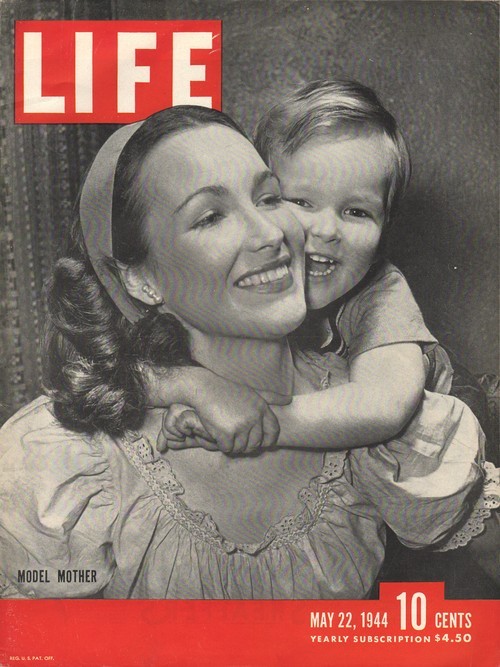
Occasionally, the façade cracked. Consider, for example, the May 22, 1944 issue of Life
Magazine (the leading US photojournalism periodical). The typical
American man or woman settling in for a spell of leisure reading found
on its cover a heartwarming tale of professional success and
domesticity.
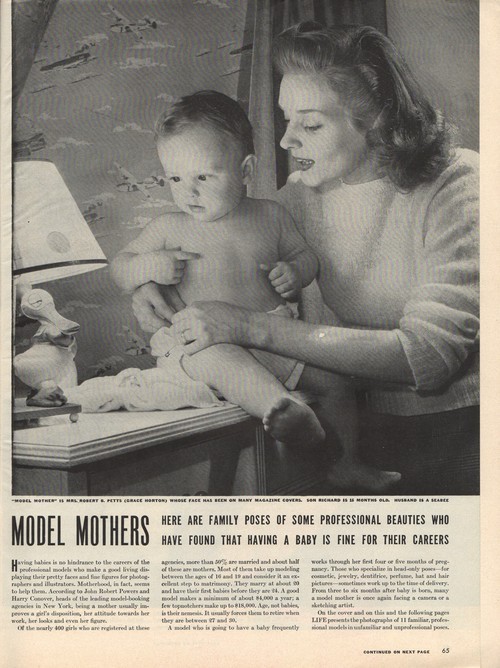
As the title story on page 65 explained, photogenic young women were
finding no contradiction–and indeed, many rewards–in combining
motherhood with modeling. (This was apparently the 1940s privileged
version of “having it all.”).
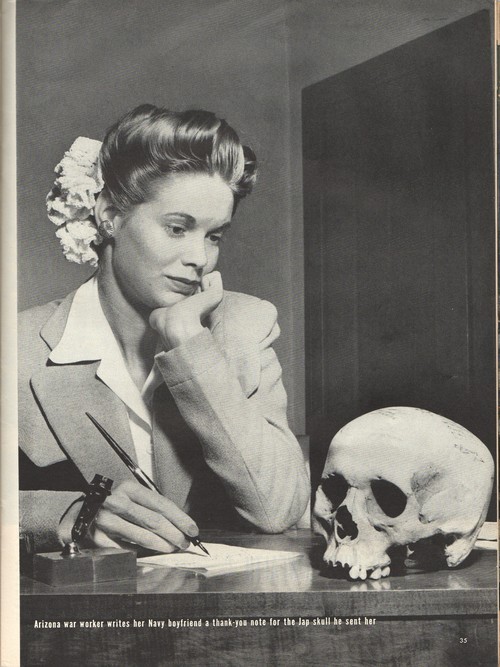
If that reader passed too quickly over page 35, he or she might have
been forgiven for assuming it was part of the title story. It, too,
featured a photograph of a similarly attractive young woman. It’s just
that, rather than holding her baby, she happens to be holding a pen
while contemplating a human skull. The homemaker as Hamlet–but evidently
without the self-scrutiny.
When he said goodby two years ago to Natalie Nickerson, 20, a war
worker of Phoenix, Ariz., a big handsome Navy lieutenant promised her a
Jap. Last week Natalie received a human skull, autographed by her
lieutenant and 13 friends. and inscribed: ‘This is a good Jap–a dead one
picked up on the New Guinea beach.’ Natalie, surprised at the gift,
named it Tojo. The armed forces disapprove strongly of this sort of
thing.
As John Dower wrote in his War Without Mercy: Race and Power in the Pacific War (1987), “Life
treated it as a human-interest story, while Japanese propagandists gave
it wide publicity as a revelation of the American national character.”
(65) It was the more ironic given that American propagandists made much
of the sixteenth-century Japanese Hideyoshi’s “ear mound” of 40,000
pickled noses and ears in the wake of war with Korea. (20, 28, 65) As
Dower says, Japanese atrocities accounted for some of the behavior of
the US forces, though not all. In his words:
On the Allied side, some forms of battlefield degeneracy were in
fact fairly well publicized while the war was going on. This was
especially true of the practice of collecting grisly battlefield
trophies from the Japanese dead or near dead, in the form of gold teeth,
ears, bones, scalps, and skulls… . [64]
Despite the attention given in Allied propaganda to Hideyoshi’s
three-and-a-half-century-old ear mound, in the current war in Asia it
was Allied combatants who collected ears. Like collecting gold teeth,
this practice was no secret. “The other night,” read an account in the
Marine monthly Leatherneck in 1943, “Stanley emptied his pockets
of 'souvenirs’–eleven ears from dead Japs. It was not as disgusting, as
it would be from a civilian point of view. None of us could get
emotional over it.” Even as battle-hardened veterans were assuming that
civilians would be shocked by such acts, however, the press in the
United States contained evidence to the contrary. In April 1943, the Baltimore Sun
ran a story about a local mother who had petitioned authorities to
permit her son to mail her an ear she had cut off a Japanese soldier in
the South Pacific. She wished to nail it to her front door for all to
see. On the very same day, the Detroit Free Press deemed
newsworthy the story of an underage youth who had enlisted and 'bribed’
his chaplain not to disclose his age by promising him the third pair of
ears he collected. [65]
Dower goes on to say that “Scalps, bones, and skulls were somewhat
rarer trophies, but the latter two achieved special notoriety in both
the United States and Japan” in two cases: first, when a soldier sent
FDR a letter opener made from Japanese bones (the President rejected the
gift), and the second, the aforementioned picture in Life. As Dower further explains:
Most combatants did not engage in such souvenir hunting, and Leatherneck
itself published a cartoon which expressed contempt and pity for all
scavengers of the dead. At the same time, most fighting men had personal
knowledge of such practices and accepted them as inevitable under the
circumstances. It is virtually inconceivable, however, that teeth, ears,
and skulls could have been collected from German or Italian war dead
and publicized in the Anglo-American countries without provoking an
uproar; and in this we have yet another inkling of the racial dimensions
of the war. [66]
War is still hell, but at least this is a circle that we visit less frequently.
Among the first little historical curiosities that I collected as a
high school student was a group of World War II Associated Press
Wirephotos found among the random stuff in the bins of a Wisconsin antiques store. (I seem to recall that there were other subjects and I simply picked out
the few wartime shots as most suited to my interests and budget.)
Accustomed
as we now are to being able to receive the news in live time,
most of us have no idea what the classic AP "Wirephoto" service was: how
it functioned , and how it revolutionized journalism by transmitting
images
with unprecedented speed, thus enabling them to become news in their own
right.
As this retrospective nicely explains, a transmitter, equipped with a sort of early optical scanner, converted a
photo to electrical signals, sent via "10,000 miles of leased telephone lines –
the wires," to a receiver, where they were "converted
back into
light, which was then recorded onto the negative, reproducing the
original image." (The "Wirephoto" still exists, but in digital form since 1989.)
The battle for Okinawa was one of the greatest land and sea engagements of the war, as well as one of the fiercest, lasting for three months, from 23 March to 23 June 1945. US deaths were at least 12,520 killed in action, while estimates of Japanese losses range from around 77,000 to 110,000. Above and beyond that, anywhere from 42,000-150,000 Okinawan residents (out of a total of some 435,000) perished. Total deaths thus arguably exceed the combined toll of Hiroshima and Nagasaki.
The heavy losses on both sides are generally said to have played a role in the US decision to use the atomic bomb in hopes of avoiding an even bloodier invasion of the Japanese home islands. Of particular concern to the Americans were the mass suicides of Okinawan civilians: on the one hand, natural cause for humanitarian empathy, on the other, presumed proof of Japanese "fanaticism" and the resistance they could expect in "Operation Downfall."
This photo remains one of the most moving pieces of World War II memorabilia in my small and eclectic collection.
CHILD RESCUED FROM MASS SUICIDE-- A SMALL CHILD, RESCUED BY TROOPS OF THE U.S. 77TH INFANTRY
CHILD RESCUED FROM MASS SUICIDE... A small child,
rescued by troops of the U.S. 77th Infantry Div. who braved Jap
machine gun fire to frustrate an attempted mass suicide on
Tokashiki Shima in the opening stages of the battle for
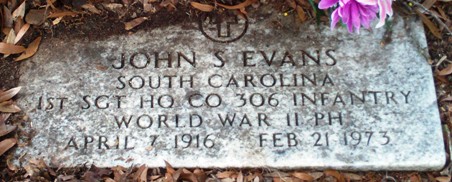
Okinawa. ( Nestled in the arms of 1st/Sgt. John S.Evens [sic],
of Springfield, S.C.)
The child appears placid, yet questioning, cautious, The unshaven soldier appears gentle but fatigued. That he does not look directly into the camera allows us to speculate: presumably he is not indifferent, and rather, weary, contemplating what he has experienced. The eyes have that familiar wartime look of having seen too much. Yet we know that on April 4, the land battle had gone on for only 4 days, whereas 80 more remained.
The mass suicides remain controversial to this day. Some civilians evidently killed themselves because they believed atrocity stories about the Americans that the authorities told them, but in other cases, the Japanese military forced civilians to commit suicide (e.g. 1, 2, 3). Either way, the Imperial Japanese government and military bore the responsibility, but as in other cases of wartime atrocities, conservative forces in contemporary Japan have attempted to erase or rewrite the history. (It is hard to imagine what is more painful to an elderly man: the memory of having beaten his mother, brother, and sister to death because he believed the propaganda--or that the textbooks suddenly portray this as a voluntary act, committed in a vacuum.)
Reviewing a book of Japanese testimony about the civilian experience on Okinawa (2014), Jonathan Mirsky explains that he has gone from childhood belief in the conventional US narrative to acceptance of the view of "liberal and leftist Americans: that the reasons given for dropping the bombs—among them, above all, that the Japanese would never surrender unless pulverized—were self-serving and false." But "Because of this new book I am thinking again." He concludes:
In early 1945, the Japanese prime minister had recommended that the war be brought to an end, but as Ealey and McLauchlin [the editors of the volume under review] write, Hirohito believed that one last military success “would force the United States and its allies to offer peace terms that would allow Japan to maintain its national polity, which of course hinged on the status and institution of the emperor.“ Had the prime minister’s advice been followed, they observe, “there may never have been a Battle of Okinawa, or atomic bombs dropped on Hiroshima or Nagasaki.” Indeed. General Douglas MacArthur urged that the emperor’s status be preserved, and there is a memorable photograph of the two recent adversaries standing side by side in Tokyo not long after the war ended. Hirohito’s descendants have remained on the throne to this day. What we learn from this profoundly disturbing and enlightening book is that tens of thousands of misled Okinawans died for nothing.
This photo is a reminder. It continues to haunt me.
Resources
Roy E. Appleman, James M. Burns, Russell A.
Gugeler, and John Stevens Okinawa: The Last Battle (Washington, DC:
Center of Military History United States Army, 1948)
Among the first little historical curiosities that I collected as a
high school student was a group of World War II Associated Press
Wirephotos found among the random stuff in the bins of a Wisconsin antiques store. (I seem to recall that there were other subjects and I simply picked out the few wartime shots as most suited to my interests and budget.)
Accustomed
as we now are to being able to receive the news in live time,
most of us have no idea what the classic AP "Wirephoto" service was: how it functioned , and how it revolutionized journalism by transmitting images
with unprecedented speed, thus enabling them to become news in their own
right.
As this retrospective nicely explains, a transmitter, equipped with a sort of early optical scanner, converted a
photo to electrical signals, sent via "10,000 miles of leased telephone lines –
the wires," to a receiver, where they were "converted
back into
light, which was then recorded onto the negative, reproducing the
original image." (The "Wirephoto" still exists, but in digital form since 1989.)
World
War II, understandably enough, greatly increased the demand for
photographic reportage, and the US Army Signal Corps developed its own radiophoto system. This Wirephoto depicts a US security checkpoint on the eve of the Potsdam Conference.
MPs CHECK VEHICLES IN CONFERENCE AREA--MILITARY POLICE OF THE 713TH
MP BATTALION CHECK VEHICLES AND PERSONNEL AT A ROAD BARRIER IN THE
AMERICAN COMPOUND OF THE POTSDAM CONFERENCE AREA, JULY 15. (AP WIREPHOTO FROM SIGNAL CORPS RADIOPHOTO FROM PARIS)
The
meeting (July 17- August 2, 1945) is of course best known for mandating the shared occupation and
denazification of recently defeated Germany, as well as endorsing the
redrawing of the Soviet-Polish-German borders and, more controversially,
permitting the expulsion of ethnic Germans from the former occupied
territories of Central Europe.
But the Conference also had a bearing on the war in the Pacific and the dropping of the atomic bomb, treated in a recent post. The official declaration
demanded unconditional surrender of Japan, lest she suffer "the
inevitable and complete destruction of the Japanese armed forces and
just as inevitably the utter devastation of the Japanese homeland."
There was no mention of the atomic bomb, as such (tested in secret just as the conference began), but it did figure in a now-famous conversation between Truman and Stalin.
During the second week of Allied
deliberations
at Potsdam, on the evening of July 24, 1945, Truman approached Stalin
without an
interpreter and, as casually as he could, told him that the United
States had a
"new weapon of unusual destructive force." Stalin showed little
interest, replying only that he hoped the United States would make
"good
use of it against the Japanese." The reason for Stalin's
composure became clear
later: Soviet intelligence had been
receiving
informationabout the atomic bomb program since fall
1941.