Showing posts with label Hiroshima & Nagasaki. Show all posts

Tuesday, August 25, 2015

August 2002: Julia Child's Kitchen Becomes Historical. And stray thoughts on the period room (not necessarily in that order)

Traditional "period rooms," once a staple feature of the museum of history or fine arts, fell into disrepute in recent years for a variety of reasons. As one curator puts it, they often incoherently (re)presented "decorative arts displays" or "local history" or "confusing combinations of both approaches." Still, there is certainly a value to preserving the individually significant interior as well as the exemplary collection for the study of material culture in general.

In its original incarnation as the spanking new but architecturally retrograde Museum of History and Technology (1964), the National Museum of American History (as it is now known) still featured old-fashioned period rooms (e.g. for showing off the dresses of First Ladies), considered at the time "a certain crowd-puller."


"history happens in parlors and kitchens as well as in the halls of Congress"

Still, this is not to say that everything was choked in conceptual cobwebs. My favorite example: in 1963, activists saved an 18th-century Ipswich, Massachusetts, house from demolition literally at the last moment by arranging to have the Smithsonian acquire it. So, instead of yet another Colonial period room, we have an entire home (the largest--some say: greatest--artifact in the collection) which tells the story of both structure and inhabitants from its origins to its abandonment. As the Smithsonian puts it, "The five families whose stories are told here were not famous, but they remind us that history happens in parlors and kitchens as well as in the halls of Congress." In the most recent interpretation (2002), portions of the walls have been opened up to reveal the timber-frame structure, thus doing justice to the original focus on the evolution of technology.


The Museum continues to think innovatively in its acquisition and interpretation practices regarding historic interiors and objects. To be sure, you can still find such things as a 17th-century chair-table (nothing wrong with that!)--but also Archie and Edith Bunker's chairs, from the TV series, "All in the Familly"--which a curator boldly calls "the equivalent of the "Appomattox chairs" used by Grant and Lee when the Confederacy surrendered.

Equally interesting are the larger interior ensembles. For me, one of the most memorable and moving is the famed Greensboro desegregation lunch counter. As of 2008, it is also part of a new series of "landmark objects" anchoring and highlighting the themes of a given wing.


One kitchen that made history

As the Smithsonian says of the Ipswich House, "history happens in parlors and kitchens as well as in the halls of Congress." And so, it seemed but fitting that at least a portion of another Massachusetts house should enter those galleries. It didn't make the cut as a "landmark object," it didn't date back to the 18th century, and it didn't play a role in the triumph of human rights, but it did change America in its own way, from foodways to women's history, and it has proven extremely popular. I am speaking of Julia Child's kitchen.

It opened at the Smithsonian on August 19, 2002, only shortly after the updated installation of the Choate House from Ipswich. When Julia Child (1912-2004) decided to relocate from Cambridge, Massachusetts to her native California at the end of her public career, she gave her kitchen to the Smithsonian.

"A Place for Everything"

"While kitchens of the 1950s and 1960s were often designed to keep everything hidden from view, Julia and Paul preferred to hang their pots and pans on a pegboard for quick and easy access. Nor would there be any confusion about where that pan belonged after it had been used, thanks to the outlines Paul traced on the pegboard. Later, for the benefit of student and guest cooks working in the kitchen with Julia, snapshots were added." (Smithsonian)
"Work zones"

"Julia organized her kitchen around work zones, making sure tools and equipment were placed near the surfaces where they would be used. Her pots, pans, and utensils are near the stove, her knives are near the sink, and her small appliances are set on solid work surfaces, ready to use." (Smithsonian)

As Mass Moments puts it:
Designed by her husband Paul in 1961, the room was specially tailored to his wife's particular needs, with high countertops to accommodate her six-foot two-inch frame. In her ten cookbooks and eight television programs, several of which were filmed in her own kitchen, Julia Child demystified French cooking for American audiences. She became, in the words of the New York Times, "the French chef for a Jello nation." The exhibit is titled "Bon Appétit!" — as she signed off at the end of every show she hosted during her 38 years as a television icon.
Viewers of the film, "Julie and Julia" (the former was a whining Amherst College graduate: nuff said) will be familiar with the backstory behind the first great cookbook, but just in case, Mass Moments explains:
She fell in love with French food and enrolled in the prestigious Cordon Bleu culinary school. In 1952 she and two Frenchwomen formed a cooking school and began writing a French cookbook for American readers.

In 1956 the Childs returned to the U.S. and settled in Cambridge, Massachusetts. Julia Child continued work on the book, communicating frequently with her French partners. When Mastering the Art of French Cooking was published in 1961, with 734 pages of detailed but unintimidating recipes, it was a critical and popular success. In an era when American "cuisine" consisted of cake mixes, TV dinners, and health food crazes, the book made sophisticated French food not only appealing but accessible. Child ignored fads, and Americans embraced her "cuisine soignée: long, caring cooking."

My mother was a good cook, but by no means a gourmet. Still, Julia Child's first great book was one of the main cookbooks in our kitchen. I believe it was a present from my father.

When I learned to cook (mostly while I was a grad student: it seemed preferable to bankruptcy or starvation), I bought myself a copy, too. (Later, my mother gave me more recent Julia Child books as presents.)


The original installation, pictured above, closed in early 2012 and, to mark the centennial of Child's birth, was reinterpreted later that year as the focus of a new exhibition, "FOOD: Transforming the American Table 1950-2000."

It seems fitting: just as the Choate house chronicled the lives and material culture of ordinary people "who were not famous," so, too, her kitchen helps to chronicle the transformation of the way that all of us eat and think about food.  There is more than one way for history to happen in the kitchen.

Bon appétit.


Footnote:

Local connection: The pioneering chef was a graduate of Smith College (history major, I am proud to say), which celebrates a Julia Child Day. In fact, I recall meals at the former Faculty Club where we were served a special "Julia Child" label house wine.

Resources

Bon Appétit! Julia Child's Kitchen at the Smithsonian
10 Crucial Facts About the Julia Child's Kitchen Exhibit, Reopening Tomorrow, Washington Eater staff, 14 August 2012 (includes video of the conservation and reinstallation process)

[updated 26 August; full piece did not post the first time]

Thursday, August 20, 2015

‘This is a good Jap–a dead one" - "The armed forces disapprove strongly of this sort of thing."

Lest one conclude, from recent posts, that the emphasis here should be exclusively on Japanese atrocities and fanaticism: on the contrary. The intensity of the animosities and combat also elicited behaviors from US forces that we nowadays find hard to contemplate.

For example, the previous post dealt with the rescue of civilians--including a child--from mass suicide attempts that the Japanese military either encouraged or compelled. But as combat dragged on and intensified, US forces became less cautious in the application of force. The Wikipedia entry for the battle of Okinawa--a site from which a great many Americans will presumably get their information--cites this recollection by a soldier:
There was some return fire from a few of the houses, but the others were probably occupied by civilians – and we didn't care. It was a terrible thing not to distinguish between the enemy and women and children. Americans always had great compassion, especially for children. Now we fired indiscriminately.
Earlier this year, I noted here a piece posted on the tumblr about one of the most notorious images of US World War II photojournalism. Because we are now marking the anniversary of the atomic bomb and the end of the Pacific War, I'll reproduce it here:

The Bloodiest Battlefield Mementos: Even the “Good War” Had Its Bad Side


Although all war is terrible and we may recoil at the scenes that we see on our televisions and computer screens, the shock is the result of both greater moral sensitivity and continual and less inhibited flow of information (including that from nongovernmental and nonprofessional sources). As I noted in the previous post, we therefore find it all the more difficult to imagine the wars of the past, which were often both more bloody and less explicitly reported.
Even during World War II–the so-called “Good War”–US troops at times engaged in behavior that would by our standards (or even those of that day) be considered barbaric.
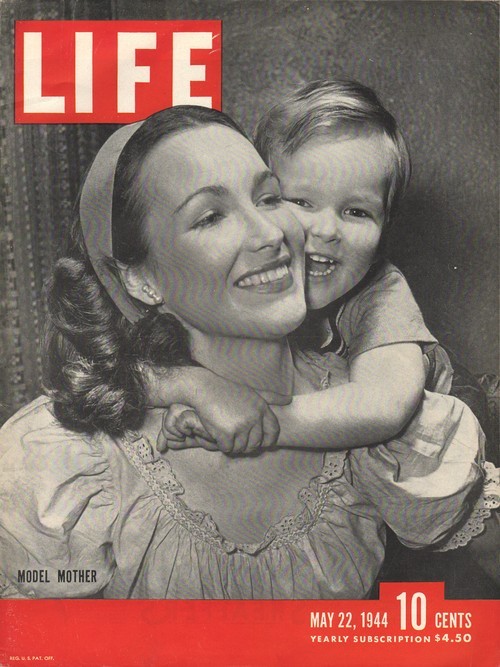
Occasionally, the façade cracked. Consider, for example, the May 22, 1944 issue of Life Magazine (the leading US photojournalism periodical). The typical American man or woman settling in for a spell of leisure reading found on its cover a heartwarming tale of professional success and domesticity.

image 

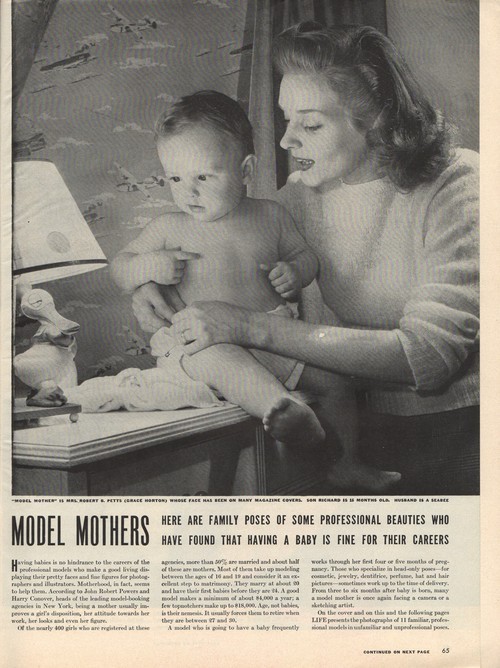
As the title story on page 65 explained, photogenic young women were finding no contradiction–and indeed, many rewards–in combining motherhood with modeling. (This was apparently the 1940s privileged version of “having it all.”).

image 
 [enlarge]

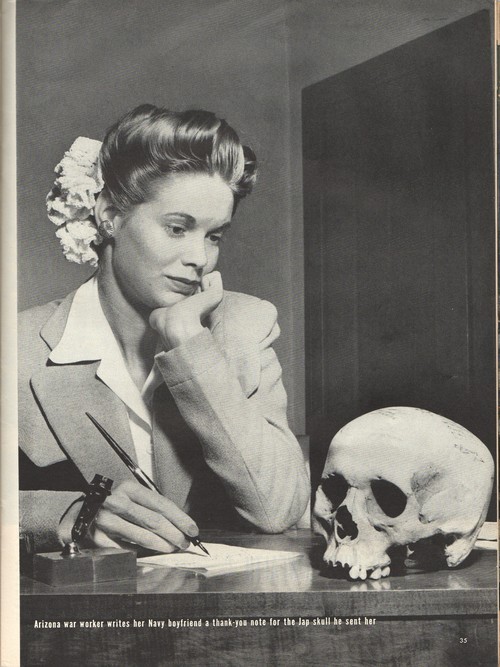
If that reader passed too quickly over page 35, he or she might have been forgiven for assuming it was part of the title story. It, too, featured a photograph of a similarly attractive young woman. It’s just that, rather than holding her baby, she happens to be holding a pen while contemplating a human skull. The homemaker as Hamlet–but evidently without the self-scrutiny.

image 
 [enlarge]


The caption of this “Picture of the Week” read:
When he said goodby two years ago to Natalie Nickerson, 20, a war worker of Phoenix, Ariz., a big handsome Navy lieutenant promised her a Jap. Last week Natalie received a human skull, autographed by her lieutenant and 13 friends. and inscribed: ‘This is a good Jap–a dead one picked up on the New Guinea beach.’ Natalie, surprised at the gift, named it Tojo. The armed forces disapprove strongly of this sort of thing.
As John Dower wrote in his War Without Mercy: Race and Power in the Pacific War (1987), “Life treated it as a human-interest story, while Japanese propagandists gave it wide publicity as a revelation of the American national character.” (65) It was the more ironic given that American propagandists made much of the sixteenth-century Japanese Hideyoshi’s “ear mound” of 40,000 pickled noses and ears in the wake of war with Korea. (20, 28, 65) As Dower says, Japanese atrocities accounted for some of the behavior of the US forces, though not all. In his words:
     On the Allied side, some forms of battlefield degeneracy were in fact fairly well publicized while the war was going on. This was especially true of the practice of collecting grisly battlefield trophies from the Japanese dead or near dead, in the form of gold teeth, ears, bones, scalps, and skulls… . [64]
  Despite the attention given in Allied propaganda to Hideyoshi’s three-and-a-half-century-old ear mound, in the current war in Asia it was Allied combatants who collected ears. Like collecting gold teeth, this practice was no secret. “The other night,” read an account in the Marine monthly Leatherneck in 1943, “Stanley emptied his pockets of 'souvenirs’–eleven ears from dead Japs. It was not as disgusting, as it would be from a civilian point of view. None of us could get emotional over it.” Even as battle-hardened veterans were assuming that civilians would be shocked by such acts, however, the press in the United States contained evidence to the contrary. In April 1943, the Baltimore Sun ran a story about a local mother who had petitioned authorities to permit her son to mail her an ear she had cut off a Japanese soldier in the South Pacific. She wished to nail it to her front door for all to see. On the very same day, the Detroit Free Press deemed newsworthy the story of an underage youth who had enlisted and 'bribed’ his chaplain not to disclose his age by promising him the third pair of ears he collected. [65]
Dower goes on to say that “Scalps, bones, and skulls were somewhat rarer trophies, but the latter two achieved special notoriety in both the United States and Japan” in two cases: first, when a soldier sent FDR a letter opener made from Japanese bones (the President rejected the gift), and the second, the aforementioned picture in Life. As Dower further explains:
     Most combatants did not engage in such souvenir hunting, and Leatherneck itself published a cartoon which expressed contempt and pity for all scavengers of the dead. At the same time, most fighting men had personal knowledge of such practices and accepted them as inevitable under the circumstances. It is virtually inconceivable, however, that teeth, ears, and skulls could have been collected from German or Italian war dead and publicized in the Anglo-American countries without provoking an uproar; and in this we have yet another inkling of the racial dimensions of the war. [66]
War is still hell, but at least this is a circle that we visit less frequently.

Monday, August 17, 2015

Background to Hiroshima and V-J Day: Death and Life on Okinawa, AP Wirephoto

Among the first little historical curiosities that I collected as a high school student was a group of World War II Associated Press Wirephotos found among the random stuff in the bins of a Wisconsin antiques store. (I seem to recall that there were other subjects and I simply picked out the few wartime shots as most suited to my interests and budget.)

Accustomed as we now are to being able to receive the news in live time, most of us have no idea what the classic AP "Wirephoto" service was: how it functioned , and how it revolutionized journalism by transmitting images with unprecedented speed, thus enabling them to become news in their own right.

As this retrospective nicely explains, a transmitter, equipped with a sort of early optical scanner, converted a photo to electrical signals, sent via "10,000 miles of leased telephone lines – the wires," to a receiver, where they were "converted back into light, which was then recorded onto the negative, reproducing the original image." (The "Wirephoto" still exists, but in digital form since 1989.)


World War II, understandably enough, greatly increased the demand for photographic reportage, and the US Army Signal Corps developed its own radiophoto service, a matter of particular importance and difficulty in the Pacific theater.

The battle for Okinawa was one of the greatest land and sea engagements of the war, as well as one of the fiercest, lasting for three months, from 23 March to 23 June 1945. US deaths were at least 12,520 killed in action, while estimates of Japanese losses range from around 77,000 to 110,000. Above and beyond that, anywhere from 42,000-150,000 Okinawan residents (out of a total of some 435,000) perished. Total deaths thus arguably exceed the combined toll of Hiroshima and Nagasaki.

The heavy losses on both sides are generally said to have played a role in the US decision to use the atomic bomb in hopes of avoiding an even bloodier invasion of the Japanese home islands. Of particular concern to the Americans were the mass suicides of Okinawan civilians: on the one hand, natural cause for humanitarian empathy, on the other, presumed proof of Japanese "fanaticism" and the resistance they could expect in "Operation Downfall."

This photo remains one of the most moving pieces of World War II memorabilia in my small and eclectic collection.

 enlarge
CHILD RESCUED FROM MASS SUICIDE--
A SMALL CHILD, RESCUED BY TROOPS OF THE U.S. 77TH INFANTRY

The appended fuller description reads:
CHILD RESCUED FROM MASS SUICIDE... A small child,
rescued by troops of the U.S. 77th Infantry Div. who braved Jap
machine gun fire to frustrate an attempted mass suicide on
Tokashiki Shima in the opening stages of the battle for
Okinawa. ( Nestled in the arms of 1st/Sgt. John S.Evens [sic],
of Springfield, S.C.)
The child appears placid, yet questioning, cautious, The unshaven soldier appears gentle but fatigued. That he does not look directly into the camera allows us to speculate: presumably he is not indifferent, and rather, weary, contemplating what he has experienced. The eyes have that familiar wartime look of having seen too much. Yet we know that on April 4, the land battle had gone on for only 4 days, whereas 80 more remained.

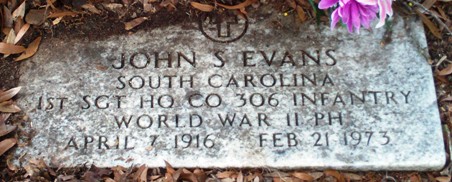
We also know that Sgt. Evans of the 306th Regiment survived the war. Apparently, he died in 1973 and was buried in his home town.


Famed war correspondent Ernie Pyle was not as fortunate: he was killed by machine gun fire while at the front with the 77th on April 18.


The mass suicides remain controversial to this day. Some civilians evidently killed themselves because they believed atrocity stories about the Americans that the authorities told them, but in other cases, the Japanese military forced civilians to commit suicide (e.g. 1, 2, 3). Either way, the Imperial Japanese government and military bore the responsibility, but as in other cases of wartime atrocities, conservative forces in contemporary Japan have attempted to erase or rewrite the history. (It is hard to imagine what is more painful to an elderly man: the memory of having beaten his mother, brother, and sister to death because he believed the propaganda--or that the textbooks suddenly portray this as a voluntary act, committed in a vacuum.)

Reviewing a book of Japanese testimony about the civilian experience on Okinawa (2014), Jonathan Mirsky explains that he has gone from childhood belief in the conventional US narrative to acceptance of the view of "liberal and leftist Americans: that the reasons given for dropping the bombs—among them, above all, that the Japanese would never surrender unless pulverized—were self-serving and false." But "Because of this new book I am thinking again."  He concludes:

In early 1945, the Japanese prime minister had recommended that the war be brought to an end, but as Ealey and McLauchlin [the editors of the volume under review] write, Hirohito believed that one last military success “would force the United States and its allies to offer peace terms that would allow Japan to maintain its national polity, which of course hinged on the status and institution of the emperor.“ Had the prime minister’s advice been followed, they observe, “there may never have been a Battle of Okinawa, or atomic bombs dropped on Hiroshima or Nagasaki.” Indeed. General Douglas MacArthur urged that the emperor’s status be preserved, and there is a memorable photograph of the two recent adversaries standing side by side in Tokyo not long after the war ended. Hirohito’s descendants have remained on the throne to this day. What we learn from this profoundly disturbing and enlightening book is that tens of thousands of misled Okinawans died for nothing. 
This photo is a reminder. It continues to haunt me.


Resources 

Roy E. Appleman, James M. Burns, Russell A. Gugeler, and John Stevens Okinawa: The Last Battle (Washington, DC: Center of Military History United States Army, 1948)


Previous Wirephoto: Potsdam Conference

Sunday, August 16, 2015

Background to Hiroshima and V-J Day: Potsdam Conference, AP Wirephoto

Among the first little historical curiosities that I collected as a high school student was a group of World War II Associated Press Wirephotos found among the random stuff in the bins of a Wisconsin antiques store. (I seem to recall that there were other subjects and I simply picked out the few wartime shots as most suited to my interests and budget.)

Accustomed as we now are to being able to receive the news in live time, most of us have no idea what the classic AP "Wirephoto" service was: how it functioned , and how it revolutionized journalism by transmitting images with unprecedented speed, thus enabling them to become news in their own right.

As this retrospective nicely explains, a transmitter, equipped with a sort of early optical scanner, converted a photo to electrical signals, sent via "10,000 miles of leased telephone lines – the wires," to a receiver, where they were "converted back into light, which was then recorded onto the negative, reproducing the original image." (The "Wirephoto" still exists, but in digital form since 1989.)


World War II, understandably enough, greatly increased the demand for photographic reportage, and the US Army Signal Corps developed its own radiophoto system. This Wirephoto depicts a US security checkpoint on the eve of the Potsdam Conference.

MPs CHECK VEHICLES IN CONFERENCE AREA--MILITARY POLICE OF THE 713TH MP BATTALION CHECK VEHICLES AND PERSONNEL AT A ROAD BARRIER IN THE AMERICAN COMPOUND OF THE POTSDAM CONFERENCE AREA, JULY 15. (AP WIREPHOTO FROM SIGNAL CORPS RADIOPHOTO FROM PARIS)

The 713th Military Police Battalion was responsible for security in the US sector of nearby Berlin. The Signal Corps radiophoto above features in Robert L. Gunnarsson's history of American Military Police in Europe.

The meeting (July 17- August 2, 1945) is of course best known for mandating the shared occupation and denazification of recently defeated Germany, as well as endorsing the redrawing of the Soviet-Polish-German borders and, more controversially, permitting the expulsion of ethnic Germans from the former occupied territories of Central Europe.

But the Conference also had a bearing on the war in the Pacific and the dropping of the atomic bomb, treated in a recent post. The official declaration demanded unconditional surrender of Japan, lest she suffer "the inevitable and complete destruction of the Japanese armed forces and just as inevitably the utter devastation of the Japanese homeland." There was no mention of the atomic bomb, as such (tested in secret just as the conference began), but it did figure in a now-famous conversation between Truman and Stalin.

As the US Department of Energy aptly summarizes:
During the second week of Allied deliberations at Potsdam, on the evening of July 24, 1945, Truman approached Stalin without an interpreter and, as casually as he could, told him that the United States had a "new weapon of unusual destructive force."  Stalin showed little interest, replying only that he hoped the United States would make "good use of it against the Japanese."  The reason for Stalin's composure became clear later: Soviet intelligence had been receiving information about the atomic bomb program since fall 1941.
The nuclear arms race was already beginning.


Next Wirephoto:  Okinawa

V-J Day or VFE Day? August 10 or August 15?

In the previous post, I described how my parents learned about the atomic bomb and victory over Japan.

In the course of writing up that story, I was reminded that the things we take for granted were sometimes more complicated and interesting.

Two examples: I mentioned that my father's diary recorded "VFE celebrations"--that is, victory celebrations--already on August 10, 1945. As noted there, this was the date on which the Japanese government in fact offered to surrender, but it took several more days for the US to decide that acceding to the Japanese request to leave Emperor in place was compatible with the Allied demand for unconditional surrender. The official decision to surrender was not announced until August 14 (15), and the actual surrender ceremony took place only on September 2, aboard the battleship "Missouri" in Tokyo Bay

And VFE? People alive at the time will never forget "V-E" and "V-J" Day: Victory in Europe and Victory Over Japan. These are the terms by which historians, too, know those momentous occasions. In fact, however, the terminology for the latter was not set, at least in the United Kingdom.

An Australian paper that I came across in my research (thanks to "Trove," the outstanding digital newspaper collection of the National Library of Australia), nicely tells the story of both the anticipatory celebration and the name. The Advertiser of Adelaide reported on August 11:

CHEERING CROWD IN LONDON

Gaiety in Piccadilly Circus

Australian Associated Press And Our Special Representative 
LONDON, August 10.

Although more cautious Londoners telephoned to newspaper offices asking whether the reported Japanese surrender was correct, the mass of civilians and members of the services, especially Americans, did not wait for confirmation, but began celebrations.

Piccadilly Circus and nearby streets soon became packed with cheering revelers strewing paper and streamers and flying flags. Office windows opened up all over London, and torn-up paper began to flutter down. Many a card index system was torn up and flung out into the streets.


Before long, groups of servicemen and civilians carrying the flags of the United Nations were marching up and down, cheering and singing. The crowd looked at them happily, and cheered, too. Two Chinese officers were picked up and carried shoulder high through Piccadilly. Someone called for three cheers for China, and Piccadilly rang with the applause.

American sailors joined in the celebrations, dancing up and down and shouting, "We're going home! We're going home!" American sailors made "whoopee." They climbed the boardings hiding the site of the statue of Eros and drank bottles of beer in the streets. Traffic was slowed down to a crawl. Oxford street was similarly crowded and strewn with paper almost throughout its length.

Victory sirens and hooters and railway whistles shrieked from the blitzed eastern London dockside. . All the afternoon long flags fluttered to the mastheads and over the roofs of the metropolis, with the Hammer and Sickle renewing its pride of place alongside the Union Jack and the Stars and Stripes.

Most workers later quietly went back to their offices. Holiday makers returned to the pubs to discuss atom bombs. Only in Piccadilly Circus and a few centres frequented by US and Australian servicemen did the celebrations continue.

Jubilation was shown by the staff of Australia House, who bestrewed the streets beside their building with papers. One of the officials said:—"Most Australians here are thinking of the 18.000 Australian war prisoners, and of the strain which their country has gone through during the period in which it was directly menaced for the first time in its history."
And as for the name:
Preparations have already been made for celebrating the end of the Pacific War. although it has not yet been decided how the occasion will be designated.
Titles so far suggested are VFE (Victory Far East) Day and VJ (Victory Against Japan) Day. It is expected that official celebrations will include two and possibly three days' public holiday, except for public utilities; broadcasts by His Majesty the King; and Mr. Attlee thanking Britain, the Empire and the United Nations for their efforts; the Queen will broadcast to the women of the world, and Princess Elizabeth will broadcast to the children of the world. There will be a Victory March In London in which troops of the Red Army will possibly take part. Public buildings will be decorated and floodlit and church bells will be rung throughout the country. Parliament's plans will be kept fluid.
August 10 vs. August 15? VFE Day vs. V-J Day? All minor historical points, but points of entry into the past, and among the small instructive pleasures of research.

Saturday, August 15, 2015

How My Parents Learned About the Atomic Bomb

If it's early August, it must be time for the obligatory reflection on the dropping of the atomic bomb, a doubly topical subject this year, given that we mark the 70th anniversary even as we debate the efficacy of the recently concluded agreement to control the Iranian nuclear program.

And so, columnists return to the eternal questions: Was the use of the "The Bomb" necessary? Could the US not have demonstrated it first? Was it racism that prompted the US to use the bomb against Japan? Or, did the US really drop it in order to overawe the Soviets in the incipient Cold War? (Okay, in the current debased intellectual climate, that latter issue has pretty much dropped out of a picture oversimplified by both the know-nothing right and the identity-fixated left.) And so on and so on and so forth, covering all the topics that we rehearsed and rehashed in grad school.


The classic argument and the counterargument

The classic argument for the use of the bomb, of course, was that, given the tenacity with which the Japanese defended such outposts as Iwo Jima (circa 6,800 US dead) and Okinawa (circa 14,000 US dead), an invasion of Mainland Japan might have cost 250,000 US lives (estimates varied widely: from several tens of thousands to half a million or even 800,000, depending on the logic and the assumed length of the operation). Recall that the costs of the invasion of Europe were far lower: 4,413 total Allied dead on D-Day itself, and in the subsequent Battle of Normandy, 53,714. (For comparison, US dead in Operation Iraqi Freedom, 2003-10: 4,424. Vietnam War: 58,220.) On the assumption that the Japanese population as well as the military would fight ferociously to defend the homeland, US sources also predicted high civilian losses: by the top estimate, five to ten million dead. Among the counter-arguments: Japan was already beaten and knew it, but the US was not sufficiently forthcoming in recognizing this in formulating its demands for unconditional surrender--or, was simply determined to use the bomb at all costs for extrinsic reasons.

Bret Stephens of the Wall Street Journal recently summarized the classic argument, citing cultural critic Paul Fussell's 1981 essay, "Thank God for the Atom Bomb." Fussell's point was simple: as a combat infantryman, he had survived the war in Europe and seen his friends killed beside him (he dedicated his great book on World War I to one of them), only to learn that he was about to be sent to the Pacific to take part in the invasion of Japan. In his view, that of the ordinary soldier, the atomic bomb saved his life and that of thousands or millions of US and Japanese. By contrast, a distinguished historian of Japan once told me he considered the essay a dangerous piece of writing because the author made the case seem irrefutably compelling to the general reader.

(more on this stamp)

Debating Hiroshima over dessert

One of the most memorable if low-key debates about the atomic bomb that I can recall took place many years ago in a most unusual setting: dinner at the home of Japanese-American friends of my parents'. Both members of the couple had been interned in U.S. camps during the war. The father nonetheless reluctantly accepted the use of the bomb, arguing that the fascist-militarist Japanese regime would not otherwise have surrendered. The children were against it on abstract moral principle. I had always emotionally been on their side, although I understood the arguments on the other. The discussion underscored for me, as a rising history major, the role of generational experiences and perspectives--as well as evidence. In the intervening years, I've come to see more of the nuances.

It's not that I have changed my general attitude toward deliberate bombing of large civilian populations (what was accepted practice then would, thankfully, be considered a clear-cut war crime in today's climate). Rather, it is that, as a historian, I am more aware of the complexities of the historical situation. Many factors, military and other, went into the decision to use the bomb. Mentalities different from our own were at work. Stephens cites Fussell's admonition, "Understanding the past requires pretending that you don’t know the present. It requires feeling its own pressure on your pulses without any ex post facto illumination.” He continues in his own words, "Historical judgments must be made in light not only of outcomes but also of options. Would we judge Harry Truman better today if he had eschewed his nuclear option in favor of 7,000 casualties a week; that is, if he had been more considerate of the lives of the enemy than of the lives of his men?" Difficult, unanswerable questions.


So, what did people actually think back then?

How did people think about the bomb at the time? Amidst all the predictable and mostly banal or maudlin commemorative pieces (variously self-accusing or self-exculpatory--some manage to be both at once) this August, at least a few instead address this more interesting question.

Writing in The Atlantic, Paul Ham, in a piece subtitled, "How committee meetings, memos, and largely arbitrary decisions ushered in the nuclear age," reconstructs the logic behind the choice of Hiroshima as the first target. NPR touches on the same subject more briefly. Stephen Harding explains that continuing attacks by Japanese aviators after the surrender offer but before the arrival of the Japanese negotiating team nearly provoked a full-scale resumption of hostilities. The Economist simply republishes "Victory in the East" from August 18, 1945. Most of the article is concerned with the modalities of peacemaking--from a new great-power arrangement to demilitarization and reconstruction of the defeated nations--but it begins with a reflection on the bomb and its meaning:
THE war is won. Within four months of Germany's final surrender, the Japanese have laid down their arms. This is the moment for which the world has long been waiting. Now the carnage and the destruction can cease. The creative energies of mankind can be withdrawn from slaughter and battle and be devoted to the rebuilding of a decent world.

It is because this task is so vast and the implications of failure so terrifying that most  people are facing victory not only with profound relief and thankfulness, but also with a sense of uneasiness and awe. The bombs which wiped out Hiroshima and Nagasaki stopped the war. But they started something else, a new age in human history, in which the issue of peace and war is literally the issue of extermination or survival. Who can fail under those circumstances to approach the task of making peace with passionate hope and anxiety?
There is no self-flagellation, no moral hand-wringing: just a somber awareness of the task ahead in light of the implications for any future conflict. It is a useful reminder.

I don't remember my parents taking a direct part in the above dinner-table debate (after all, they were guests, and it was a sensitive intra-family discussion), so I tried to recall whether they had addressed the topic on other occasions. I had certainly learned about it at home and in school. They had a copy of John Hersey's 1946 Hiroshima on the bookshelf in the living room (an early edition, as I recall, if not a first printing), which I read in junior high or high school.

I don't recall my father saying much explicitly about the bomb: One might assume that, as a member of the military during the war, he would have been for it--but that might be to assume too much. I clearly recall critical remarks about the firebombing of Dresden, the undisciplined mass expulsions of ethnic Germans from East Central Europe, and similar wartime actions that entailed a high cost in civilian life or suffering arguably beyond the demands of justice or military necessity. (The war in Europe was, naturally, the focus of his reflections.) By contrast, my mother certainly did speak of it occasionally, noting the fears for the future she felt at the time. She also told me about the visit of the Hiroshima Maidens to the United States in the 1950s.

One always wishes that one had asked one's parents more questions while one still had the chance. But I did not. So I went back to the sources, such as they are.


A laconic wartime diary

In my father's case, I had only a little war diary. He was in London, still serving in the Polish Army but employed on the British home front at the time.


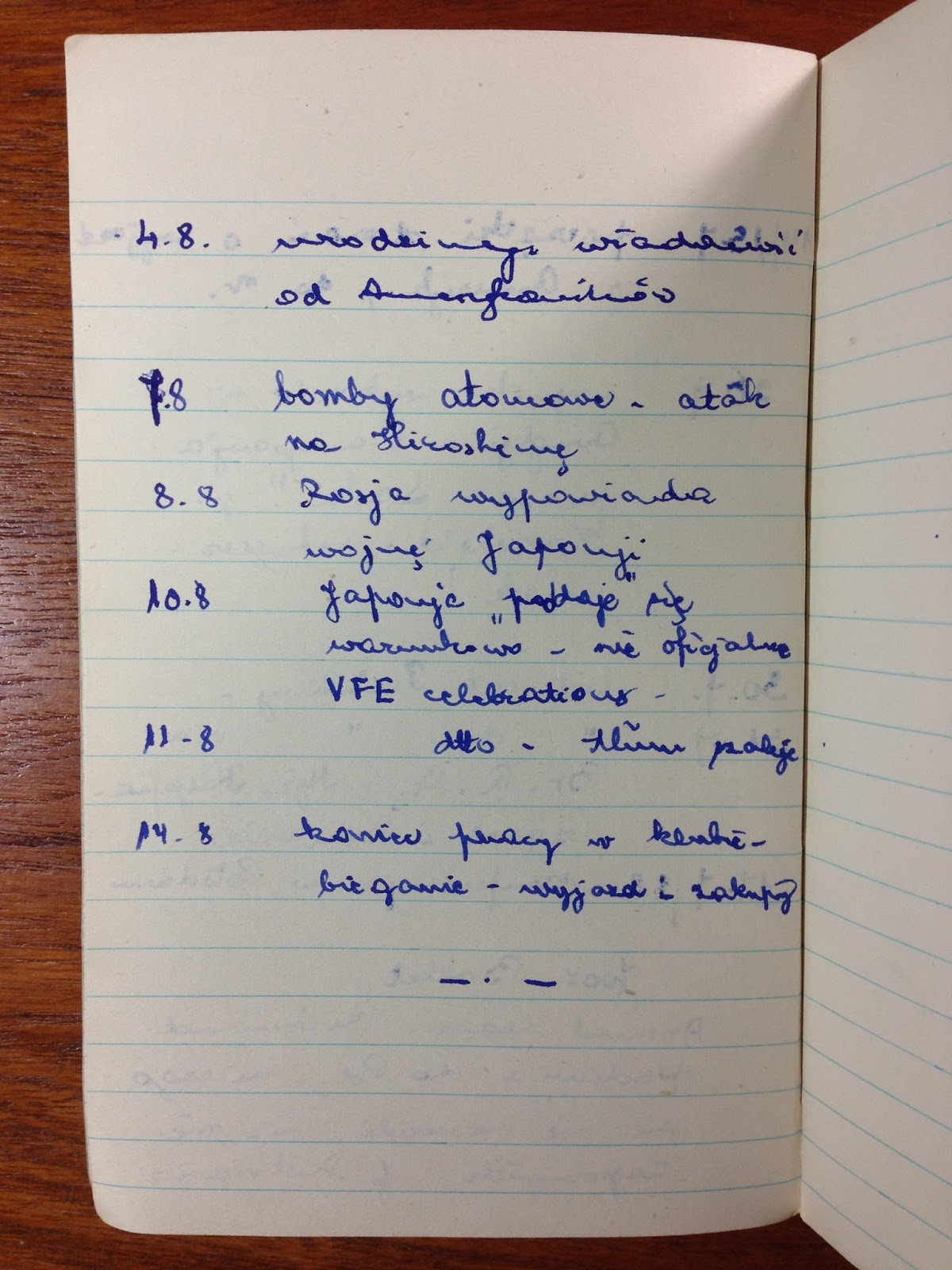
The entries are in his usual laconic fashion: just an annotation of events or places and the like, as an aid to memory. Even so, they may prove informative, at the least as a reminder of how news of the final phase of the war reached the public, which by definition lacked our knowledge of the course and duration of the endgame.

Under 7 August--written over 6 August, perhaps distinguishing between the date of the event and the majority of the press coverage(?), we find:
atom bombs [sic: plural] -- attack on Hiroshima
Under 8 August:
Russia declares war on Japan
This may seem an anticlimax today, but the Soviet declaration of war was headline material: one of the outcomes of the Yalta Conference, urgently sought by the US, given the anticipated cost of the invasion of the Japanese home islands. Again, no one could be sure the dropping of the atomic bomb(s) would bring about Japanese surrender. And of course, given the great secrecy that had enshrouded the whole development process, no one outside the highest circles knew that the U.S. had only two of the devastating weapons (though there were plans to rush ten more into production, for a total of twelve).

Curiously, there is no mention of the Nagasaki bomb on 9 August. Perhaps the entry for the 7th was written retroactively, as he caught up with events, and intended to cover both air attacks (thus the odd plural: "bombs"), or perhaps, in the rush of events, Nagasaki was simply eclipsed by the greater news of Soviet entry into this theater of war and then, immediately thereafter, of an impending end to the war itself.

Under 10 August:
Japan to "surrender" conditionally  -- unofficial
The term, "conditionally," is striking but in fact historically accurate because, although the Japanese message to the Allies spoke of accepting the terms of the Potsdam Declaration, mandating unconditional surrender, it also contained the qualifier: provided "said Declaration does not comprise any demand which prejudices the prerogatives of His Majesty as sovereign ruler.” In point of fact, although President Truman ordered a halt to bombing (even as the Soviet campaign continued), discussions continued for several days until the Emperor made an unprecedented radio broadcast and announced the surrender.

Although that occurred only on August 15, the news of 10 August proved good enough for the general public.  The diary records:
VFE celebrations
"VFE" here stands for "Victory in the Far East." This in itself is interesting, for it reminds us that even the name of the holiday (actual or anticipated) was not yet set: (see the next post). The formal surrender ceremony of course took place only on 2 September aboard the battleship "Missouri" in Tokyo harbor.


A memoir of old age

My mother described her situation in one of the essays that she produced for her writing group, in her final years. It is thus from long after the fact, but is in accord with what she had told me long before.

In April 1945, with defeat of Germany on the horizon, she had just completed a Master's thesis on modern German history at Columbia when she was offered a fellowship to continue graduate work in ancient history. She reluctantly turned town the offer because she had already made a commitment for the coming years: denazification work with the US military government in occupied Germany. It was a moral and political priority for her. (Nowadays a student would turn to "activism" and seek out an NGO. In this case, the work was done through the US government and had the power to make a difference.) She had in effect been training for this work without knowing it, for she helped to put herself through school by working as a censor of German POW letters: the government needed people who not only spoke German but could read the peculiar cursive script and were moreover familiar with the geography and culture.

She arrived in Europe in June 1945, as part of a Civil Censorship Division (CCD) team assigned to set up offices in a given locale and then move on to the next. Her second post was in Bremen, an American enclave within the British occupation zone:
Parts of the center of the city, the bank, the stock exchange etc. had been bombed, but fortunately not the beautiful old Rathaus [Town Hall], the “Dom,” i.e. the Cathedral. The famous statue of Roland had early on been moved to a place of safety.  Part of the Rathaus was turned into a Red Cross Club, where we could find refuge in a comfortable, relaxed setting, drinking coffee or tea, listening to a small German orchestra play light classical music, or even dancing a little.  It was at the Rathaus that we heard, in hushed silence, the news that an atomic bomb had been dropped on Hiroshima!  People were incredulous, also shocked.  Did this mean that Japan had given up, surrendered? We learned of course that the Japanese had not done so, and that a second atomic bomb, this time dropped on Nagasaki, did result in surrender and an end to war in the Pacific.  Everyone was jubilant, but even on August 6, 1945, the events at Hiroshima left me ambivalent: what did this mean for future wars, and to the people of all nations?
Relief, then, but not without a sense of foreboding or concern for the future. That seems about right.

* * *

Resources

New York Times coverage of the dropping of the atomic bomb

2015 Pew Research poll: 70 years after Hiroshima, opinions have shifted on use of atomic bomb