We are about to be inundated with coverage of our Civil War, which took up a mere four years in the history of a country then not even a century old. As recently noted, the origins and consequences of that war still divide us. And yet, there is hope for change.
By contrast, as journalists are constantly reminding us, the world is filled with and vexed by "ancient hatreds" that cannot be so easily cured:
Showing posts with label General. Show all posts
Showing posts with label General. Show all posts
Tuesday, April 12, 2011


Sunday, March 27, 2011
What's In a Name? Mobsters and Loggers
What's in a name? Earlier this year, I wrote about surnames in both the United States and Central Europe. i mentioned in passing the distinction between so-called "natural" and "artificial" names. The former are based on personal attributes of the first bearer: e.g. physical traits, character, occupation, and so forth. Nicknames are not quite the same as natural names, but they, too, often derive from the habits or appearance of the person in question.
The American organized crime world has long been known for colorful nicknames, and so, when there was a major wave of arrests in New York January, Joe Coscarelli of the Village Voice, quite understandably, decided to compile a list of the top 20:
Anyway, all this reading about names got me thinking. And then there is serendipity. By purest chance, I got involved in a Twitter conversation with a fellow New Englander about slang. A question arose as to the names for various cast-iron skillets. It suddenly occurred to me that I had a perfect reference work at hand: L.G. Sorden's Lumberjack Lingo (1969). It proved to be doubly appropriate and useful, because it combines the wisdom of my native Midwest and my adopted New England. My copy of the first edition of this Wisconsin book not only bears the autographs of author and (anonymous) illustrator, but also contains handwritten annotations by an old (now-deceased) Massachusetts hilltown native, who checked off terms he had encountered in his long career. Problem solved.
Of course, once you've picked up a fascinating book such as this in search of a specific piece of information, you can't just put it down. Rather, you are compelled to keep leafing through it.
The final topic in the book is "Nicknames of Lumberjacks." As the author explains:
The American organized crime world has long been known for colorful nicknames, and so, when there was a major wave of arrests in New York January, Joe Coscarelli of the Village Voice, quite understandably, decided to compile a list of the top 20:
20. VINCENT AULISI, also known as "The Vet"Not bad, I suppose, though I think only a few really rise to the level of such past classics as "Johnny the Nose" and "Miserable," or "Big Tuna," "Willie Potatoes, "Cockeyed Louis," and "Three Finger Brown." (1, 2)
19. GIOVANNI VELLA, also known as "John Vella," "Mousey" and "Little John"
18. STEPHEN DEPIRO, also known as "Beach"
17. ANTHONY CAVEZZA, also known as "Tony Bagels"
16. JOHN BRANCACCIO, also known as"Johnny Bandana"
15. ANTHINO RUSSO, also known as "Hootie"
14. FRANK BELLANTONI, also known as "Meatball"
13. CHRISTOPHER REYNOLDS, also known as "Burger"
12. VINCENZO FROGIERO, also known as "Vinny Carwash"
11. JOSEPH CARNA, also known as "Junior Lollipops"
10. DENNIS DELUCIA, also known as "Fat Dennis," "Little Dennis" and "the Beard"
9. LUIGI MANOCCHIO, also known as "Baby Shacks," "The Old Man," and "the Professor"
8. ANTHONY DURSO, also known as "Baby Fat Larry" and "BFL"
7. GIUSEPPE DESTEFANO, also known as "Pooch"
6. JOHN AZZARELLI, also known as "Johnny Cash"
5. ANDREW RUSSO, also known as "Mush"
4. VINCENT FEBBRARO, also known as "Jimmy Gooch"
3. BENJAMIN CASTELLAZZO, also known as "Benji," "The Claw" and "the Fang"
2. ANTHONY LICATA, also known as "Cheeks," "Anthony Firehawk," "Anthony Nighthawk," "Nighthawk" and "Firehawk"
1. JOHN HARTMANN, also known as "Lumpy," "Fatty" and "Fats"
Anyway, all this reading about names got me thinking. And then there is serendipity. By purest chance, I got involved in a Twitter conversation with a fellow New Englander about slang. A question arose as to the names for various cast-iron skillets. It suddenly occurred to me that I had a perfect reference work at hand: L.G. Sorden's Lumberjack Lingo (1969). It proved to be doubly appropriate and useful, because it combines the wisdom of my native Midwest and my adopted New England. My copy of the first edition of this Wisconsin book not only bears the autographs of author and (anonymous) illustrator, but also contains handwritten annotations by an old (now-deceased) Massachusetts hilltown native, who checked off terms he had encountered in his long career. Problem solved.
Of course, once you've picked up a fascinating book such as this in search of a specific piece of information, you can't just put it down. Rather, you are compelled to keep leafing through it.
The final topic in the book is "Nicknames of Lumberjacks." As the author explains:
A camp 'ink slinger' was having trouble keeping the camp records straight because there were three men working at the same camp with the same name. None had a middle name; the men did not start work on the same day, but as each one arrived the problem grew.The author goes on to explain that most lumberjacks were known by nicknames. Some, as above, had them assigned. Others chose them in order to shed a past identity. Most, however, received them from their fellow workers. He lists some names of actual lumberjacks from the heyday of the trade in Wisconsin and Michigan. The best of these, IMHO, are quite worthy to stand beside those of any distinguished crime figure. See what you think:
After studying each man's appearance and checking starting dates, the ink slinger solved his problems simply by entering the following names in his book:
1. Dirty Joe Michaud
2. Bald Headed Joe Michaud
3. Joe Come-Lately Michaud
1. Angus the Pope
2. Battle Axe Nelson
3. Bill the Dangler
4. Blueberry Bob
5. Bug House Lynch
6. Cruel Face
7. Dick the Dancer
8. Double Breasted Corrigan
9. Drop Cake Morley
10. Gin Pole Smith
11. One Round Hogan
12. Pancake Billie
13. Panicky Pete
14. Protestant Jack
15. Prune Juice Doyle
16. Smutty John
17. Stub Nelson
18. The Hemlock Bull
19. Three Fingered Ole
20. Whispering Bill
Saturday, December 4, 2010
Are You Smarter than an Eighth Grader (from 1895)?
Serendipity is a fine thing. Having just posted about graduate school applications and college admissions, I stumble across a document on adolescent learning standards from 1895 (h.t.: McK66). The person who posted it, a professor of education, explains:
And under geography, we find:
This is the eighth-grade final exam from 1895 from Salina, KS. USA.It covers five areas: grammar, arithmetic, U.S. history, orthography, and geography. I'll reproduce just history here:
It was taken from the original document on file at the Smoky Valley
Genealogical Society and Library in Salina, KS and reprinted by the
Salina Journal.
U.S. History (Time, 45 minutes)You can examine the rest for yourselves, and it's worthwhile, though possibly intimidating. Can you "name and describe" Hecla, Juan Fernandez, and Aspiwall, or answer the question, "Why is the Atlantic Coast colder than the Pacific in the same latitude?" I'd like to give this one (from orthography) to my students (or, for that matter, a good many journalists, newspaper editors, and bloggers)
1. Give the epochs into which U.S. History is divided.
2. Give an account of the discovery of America by Columbus.
3. Relate the causes and results of the Revolutionary War.
4. Show the territorial growth of the United States.
5. Tell what you can of the history of Kansas.
6. Describe three of the most prominent battles of theRebellion.
7. Who were the following: Morse, Whitney, Fulton, Bell, Lincoln, Penn, and Howe?
8. Name events connected with the following dates:
1607
1620
1800
1849
1865
9. Use the following correctly in sentences, Cite, site, sight, fane, fain, feign, vane, vain, vein, raze, raise, rays.Hell, I'd be happy if they knew the difference between "its" and "it's."
And under geography, we find:
1. What is climate? Upon what does climate depend?We already know that the entire incoming Republican Congressional cohort would flunk that one.
Monday, October 11, 2010
Monday Morning Leaves: A Delayed Amherst Autumn and a Bouquet for Orra Hitchcock
Sept. 21
Neither when I crossed the Connecticut River at Hadley via the Calvin Coolidge Memorial Bridge nor when I paused at the "scenic" overlook above Holyoke on the way back from the auto glass shop in West Springfield did I see much fall foliage. However, here in the uplands, signs of the change were more common. I noticed them on the dog's morning walk (in fact: spotted the first ones, below, on Labor Day weekend, which is the symbolic if not astronomical end of summer).

Oct. 4
Last week, I would have written that we were still ahead of the game (and the season), but when I retraced that same route along I-91 today, there was still far more green than red and orange to be seen, even at the overlook.
Now people are starting to worry. Just today, Springfield's Channel 22 quoted people in the hospitality trades expressing concern that the delayed leaf-peeping season was hurting tourism. The foliage is supposed to reach peak color just after the Columbus Day weekend.
Coincidentally, the Library of Congress today posted its list of readings on "The Nature & Science of Autumn."
It's ironic that this year's season is causing worries because Yankee Magazine recently named Amherst one of the top 25 foliage towns in autumn New England:

This lithograph, "Autumnal Scenery, View in Amherst" (from the volume of plates for Edward Hitchcock's Geology of Massachusetts, 1833), depicts Amherst as seen from the east, in the Pelham Hills. Amherst College (Johnson Chapel; South, North, and Williston Halls) is at far left. What is perhaps most noteworthy about the scenery is the relative paucity of trees compared with the view that would greet the traveler today. Hitchcock painted the scene at the height of deforestation, by which time, as the Fisher Museum of Harvard Forest explains, "60 to 80 percent of the land was cleared for pasture, tillage, orchards and buildings. Small remaining areas of woodland were subjected to frequent cuttings for lumber and fuel."
Here, in her husband's Religious Lectures on Peculiar Phenomena in the Four Seasons. . . (Amherst: J. S. &. C. Adams, 1850), she depicted the "Autumnal Scenery" at the "Confluence of Connecticut and Deerfield Rivers," to the west.

For Edward Hitchcock, as the volume's title implies, nature was a book to be studied for its spiritual message. Opening his lecture on "The Euthanasia of Autumn" (probably not a title that we would choose today, though it just means: good death) with Isaiah's 'We all do fade as a leaf" (64:6), he finds that the season instructs: our bodily powers, beauty, and glory are fleeting. Accordingly, autumn ought to teach us piety, strength in adversity, and preparation for both a beautiful death and eternal life to come.The frost, far from killing the plant, causes its organs to "develope hues still more brilliant, and make creation smile, though about to descend into her wintry grave." (98) And
He had lectured on Orra herself the previous year, after publishing A Woman of Amherst: The Travel Diaries of Orra White Hitchcock, 1847 and 1850. Next semester, the Mead Museum at Amherst College will mount a major exhibition, Orra White Hitchcock (1796–1863): An Amherst Woman of Art and Science, curated by Bob Herbert and former College Archivist Daria D'Arienzo.
Unfortunately, the historical landscape of the house of the Hitchcocks' scarcely less distinguished son, Edward, Jr., is under threat today as Amherst College proposes to remove an elegant 310-foot fence that frames the property. The decision of the Amherst Historical Commission to impose a twelve-month demolition delay has sparked controversy in some circles but is also serving as a useful opportunity to inform and engage the public on the subject of historic preservation.
Mary Loeffelholz outruns the evidence when she (following Richard Sewall) postulates that the Hitchcock volume about flowers that Emily Dickinson recalled reading every autumn as a child was the Religious Lectures. A careful consideration of both the subject matter and the publication date precludes that. Still, we do know that the book was in the Dickinson Homestead library, and in light of the poet's own views and works, as well as the connections between the two families, it is reasonable to assume that she had read and knew it. And certainly, like Hitchcock, she (though not without struggle) hoped for and believed in bodily resurrection.
I don't know about that, but like Dickinson, I do have faith that, even this year, as in others, autumn will arrive in its full glory and then:

Neither when I crossed the Connecticut River at Hadley via the Calvin Coolidge Memorial Bridge nor when I paused at the "scenic" overlook above Holyoke on the way back from the auto glass shop in West Springfield did I see much fall foliage. However, here in the uplands, signs of the change were more common. I noticed them on the dog's morning walk (in fact: spotted the first ones, below, on Labor Day weekend, which is the symbolic if not astronomical end of summer).

Oct. 4
Last week, I would have written that we were still ahead of the game (and the season), but when I retraced that same route along I-91 today, there was still far more green than red and orange to be seen, even at the overlook.
Now people are starting to worry. Just today, Springfield's Channel 22 quoted people in the hospitality trades expressing concern that the delayed leaf-peeping season was hurting tourism. The foliage is supposed to reach peak color just after the Columbus Day weekend.
Coincidentally, the Library of Congress today posted its list of readings on "The Nature & Science of Autumn."
It's ironic that this year's season is causing worries because Yankee Magazine recently named Amherst one of the top 25 foliage towns in autumn New England:
(1.) Kent, ConnecticutWhile we wait for the real thing, I thought I'd share some historical autumn imagery from one of our local nineteenth-century artists, Orra White Hitchcock (1798-1863). The wife of famed Amherst College President Edward Hitchcock (1793-1864), she produced images for some of his scientific and religious works (he was Professor of both Geology and Natural Theology) and was a distinguished cultural figure in her own right, in the words of the Amherst College archivists: "one of the earliest female artists and illustrators in a the U.S." When the Historical Subcommittee of the Amherst 250th Anniversary chose subjects for the re-enactors at the graves in West Cemetery, Orra rather than Edward was the Hitchcock whom they selected.
(2.) Bethel, Maine
(3.) Manchester, Vermont
(4.) Williamstown, Massachusetts
(5.) Middlebury, Vermont
(6.) Camden, Maine (tie)
(6.) Waitsfield, Vermont (tie)
(7.) Conway/North Conway, New Hampshire
(8.) Sandwich, New Hampshire
(9.) Rangeley, Maine
(10.) Blue Hill, Maine (tie)
(10.) Woodstock, Vermont (tie)
(10.) Waterville Valley, New Hampshire (tie)
(10.) Amherst, Massachusetts (tie)
(11.) Grafton, Vermont (tie)
(11.) East Haddam, Connecticut (tie)
(11.) Walpole, New Hampshire (tie)
(12.) The Cornwalls, Connecticut (tie)
(12.) Litchfield, Connecticut (tie)
(12.) Jackson, New Hampshire (tie)
(13.) Jeffersonville, Vermont (tie)
(13.) Shelburne Falls, Massachusetts (tie)
(13.) Montgomery, Vermont (tie)
(13.) Stowe, Vermont (tie)
(13.) Hanover, New Hampshire (tie)

This lithograph, "Autumnal Scenery, View in Amherst" (from the volume of plates for Edward Hitchcock's Geology of Massachusetts, 1833), depicts Amherst as seen from the east, in the Pelham Hills. Amherst College (Johnson Chapel; South, North, and Williston Halls) is at far left. What is perhaps most noteworthy about the scenery is the relative paucity of trees compared with the view that would greet the traveler today. Hitchcock painted the scene at the height of deforestation, by which time, as the Fisher Museum of Harvard Forest explains, "60 to 80 percent of the land was cleared for pasture, tillage, orchards and buildings. Small remaining areas of woodland were subjected to frequent cuttings for lumber and fuel."
Here, in her husband's Religious Lectures on Peculiar Phenomena in the Four Seasons. . . (Amherst: J. S. &. C. Adams, 1850), she depicted the "Autumnal Scenery" at the "Confluence of Connecticut and Deerfield Rivers," to the west.

For Edward Hitchcock, as the volume's title implies, nature was a book to be studied for its spiritual message. Opening his lecture on "The Euthanasia of Autumn" (probably not a title that we would choose today, though it just means: good death) with Isaiah's 'We all do fade as a leaf" (64:6), he finds that the season instructs: our bodily powers, beauty, and glory are fleeting. Accordingly, autumn ought to teach us piety, strength in adversity, and preparation for both a beautiful death and eternal life to come.The frost, far from killing the plant, causes its organs to "develope hues still more brilliant, and make creation smile, though about to descend into her wintry grave." (98) And
The gay splendor of our forests, as autumn comes on, may seem to some inappropriate, when we consider that it is the precursor of decay and death. But when we remember that the plant still lives, and after a season of inaction will awake to new and more vigorous life, and that the apparent decay is only laying aside a summer robe, because unfit for winter, is it not appropriate that nature should hang out signals of joy rather than of sorrow? Why should she not descend exultingly, and in her richest dress, into the grave, in hope of so early and so glorious a resurrection? (100)Thankfully, Orra White Hitchcock's legacy is being recovered. Last winter, in the context of the Amherst 250th and the Darwin 200th, Mount Holyoke Professor of Art History Emeritus Robert Herbert made mention of her work in a lecture on "Edward Hitchcock: Science and Religion in the Embrace of Nature," sponsored by the Emily Dickinson Museum.
 |
| Robert Herbert lecture: art by Orra Hitchcock, March 2009 |
Unfortunately, the historical landscape of the house of the Hitchcocks' scarcely less distinguished son, Edward, Jr., is under threat today as Amherst College proposes to remove an elegant 310-foot fence that frames the property. The decision of the Amherst Historical Commission to impose a twelve-month demolition delay has sparked controversy in some circles but is also serving as a useful opportunity to inform and engage the public on the subject of historic preservation.
Mary Loeffelholz outruns the evidence when she (following Richard Sewall) postulates that the Hitchcock volume about flowers that Emily Dickinson recalled reading every autumn as a child was the Religious Lectures. A careful consideration of both the subject matter and the publication date precludes that. Still, we do know that the book was in the Dickinson Homestead library, and in light of the poet's own views and works, as well as the connections between the two families, it is reasonable to assume that she had read and knew it. And certainly, like Hitchcock, she (though not without struggle) hoped for and believed in bodily resurrection.
I don't know about that, but like Dickinson, I do have faith that, even this year, as in others, autumn will arrive in its full glory and then:
The morns are meeker than they were,
The nuts are getting brown;
The berry's cheek is plumper,
The rose is out of town.
The maple wears a gayer scarf,
The field a scarlet gown.
Lest I should be old-fashioned,
I'll put a trinket on.
Sunday, October 3, 2010
Sunday Morning Salmon Station (touch of evil or tranquility bay?)
I always like to walk the dog down Plumtree Road, which runs from Amherst down to Sunderland. It's a pleasant rural walk on a quiet, partially unpaved route bordered by forest. One is sure to hear a rooster or two on the way or on the road, and every once in a while, one encounters a group of wild turkeys instead of a jogger or bicyclist. (One of the latter wheeled by yesterday, remarking, "Giant dog!")
To be sure, new houses came in here in recent years, and I regretted the loss of the "rural" setting, but this supposedly unspoiled landscape was of course the product of repeated human intervention (these are secondary forests that took over old farms) and our home is a former farmhouse. At some point, someone perhaps complained when it went up. There's more than enough NIMBY-ism around here, and humility and restraint are the proper response.
At any rate, I also particularly enjoy the road because it brings me into contact with aspects of the real world that we don't usually see in our little college town. At one point on the north side of the road is the heavy-equipment training site for the labor union of Operating Engineers, and across from it to the south is the office of the Connecticut River Resource Management Complex, whose responsibilities include ensuring the welfare of migratory fish populations in the Connecticut River Basin. Both offices perhaps deal with endangered species.

A bit farther west is one of the most interesting and idyllic spots: the Richard Cronin National Salmon Station.

Most of the work takes place inside the buildings beyond secured chain-link fences, but there is also a popular public viewing area, which one reaches after walking past an idyllic little pond.

Subdued—slightly rubbed—yellow salmon stencils on the asphalt path point the way; the worn paint and softened colors match the quiet setting.

In the long, shallow, cement tanks, one can observe—sometimes with just a bit of extra effort, depending on the reflection on the water's surface—the salmon.

Here and there, one spots a smaller, strangely dark, even blackish fish, and is taken aback.

Whether for this reason or others, urban (or is it: rural?) legends have sprung up around the site. According to the most popular one, the salmon were brought here in hopes of breeding a superior fish, but as a result of some secret experiment gone horribly awry, can never safely be released into the natural environment. Either because it would be inhumane to kill them or because the scientists are still attempting to figure out what went wrong, the poor piscine creatures are condemned to live out their lives in the confines of the long concrete holding tanks.
Whether the slicker-coated scarecrow adds a touch of the sinister or the humorous is a question of opinion and individual psychology,

but happening upon small mammalian remains farther down the path, right at the edge of the shallower tanks lush in wild vegetation and devoid of fish (save for the isolated and ghostly white remains of an unfortunate comrade) can, under the right circumstances, introduce a hint of inexplicable menace.


Can legends of monster fish arise for no reason?
The truth, of course, is far more mundane.
We are concerned here with anadromous fish, which "are born in fresh water, migrate to the ocean to grow into adults, and then return to fresh water to spawn." The Connecticut River Resource Management Office is tasked with protecting and enhancing the resources and biodiversity of the river's watershed.
One tantalizing philosophical question: To what extent is transformation of an animal through genetic engineering qualitatively different from the manipulation that we have undertaken for centuries (and in some cases, millennia) through selective breeding? The dog is a case in point. With over 400 recognized breeds, it is, as one PBS science documentary put it, the most varied animal on the planet. Unfortunately, that deliberate diversity comes at a cruel price, as any dog lover or responsible dog breeder or trainer can tell you. In the first place, there is the biological dimension, when dogs are doomed to suffer physical pain as a result of inbreeding and other poor practices. The prevalence of hip dysplasia in German Shepherds is but the most familiar example. In the second place, there is the social dimension. "Before the Victorians invited the dog into our home," as that documentary explained, dogs were bred for specialized purposes. Trying to make domestic pets out of creatures with genetic traits developed for completely different circumstances can be a recipe for disaster. As one dog expert observed, our longstanding symbiotic relationship with the species is “in crisis” because
“we have completely forgotten” what this animal was intended to do.
Clearly, the issues are complex and multilayered. Sadly, much of the discussion of genetic modifications is ill-informed.
Large sectors of the European and American public have become downright paranoid about Genetically Modified Organisms [GMO's] in the food supply, which they histrionically denounce as "Frankenfoods." In the meantime, as I've noted, Europeans, while overwhelmingly rejecting traditional theological beliefs, evince a peculiar faith in homeopathy, an unscientific superstition if ever there was one. (It's not immediately obvious why the idea of a transcendent Creator is intrinsically more preposterous than a chemical theory that ignores the consequences of Avogadro's Number.)
There is a debate to be had, but it needs to be a serious and scientific one.
Organic farmers recently won a landmark legal battle when they secured a ban on the genetically modified sugar beet on the grounds that its prevalence (95 percent of the US crop) deprived them of freedom of choice (not enough conventional seed available, plus the danger that cross-pollination from neighboring fields would contaminate their crop and deprive them of their organic certification). A true evaluation of genetically modified organisms, as a recent UN study on African agriculture likewise showed, needs to take into account the full panoply of factors and consequences: technological, biological, economic, ecological, and ethical, on both the local and wider scales.
On the less serious side of the newsroom at NPR, the folks at "Wait, Wait, Don't Tell Me," noting the rise of strange animal hybrids and the amusing task of creating the appropriate names—a cross between a zebra and a horse is called a "zorse"—have some fun with the idea. Thus, for example, by that naming convention, a cross between a beagle and an eagle would be a grotesque (and impossible) creature, but called: a beagle. The examples get worse.
Fiction is still stranger than truth. But that may change.

To be sure, new houses came in here in recent years, and I regretted the loss of the "rural" setting, but this supposedly unspoiled landscape was of course the product of repeated human intervention (these are secondary forests that took over old farms) and our home is a former farmhouse. At some point, someone perhaps complained when it went up. There's more than enough NIMBY-ism around here, and humility and restraint are the proper response.
At any rate, I also particularly enjoy the road because it brings me into contact with aspects of the real world that we don't usually see in our little college town. At one point on the north side of the road is the heavy-equipment training site for the labor union of Operating Engineers, and across from it to the south is the office of the Connecticut River Resource Management Complex, whose responsibilities include ensuring the welfare of migratory fish populations in the Connecticut River Basin. Both offices perhaps deal with endangered species.

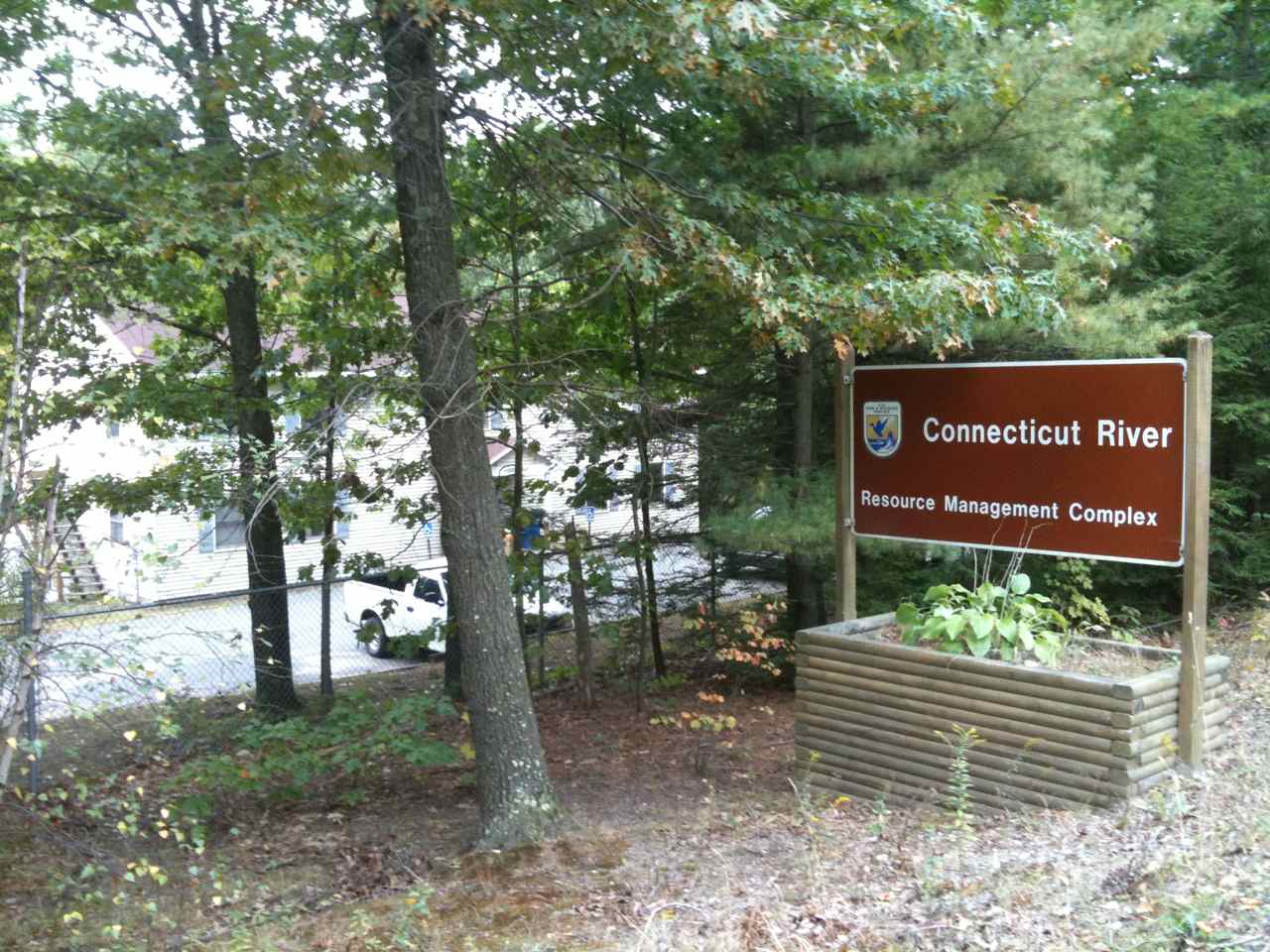
A bit farther west is one of the most interesting and idyllic spots: the Richard Cronin National Salmon Station.

 |
| fish trucks at rest over Labor Day weekend |

Subdued—slightly rubbed—yellow salmon stencils on the asphalt path point the way; the worn paint and softened colors match the quiet setting.
 |
| Fish Tracks |


In the long, shallow, cement tanks, one can observe—sometimes with just a bit of extra effort, depending on the reflection on the water's surface—the salmon.

Here and there, one spots a smaller, strangely dark, even blackish fish, and is taken aback.

Whether for this reason or others, urban (or is it: rural?) legends have sprung up around the site. According to the most popular one, the salmon were brought here in hopes of breeding a superior fish, but as a result of some secret experiment gone horribly awry, can never safely be released into the natural environment. Either because it would be inhumane to kill them or because the scientists are still attempting to figure out what went wrong, the poor piscine creatures are condemned to live out their lives in the confines of the long concrete holding tanks.
Whether the slicker-coated scarecrow adds a touch of the sinister or the humorous is a question of opinion and individual psychology,

but happening upon small mammalian remains farther down the path, right at the edge of the shallower tanks lush in wild vegetation and devoid of fish (save for the isolated and ghostly white remains of an unfortunate comrade) can, under the right circumstances, introduce a hint of inexplicable menace.


Can legends of monster fish arise for no reason?
The truth, of course, is far more mundane.
We are concerned here with anadromous fish, which "are born in fresh water, migrate to the ocean to grow into adults, and then return to fresh water to spawn." The Connecticut River Resource Management Office is tasked with protecting and enhancing the resources and biodiversity of the river's watershed.
Staff and volunteers of the Richard Cronin National Salmon Station have the unique responsibility of capturing and retrieving the Connecticut River’s returning adult Atlantic salmon. Every spring, the wild fish are trucked from the river and its tributaries to the hatchery where they are held safely through summer. In the fall, these fish are mated using techniques that maximize genetic diversity. The eggs are incubated on site and then distributed to other state and federal hatcheries throughout the watershed as part of the Connecticut River Atlantic Salmon Program Restoration Program.Fortuitously, my recent weekend peregrinations come at a time when salmon and scientific experiments have been much in the news. As NPR explained in a recent very thorough piece, the Food and Drug Administration (FDA) is in the process of reviewing the first request to permit genetically modified animals for human consumption. A company called AquaBounty Technologies has developed a technique that, by adding a growth hormone from a Chinook salmon and a genetic switch from another species of fish, allows Atlantic salmon to grow roughly twice as fast—and thus be "harvested" in roughly half the time—as usual. There are really three possible basic concerns here. It s still hard to see how consumption of the fish would constitute a hazard to human health. We are told that the prevalence of fish allergies argues for caution. Fair enough, but if one is already allergic and aware of that fact, what new risk would this pose? The issue seems to come down to the ambiguity of evidence or inconsistency of test methods and data presentation. (Part of the problem is that the FDA's standards and procedures have not kept up with the science itself; among other things, the fish is regulated as a drug.). More serious, one would think, is the possibility of unforeseen environmental harm if fish escape and interbreed with natural stocks or otherwise alter the environment. Aquabounty says the latter cannot happen because the eggs will all be female and sterile, and the fish raised on land rather than in ocean pens. The generally admirable Union for Concerned Scientists rejected that assurance with an expression of general skepticism regarding supposedly redundant safety systems, but its argument was not made more persuasive by the fact that it referenced the BP oil spill (something of a cheap shot as well as irrelevant) rather than directly addressing an entirely different system with both physical and biological elements. This is not to say that concerns are not justified; just that this was a feeble riposte. Most generally, of course, there is the ethical concern that should attach to any genetic modification of a sentient creature, especially when undertaken in order to provide human food. One would think that should be the starting point for any deliberation.
One tantalizing philosophical question: To what extent is transformation of an animal through genetic engineering qualitatively different from the manipulation that we have undertaken for centuries (and in some cases, millennia) through selective breeding? The dog is a case in point. With over 400 recognized breeds, it is, as one PBS science documentary put it, the most varied animal on the planet. Unfortunately, that deliberate diversity comes at a cruel price, as any dog lover or responsible dog breeder or trainer can tell you. In the first place, there is the biological dimension, when dogs are doomed to suffer physical pain as a result of inbreeding and other poor practices. The prevalence of hip dysplasia in German Shepherds is but the most familiar example. In the second place, there is the social dimension. "Before the Victorians invited the dog into our home," as that documentary explained, dogs were bred for specialized purposes. Trying to make domestic pets out of creatures with genetic traits developed for completely different circumstances can be a recipe for disaster. As one dog expert observed, our longstanding symbiotic relationship with the species is “in crisis” because
“we have completely forgotten” what this animal was intended to do.
Clearly, the issues are complex and multilayered. Sadly, much of the discussion of genetic modifications is ill-informed.
Large sectors of the European and American public have become downright paranoid about Genetically Modified Organisms [GMO's] in the food supply, which they histrionically denounce as "Frankenfoods." In the meantime, as I've noted, Europeans, while overwhelmingly rejecting traditional theological beliefs, evince a peculiar faith in homeopathy, an unscientific superstition if ever there was one. (It's not immediately obvious why the idea of a transcendent Creator is intrinsically more preposterous than a chemical theory that ignores the consequences of Avogadro's Number.)
There is a debate to be had, but it needs to be a serious and scientific one.
Organic farmers recently won a landmark legal battle when they secured a ban on the genetically modified sugar beet on the grounds that its prevalence (95 percent of the US crop) deprived them of freedom of choice (not enough conventional seed available, plus the danger that cross-pollination from neighboring fields would contaminate their crop and deprive them of their organic certification). A true evaluation of genetically modified organisms, as a recent UN study on African agriculture likewise showed, needs to take into account the full panoply of factors and consequences: technological, biological, economic, ecological, and ethical, on both the local and wider scales.
On the less serious side of the newsroom at NPR, the folks at "Wait, Wait, Don't Tell Me," noting the rise of strange animal hybrids and the amusing task of creating the appropriate names—a cross between a zebra and a horse is called a "zorse"—have some fun with the idea. Thus, for example, by that naming convention, a cross between a beagle and an eagle would be a grotesque (and impossible) creature, but called: a beagle. The examples get worse.
Fiction is still stranger than truth. But that may change.
Sunday, September 19, 2010
Marla Miller on Betsy Ross on C-SPAN 2

Saturday, September 18, 2010
Labor Day Postscript
Just after I posted my little Labor Day piece, The Nation came out with a series of articles that fortuitously complemented the ones I cited, so I simply mention them here:
• John Nichols (echoing Paul Krugman), the "Right Response to Unemployment is More Stimulus Spending"
• Johsua Clover, "Busted: Stories of the Financial Crisis" ("The one thing that a thousand books written from within the financial crisis won't contemplate is the possibility of an unhappy ending for capitalism.")
• Katha Pollitt, "It's Better Over There" ("In Germany, a strong social safety net keeps people from plunging into the abyss. Why are we so averse to having that security in the United States?")
Here in Amherst, a local resident on the Town Meeting listserve cited the words of Robert Kennedy on our social crisis in 1968. He may well have pulled the excerpt from piece by Michael Moore and others who circulated it that weekend, but here's a longer passage, with a link to the full text from the Kennedy Library:
• John Nichols (echoing Paul Krugman), the "Right Response to Unemployment is More Stimulus Spending"
• Johsua Clover, "Busted: Stories of the Financial Crisis" ("The one thing that a thousand books written from within the financial crisis won't contemplate is the possibility of an unhappy ending for capitalism.")
• Katha Pollitt, "It's Better Over There" ("In Germany, a strong social safety net keeps people from plunging into the abyss. Why are we so averse to having that security in the United States?")
Here in Amherst, a local resident on the Town Meeting listserve cited the words of Robert Kennedy on our social crisis in 1968. He may well have pulled the excerpt from piece by Michael Moore and others who circulated it that weekend, but here's a longer passage, with a link to the full text from the Kennedy Library:
And if we seem powerless to stop this growing division between Americans, who at least confront one another, there are millions more living in the hidden places, whose names and faces are completely unknown - but I have seen these other Americans - I have seen children in Mississippi starving, their bodies so crippled from hunger and their minds have been so destroyed for their whole life that they will have no future. I have seen children in Mississippi - here in the United States - with a gross national product of $800 billion dollars - I have seen children in the Delta area of Mississippi with distended stomachs, whose faces are covered with sores from starvation, and we haven't developed a policy so we can get enough food so that they can live, so that their children, so that their lives are not destroyed, I don't think that's acceptable in the United States of America and I think we need a change.
I have seen Indians living on their bare and meager reservations, with no jobs, with an unemployment rate of 80 percent, and with so little hope for the future, so little hope for the future that for young people, for young men and women in their teens, the greatest cause of death amongst them is suicide. . . . .
I don't think that's acceptable and I think the United States of America - I think the American people, I think we can do much, much better. And I run for the presidency because of that, I run for the presidency because I have seen proud men in the hills of Appalachia, who wish only to work in dignity, but they cannot, for the mines are closed and their jobs are gone and no one - neither industry, nor labor, nor government - has cared enough to help.
I think we here in this country, with the unselfish spirit that exists in the United States of America, I think we can do better here also.
I have seen the people of the black ghetto, listening to ever greater promises of equality and of justice, as they sit in the same decaying schools and huddled in the same filthy rooms - without heat - warding off the cold and warding off the rats.
If we believe that we, as Americans, are bound together by a common concern for each other, then an urgent national priority is upon us. We must begin to end the disgrace of this other America.
And this is one of the great tasks of leadership for us, as individuals and citizens this year. But even if we act to erase material poverty, there is another greater task, it is to confront the poverty of satisfaction - purpose and dignity - that afflicts us all. Too much and for too long, we seemed to have surrendered personal excellence and community values in the mere accumulation of material things. Our Gross National Product, now, is over $800 billion dollars a year, but that Gross National Product - if we judge the United States of America by that - that Gross National Product counts air pollution and cigarette advertising, and ambulances to clear our highways of carnage. It counts special locks for our doors and the jails for the people who break them. It counts the destruction of the redwood and the loss of our natural wonder in chaotic sprawl. It counts napalm and counts nuclear warheads and armored cars for the police to fight the riots in our cities. It counts Whitman's rifle and Speck's knife, and the television programs which glorify violence in order to sell toys to our children. Yet the gross national product does not allow for the health of our children, the quality of their education or the joy of their play. It does not include the beauty of our poetry or the strength of our marriages, the intelligence of our public debate or the integrity of our public officials. It measures neither our wit nor our courage, neither our wisdom nor our learning, neither our compassion nor our devotion to our country, it measures everything in short, except that which makes life worthwhile. And it can tell us everything about America except why we are proud that we are Americans.In the meantime, we heard that percentage of Americans living in poverty (one in seven people, or some 44 million individuals) is now the highest in fifteen years. The critical social and political thinkers of the late nineteenth and early twentieth centuries may not have had all the answers for all time, but at least they understood that there was a problem.
Tuesday, July 27, 2010
A Tale of Three Poetry Contests (hmmm . . . what rhymes with Jerusalem, entropy, and free trade?)
I know it is often said that poetry is hot again, so perhaps I should not be surprised at the appearance of several poetry competitions reaching well beyond the usual circles.
• The first is the more expected, socially engaged in an uplifting way (is there any other?):
I suppose any starting point for such a contest would be that infamous old couplet:
• The second competition is a bit less conventional:
• The third really rather takes one by surprise.
One's first reaction has to be: Is this a joke? Second: Are they really desperate, ow what?
As Shakespeare sighed in Sonnet 100:
And then, there's that Cuttlefish guy again.
In all honesty, though there's more out there than you'd imagine. My favorite recent science poem actually combines my love of science and book history. It's a collaboration between poet Brad Leithauser (of neighboring Mount Holyoke College) and his brother Mark (an artist and curator at the National Gallery), published by the incomparable David Godine.
The opening poem of Lettered Creatures is entitled, "Alphabets: A Greeting":
In point of fact, though, there is an honored tradition of science poetry, going back at least to Lucretius. Not all of it is great, but there was a time when science writing was not dry and technical and approached the lyrical, and when poets found the truths of science aesthetically compelling.
Who, for example, could forget Pope's immortal:
Of course, astronomy has perhaps always had a special appeal, though science here sometimes becomes an excuse to leave the analytical world of classroom and laboratory and return to unadulterated nature (old theme), as in Whitman's
Coming up with poems on international trade could be a bit tougher, but I'll start you off with Schiller's "The Merchant" (1796), set in Classical Antiquity:
Wait: I almost forgot two crucial details. The WTO poems must be:
• limited to 110 words:
now where did that number come from? Admittedly, you can fit in many a decent sonnet. Shakespeare's # 100 happens to contain 111 words. Close, but no cigar. And Kumar's lyrical masterpiece weighs in at a chunky 127. Bummer, dude! I guess there's always the rap song to shoot for.
• and written in Engiish, French, or Spanish. Seems a wee bit ethnocentric to me. Let's just forget the land of Dante, Goethe, and Pushkin—not to mention much of the "Third World." (Is that revealing, or what?)
Robert Frost managed to write poems about both astronomy and economics—separately, of course.
Come to think of it, though, it should be possible to come up with a poem that one could submit to all three contests: say, about Israeli-Palestinian cooperation on wind turbines or green building. Or perhaps an encomium to those two technocrats, Salam Fayyad and Shimon Peres. Maybe the possibilities really are endless. (oh, yeah: except that you couldn't use Arabic or Hebrew, of course)
In the case of all the contests, just two reminders:
1) In the eighteenth century—that greatest of eras, populated by more great intellects than any before or since—almost every author tried his hand at poetry, but much of it was garbage. Being smart doesn't make you poetic.
2) Everyone can try to be a poet, but as the saying goes, "everyone is a critic."
So, write boldly, but carry a big stick.

• The first is the more expected, socially engaged in an uplifting way (is there any other?):
Galway’s literary events organisation, Over The Edge, is looking for poems from poets worldwide on any aspect of the Israel-Palestine issue. The poems can be from any point of view. The only criteria being that they must work as poems and be in some way relevant to what has been happening in that part of the world.In the talkbacks, the organizers assure the curious and skeptical that they really do welcome all points of view. It's easy to imagine how a topic such as this could generate all sorts of propaganda, so it's good to see the insistence that this be real poetry and not just activism in weak verse. (Heinrich Heine taught us that lesson more than 150 years ago, but some have yet to learn it.)
We also welcome poems from those living in Israel, Gaza and the West Bank on any aspect of life as it is lived there.
We will publish the poems as part of a special feature on the Over The Edge website.
The title of the project Will Days Indeed Come: I Come From There is borrowed from the titles of two poems: Will Days Indeed Come by Leah Goldberg and I Come From There by Mahmoud Darwish.
SUBMISSION GUIDELINES: Poems should be e-mailed, both in the body of the e-mail and as an attachment to over-the-edge-openreadings@hotmail.com Poets should also simultaneously send a bio of no more than thirty words in the same format. [h.t.: Harry's Place]
I suppose any starting point for such a contest would be that infamous old couplet:
How odd of GodHard to be more concise and provocative than that.
To choose the Jews
• The second competition is a bit less conventional:
A Poetry Contest for science nerds
Category: Art
Posted on: July 25, 2010 2:11 PM, by PZ Myers
Dr Charles is having a Poetry Contest, with wonderful prizes to be awarded to the winner with the best poem about "experiencing, practicing, or reflecting upon a medical, scientific, or health-related matter."
It sounds great until you realize you're probably going to have to compete against the Cuttlefish.
• The third really rather takes one by surprise.
INVITATION TO TAKE PART IN THE POETRY COMPETITION “THE WTO: A VISION IN VERSE”(That's: World Trade Organization, in case you didn't know.)
Test your poetic skills in a competition organized in the context of the WTO Open Day on 19 September 2010. Put pen to paper and craft a poem on the WTO or international trade. Those of you who feel more at home with music can try your hand at a rap or slam poem. The competition is open to one and all. (details)
(h.t.: OD)
One's first reaction has to be: Is this a joke? Second: Are they really desperate, ow what?
As Shakespeare sighed in Sonnet 100:
Where art thou Muse that thou forget'st so long,As for science verse, I imagine the result as something like the "Square Root of 3" poem from "Harold and Kumar Escape from Guantanamo Bay":
To speak of that which gives thee all thy might?
Spend'st thou thy fury on some worthless song,
Darkening thy power to lend base subjects light?
I’m sure that I will always be(YouTube won't let us embed the code for his one, but you can view the clip here)
A lonely number like root three
The three is all that’s good and right,
Why must my three keep out of sight
Beneath the vicious square root sign,
I wish instead I were a nine
For nine could thwart this evil trick,
with just some quick arithmetic
I know I’ll never see the sun, as 1.7321
Such is my reality, a sad irrationality
When hark! What is this I see,
Another square root of a three
As quietly co-waltzing by,
Together now we multiply
To form a number we prefer,
Rejoicing as an integer
We break free from our mortal bonds
With the wave of magic wands
Our square root signs become unglued
Your love for me has been renewed
And then, there's that Cuttlefish guy again.
In all honesty, though there's more out there than you'd imagine. My favorite recent science poem actually combines my love of science and book history. It's a collaboration between poet Brad Leithauser (of neighboring Mount Holyoke College) and his brother Mark (an artist and curator at the National Gallery), published by the incomparable David Godine.
The opening poem of Lettered Creatures is entitled, "Alphabets: A Greeting":
It seems we're each a sort of book—Top that one, I dare you.
As scientists now say—
Composed in the four-letter alphabet
Of our DNA;
Or call it a book-with-printing-press,
Since we share the common fate
Of going out of print unless
We manage to duplicate.
(It appears that Nature's Imperative
Consists of one rule only: Live.)
So what does it mean—that we are books?
Perhaps that you and I
(Along with the Mouse, the Moose, the Muskrat,
Spider and Hangingfly,
The Ground Sloth and the bounding Gazelle,
The neighbor
s ungodly Dog,
Some mite-sized Creature in a shell
Under a fallen log,
The Eagle and the Bottom Feeder)
Are each a writer and a reader.
In point of fact, though, there is an honored tradition of science poetry, going back at least to Lucretius. Not all of it is great, but there was a time when science writing was not dry and technical and approached the lyrical, and when poets found the truths of science aesthetically compelling.
Who, for example, could forget Pope's immortal:
Nature and nature's laws lay hid in Night.or Voltaire's poem on the Lisbon Earthquake?
God said, 'Let Newton be!' and all was light"
Of course, astronomy has perhaps always had a special appeal, though science here sometimes becomes an excuse to leave the analytical world of classroom and laboratory and return to unadulterated nature (old theme), as in Whitman's
WHEN I HEARD THE LEARN'D ASTRONOMERSpeaking of Whitman and astronomy, Jay Adler recently called our attention to Whitman's striking "Year of Meteors" (1859-60), in which he combines his assessment of the natural and social worlds, linking the great meteor to the abortive rebellion of John Brown. An excerpt:
When I heard the learn'd astronomer,
When the proofs, the figures, were ranged in columns before me,
When I was shown the charts and diagrams, to add, divide, and measure them,
When I sitting heard the astronomer where he lectured with much applause in the lecture-room,
How soon unaccountable I became tired, and sick,
Till rising and gliding out I wander'd off by myself,
In the mystical moist night-air, and from time to time,
Look'd up in perfect silence at the stars.
Year of comets and meteors transient and strange!—lo!At first sight, it's a bit hard to see how the WTO poems could compete with products from the other contests, but we should not be too quick to dismiss the possibilities. Bernard Mandeville's Fable of the Bees (1714) is a foundational text of capitalism. Shakespeare, as is well known, is replete with references to the power of money, though that's only one reason that Karl Marx, who described his "favourite occupation" as "Book-worming," so admired him and drew upon his images and metaphors. And, once you start to poke around, you can find economic references everywhere in the lyrical realm, from Swift's "The Run Upon the Bankers" (pretty obvious) to Shelley's "Queen Mab" (less so) and Allen Ginsberg's "American Change" and Howard Nemerov's "Money: an introductory lecture" (on the "Indian Head Nickel" of yore). We don't even need to mention Ezra Pounds's fulminations on usury.
even here, one equally transient and strange!
As I flit through you hastily, soon to fall and be gone, what is this book,
What am I myself but one of your meteors?
Coming up with poems on international trade could be a bit tougher, but I'll start you off with Schiller's "The Merchant" (1796), set in Classical Antiquity:
Der KaufmannAnd, more recently (1936), Carl Sandburg, portraying economic competition as tragic rather than heroic (the difference between those two ages), observed:
Wohin segelt das Schiff? Es trägt Sidonische Männer,
Die von dem frierenden Nord bringen den Bernstein, das Zinn.
Trag’ es gnädig, Neptun, und wiegt es schonend, ihr Winde,
In bewirthender Bucht rausch’ ihm ein trinkbarer Quell.
Euch gehört der Kaufmann, ihr Götter. Er steuert nach Gütern,
Aber, geknüpft an sein Schiff, folget das Gute ihm nach.
Money is power: so said one.Probably not exactly what the WTO wants to hear, but you get the idea. Now, off you go: write!
Money is a cushion: so said another.
Mnoney is the root of evil: so said still another.
Money means freedom: so runs an old saying.
And money is all of these—and more.
Money pays for whatever you want—if you have the money.
Money buys food, slothes, houses, land, guns, jewels, women, women, time to be lazy and listen to music.
Money buys everything except love, personality, freedom, immortality, silence, peace.
Therefore men fight for money.
Therefore men steal, kill, swindle, walk as hypocrites and whited sepulchers.
Therfore men speak softly carrying plans, poisons, weapons, each in the design: The words of his mouth were as butter but war was in his heart.
Therefore nations lay strangle holds on each other; bombardments open, tanks advance, salient ares seized, aviators walk on air; truckloads of amputated arms and legs are hauled away.
Money is power, freedom, a cushion, the root of all evil, the sum of blessings.
Wait: I almost forgot two crucial details. The WTO poems must be:
• limited to 110 words:
now where did that number come from? Admittedly, you can fit in many a decent sonnet. Shakespeare's # 100 happens to contain 111 words. Close, but no cigar. And Kumar's lyrical masterpiece weighs in at a chunky 127. Bummer, dude! I guess there's always the rap song to shoot for.
• and written in Engiish, French, or Spanish. Seems a wee bit ethnocentric to me. Let's just forget the land of Dante, Goethe, and Pushkin—not to mention much of the "Third World." (Is that revealing, or what?)
Robert Frost managed to write poems about both astronomy and economics—separately, of course.
Come to think of it, though, it should be possible to come up with a poem that one could submit to all three contests: say, about Israeli-Palestinian cooperation on wind turbines or green building. Or perhaps an encomium to those two technocrats, Salam Fayyad and Shimon Peres. Maybe the possibilities really are endless. (oh, yeah: except that you couldn't use Arabic or Hebrew, of course)
In the case of all the contests, just two reminders:
1) In the eighteenth century—that greatest of eras, populated by more great intellects than any before or since—almost every author tried his hand at poetry, but much of it was garbage. Being smart doesn't make you poetic.
2) Everyone can try to be a poet, but as the saying goes, "everyone is a critic."
So, write boldly, but carry a big stick.
Thursday, July 22, 2010
A Great Historian Having a Bad Day
Writing about analogies recently and going back to David Hackett Fischer's Historians' Fallacies (1970) allowed me to rediscover a few howlers.
This one, by the great historian of popular movements and Revolutionary France, George Rudé, shows what happens when vigilance slackens and we lose control of language. His intended point might have been a good one, but the carelessness of the wording and logic undercut it and cause us to question the soundness of the analysis itself:
David Hackett Fischer observes, "This statement combines three disparate analogies. It is objectionable on both stylistic and substantive grounds. As a mixed metaphor, it is a literary monstrosity. As a multiple analogy, it is a logical absurdity."
Moral: Even great historians have bad days. As the blurb on the back cover from Robin Winks in the New York Times Book Review says, "Scarcely a major historian escapes unscathed. Ten thousand members of the American Historical Association will rush to the index and breathe a little easier to find their names absent." (hmm, working on the quantitative reasoning and logic of that one, too.)
Lesson: Watch out. (but be charitable)
This one, by the great historian of popular movements and Revolutionary France, George Rudé, shows what happens when vigilance slackens and we lose control of language. His intended point might have been a good one, but the carelessness of the wording and logic undercut it and cause us to question the soundness of the analysis itself:
Thus, beheaded, the sans culotte movement died a sudden death; and having, like the cactus, burst into full bloom at the very point of its extinction, it never rose again.Ouch. Perhaps not fatal, but painfully embarrassing.
David Hackett Fischer observes, "This statement combines three disparate analogies. It is objectionable on both stylistic and substantive grounds. As a mixed metaphor, it is a literary monstrosity. As a multiple analogy, it is a logical absurdity."
Moral: Even great historians have bad days. As the blurb on the back cover from Robin Winks in the New York Times Book Review says, "Scarcely a major historian escapes unscathed. Ten thousand members of the American Historical Association will rush to the index and breathe a little easier to find their names absent." (hmm, working on the quantitative reasoning and logic of that one, too.)
Lesson: Watch out. (but be charitable)
Wednesday, July 21, 2010
Just imagine . . .
Overheard: "I took a course on "The Puritan Imagination" because I figured the Puritans didn't have a lot of imagination, so it wouldn't be much work."
Tuesday, July 6, 2010
New Database on London Social History
"London Lives 1690 to 1800" presents sources on "Crime, Poverty and Social Policy in the Metropolis," in a searchable database of some 240,000 manuscripts drawn from 8 archives and containing some 3.35 million names.
Funded by the Economic and Social Research Counci, it is the joint initiative of the Humanities Research Institute at the University of Sheffield and the Higher Education Digitisation Service at the University of Hertfordshire.
[h.t.: Kathy Harris]
Funded by the Economic and Social Research Counci, it is the joint initiative of the Humanities Research Institute at the University of Sheffield and the Higher Education Digitisation Service at the University of Hertfordshire.
[h.t.: Kathy Harris]
Saturday, June 12, 2010
How to Deal With Infantile Leftists (a lesson from history)
Lenin famously denounced ultra-radical pseudo-leftism as an "infantile disorder." Although he had something very specific in mind, namely a doctrinaire adherence to forms or slogans and an inability to see changing content or conditions, the general problem is in a certain political sense timeless. There have always been "radicals" and "activists" who lay great stress on symbolic gestures but either don't think them through or haven't the will to follow through.
Writing up the posts on the Heydrich assassination prompted me to go back to one of my favorite historical sources, the recollections of the former head of Czechoslovak military intelligence, František Moravec. (J. C. Masterman called it, "the best book on espionage and counterespionage which I have read since the war ended.") I was therefore amused to read again his account of how he dealt with this challenge. In the closing phase of the Second World War, the Soviets and their domestic allies were pressuring his government-in-exile to undertake largely symbolic resistance operations even though logistical conditions were unfavorable and the actions would have brought about vicious retaliation without corresponding military gain:
Writing up the posts on the Heydrich assassination prompted me to go back to one of my favorite historical sources, the recollections of the former head of Czechoslovak military intelligence, František Moravec. (J. C. Masterman called it, "the best book on espionage and counterespionage which I have read since the war ended.") I was therefore amused to read again his account of how he dealt with this challenge. In the closing phase of the Second World War, the Soviets and their domestic allies were pressuring his government-in-exile to undertake largely symbolic resistance operations even though logistical conditions were unfavorable and the actions would have brought about vicious retaliation without corresponding military gain:
At the request of the President I made a public speech in London explaining this. The hall was full, but the audience consisted primarily of Communists who, when I was finished, screamed their disagreement. However, it was not difficult to quieten them. They were mainly youngish office workers whose comfortable jobs provided them deferment from military service. I made them a proposal: those who wished could be immediately enrolled for a special course, trained as parachutists and dropped into occupied territory. There they could put into practice what they were now so fiercely advocating in theory. The hall swiftly emptied.Problem solved.
Master of Spies: The Memoirs of General Frantisek Moravec (Garden City, NY: Doubleday, 1975), 225
Monday, April 26, 2010
Kundera on youth, politics, stupidity, cruelty, and history
"Youth is terrible: it is a stage trod by children in buskins and a variety of costumes mouthing speeches they've memorized and fanatically believe but only half understand. And history is terrible because it so often ends up a playground for the immature; a playground for the young Nero, a playground for the young Bonaparte, a playground for the easily aroused mobs of children whose simulated passions and simplistic poses suddenly metamorphose into a catastrophically real reality."
—Milan Kundera, The Joke, definitive edition (NY: Harper Perennial/Aaron Asher Books, 1993) 87
Thursday, April 22, 2010
E-Day/Earth Day turns 40
We mark 40 years of the international holiday dedicated to environmentalism. As noted in a recent post, Earth Day was the brainchild of distinguished Wisconsin Senator and environmentalist pioneer Gaylord Nelson (1916-2005), and I recall the celebration and events in school. Already on that first occasion, some 20 million people around the world took part.
Among the numerous actions this year:
• Environment America created a "Declaration of Energy Independence" bemoaning the fact that, 40 years of progress notwithstanding,
The National Council for Science and the Environment—which also celebrates its 40th anniversary this year—noting that only 2 percent of Americans buy clean energy when offered the choice, launched a Buy Clean Energy Campaign.
Jewish Funds for Justice asked members to support congressional action in favor of Green Jobs.
Repower America both addressed green jobs and sought to cash in on the shared birthday of hip hop and Earth Day by offering a Biz Markie remix.
The music and text in the first half remain good, though there's not much that one can do to save the maudlin and banal second part (still, not as disturbing as the picture of Al Gore on the top page of the site).
Environment Massachusetts sought to cash in, period: asked for 40 bucks in honor of 40 years. Simple and straightforward, at least.
As for Stephen Colbert, on tonight's Report, he declared: "I celebrate Earth Day because this is America's planet."
Among the numerous actions this year:
• Environment America created a "Declaration of Energy Independence" bemoaning the fact that, 40 years of progress notwithstanding,
America has had a failing energy policy that continues to reward polluters, undermines the health of the American people, threatens our national and economic security, and keeps us dependent on energy sources from overseas. We call on Congress to finally push aside the obstruction of the polluter lobby and stand with America's Clean Energy Patriots. We call for America's elected leaders to join us as Clean Energy Patriots and deliver on the promise of a clean energy revolution and climate action now.By contrast, Repower America took the opposite tack, arguing that we are closer than ever to our goal (thus: the revolution of rising expectations rather than declining status). The goal is the same, though: call your senators and urge them to support the forthcoming bill for clean energy and action against climate change.
The National Council for Science and the Environment—which also celebrates its 40th anniversary this year—noting that only 2 percent of Americans buy clean energy when offered the choice, launched a Buy Clean Energy Campaign.
Jewish Funds for Justice asked members to support congressional action in favor of Green Jobs.
Repower America both addressed green jobs and sought to cash in on the shared birthday of hip hop and Earth Day by offering a Biz Markie remix.
The music and text in the first half remain good, though there's not much that one can do to save the maudlin and banal second part (still, not as disturbing as the picture of Al Gore on the top page of the site).
Environment Massachusetts sought to cash in, period: asked for 40 bucks in honor of 40 years. Simple and straightforward, at least.
As for Stephen Colbert, on tonight's Report, he declared: "I celebrate Earth Day because this is America's planet."
Saturday, April 3, 2010
Just Plain April Fools (those poor confused SJP kids)
 Trying to think of something to write for April Fool's Day, when the fates again come to my rescue: The Hampshire College Climax has a feature story on Students for Justice in Palestine and "Divestment: A year later."
The follow-up title on the continuation page is even funnier and inadvertently more revealing:
"One year later, causes and results of Hampshire's divestment from [sic] remain contested"Yep, that's right: "divestment from".....uh, . . . oh, I forgot. Whoops.
Although the newspaper coyly refers to divestment from over 200 companies found to be in violation of the College's ethical investment guidelines, it's still unwilling or unable to say just what the College divested from or why. (Thank you, Dr. Freud!) Not the Israeli Occupation (remember to hold down that shift key, or it's not official!) of Palestine, that's for sure.
But as if the preceding howler were not embarrassing enough, we find:
For SJP, the confusion didn't just start with the administration. The students in that group felt that a lot of confusing information was sent out and that many did not understand that the group was not trying to divest from Israel but companies that supported the occupation of Israel [emphasis added].Huh?! Poor fools. No wonder they're confused.
[Note: this issue of the paper is not yet online, so I have uploaded a scan of the article here.]

Monday, October 12, 2009
History: good TV, bad TV
History channel continues to explore the rich possibilities of self-abasement with the new series, "The Nostradamus Effect," which, it rather disingenuously claims, attempts to "to separate the prophecies that appear to be inspired visions from those that are merely crackpot conspiracy theory."
Historians of course, can accept no such distinction: (1) conspiracy theory, which retroactively imposes fanciful interpretations upon the past, is not "prophecy." (2) Prophecy, which seeks to predict the future through some occult means, is impossible. Both are bunk. (This, incidentally, is why I, by contrast, have an affectionate respect for "Monster Quest." Although, once you've been through the Loch Ness monster, Sasquatch, the Yeti, the giant squid, and maybe the goatsucker, it gets increasingly difficult to find compelling subjects, the fact remains that the show takes a case or hypothesis, examines evidence, and comes up with an answer. In other words, it adheres to an accepted standard of proof.)
What sort of fellow might that be? Well, the serious student and nice guy—I mean: one with small canines, who can be attractive and win her over in other ways. For example, he may go out and bring back exotic or otherwise desirable foods. She will be willing to trade copulation for food. And then this will become a regular habit. And in the process, he'll have to make quite a trek through forests. What's the result: the trait for small canines is passed along, the development of bipedalism is encouraged. So, one human trait connects with another: our teeth and walking upright. Voilà.
Let's recap:
As usual, these "Nostradamus Effect" programs turn out to be at least half hoakum, interspersed with relatively objective background information, sometimes consisting of interviews with serious scholars who may not even be aware of the actual use to which the footage is put.
By contrast, Discovery Channel broadcast an excellent program,"Discovering Ardi," on the recent presentation of the remains of Ardipithecus ramidus, "the oldest skeleton from our branch of the primate tree."
The contrast, indeed, could not be greater. When I watch one of those History channel programs, I find myself growing impatient and looking at my watch (isn't it time for the commercial and another beer?), unless I am busy scribbling down notes about another new inanity. In the case of Discovery's "Ardi" program, however, two hours devoted largely just to conversation by scholars sitting around a table went by quickly. They were interesting because intelligent people were teaching us something new.
By contrast, Discovery Channel broadcast an excellent program,"Discovering Ardi," on the recent presentation of the remains of Ardipithecus ramidus, "the oldest skeleton from our branch of the primate tree."
The contrast, indeed, could not be greater. When I watch one of those History channel programs, I find myself growing impatient and looking at my watch (isn't it time for the commercial and another beer?), unless I am busy scribbling down notes about another new inanity. In the case of Discovery's "Ardi" program, however, two hours devoted largely just to conversation by scholars sitting around a table went by quickly. They were interesting because intelligent people were teaching us something new.
Here's an example of the difference:
• History channel:
Somebody in the nineteenth century predicted that there would be war and destruction in the future. Then along came Hitler in the twentieth century. Pretty spooky.
• Discovery Channel:
• Discovery Channel:
How did we come to be and look human rather than ape-like? (though as one of the participants points out, one small bone in the foot is a relic of our early ape-like ancestry; fun facts to know and tell).
Let us consider the single tiny but telling example of how our skulls and faces became "human." Although we usually think of brow ridges, facial angles, and jaw structures, another measure is: small canines.
The female, "Ardi" is going to mate one day and will have to make a choice: She could of course succumb to the blandishments (well, it's not quite that romantic in the natural realm, but then, our dating customs are not all they're cracked up to be, either) of the traditionally attractive male with large canines. He's sort of like the captain of the football team. But does she want a guy like that, who's going to spend all his time competing with other males for prestige? or is she going to choose a guy with other desirable characteristics?
Let us consider the single tiny but telling example of how our skulls and faces became "human." Although we usually think of brow ridges, facial angles, and jaw structures, another measure is: small canines.
The female, "Ardi" is going to mate one day and will have to make a choice: She could of course succumb to the blandishments (well, it's not quite that romantic in the natural realm, but then, our dating customs are not all they're cracked up to be, either) of the traditionally attractive male with large canines. He's sort of like the captain of the football team. But does she want a guy like that, who's going to spend all his time competing with other males for prestige? or is she going to choose a guy with other desirable characteristics?
What sort of fellow might that be? Well, the serious student and nice guy—I mean: one with small canines, who can be attractive and win her over in other ways. For example, he may go out and bring back exotic or otherwise desirable foods. She will be willing to trade copulation for food. And then this will become a regular habit. And in the process, he'll have to make quite a trek through forests. What's the result: the trait for small canines is passed along, the development of bipedalism is encouraged. So, one human trait connects with another: our teeth and walking upright. Voilà.
Let's recap:
- It's serious history and science
- They got it out in short order (the discovery was announced only two weeks ago)
- No glitzy special effects, no cheesy re-enactments, just serious talk about important matters.
There's a broader lesson there. At least coincidentally, Discovery made a virtue of a necessity. The producers didn't have a lot of lead time in which to build sets, go on location, and undertake complex and expensive reenactments. (Does History channel have a huge warehouse, in which it stores all those long robes, lace collars, and swords?) In that sense, it's in some ways the educational equivalent of reality TV. Or maybe it's a resurrection of the best documentary and discussion from a more classic age of TV. In other words, if you just take the trouble to put on a serious program on a compelling topic, people will watch it. In any case, more power to you.
Saturday, May 9, 2009
Poet and Professor--and Prague
 In my eagerness to announce to the world that the Hampshire College campus had earned the rating of "moderate dinginess," I somehow neglected to post mention of yet another laudatory news report* on a colleague.
Kristin Palpini, "From Russia with love: Renowned poet brings her passion for literature to Hampshire College," Amherst Bulletin, 10 April:
Hampshire College professor Polina Barskova discovered poetry at age 8 while waiting for her mother in a grocery store parking lot in Russia's Leningrad.
The words poured from her - a poem about fairy tales that came to the child from the "magic voices of the night itself," Barskova recalls.
And the words kept coming.
At age 9, Barskova had a poem, "Young Children of Lenin," published in the Leningrad newspaper.
. . . .
Some called her a prodigy.
Standing in her office in Amherst one day last month, pulling off layers of winter outerwear, Barskova, now 33, reflected on that. "Prodigy is more of an ironic title, right? I began writing early, so some people thought I am some kind of circus freak,' like a talking seal," she said, "but it's still my craft and my vocation." (read the rest)
Polina and I share an interest in the literature, history, and politics of Central and Eastern Europe, and supervise student examinations together. We are about to embark on a new collaboration, leading a study trip to Prague and Kraków from late May through mid-June. The course enrolled students from Hampshire, Mount Holyoke, and Emerson Colleges, and is being offered in collaboration with the Dartmore Institute for Central European Studies, a leader in study-abroad programs in that part of the world (and one of the best-kept secrets in the field).
I plan to report regularly here about our activities, and we expect that our students will also be blogging from Prague.

(* see also the reports on recent accomplishments by Rachel Rubinstein, Salman Hameed, and the team working on the Darwin anniversary celebrations)
Saturday, March 7, 2009
Update and placeholder
Having been preoccupied with work and work-related distractions, I find myself behind in posting these past two weeks. Look for a batch of updates this weekend on various topics, including some of the recent political controversies at Hampshire College.
Monday, January 19, 2009
Obama Inauguration Honors Black Civil War Soldiers: Amherst is part of the story

The Saint-Gaudens memorial to Col. Robert
Gould Shaw and the Mass 54th on Boston
Common, opposite the State House
• lecture by David Lubin (Dartmouth, 2007)
The presidential transition is heavy with symbolism, both coincidental and contrived, beginning with the fact that the inauguration of the first African-American president follows on the heels of the Martin Luther King holiday.
One of the nicer pieces of deliberate symbolism is that (as noted in an earlier posting) the heritage of the first all-black Army regiment--of "Glory" fame--will be doubly represented in the parade: by both the 54th Massachusetts Volunteer Regiment and the 54th Massachusetts Regiment reenactors.
That we have an active 54th is a situation that dates only from this autumn and is something of a story in itself. At the suggestion of Major General Joseph Carter, the first African-American commander of the Commonwealth's National Guard, Deval Patrick--the first African-American governor of the Commonwealth--redesignated the state National Guard Ceremonial Unit as the 54th Massachusetts Volunteer Infantry in honor of its famous predecessor.
As chance would have it, the 54th is also part of Amherst's history, and this is our 250th anniversary year. Although the Mass 54th is famous as the first all-black regiment, African-Americans enlisted in other units as well: in the case of Amherst residents, in the 5th Massachusetts Cavalry.
Twenty-one black residents of the town served in the war (†=killed):

54th Massachusetts Volunteers• Jason Champlin †• Charles A. Finnemore• Sanford Jackson †• Francis W. Jennings• William H. H. Jennings• Alexander Taylor• James Thompson5th Massachusetts Cavalry• Samuel Freeman• Jarvis W. Jackson †• Winsor Jackson• William Jennings• Howard E. Paxen• Joseph J. Solomon• Loreno Sucland• Charles H. Thompson• Christopher Thompson• Henry Thompson †• John Thompson †• Charles Turner• Charles Waters• William Williamson
The story of Sanford Jackson is the most dramatic. In 1840, he was one of several African-American residents of Amherst who forcibly intervened to prevent a young African-American servant, Angeline Palmer, from being sold into slavery by her employers in a neighboring town. Although temporarily jailed for abducting Palmer and keeping her in hiding, Sanford Jackson and his fellow rescuers were in fact treated as heroes in Amherst. Jackson later married Palmer. He was one of three Jackson brothers who enlisted in the Union Army; only one came back alive. Sanford took part in the now-famous assault on Fort Wagner but died soon afterwards of his wounds and was buried in South Carolina.

(photo: Alan Root)
Sanford Jackson is commemorated on the history mural in West Cemetery: Since we have no portrait likeness, the artist used the features of a soldier depicted on a contemporaneous recruiting poster. Sanford Jackson stands behind teamster Henry Jackson (no relation), who played a leading role in the rescue of Angeline Palmer.
Selected press coverage of the 54th and the inauguration:
• Emily Rooney, "The 54th Massachusetts Volunteer Regiment prepares for the presidential inauguration," WGBH TV [video]
• Foon Rhee, "54th Massachusetts regiment to march in parade," Boston Globe, 8 Dec.
• "Presidential Inauguration Committee Invites Massachusetts Residents to Perform in 56th Inaugural Parade," TuBoston.com, 8 Dec.
• Colneth Smiley Jr., "Local brigade brings 'Glory' to inauguration parade, Boston Herald, 14 Dec.
• Lt. Col. Ellen Krenke, "National Guard details support to inauguration," National Guard website, 18 Dec.
• Stephen Kaufman, "Obama Inauguration Will Honor Black Civil War Volunteers," America.gov, 6 Jan.
• Frances Folsom, "Massachusetts 54th Regiment to march in President Obama's inaugural parade," Boston Landmarks Examiner, 13 Jan.
• WBZ TV Worcester: "Famous 54th Regiment Gears Up for Inauguration," 14 Jan. [video]
• John M. Guilfoil, "Mattapan reenactment group revives Civil War regiment for inauguration," Boston Globe, 11 Jan.
• Susan Anderson, "The history of the soldiers in the inauguration parade," The Loop blogs, 14 Jan.
• David Pevear, "Dracut woman to join Inauguration Day salute to Civil War sacrifice," Lowell Sun, [updated] 19 Jan.
• Bob Haskell, "54th Regiment makes history again," Cape Cod Times, 19 Jan.
(Visit this blog again for updates of Amherst 250th celebrations and commemoration of our African-American heritage.)
Subscribe to:
Posts (Atom)