Showing posts with label African America. Show all posts

Thursday, November 24, 2016

Over the River and to Northampton? Did You Know Thanksgiving Poem Author Lived Here?

ICYMI: last month, I posted a short piece on Lydia Maria Child, best known as the author of "Over the River and Through the Wood." Less well known is the fact that she resided in our area as a member of a utopian and abolitionist community, a story preserved and told by the David Ruggles Center in Florence.


Read the rest.


Tuesday, November 17, 2015

An Old Picture About Race in Amherst

A year ago today, I put up a little post about a picture involving attitudes toward race in Amherst.

With renewed discussion of problems of race and race relations on our college campuses among other places (e.g. 1, 2, 3, 4), it still seems relevant.


Monday, July 27, 2015

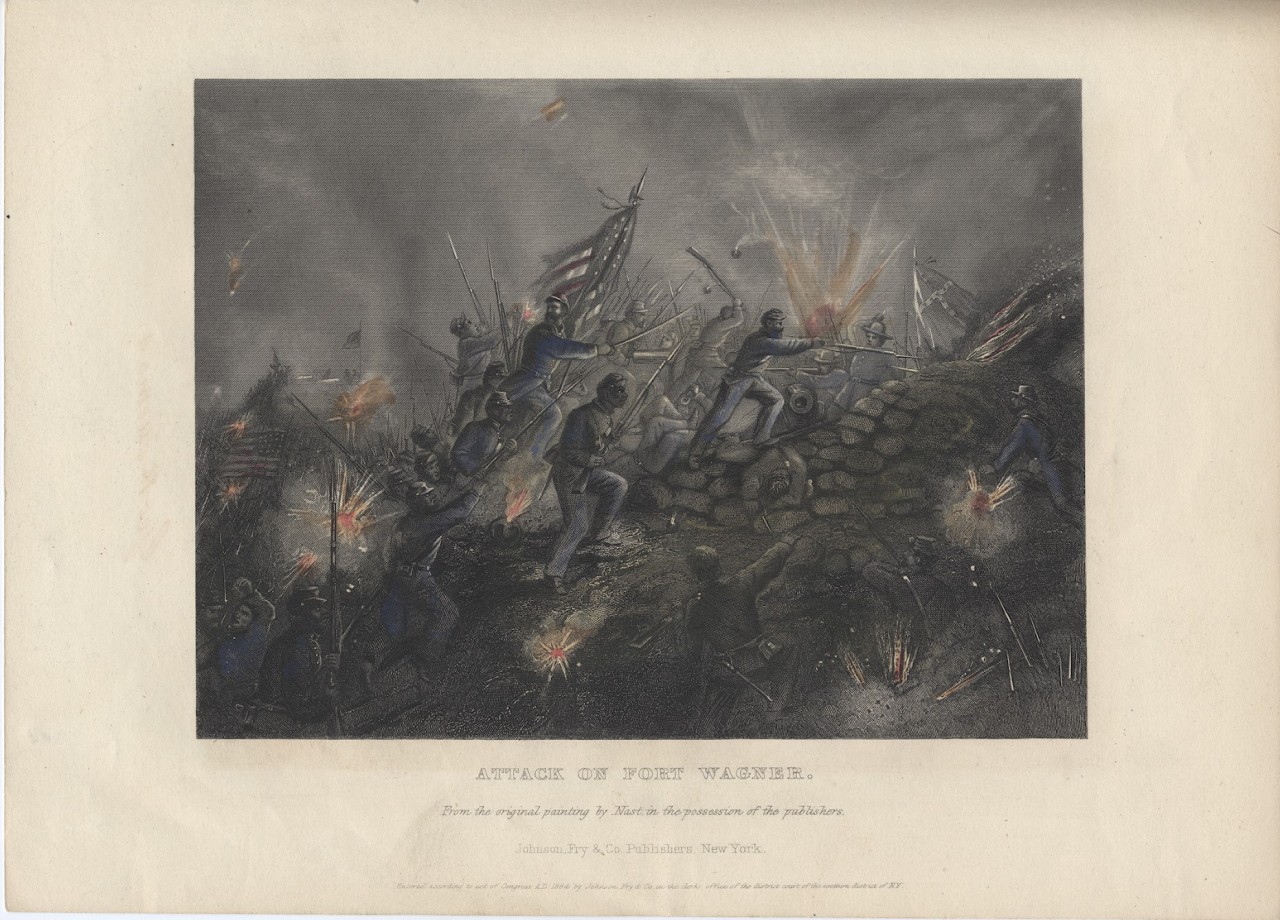
18 July 1863: Union Attack on Fort Wagner by Massachusetts 54th Infantry

18 July marks the anniversary of the assault on Fort Wagner by African-American troops of the 54th Massachusetts Volunteer Infantry, made famous to the present generation by the film, "Glory."

This year, instead of posting about it on that day, I earlier wrote about the changing reactions to the "Shaw Memorial" in Boston, which commemorates Col. Robert Gould Shaw and the troops that he commanded.


For today, several engraved representations of the battle over on the tumblr:


(details here


(details here)

Note the difference: Although both depict the assault, including a heroic bearer of the Union flag (the first bearer was hit, and then Sgt. William Harvey Carney seized it, the first Black to be awarded the Congressional Medal of Honor), the first was produced by a British reporter "embedded" with the Confederate troops, and thus views the attack from the inside. The second, based on a painting by Thomas Nast, presents the (to us) more familiar view of the assault seen from the perspective of the Union attackers.

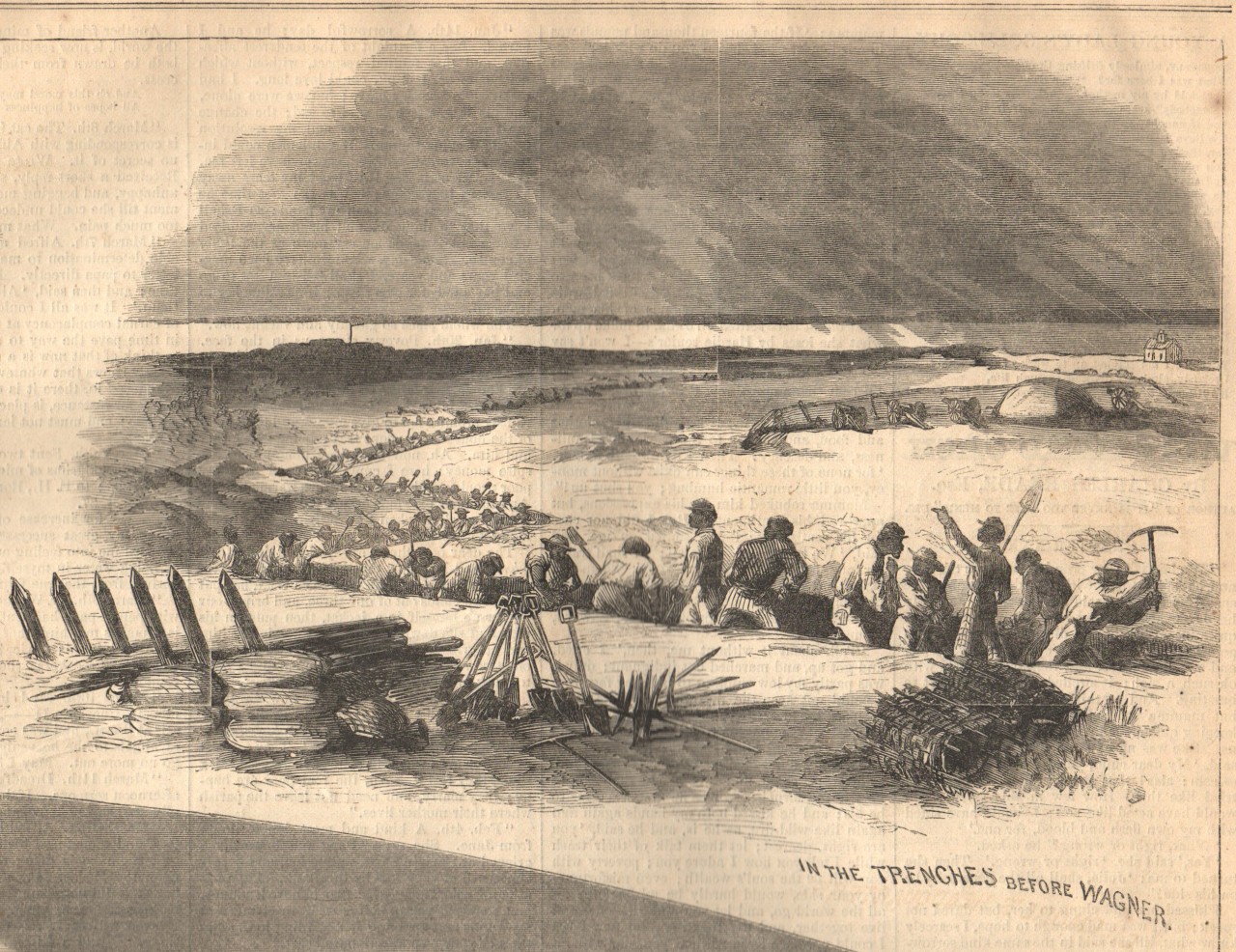
This piece, from an August 1863 issue of Harper's Weekly, depicts African-American troops digging fortifications as the siege of Fort Wagner continued


 (details here)

See all posts relating to the Mass 54th regiment (including the soldiers who came from Amherst).

Tuesday, July 14, 2015

The Confederate Flag and Defending the Shaw (Massachusetts 54th) Memorial


What a difference a century makes.


The great Saint-Gaudens bronze on the Boston Common, depicting the white officer and black soldiers of the Massachusetts 54th Volunteer Infantry Regiment, has become an iconic image of the struggle for freedom and serves as the starting point for the Boston Black Heritage History Trail.

In the wake of the controversy over the flying of the Confederate battle flag in the US south, many of us up here were shocked and concerned to hear that one of these emblems had been attached to the monument.

(Boston Globe)

It turned out, according to the Boston Globe, that the incident was entirely benign. A group of demonstrators had started to burn a Confederate flag, and when dispersed by police, decided to affix the remnants of the banner to Col. Shaw's sword in what they saw as a symbol of victory over the Confederacy and racism. It never occurred to one of the highly educated organizers, described as "a student in a joint program at Harvard Medical School and the Massachusetts Institute of Technology," that anyone might take the  gesture differently.

As the article points out, the monument has occasionally been vandalized in recent years. As chance would have it, I had just recently acquired a little testimony to hostile sentiment about the 1897 sculpture when it was still relatively new.

It is a postcard from 1906, produced by the Metropolitan News Co. of Boston, which was active from 1905 to 1916. Like many other US cards of the era, it was printed in Germany. Prior to 1907, US postcards did not have divided backs: the blank side was reserved for the address, and senders wrote messages on the side of the card bearing the picture. In this case, the anonymous sender expressed revulsion at the sight of the Shaw Memorial, writing "Abominable!!"--with two exclamation points--below the caption.


The message is clear, yet it is puzzling: if the sender was revolted by the image, why buy it? Was the sender so angry that s/he just could not refrain from sharing the outrage?

Although the monument won plaudits from many contemporaries, including Henry James, clearly, not all felt this way. The card thus serves as a salutary reminder. Just over a century ago, some viewers found the memorial repugnant. Today, at even a hint of desecration, we rush to its defense. That is a useful reminder, as well.

Tuesday, July 7, 2015

Surprised that people think the Confederate flag is not a symbol of racism? Listen to what they think about slavery.

Southerners can continue to honor their ancestors, but doing so does not necessitate embracing the vile cause for which they fought — just as Germans can honor their ancestors without embracing Nazism and Japanese without embracing militarism.
--Max Boot, Commentary


many Americans don't seem to think slavery was much of a problem in the first place

In the wake of the horrendous massacre at the Charleston African American church by the racist fanatic Dylan Roof, there has been a startling, salutary, and long overdue willingness to challenge the perversely enduring presence of the so-called "Confederate flag" (actually a version of the battle flag) as ensign and emblem. Where else but in the US today--or until today--would the public display of a symbol of treason be not only tolerated but celebrated? And that's not even taking the question of racism and slavery into account.

Some have expressed surprise that otherwise well-meaning people could insist that the flag is simply a symbol of regional and historical pride, which has nothing to do with slavery and should not be seen as an offense and a provocation. That becomes much less surprising when one realizes that a good many Americans don't seem to think slavery was all that much of a problem in the first place.

Yesterday, the South Carolina Senate voted to remove the offending "Confederate flag" from the grounds of the Statehouse, although subsequent necessary approval from the House was far from certain, and even if successful, the measure might just result in replacement of the battle flag by another Confederate flag. Meanwhile, in Texas, schools are preparing to use textbooks "based," in the words of the Washington Post, "on state academic standards that barely address racial segregation" and "also do not mention the Ku Klux Klan or Jim Crow laws." A Republican Board of Education member was quoted as having called slavery a "side issue to the Civil War.”


"earnest but deep misunderstandings about the nature of American slavery"

I tend to use Twitter more for professional than personal purposes, to keep up with news from and network with colleagues in various historical fields, including historic preservation and history museums. One of the accounts that I follow is @AfAmHistFail. The author, Margaret Biser, who for six years gave tours of a historic southern plantation on which the captive Africans outnumbered the whites by three to one, was dumbfounded when visitors "reacted with hostility to hearing a presentation that focused more on the slaves than on the owner." She began to tweet some of their choicest remarks, which range from the offensive and mindboggling to those reflecting "earnest but deep misunderstandings about the nature of American slavery."

Last month, she offered a summary of what she had heard:
  1. People think slaveholders "took care" of their slaves out of the goodness of their hearts, rather than out of economic interest
  2. People know that field slavery was bad but think household slavery was pretty all right, if not an outright sweet deal
  3. People think slavery and poverty are interchangeable
  4. People don't understand how prejudice influenced slaveholders' actions beyond mere economic interest
  5. People think "loyalty" is a fair term to apply to people held in bondage
As she notes, in many cases, it is probably not so much about an intentional desire to defend slavery as such, and rather, more about the need to defend one's individual or collective national ancestors. (We all saw how Ben Affleck forced PBS to censor the presentation of his ancestry on "Finding Your Roots" because he discovered he had slave-owning forebears--even though no one would seek to visit their sins upon the quintessentially liberal actor.)


How do public historians teach the population about the legacy of slavery and the contributions of African Americans to our collective heritage?

Two African American public historians (among others) are doing brilliant work to teach about the history of slavery and foster understanding by emphasizing a common but not unproblematic American heritage.

Historic preservationist Joseph McGill (@slavedwelling) hit upon the simple but radically original idea of traveling the country to visit every former slave dwelling and, by spending the night in them, calling attention to this lost history and these lost-from-memory historic structures.

The immediate purpose of his Slave Dwelling Project "is to become a clearinghouse for the identification of resources to document and preserve these slave dwellings," but there is also a larger mission:
Now that I have the attention of the public by sleeping in extant slave dwellings, it is time to wake up and deliver the message that the people who lived in these structures were not a footnote in American history.
His work is among the most exciting and innovative efforts of the National Trust for Historic Preservation. It has provoked considerable conversation and now inspired two national conferences. Clearly, it no longer suffices simply to mark sites of memory with a sign. We need new ways to engage the public, so that it can understand the place of history as not only the past and memory but also an active contributor to the world that we have inherited.


In a related realm, Michael Twitty (@koshersoul) travels the country to explain our fascinating and tangled foodways. His afroculinaria.com presents his work as "a food writer, independent scholar, culinary historian , and historical interpreter personally charged with preparing, preserving and promoting African American foodways and its parent traditions in Africa and her Diaspora and its legacy in the food culture of the American South." His work is multifaceted, focused on three fronts:


Antebellum Chef emphasizes "the vast number of unknown Black cooks across the Americas that were essential in the creation of the creole cuisines of Atlantic world" and their contribtion to the overall "Southern food heritage. A corollary is the need for “culinary justice” in contemporary African American communities suffering from poor health, food deserts, and other symptoms of inequality.

Kosher Soul explains: "Identity cooking isn’t about fusion; rather its how we construct complex identities and then express them through how we eat.  Very few people in the modern West eat one cuisine or live within one culinary construct."


Finally, The Cooking Gene seeks "to document the connection between food history and family history from Africa to America, from slavery to freedom" as Michael "visits sites of cultural memory, does presentations on his journey, and visits places critical to his family history while conducting genealogical and genetic research to discover his roots and food heritage." It is not only an attempt to recover the Black heritage, but also "a proving ground for racial reconciliation and healing and dialogue" which thus "seeks to connect the whole of the Southern food family."

The nation's history, good and bad, black and white, is our collective history. The sooner we recognize that, the better off we will all be. As the foregoing examples show, historic preservation and public history have a crucial role to play here--and the individual with a vision can make difference.


Friday, February 27, 2015

When a Minstrel Show in Amherst "was considered a success"


To be precise, "considered a success both in its performance and numbers, as shown by about 350 in attendance."

The date: 1951. A few years before Brown v. Board of Education but well after supposedly decent and educated people should have known better.

Not even 65 years ago, but the distance between that time and this seems much greater.


ICYMI: Read the full story.

And afterwards, be sure to fill out the Amherst Together survey so that we can "advanc[e] community, collaboration, equity and inclusion."


Update (19 March)
Of course, it could be worse:

Belgium minister sparks scorn by 'blacking up' (CNN, 19 March 2015)

Wednesday, February 18, 2015

Scenes From the First Official Amherst Black History Month Celebration, 2014

The weather on the occasion of the first official Black History Month celebration in Amherst last year could not have been more different from what we experienced this past weekend. In 2014, some of the roughly two dozen participants wore short sleeves as they listened to UMass student and Amherst Human Rights Commissioner Damon Mallory open the ceremony.


State Representative Ellen Story and State Senator Stan Rosenberg presented the Town with two documents from Boston. The first of these was a citation from the Legislature, honoring the founding of the Amherst Human Rights Commission.


Front row, left to right: NAACP member and former Select Board member Judy Brooks, Human Rights Commissioners Sid Ferrierra, Damon Mallory, Kathleen Anderson (also NAACP President), and Gregory Bascomb.
Back row, left to right: Civil War reenactor Charleston Morris, State Rep. Ellen Story, State Sen. Stan Rosenberg


The second document was a proclamation by Governor Deval Patrick in honor of Black History Month.


Proclamation By His Excellency Governor Deval L. Patrick 


Whereas During the month of February people gather together across the country to celebrate Black History Month and

Whereas Black History Month reminds us of the struggles and personal sacrifices of African Americans, and honors their outstanding contributions and achievements, especially in the advancement of civil rights and equality; and

Whereas Massachusetts African Americans have made a great imprint upon our country's landscape: Edward Brooke, the first Black Senator elected by popular vote; Crispus Attucks, the first causality of the American Revolution; W.E.B Du Bois, author, historian and civil rights activist; and the 54th Massachusetts Volunteer Infantry Regiment, one of the first official black regiments of the Civil War; and

Whereas Our vibrant African American community continues to be a vital part of the Commonwealth's rich diversity by contributing significantly to all aspects of daily life, including education, medicine, commerce, agriculture, communications, public service and high technology,

Now therefore, I, Deval L. Patrick, Governor of the Commonwealth of Massachusetts, do hereby proclaim February 2014, to be,

BLACK HISTORY MONTH
And urge all the citizens of the Commonwealth to take cognizance of this eventand participate fittingly in its observance.
Given at the Executive Chamber in Boston, this twelfth day of February, in the year two thousand and fourteen, and the Independence of the United States of America, the two hundred and thirty-seventh. 
By His Excellency Deval L. Patrick


Another project of Black History Month in Amherst consisted of posters in local store windows, celebrating African American figures with a connection to the town. Two examples:


 Singer-songwriter Natalie Cole studied at the University of Massachusetts.


Prolific author and former UMass professor Julius Lester. On April 16, he
will receive the 2015 Award for Local Literary Achievement 


Springfield-area Civil War reenactors of the Stone Soul Soldiers, Peter Brace Brigade, provide an honor guard for the ceremony.

Second Annual Amherst Black History Month Celebration, New Select Board Proclamation

For the second year in a row, the Town of Amherst, responding to the initiative of residents, has celebrated Black History Month with a ceremony in front of Town Hall.

Black History Month word cloud logo on Town website, 
designed by our skilled GIS guy and all-'round IT expert Mike Olkin (@MikeOlkin)


Over three dozen participants--an impressive figure given that the thermometer stood at a bitter 8 degrees Fahrenheit (-13 C) with a wind chill of around -1--braved the cold to signal their commitment to Black history and human rights.


Community activist and former Select Board member Judy Brooks in both years played a crucial role in making this event happen. My fellow Select Board member Alisa Brewer (@avbrewer) took the initiative in coordinating the Town involvement and working out the details of our 2015 ceremony.

This year, likewise in response to requests from the community, the Town for the first time issued an official proclamation marking the occasion and calling upon all residents to join in celebration. It made perfect sense: after all, we annually issue a proclamation for Puerto Rican Day and Tibet Day, and just two weeks ago, we marked the first Irish Day. It was but logical that we formally acknowledge an event that has been celebrated around the country for decades.


From Negro History Week to Black History Month

Many of us are familiar in general terms with "Black History Month," but not with its origins. In 1926, historian and journalist Carter G. Woodson initiated Negro History Week as a means of calling attention to the struggles and success of African Americans. He chose the second week of February because it included the birthdays of both Abraham Lincoln and Frederick Douglass fell. Within a few years, most states acknowledged the event. In 1969, in the context of the political upheavals of the Civil Rights and peace movements, members of the Black United Students at Kent State University urged the expansion of the celebration to a full month, which took place the following year, (only months before the University gained notoriety as the site of the notorious killing of antiwar protesters). In 1976, President Gerald Ford lent the authority of the federal government to the new month-long celebration, which entered into public law with the Congressional Resolution of February 11, 1986. Since 1978, the United States Postal Service has issued commemorative stamps for Black History Month. Although referred to as "National African American History Month" in more recent US proclamations, "Black History Month" remains the more common popular term.


Amherst Black History Month Proclamation, 2015

Whereas, since the Bicentennial year of 1976, Americans of all walks of life have come together during the month of February “to honor the too-often neglected accomplishments of black Americans in every area of endeavor throughout our history,”

Whereas these accomplishments are the more remarkable for having been won at the cost of great struggle and sacrifice by men and women who came to these shores in chains, and by their descendants,

Whereas the authors of these accomplishments in Massachusetts history include:
  • Phillis Wheatley, the first African American to publish a book of poetry in America; 
  • Crispus Attucks, the first causality of the American Revolution; 
  • Edward Jones of Amherst College, the second African American to earn a college degree; 
  • Edmonia Lewis, the first professional African American sculptor, who learned her craft in Boston; 
  • the members of the 54th Massachusetts Volunteer Infantry, the first and most famous unit of African American Union soldiers raised in the Civil War 
  • Jan Matzeliger, inventor who revolutionized the shoe manufacturing industry; 
  • W. E. B Du Bois, pioneering scholar and civil rights activist; 
  • Edward Brooke, the first African American senator elected by popular vote; 
  • Deval Patrick, the second elected African American governor in the nation 
Whereas captive Africans and free people of color were already part of the Amherst story in the Colonial era,

Whereas the African American residents of Amherst have fought for our collective defense and freedom from the Revolution and Civil War to the present,

Whereas the African American community—some of whose distinguished figures are depicted on the History Mural in West Cemetery—continues to contribute to the rich diversity and general welfare of both the Town of Amherst and the Commonwealth,

Whereas, to its shame, Massachusetts participated in the slave trade since 1638, but to its honor, in 1783 became the first state in the new nation to abolish slavery as “inconsistent with our own conduct and Constitution," thereby demonstrating our determination to live up to our historical ideals as we strive to build a better common future,

Whereas, as President Barack Obama has proclaimed, “Every American can draw strength from the story of hard-won progress, which not only defines the African-American experience, but also lies at the heart of our Nation as a whole,”

Now, therefore, we the Select Board of the Town of Amherst, do hereby proclaim February 2015 as Black History Month, and urge all residents to mark this occasion, and to participate fittingly in its observance, beginning with a flag-raising ceremony to be held in front of Town Hall on February 14.

Voted this 10th day of February, 2015

Amherst Select Board

Aaron Hayden, Chair
Andy Steinberg
James Wald
Alisa Brewer
Constance Kruger 


Let our rejoicing rise / High as the listening skies

In 2015 as in 2014, a central feature was the raising of the African American flag, and the singing of "Life Every Voice and Sing," often referred to as the "Black National Anthem."


A member of the Massachusetts 54th reeenactors from the Springfield area
salutes the flag. What further commentary could be needed?

We were sorry that the press did not show up to cover the event, but all the more grateful that reporter Scott Merzbach (@scottmerzbach) managed to rush out an advance story on Black History Month in the Gazette, which probably did a great deal to boost turnout. We hope that next year the Human Resources/Human Rights Department in Town Hall will take charge of the event to emphasize its status as a Town-sponsored and regular observance.

Note: because I was participating in the ceremony, I could not take as many photos as I wished, but Larry Kelley offers a selection on his blog. Unfortunately, his post generated some ugly comments. I am appalled at (by not surprised by) the venom and racism. It is a real shame: he tried to report objectively on a town event, and the talkbacks are dominated by hate speech (and rebuttals).

* * *


Amherst Proclamation on Black History Month: the names

I was tasked with crafting the document for the Town. One course of action that was suggested--and it would have been the easiest--would have been simply to duplicate either the current presidential or recent Massachusetts gubernatorial proclamations. However, the former dealt with both more general and more contemporary matters, and the latter seemed, frankly, rather perfunctory as regards Massachusetts history, as well as lacking the eloquence of the former.
 
Some topics or individuals appear virtually de rigueur, but at the same time, one hopes not simply to reinforce the commonplace. For example, it seemed obligatory to mention the soldiers of the famed Massachusetts 54th Volunteer Infantry--but, although they are among my personal historical favorites, the single-minded focus on this one regiment (an emphasis reinforced by the popularity of the Hollywood portrayal in "Glory") can tend to shortchange the Black soldiers who fought in other units: Of the 21 Amherst African Americans who bore arms for the Union, only 7 served in the 54th. Only 5 of the 21 identified by name are buried in West Cemetery, and only one of those is from the 54th. Our text therefore notes that the 54th was the first and most famous of these heroic units.

The 2014 Massachusetts proclamation listed only male politicians and military men, so I made sure to include figures from other fields--and women.

For example, many believe that the first Black US college graduate was from Oberlin--presumably because of the school's association with abolitionism--but the earliest Black college graduates were in fact all from New England: the first from Middlebury, in 1823; and the second, Edward Jones, from Amherst (1826). It seemed important to call attention to our local history, and to remind the public that innovation and inclusiveness at Amherst College have a long tradition. The inclusion of Jan Matzeliger, the self-taught inventor who solved the last and most difficult problem in the mechanization of the shoe trade, calls attention both to Black immigrants (he was from Dutch Guiana) and to the neglected but important role of African Americans in technology and industry. As Mass Moments explains, his invention made it "possible for working people to afford decent shoes" and "Today, all shoes manufactured by machine — more than 99% of the shoes in the world — use machines built on Matzeliger's model."

In the case of women in African American history, we often think of the political activists, such as famed abolitionist Sojourner Truth, who lived in nearby Florence. I chose to focus on the contributions to high culture: the eighteenth-century poet Phillis Wheatley is of course known to scholars of American history and literature but is not exactly a household name. Even less well known is Edmonia Lewis, the first professional African American sculptor. It was in Boston in the 1860s that she studied art and exhibited two sculptures of heroes of the Massachusetts 54th. Proceeds from sales of copies of her bust of Col. Shaw both supported Black soldiers and funded her relocation to Rome, where she won international acclaim.

Any short list is necessarily incomplete and subjective, but future proclamations can include further individuals and groups. One hopes that the proclamations and lists will provide an opportunity to educate our community about the African American contributions to our collective society and heritage. (See also the resources for further reading at the bottom of this page.)


A footnote:

After the ceremony, retired Amherst College physics professor and amateur historian Bob Romer buttonholed me to "quibble" with one aspect of the proclamation: The "abolition" of slavery, he said, hadn't actually eliminated the practice in Massachusetts. His research taught him that here, as elsewhere in New England, "slaves" continued to appear in lists of property and the like for some time afterward. That is true, but it's also irrelevant, and in two ways.

     First, although this fact may come as a revelation to some, it is not news to professional historians. As the Massachusetts Historical Society explains, "slavery did not disappear completely for some time. Slavery, often recast as indentured servitude . . . was not unheard of in Massachusetts through the end of the eighteenth century."

     Second, be that as it may, it in no wise diminishes the significance of the action, and to harp on it is therefore to misunderstand the nature of both historical action and contemporary commemoration.

The Massachusetts Constitution stated:
All men are born free and equal, and have certain natural, essential, and unalienable rights; among which may be reckoned the right of enjoying and defending their lives and liberties; that of acquiring, possessing, and protecting property; in fine, that of seeking and obtaining their safety and happiness.
Two legal cases in the 1780s used this text to argue that slavery was illegal in the Commonwealth, and the Chief Justice agreed, writing, "there can be no such thing as perpetual servitude of a rational Creature ..." 

The Massachusetts Historical Society concludes, "Together with the Mumbet decision, the Quock Walker trials effectively ended slavery as a legal practice in Massachusetts." It therefore calls the 1783 decision a "monumental ruling."

One could make a comparable point about the Emancipation Proclamation, whose anniversary we recently celebrated. It applied only to the territories of the Confederacy not yet under the control of the Union. Secretary of State William Seward observed with bitter but exquisite irony: "We show our sympathy with slavery by emancipating slaves where we cannot reach them and holding them in bondage where we can set them free." Nonetheless, as the National Archives says, "Although the Emancipation Proclamation did not immediately free a single slave, it captured the hearts and imagination of millions of African Americans, and fundamentally transformed the character of the war from a war for the Union into a war for freedom."

We can acknowledge the limitations of these two abolition measures and nonetheless hail them as landmarks.


Q.E.D.


Coming attractions:

Because I didn't manage to write at the time of last year's ceremony, I will now post some photos from that event.


Resources


The History of Black History Month

Historic Sites


Further reading on some of the figures and events mentioned in our proclamation:


Phillis Wheatley
Slavery and the Abolition of Slavery
Edward Jones
 54th Massachusetts Volunteers
Edmonia Lewis
 Jan Matzeliger
W. E. B. Du Bois
Edward Brooke


Friday, December 12, 2014

Amherst Woman During Prohibition Era: George Washington was NOT a drunk!


What curious, serendipitous finds one makes when doing research. A week ago, we marked the anniversary of the repeal of Prohibition. Not long before that, I came across a perfect illustration of how American attitudes about drinking have changed since the Colonial situation described in the last post.
 "Local D.A.R. Woman Defends U.S. Ideals.
 Writes Paper Denying That George Washington was 'a Drinking Man'"
Is that one subject or two? readers could be excused for wondering as they picked up the Springfield newspaper in 1930.

The news was that the Massachusetts Daughters of the American Revolution had asked the head of the Amherst chapter to send copies of her paper on cultural conflicts and American ideals to the state and national headquarters. Her point, it seems, was openness to change, provided it occurred within the framework of our founding system: to avoid "letting down the bars to strange and foreign ideas and ideals" and "see to it that the constitution is not wrecked by the addition of weakening amendments." "The American," she said, does not hesitate to change methods if by so doing he can better conditions, but he does hold fast to the fundamentals upon which his country is founded."

A liberal defense of traditional freedoms? Conservative "strict constructionism"? It can be hard to tell from such fragments. For example, many of us now associate the D.A.R. of that period with the notorious refusal to allow African-American singer Marianne Anderson to perform in its Constitution Hall in 1939, and indeed, Amherst itself was hardly free of nativism and racist behavior. However, the author's biography suggests greater complexity.

Estella Adaline Eastman Harris (1880-1974) was a resident of my own North Amherst who married carpenter Charles Dickinson Harris (1877-1955) in 1904. Neither went to college, but clearly, she had intellectual ambitions. She was also proud of her ancestors, who included not only the Pilgrim Roger Eastman and her Revolutionary forebears, but also the great abolitionist Zebina Eastman (1815-83), one of the founders the Republican Party in Illinois, appointed by Abraham Lincoln as Consul in Bristol (1861-69).

The Liquor is the Lede?

"Foreign ideas" and challenges to the Constitutional order must have been among the pressing concerns in the political and economic crisis of the 1930s, but, curiously, the article led with the liquor, explaining that the essay "describes the attempts to discredit the great men of American history, especially George Washington, saying he was 'a drinking man.'" We don't get to the Constitution and Monroe Doctrine until more than halfway through.

The article quotes Mrs. Harris as saying:
In the olden days it was the commonly accepted custom to use liquors. As we know, many of the churches were raised to the accompaniment of strong drink. So why endeavor to dim the luster of a great man's life by accusing him of doing something that everyone at that time accepted as correct. Even in those days, he was rated as temperate.
This could of course take us into the intellectual and moral morass of historicist relativism. After all, slavery was also something that (almost) "everyone at that time accepted as correct." And when she wrote, the DAR itself practiced racial discrimination. That said, her point is quite accurate, and the subject of the previous post.

As Corin Hirsch (@latesupper) explained in her Amherst Historical Society lecture last month, everyone in Colonial America, from churchmen to Founding Fathers, drank like a sailor on leave all year 'round (and often all day). Implicitly agreeing with Mrs. Harris, she said:
  • George Washington "was a man of all things alcoholic, but he was not an alcoholic,"  "a fanboy of small beer . . . and enthusiastic swiller of porter." He also became one of the nation's leading distillers of whiskey. 
  • As for Ben Franklin, he was "a sot, marinating in porter, Champagne, brandy, Madeira and the fine wines of France." 
W. J. Rorabaugh'sThe Alcoholic Republic, (Oxford, 1981), which she used in her research, confirms Mrs. Harris's view that, when it came to heavy drinking, at least, there was no wall of separation between church and state:
New York Governor Georg Clinton honored the French ambassador with a dinner at which 120 guests downed 135 bottles of Madeira, 36 bottles of port, 60 bottles of English beer, and 30 large cups of rum punch. Even in staid New England the upper classes continued to imbibe; at one Congregational minister's ordination in 1793, the celebrants consumed dozens of bottles of hard cider, wine, sherry, cherry brandy, and Jamaica rum. (48)
Ms. Hirsch provides some specific numbers: "At the 1785 ordination of a Beverly, Massachusetts, minister, the eighty attendees drank seventy-four bowls of punch as well as twenty-eight bottles of wine and eight bottles of brandy."

Lots of Liquor at Raisings. High Church?

Speaking of the church: It is said that when the horse teams brought in the granite for the foundations of our own North Amherst Church, Oliver ("Landlord") Dickinson, who had financed much of the project, rode all the way into town from Pelham atop one such load of stone, moved by drink to boisterous song. And when the church was finally dedicated, Carpenter and Morehouse tell us in their classic history of the town, "The raising was made a gala occasion, liquor being generously provided and consumed, the expenses being met by contributions."

Dickinson was a tavernkeeper, for like every good New England town, Amherst had its share of taverns. The reason this institution was so popular, as both they and Hirsch explain, is because the "public house," as the name implies, was not just a source of food, drink, and lodging, but also a social center: for meetings, discussion, reading of periodicals, even convening of court. Take the Baggs Tavern (1818 ff.), for example.

source: Wikimedia Commons


In the words of Carpenter and Morehouse:
In 1828, it was the headquarters of the democratic party in town, where caucuses were held and the politicians gathered in the bar-room of an evening to discuss the state of the country. It was famous for the excellence of the liquors served over its bar and the royal good times that were enjoyed by those who loved the liquors, not wisely but too well. It was a favorite gathering place for the old stage-drivers, who found its toddy and its flip a powerful antidote against winter's cold and summer's heat.
The Amherst branch of the D.A.R., to which Mrs. Harris belonged, is the Mary Mattoon chapter, named after the wife of a local patriot. (With characteristic inflation, we generally refer to him as "General Mattoon," but that title came late in life when he led the Massachusetts Militia; during the Revolution, he was a mere lieutenant.)


As it happens, this chapter, founded in 1894, met and now once again meets at the eighteenth-century Simeon Strong House, which was also since 1916 the home of the Amherst Historical Society, where Corin Hirsch demonstrated her Colonial bartending skills last month.


The Cider House. It Rules!

When Simeon Strong--theologian, Tory, and then respected jurist in the new republic--died in 1805 with an estate worth approximately $ 10,000, he was among the ten richest men in Amherst. A glance at his probate inventory provides some hints at the culture of drink among the upper class. It lists, for example,
  • 1 pair fluted decanters (valued at 2.50)
  • 2 pair plain decanters (2.00)
  • 2 pair round-bottomed decanters (.75), and 
  • 1 pair decanter stands (1.25). 
This, in addition to:
  • 16 wine glasses (best sort) (worth 4--)
  • 9 wine glasses (worth .90)
  • 14 tumblers (worth 1.75)
  • 5 pint tumblers (worth .62)
  • 10 tumblers and 2 small glass canns ["cans" were small, straight-sided drinking vessels] (@10, worth 1.00), and 
  • 2 one-quart tumblers (@ .33)
Among the items that his second wife brought to the marriage was a china punch bowl, once again, a luxury item (1.00: equivalent to four chamber pots--or a volume of Foster's Crown Law Reports--in case you were wondering).

At the same time, we are able to discern tastes that crossed class lines. Hirsch tells us that the hard cider "was an almost uniquely New England drink," and Timothy Dwight's account of his travels (1796-1815) described it as "the common drink of all its inhabitants, the rich and poor alike." John Adams found it "mortifying beyond all expression that we Americans should exceed all other eight millions of people on the globe . . . in this degrading, beastly vice of intemperance"--and nonetheless downed a tankard of hard cider at his daily breakfast (yes, breakfast), which speaks volumes about the cultural gap between that era and ours.

In Strong's probate inventory, we thus find 13 barrels of cider, 28 empty cider barrels, 5 old cider barrels, and 1 barrel of old cider. The typical New England farmer, we are told, produced about 10 (50-gallon) barrels per year. According to Hirsch, "By the mid-1700s, the average New England family might consume a barrel of cider a week," which explains her verdict, "Early Americans imbibed hard cider with gusto."

You see how everything comes full circle?

Today, although our drinking habits and mores have changed, cider has been undergoing a revival. Our Pioneer Valley cider business, too, is growing: its products are sold at the Amherst farmers market, the All Things Local Cooperative, and an annual festival dedicated to the juice of the apple.

One is strongly tempted to conclude that Mrs. Harris took much of her argument from Carpenter and Morehouse. They write, somewhat apologetically, before launching into a discussion of the rise of temperance movements:
the drinking habits of the earlier residents of Amherst . . . . were not peculiar, merely following the fashion of their times. It is almost impossible, in later times and under changed conditions, to write of the liquor problem as it existed in the closing years of the 18th and the opening years of the 19th centuries, without doing something of an injustice to those who upheld a system which has since come to be looked upon as pernicious and degrading. The part that liquor then bore in social, business and community life was honored if not honorable. Total abstinence from liquor, while not unknown, was looked upon as an eccentricity rather than a virtue. The minister drank liquor with his deacons, the lawyer with his clients, the doctor with his patients. A 'raising' without the presence of liquor was unknown; ministers drank flip at ecclesiastical councils and ordinations; hardly a trade was made at the village without 'something to wash it down.' . . . Drunkenness, while not encouraged, was tolerated, carrying with it no special disgrace.
Like it or not, heavy drinking was among "the fundamentals upon which [t]his country is founded." As the late historian Eugen Weber wrote, the decent folk in the Anglo-American world of that era were drunk all the time, dead drunk most of the time, and apparently none the worse for it except in the long run, and perhaps not even then. Mrs. Harris--whose drinking habits we do not know (though she lived to the ripe old age of 93)--might not have put it quite that way to the prim dames of the DAR, but her point was the same.


Cheers.


updates:

updated images