Showing posts with label November Anniversaries. Show all posts

Friday, December 2, 2016

Civic Forum: The Velvet Revolution of November 1989 and Beyond

Because I'm teaching my course on modern East Central Europe again this fall, it seems an appropriate time to remember the so-called "Velvet Revolution" (a sappy term I never liked) in the course of which dissidents peacefully forced the hard-line Czechoslovak communist regime from power in 1989.

The driving force behind the revolution were the dissidents such as Václav Havel, associated with the Charter 77 human rights movement. As the spirit of protest spread throughout the bloc in the fall of 1989, they organized themselves as  the "Civic Forum" (Občanské fórum, OF).


I acquired this small--I guess you would call it a (?)--mini-placard some years ago in a Prague antiquariat. It displays the name of the organization against the background of the Czechoslovak flag. It is the size of a small bumper sticker (193 x 63 mm.) but is printed on stiff (now yellowed) pasteboard and thus lacks adhesive, which makes me wonder what its intended use was: for display in apartment or store windows? (After all, Havel's famous essay on "the power of the powerless" anchors its notion of "living in truth" in the story of those who agree vs. decline to accede to the regime's supposedly meaningless and harmless demand that they place its propaganda signs in their windows.) For display in an automobile? And when? The dampstaining at the bottom suggests that it was actually placed in a window where it would have been subject to condensation arising from a heated interior in cold weather.

It is at once an inspiring and a sad memento. Although Czechoslovakia had been an island of liberal democracy among the post-World War I successor states that drifted toward authoritarianism, it became one of the most hardline communist states after 1948, and indeed, its leaders (in contrast to those of Hungary and Poland) refused even to nod to the de-Staliniziation "thaw" in the wake of Krushchev's denunciation of Stalin's crimes in 1956. Following the short-lived and optimistic episode of the "Prague Spring," crushed by Warsaw Pact tanks in August 1968, the regime pursued a quietly brutal policy of "normalization."
Despite this long history of resistance to reform, the communist regime collapsed in only ten days in 1989 in the face of determined citizens jingling their keys and refusing any longer to be afraid. Former dissident Václav Havel became president at the end of December 1989.

By 1991, however, the movement split into conservative-capitalist and liberal factions. The latter triumphed in the elections of 1992, and the latter passed from the scene.  A cautionary tale about politics in more ways than one.

Monday, November 28, 2016

My Little Book-Historical Connection to Alice's Restaurant

This book is my copy of the English edition of Ernst von Salomon's bestselling Fragebogen (The Questionnaire [1951]).


Von Salomon (1902-72) was a German right-wing extremist of the interwar years, implicated in several acts of political violence, including the assassination of German Prime Minister Walther Rathenau. Though he never gave up his extremist beliefs, he moved in heterodox arch-conservative circles and claimed that he never became a Nazi. He was nonetheless briefly imprisoned as one after the War. Several years after his release, he published his memoirs, for which he sarcastically employed the format of the lengthy questionnaire (Fragebogen) on past political activity that the Allied occupation forces used to implement their de-Nazification policy.

The translator is the World War II intelligence officer and novelist Constantine Fitzgibbon, who also produced the English version of the memoirs of Auschwitz Commandant Rudolf Höss. Ironically, his half-brother Louis Fitzgibbon became a noted Holocaust denier. 

The late Robert Wistrich was unsparing in his portrait of von Salomon as a typical "noble fascist" (as the German term has it): a violent extremist who had contributed to the death of German democracy and then claimed to have moral or practical qualms about the vulgar Nazis and their terror, yet profited from the regime and its backing, and after the war was unrepentant, drawing a false moral equivalence between Nazism and Allied occupation. The book, he said, "was a bitter, cynical personal testament, which exposed his utter indifference to questions of guilt and repentance."

The blurbs on the back cover, among my all-time favorites in this genre, are in the same spirit as Wistrich's sketch. (Hugh Trevor-Roper was the historian of Tudor-Stuart England who, while working as an intelligence officer in 1945, was tapped to write the account of The Last Days of Hitler [1947].)


I acquired this at Paul's Books, one of the great used bookstores in Madison, WI (I went to school with the kids and knew the late owner, as well as his widow, who maintained the store and always greeted me effusively whenever I returned in later years). I bought it because I was taking classes and doing research on Nazism. It turned out to command my interest for other reasons, as well.

It has to be one of the more unusual items in my library: because it is an "association copy," valued for the connection to the author or owner rather than for its intrinsic nature. In this case what makes the book unusual is not just the fact that it made its way from the northeast to the midwest, but the "Alice's Restaurant" connection. How it got to Paul's bookstore, I have no idea.

Alice's Restaurant

Many (particularly those who lived through or developed an affection for the era of the counterculture) will know this modern folk classic and the backstory. If not, the Massachustetts Cultural Council's "Mass Moments" explains:
[On November 28, 1965] 20-year-old Arlo Guthrie was convicted of littering in the Berkshire County town of Stockbridge, and the song "Alice's Restaurant Massacree" was born. The son of legendary musician Woody Guthrie, Arlo and a friend were spending Thanksgiving with Alice and Ray Brock at the couple's home in a former church. Alice asked the boys to take a load of trash to the town dump. When they arrived, they found that the dump was closed, so they threw the trash down a nearby hillside. Guthrie turned the story of their subsequent arrest and court appearance into a best-selling record.

The story of "Alice's Restaurant" begins and ends at a church in Great Barrington, Massachusetts. By the 1960s, the small, pine Gothic Revival building had lost its congregation. The Episcopal diocese put the building up for sale, and in 1964, Alice and Ray Brock purchased it. After a formal de-consecration ceremony, the young couple moved in.

The Brocks were a creative and charismatic pair who had been influenced by Jack Kerouac and other members of the Beat Generation. Ray was an architect and woodworker, Alice a painter and designer. Both worked at a private school in nearby Stockbridge. They transformed the former church into a quirky but welcoming place where their students and other young people could find refuge from "establishment pressures," especially the Vietnam War and the draft.

Ray and Alice served as surrogate parents for the young women and men who camped out, sometimes for weeks at a time, at the church. The neighbors were not happy about the arrangement. They viewed the Brocks and their guests as drug-using, long-haired hippies. Agitated residents honked their car horns and yelled as they drove past; they wrote letters to the editor protesting the presence in their community of what they called a "beatnik commune."

It was in this context that police officer Bill Obanhein reacted so strongly when the church group was implicated in the Thanksgiving trash dump. That evening, the Brocks received a call from Obanhein. He had spent "two very unpleasant hours" going through the debris until he found an envelope with the Brocks' name. Alice confirmed that Arlo and his friend were the culprits. Obanhein summoned the boys to the police station.

"Officer Obie" later admitted that he had no sympathy for longhaired, nonconformist teenagers, although he conceded that they were basically "good kids." He decided to give them a scare and make an example of them so that the town would have no more trouble with hippies. He arrested the pair and put them in a jail cell until a furious Alice Brock bailed them out. Two days later, they appeared before a blind judge and his Seeing Eye dog, who "viewed" Obanhein's photo evidence of the trash dumping and convicted the two young men of littering. He fined them $25 each and ordered them to clean up the trash.

After paying the fine and completing the cleanup, Arlo Guthrie began composing what would take up one entire side of his first album. Eventually 18 minutes long, "Alice's Restaurant Massacree" evolved slowly over the next two years. The first verses written recounted the events of Thanksgiving 1965. Later Arlo added lyrics critical of the Vietnam War. When Alice Brock opened a restaurant in Stockbridge in early 1969, the song found its refrain, "You can get anything you want at Alice's Restaurant." Then, finally, there was the draft. Called before his New York City draft board for a hearing on his fitness for military service, Arlo faced a final question: "Have you ever been arrested?" In the song, his conviction for littering saves Arlo Guthrie from the draft. In reality he was classified 1A, but his lottery number never came up.
I first learned of the incident when I was in middle school. We were having a sleepover at a friend's house, and when we got up the next morning, my friend's mother said, "Alice's Restaurant is on." Because her name was Alice, I at first thought she was just referring to her breakfast menu, but then she played the album in its final version with the Vietnam lyrics, and I made another step forward in my cultural literacy.


A Birthday in Massachusetts

Back to the book. The owner, whose rather conventional bookplate graces the inside cover, wrote a long inscription on the flyleaf, recounting bicycle travels in Massachusetts with friends, culminating in a birthday celebration at which several friends signed the volume.


The last two names are those of Ray and Alice Brock. Not a book I would ask my close friends to sign, and an odd circumstance for future hippies, perhaps, but such are the discreet charms of book history.


Resources

"51 things about Arlo Guthrie’s ‘Alice’s Restaurant’ on its 51st anniversary" (Boston Globe)

Sunday, November 20, 2016

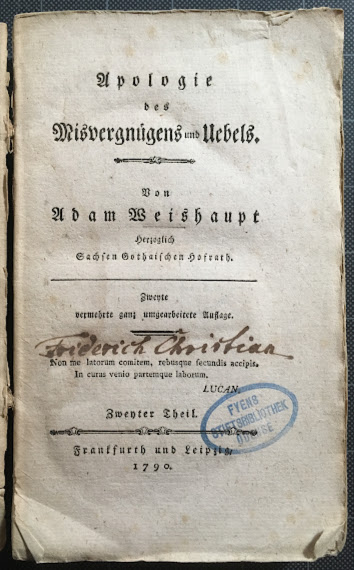
18 November 1830: Death of Adam Weishaupt, founder of the Illuminati

On 18 November 1830, Adam Weishaupt (b. 1748), founder of the Illuminati, died, age 82. Rarely does the modest achievement of a man stand in such disproportion to his historical reputation: the Illuminati stand at the center of one of the world's most enduring conspiracy theories, stretching from the debates over the French Revolution to today's popular culture. (Look it up yourself: it will be a good exercise in information literacy, i.e. separating real historical knowledge from bullshit.)

What I am sharing here is the title page of a little treasure from my personal library: the second edition of the second volume of Weishaupt's Apology of Discontent and Dissatisfaction (1790) a rather tedious (by modern standards; the readers of the eighteenth century were made of hardier stuff) dialogue about religion, philosophy, social change, and the meaning of life: at 366 pages. The book is unbound and remains in its worn blue interim paper wrapper, as issued.


What makes it special to me is actually less the authorship (though that is important) than the ownership: the title page bears the signature of the Friedrich Christian, Hereditary Prince of Augustenborg, in Denmark. In 1791, he granted the great German poet Friedrich Schiller a three-year pension to support him during a period of ill health. Schiller expressed his gratitude by setting forth his evolving ideas about aesthetics in a series of letters to the Prince, which formed the basis for his influential philosophical treatise, On the Aesthetic Education of Mankind (periodical publication, 1795; book edition, 1801).

Friedrich Christian reigned as Duke of Schleswig-Holstein-Sonderburg-Augustenburg from 1794 until his death in 1814. The stamp of the famous Fyens (=Funen) Diocesan Library of Odense appears on the title page and inside cover, and a manuscript note on the latter indicates the book passed to that institution in 1816.


Created in 1813, the library reflected the theological needs of the clergy but was dedicated to "maintaining the scientific spirit and increasing the sum of knowledge for anybody in the province who loves science." By the 1830s, the Citizen's Library operated out of the same building. In the course of the twentieth century, the collection was merged first with that of the Odense Central Library and then the Library of the University of Southern Denmark.

The theological volumes (3,000 out of the total collection of 30,000) passed to the Library of Fuller Theological Seminary in 1948. (This volume appears in the 1902 catalogue under the category of Christian Morality, subheading Mixed Moral Writings.)


* * *


Thursday, November 17, 2016

Veterans Day in Amherst

Veterans Day is one of those quiet but pleasant holidays in Amherst. Attendance at our modest commemoration is small: far lower than on Memorial Day, which entails a much larger celebration and occurs in generally more pleasant weather, as befits the de facto beginning of the summer vacation season.

Perhaps for that reason, it seems more intimate: not just that the group is smaller, but that it is composed of people who feel a personal or family connection to the holiday, especially veterans and their families. The attendees also seem more representative of the real diversity of Amherst.

A few photos from this year's event, which I attended with other Town officials, including fellow Select Board members Alisa Brewer and Doug Slaughter, Assistant Town Manager David Ziomek, Planning Director Christine Brestrup.


Rev. Anita Morris, chaplain for the Amherst Veterans of Foreign Wars, gives the invocation as Veterans' Agent Steve Connor (who organizes the event each year) holds down her papers in the breeze.


Select Board Chair Alisa Brewer offers greetings on behalf of the Town of Amherst


Victor A. Núñez Ortiz, Salvadoran immigrant, Iraq veteran, and Vice President and Chief Operation Officer of Veterans Advocacy Services.


Amherst native and veteran (Marines; Air Force Reserve) Charles Thompson
(service in the Iraq and Afghanistan theaters as well as Europe, Asia) delivers the keynote

Tuesday, November 15, 2016

November 11, 1920: Interment of the British Unknown Soldier

The mass slaughter of the Great War prompted contemporaries to find new ways to remember and mourn. The fact that many of the millions of fallen remained unidentified led to the suggestion one of their number be honored at a national commemorative site. The tombs of both the British and French Unknowns were dedicated on the anniversary of the Armistice in 1920, the former at Westminster Abbey (pointedly placing the commoner alongside the kings), the latter at the Arc de Triomphe. (The US Unknown was interred in Arlington Cemetery a year later.)

This card dates from the dedication of the British tomb.


The Christian symbolism so often associated with national memory is evident on the exterior, which seems to feature forget-me-nots and/or violas rather than the poppy, which acquired its iconic commemorative status (reproduced in silk) the following year.


Pictured at left of the interior is the Cenotaph (commemorating the war dead but containing no body) in Whitehall by Sir Edwin Luytens, dedicated on the same occasion. It replaced a temporary structure that he had designed for the Victory (Peace) Parade in 1919. The Poetry Library lists the poem among its "lost quotations," whose source remains to be identified.

The anniversary of the end of the war, originally called Armistice Day, became Remembrance Day (the closest Sunday to November 12; since 1945) in the Commonwealth and Veterans Day (1954) in the US.