Showing posts with label Amherst/New England History. Show all posts

Saturday, April 1, 2017

Amherst College Picks Emily Dickinson as New Sports Mascot

In Surprise Move, Amherst College Picks Emily Dickinson as New Sports Mascot
Edged Out Leading Contender: “Fighting Poets”


Image of Emily Dickinson from Amherst Colleges Archives and Special Collections

The long wait is over. Although the official announcement is not expected until sometime next week, sources inside the Amherst College administration revealed that, after months of controversy and speculation, they have chosen poet Emily Dickinson as their new sports mascot, replacing eighteenth-century British military leader Lord Jeffery Amherst, considered by many to be politically and morally unacceptable in this day and age. The move came as something of a surprise because, among the five finalists announced to the public, “Fighting Poets” was widely expected to get the nod. A few trustees, gathered for cocktails in the elegant and dimly lit bar of the Lord Jeffery Inn  (spoiler: yes, it’s ironic, but that name isn’t changing yet), late Friday night spoke on condition of anonymity about the process that had just concluded.


A Background of Controversy

The decision arose from the intersection of longstanding concerns and recent protests. For years, Native Americans and their allies have protested both the appropriation of American Indian culture and the related use of racist stereotypes as emblems of sports teams. American campuses have been roiled in conflict for several years over histories of white supremacy as well as continuing issues of institutional racism, but it was the recent activism associated with the Black Lives Matter movement that brought things to a head at Amherst.

The figure of Lord Jeffery Amherst, after whom the college’s sports team—the “Lord Jeffs”—was named, is no stranger to controversy on campus and beyond. In this case, the issue was not a symbol that appropriated  Native American culture, and instead, one associated with its destruction. As almost every Amherst resident and Amherst College student soon comes to learn, Amherst sought to exterminate Native Americans (“this execrable race”) during the “French and Indian War” through an early form of biological warfare by giving them smallpox-infested blankets.

For a long time his ubiquitous emblematic presence caused the administration no discomfort. The College commissioned elegant representations of him on “collectible” Wedgwood china.

Wedgwood plate on display in the library of Lord Jeffery Inn
a great way to start your day: old Amherst College dinnerware
And as late as the 1960s, a stylized depiction of Lord Jeff hunting down Indians was considered a light-hearted scene with which to greet the young WASP males of the “One Percent” as they began their day in the dining commons.

That dinnerware was in the meantime quietly removed, but the presence of Lord Jeff as sports mascot remained. When students of color and their allies rose up in protest in the fall of 2015, he became an obvious target.

Amherst Uprising protest poster, Frost Library, November 2015


A Symbol of Changing Times

The administration took the protests seriously, and President Caroline “Biddy” Martin  returned to campus from her travels to meet with protesters.  In January 2016, the College announced that it was giving Lord Jeff the heave-ho.


In late October, the College announced a public process to select a new mascot. By the end of the year, having received 2045 suggestions, the Mascot Committee chose 30 semifinalists. On Saint Patrick’s Day 2017, the College announced five finalists, to be winnowed through an online voting process ending March 31. They were:

  • “Fighting Poets” (“celebrates multiple poets who have taught, studied or written poetry in association with the college or town of Amherst")
  • “Mammoth” (a reference to fossils in the Beneski Museum)
  • “Purple and White” (the College colors)
  • “Valley Hawks” (“would reflect pride in the campus bird sanctuary and the college’s other connections to avian studies”)
  • "Wolves" (“Known for their keen senses, intelligence and power, wolves collaborate and care for one another in packs, but they can also represent individuality and independence")

Trustee Coup? “Fighting Poets” or not “Fighting Poets”: that was the question

Some of the 2045 suggestions were easy to reject for one reason or another. For example, although “Hamsters” was considered clever by some because Hamster is an anagram of Amherst, it is also the nickname of students at nearby Hampshire College. “A’s” was unimaginative. And “Pride” was just plain mystifying. A younger left-leaning trustee provided particular insight into the deliberations. In his view, it was much like the Trump White House: characterized by chaos and infighting.

The trustees faced a dilemma. Four of the five finalist names were anything but inspiring. Until just recently, “Fighting Poets” therefore seemed to be headed for victory: it was clever, had a light touch, and referred to the college’s intellectual legacy: Emily Dickinson did not attend Amherst College--it was among the last of the Ivies to go coed (1975), and only after great resistance–but her family was associated with the founding and administration of the College, and Amherst owns the Dickinson Museum, which attracts thousands of visitors to the town. Robert Frost taught at Amherst College, and the library is named after him. And Richard Wilbur, winner of the Pulitzer Prize and numerous other awards, is an alumnus (Class of ’41).

Still, as trustees weighed the choice, doubts arose. To begin with, none was really familiar with poetry. A few thought they had encountered Frost or Dickinson in a freshman English class but could not recall much else. Some remembered having seen Richard Wilbur at a dinner and admiring his tweed jacket. “Too bad that Joyce Kilmer didn’t go to Amherst,” one elderly gentleman mused over a Bone Dry Sapphire Gin Martini. “I really liked that poem about trees. But we didn’t let girls in back then.” “Wilbur who?” asked another. “Wasn’t he the guy on that show with the talking horse?” he snorted, as he took a sip from his third Macallan 18 Year Old Sherry Oak 1992.

A more politically aware younger trustee raised doubts even about Robert Frost: the poet came from a racist white nationalist family and was named for Robert E. Lee. His official biographer described him as (in the words of a reviewer) “a nasty piece of work, cruel to his family, dismissive and contemptuous of other writers, a liar and a manipulator.” The same reviewer summarized a fictional portrait of the poet by Joyce Carol Oates as: “racist, sexist, loathsome, bullying.” “’Fighting poets’?!” the trustee asked with some exasperation. “For the Confederacy? Against women? It would be worse than ironic if, after the anti-racist protests on campus, we picked this  guy. Just what kind of message are we sending?!”

“Besides,” another worried, “we might just be opening ourselves up to ridicule. “What are our boys going to yell when these ‘Fighting Poets’ take to the gridiron? You know that Haverford College football cheer: ‘Kill, Quakers, Kill!’ Come on. It’s the worst of both worlds.”


Purple and White Privilege: we’re the trustees and can do pretty much what we want

A group of more traditionally minded trustees therefore tried to come up with an alternative. When asked how they could circumvent the choices developed through an open public process, one who works in corporate law replied that it was perfectly legitimate, in the spirit if not the letter of the charge: “After all, you folks in town did the same thing: you held a flag contest calling for designs based on the theme of ‘the book and the plow’—which, I’ll have you know, was the invention of an Amherst College professor—and then chose the book and three sheaves of grain—even though they’re not a plow and no one ever grew wheat in Amherst. Sauce for the gander, you know. Anyway: we’re the trustees and can do pretty much what we want.”

This trustee faction settled on the figure of John McCloy as the new mascot. He was an alumnus, a major figure in twentieth-century American law, finance, politics, and government, and served on the Warren Commission: an ideal representation of Amherst men in the service of the nation. And of course he was male. That plan fell apart when a young leftish trustee pointed out that, as Assistant Secretary of War, McCloy had played a decisive role in the notorious internment of Japanese Americans, had refused to believe stories of Nazi artocities, and then, as High Commissioner for postwar Germany, had commuted or reduced the sentences of many of the worst Nazis:

“So: you’re dumping a guy who wanted to poison Indians but didn’t actually manage to do so—and replacing him with a guy who put loyal Americans in prison—and let German war criminals out? Bright move.” Besides, he added with a wink, “Just think about the nicknames: If the Lord Jeffs are known as ‘the Jeffs,’ then the ‘John McCloys’ would be known as ‘the Johns.’ I. Don’t. Think. So. Look, if you guys aren’t going to take the need for social change seriously, why don’t you just be done with it and call the team “Purple and White Privilege?”

Ironically, although he spoke those words with bitter sarcasm, they broke the logjam. The trustees began to think in concert about how to spin or improve upon the five final options. It was thus that they hit upon the idea of casting aside the generic “fighting poets” and singling out Emily Dickinson. It was an easy choice and a unifying one. For those on the left, it was thinking outside the box and a means to underscore the College’s commitment to diversity and modern values. For the conservatives, it was a cynical, cost-free choice. The Lord Jeff mascot was a clear liability, easily thrown off the back of the sleigh to appease the wolves. Choosing a woman as emblem would also help to distract attention from damaging news reports concerning an aggressive masculine sports ethos, ranging from rape culture to racist and misogynistic e-mail exchanges. Above and beyond that, the move would secure the future of athletics at Amherst. It is an open secret that, when the trustees reluctantly accepted former President Tony Marx’s demand for emphasis on greater ethnic and racial diversity, the quid pro quo was increased financial support for the sports teams. Was it only a coincidence that, when the trustees selected the first woman president as his successor, they chose Biddy Martin, a self-described “crazed sports fan”? The choice of Emily Dickinson as mascot thus hit the trifecta, solving numerous problems at once, changing things without really changing things.

even on March 31, search engines still show the description of the team under its old moniker


Early Reaction

Discreetly presented with the breaking news on Friday evening in the bar of the Lord Jeff, one professor of English sitting nearby looked up from her Chocolate Appletini and said, “Wow, that’s really disruptive!” “Transgressive, even!” chimed in her colleague from comp lit, giggling slightly as she took a sip from her squid-ink-garnished Firenze-Palermo cocktail. A member of the Hampshire College faculty known to be well versed in both academic and town politics happened to be at the bar, as well: “You know if I were conspiratorially minded—which I’m not: only idiots believe in conspiracy theories—I’d say that this was a cunning plan by the Emily Dickinson Museum to get the College finally to pay attention to its most valuable cultural resource. Everyone knows that, even though Biddy Martin was trained in literature, she has never really shown much interest in the Museum. She’s set foot there like, what: once in her life? But she always has time to go to a football game or tweet about sports.


With teams named after Emily Dickinson, she’d finally have to pay attention. It’s absolutely brilliant.” With that, he returned to his Vieux Carré and discussion of the upcoming Town Meeting with his two female companions.


Jeff, John, Dick, and Harried

Reached via telephone on Saturday, a spokeswoman for the Amherst College Office of Communications said that President Martin, on her way out of town for a full weekend of men’s tennis matches at Tufts, both women’s and men’s lacrosse at Middlebury, and women’s outdoor track and field at the Tufts Snowflake Invitational, would not be available for comment until late next week or whenever there is a break in the College’s sports schedule.

We pointed out that, although the choice of mascot was bold, there was one fly in the ointment. If the “Lord Jeffs” had been known as “the Jeffs,” then the “Emily Dickinsons” might come to be popularly referred to as "The Emilys"--or: “The Dicks.”


There was a brief but painful silence on the other end of the phone line. “Oh.” Pause. “We hadn’t thought of that. Boy, is our face red.” Another pause. “I’ll have to get back to you on that. First, I’ve got to check my calendar. Remind me: what day is this?”

Monday, November 28, 2016

My Little Book-Historical Connection to Alice's Restaurant

This book is my copy of the English edition of Ernst von Salomon's bestselling Fragebogen (The Questionnaire [1951]).


Von Salomon (1902-72) was a German right-wing extremist of the interwar years, implicated in several acts of political violence, including the assassination of German Prime Minister Walther Rathenau. Though he never gave up his extremist beliefs, he moved in heterodox arch-conservative circles and claimed that he never became a Nazi. He was nonetheless briefly imprisoned as one after the War. Several years after his release, he published his memoirs, for which he sarcastically employed the format of the lengthy questionnaire (Fragebogen) on past political activity that the Allied occupation forces used to implement their de-Nazification policy.

The translator is the World War II intelligence officer and novelist Constantine Fitzgibbon, who also produced the English version of the memoirs of Auschwitz Commandant Rudolf Höss. Ironically, his half-brother Louis Fitzgibbon became a noted Holocaust denier. 

The late Robert Wistrich was unsparing in his portrait of von Salomon as a typical "noble fascist" (as the German term has it): a violent extremist who had contributed to the death of German democracy and then claimed to have moral or practical qualms about the vulgar Nazis and their terror, yet profited from the regime and its backing, and after the war was unrepentant, drawing a false moral equivalence between Nazism and Allied occupation. The book, he said, "was a bitter, cynical personal testament, which exposed his utter indifference to questions of guilt and repentance."

The blurbs on the back cover, among my all-time favorites in this genre, are in the same spirit as Wistrich's sketch. (Hugh Trevor-Roper was the historian of Tudor-Stuart England who, while working as an intelligence officer in 1945, was tapped to write the account of The Last Days of Hitler [1947].)


I acquired this at Paul's Books, one of the great used bookstores in Madison, WI (I went to school with the kids and knew the late owner, as well as his widow, who maintained the store and always greeted me effusively whenever I returned in later years). I bought it because I was taking classes and doing research on Nazism. It turned out to command my interest for other reasons, as well.

It has to be one of the more unusual items in my library: because it is an "association copy," valued for the connection to the author or owner rather than for its intrinsic nature. In this case what makes the book unusual is not just the fact that it made its way from the northeast to the midwest, but the "Alice's Restaurant" connection. How it got to Paul's bookstore, I have no idea.

Alice's Restaurant

Many (particularly those who lived through or developed an affection for the era of the counterculture) will know this modern folk classic and the backstory. If not, the Massachustetts Cultural Council's "Mass Moments" explains:
[On November 28, 1965] 20-year-old Arlo Guthrie was convicted of littering in the Berkshire County town of Stockbridge, and the song "Alice's Restaurant Massacree" was born. The son of legendary musician Woody Guthrie, Arlo and a friend were spending Thanksgiving with Alice and Ray Brock at the couple's home in a former church. Alice asked the boys to take a load of trash to the town dump. When they arrived, they found that the dump was closed, so they threw the trash down a nearby hillside. Guthrie turned the story of their subsequent arrest and court appearance into a best-selling record.

The story of "Alice's Restaurant" begins and ends at a church in Great Barrington, Massachusetts. By the 1960s, the small, pine Gothic Revival building had lost its congregation. The Episcopal diocese put the building up for sale, and in 1964, Alice and Ray Brock purchased it. After a formal de-consecration ceremony, the young couple moved in.

The Brocks were a creative and charismatic pair who had been influenced by Jack Kerouac and other members of the Beat Generation. Ray was an architect and woodworker, Alice a painter and designer. Both worked at a private school in nearby Stockbridge. They transformed the former church into a quirky but welcoming place where their students and other young people could find refuge from "establishment pressures," especially the Vietnam War and the draft.

Ray and Alice served as surrogate parents for the young women and men who camped out, sometimes for weeks at a time, at the church. The neighbors were not happy about the arrangement. They viewed the Brocks and their guests as drug-using, long-haired hippies. Agitated residents honked their car horns and yelled as they drove past; they wrote letters to the editor protesting the presence in their community of what they called a "beatnik commune."

It was in this context that police officer Bill Obanhein reacted so strongly when the church group was implicated in the Thanksgiving trash dump. That evening, the Brocks received a call from Obanhein. He had spent "two very unpleasant hours" going through the debris until he found an envelope with the Brocks' name. Alice confirmed that Arlo and his friend were the culprits. Obanhein summoned the boys to the police station.

"Officer Obie" later admitted that he had no sympathy for longhaired, nonconformist teenagers, although he conceded that they were basically "good kids." He decided to give them a scare and make an example of them so that the town would have no more trouble with hippies. He arrested the pair and put them in a jail cell until a furious Alice Brock bailed them out. Two days later, they appeared before a blind judge and his Seeing Eye dog, who "viewed" Obanhein's photo evidence of the trash dumping and convicted the two young men of littering. He fined them $25 each and ordered them to clean up the trash.

After paying the fine and completing the cleanup, Arlo Guthrie began composing what would take up one entire side of his first album. Eventually 18 minutes long, "Alice's Restaurant Massacree" evolved slowly over the next two years. The first verses written recounted the events of Thanksgiving 1965. Later Arlo added lyrics critical of the Vietnam War. When Alice Brock opened a restaurant in Stockbridge in early 1969, the song found its refrain, "You can get anything you want at Alice's Restaurant." Then, finally, there was the draft. Called before his New York City draft board for a hearing on his fitness for military service, Arlo faced a final question: "Have you ever been arrested?" In the song, his conviction for littering saves Arlo Guthrie from the draft. In reality he was classified 1A, but his lottery number never came up.
I first learned of the incident when I was in middle school. We were having a sleepover at a friend's house, and when we got up the next morning, my friend's mother said, "Alice's Restaurant is on." Because her name was Alice, I at first thought she was just referring to her breakfast menu, but then she played the album in its final version with the Vietnam lyrics, and I made another step forward in my cultural literacy.


A Birthday in Massachusetts

Back to the book. The owner, whose rather conventional bookplate graces the inside cover, wrote a long inscription on the flyleaf, recounting bicycle travels in Massachusetts with friends, culminating in a birthday celebration at which several friends signed the volume.


The last two names are those of Ray and Alice Brock. Not a book I would ask my close friends to sign, and an odd circumstance for future hippies, perhaps, but such are the discreet charms of book history.


Resources

"51 things about Arlo Guthrie’s ‘Alice’s Restaurant’ on its 51st anniversary" (Boston Globe)

Saturday, November 26, 2016

Post-Thanksgiving Book History Post

What to do on that long Thanksgiving weekend after you've eaten your fill and watched too much TV? Turn to your books (or collections).

In this case, it's the ex libris, or bookplate: an interesting testimonial to evolving habits of book ownership, and since the late nineteenth century, a profitable and collectible small graphic genre (1, 2) in its own right.

This one was created by the Massachusetts Society of Mayflower Descendants (not my ancestors, God knows--though I do know more than one student who can claim membership in that elite club). Founded in 1896, the organization soon decided that it needed an ex libris to accompany donations it made.

An "American Letter" by Charles Dexter Allen of Hartford (Nov. 9, 1897) in the British Journal of the Ex Libris Society announced a competition:
The Society of Mayflower Descendants offers two prizes, one of fifty dollars and the other of twenty dollars, for a book-plate design. The plate is to be 4 1/2 by 3 inches, and the design in the centre should be 2 1/4 by 1 3/8 inches. Above this should be the title, "Society of Mayflower Descendants in Massachusetts," and at the bottom, "Presented by," with space for date and name of donor. The office of the Society is in the Tremont Building, Boston.
--Vol. 7 (1897): 178-79, quotation from 178
The following year, Allen reported on the winners. He began with an apology for his long silence:
So many months have gone by without a communication from the American correspondent, that I feel assured these present lines will be read as a decided novelty, and I am not certain that an introduction is not in order ! But really during the hot and hottest months there seemed little doing in matters of interest to book-plate collectors, though, in fact, discoveries were being made, new plates were being designed and engraved, and the ongo of matters was not wholly interrupted. But with the return of weather that makes one think of the fireside and indoor delights, correspondence is resumed and matters of general interest are passed about from one to another.
He reported on the creation of the smallest bookplate in the world (for a miniature book), and then, not bothering with a transition, launched into an update on the Mayflower contest:
Within a few months a competition for a bookplate was advertised by the Society of Mayflower Descendants in Massachusetts, and at a meeting held last March the first prize, fifty dollars, was awarded to Mr. Charles E. Heil, of Jamaica Plain, and the second, twenty dollars, to Mr. Theodore Brown Hapgood, jun., of Boston. At this meeting the sixty-eight designs submitted in competition were exhibited. The successful design has been printed in black with red capitals, and makes a very showy appearance. The lettering is good, and the pictorial design represents two Puritans, one in the layman's dress and one in the soldier's, standing by the sea-shore. At a little distance rides the Mayflower. Mr. Hapgood's design, printed wholly in black, represents the Puritan and his wife en route to church along the bleak shore, gun on shoulder, and clad in the sombre habiliments of the day. The old-style lettering and ornamentation are very pleasing, and one is impressed with the spirit of the design, which is in complete harmony with the picture and with the traditions the Mayflower Society endeavours to keep alive.
--Journal of the Ex Libris Society, 8 (1898): 171-72; here 172
Heil (1870-1950), a member of the newly founded Boston Society of Arts and Crafts (1897; today, the oldest such organization in the nation) came to be best known for his ornithological painting and has been called a second Audubon. Hapgood (1871-1938), by contrast, devoted more time to the world of book art, from binding design, title pages, and illustrations, to the ex libris (along the way finding time for ecclesiastical vestments and other artistic pursuits).

Below is Heil's winning design, from my small collection. The reddish ink has a metallic cast, which, viewed from some angles, causes it to reflect light. The back is gummed.


Reviewing a bookplate exhibition by the Boston Arts and Crafts Society at Copley Hall in 1899, the journal of the Berlin Ex-libris association called this piece "a very beautiful plate!"

I might quibble with that. Even aside from the generally retrograde aesthetic (the minimal nod to modish art nouveau taste in the left marginal column notwithstanding) and corresponding social-political doctrines, the highlighting of the key initial letters on the left is bizarrely violated by the awkward breaking of the word, "Descendants." It is jarring, conflicts with the supreme principle of legibility.

Still, I am very glad to have this historically significant piece in my collection. I don't have a copy of the second-place design, but one day ... who knows?

Thursday, November 24, 2016

Over the River and to Northampton? Did You Know Thanksgiving Poem Author Lived Here?

ICYMI: last month, I posted a short piece on Lydia Maria Child, best known as the author of "Over the River and Through the Wood." Less well known is the fact that she resided in our area as a member of a utopian and abolitionist community, a story preserved and told by the David Ruggles Center in Florence.


Read the rest.


Thanksgiving 2016: Link Dump and From the Vaults


I tend to post something about Thanksgiving every year, so, rather than writing up a long new piece, I'll just share some items in this week's news, along with links to older posts.


In the news:

• From the Library of Congress: Thanksgiving at the end of World War I, ranging from President Wilson's proclamation ("This year we have special and moving cause to be grateful and to rejoice. God has in His good pleasure given us peace.") to posters.

• From Tablet: Ed Simon, "Thanksgiving, the Pilgrims’ American Jewish Holiday: How the biblical narrative of Exodus helped shape the founders’ idea of a secular nation with liberty for all"

• From New England Historical Society: "New England’s First Thanksgiving – Maine Style:
New England’s first Thanksgiving celebrated by European colonists (the American Indians had harvest celebrations of their own long before) came in 1607 in Popham, Maine."

• From Business Insider: Jeremy Bender, "How Thanksgiving took the place of an awesome military celebration" [British evacuation of New York, 1783]

• From Smithsonian (2011): Lisa Bramen, "Thanksgiving in Literature: Holiday readings from Louisa May Alcott, Mark Twain, Philip Roth and contemporary novels that use Thanksgiving as the backdrop for family dysfunction"

• From Scientific American: Dana Hunter, "The Real Story of Plymouth Rock. Learn about the erratic past of one of America's most famous rocks" [history, mythology, geology]

• From Pilgrim Hall Museum: More Thanksgiving Recipes from America's Past (1671 through World War II) 

• And finally, since half of the seasonal articles about Thanksgiving present manifest untruths and distortions of history, while the other half take as their task the correction of these errors (in the process committing more of their own), former Chief Curator of Plimoth Plantation Jeremy Bangs offers, via History News Network (from 2005):

"The Truth About Thanksgiving Is that the Debunkers Are Wrong."


* * *

From the vaults:


• 2008 The Inevitable Thanksgiving Piece : focusing on food and fable as well as historiography: how the holiday came to assume its familiar form. Among my minor favorites are the mystery of the cranberry (pregnant insects?! wtf?) and Pilgrim drinking habits (a shot and a brew).

• 2009 Thanksgiving Day (Thanksgiving Again): brief piece with focus on historiography--contrasting historical approaches of the focus on material culture and the larger narrative (including the long-term consequences), exemplified by James and Patricia Deetz on the one hand and Nathaniel Philbrick, on the other (with links to a variety of topics, from the date of the holiday to presidential turkey pardons and the relation between poultry and dinosaurs).

• 2010 (a) The Annual Thanksgiving History Buffet: a smorgasbord of topics, starting with foodways (eels and sweet potato) and moving on to the conservative canards about Pilgrims, socialism, and capitalism.

• 2010 (b) Thanksgiving Miscellany: e.g. never rocked to the Turkey Gobbler's Ball? Here's your chance.

• 2010 (c) (I must have been on a roll that year): 13 December 1621: The "Fortune" Sails from Plymouth to England (and why the Pilgrims were neither "socialists" nor "capitalists")

• 2012: 22 December 1620: Pilgrims Land at Plymouth Rock (and post-Thanksgiving postprandial link dump)
• 2014 Post-Thanksgiving Digestif (cheers and fears): Emily Dickinson, historic beverages, the turkey industry, Black Friday and late capitalism


Friday, October 21, 2016

October 20, 1880: Death of Lydia Maria Child

Most Americans of all ages are familiar with Lydia Maria Child's work even if they have never heard her name. Her 1844 poem, “Over the River and Through the Wood," is the  anthem of Thanksgiving, popular long before that holiday was even officially established.

Less well known is her long and active career as feminist, abolitionist, and advocate of Native American rights. Still less well known is the fact that she lived here in the Pioneer Valley from 1838 to 1841.

Here is a fragment of one of her letters from my collection.


Of more interest to me than the signature (apart from proof of authorship) is the fragment of the actual letter on the other side of the paper, which tantalizingly alludes to the prospects of women authors in the mid-nineteenth-century literary-journalistic marketplace.

One longs to know who or what is at issue here. Child was well acquainted with the press and competition. She had to earn a living by her pen, but already in the 1830s, her increasingly outspoken abolitionism alienated some of her readers. The National Women's History Museum observes, her radicalism "created an uproar among family friends, who bankrupted Child’s magazine by cutting off their children’s subscriptions to Juvenile Miscellany . . . sales of her work in other areas suffered from the controversy over slavery."

Still, she had a following, and by the time of the Civil War, when this document was gifted to an admirer, opposition to slavery was national policy rather than political eccentricity. The common but barbarous practice of clipping pieces from famous writers' manuscripts and distributing them as souvenirs--or holy relics, like hairs from Peter the Hermit's donkey--drives historians and archivists to distraction, but is as good a proof as any of the new-found status of the author in the nineteenth century.

The Women's History Museum notes, laconically, "She joined her husband during the late 1830s in an agrarian enterprise doomed to fail; like Louisa May Alcott, whose writing supported her father’s family while he experimented with utopian agronomy, Lydia Child soon needed income. In 1841, she moved to New York and edited the weekly National Anti-Slavery Standard . . . ."

This is the story that Steve Strimer of the David Ruggles Center addressed in today's talk at the Amherst History Museum on utopianism in the nineteenth-century Northampton area. Child and her husband David joined abolitionist friends here in an attempt to cultivate sugar beets.

She didn't much enjoy her surroundings:
I never was in a place that I liked less that Northampton, nor have I ever in my life spent so unhappy a year as I spent there. Nature has been lavish of beauty, but the human soul is stagnant there. My strong love of freedom could ill endure the bigotry and intolerance that prevails. (June 9, 1839)

As for the Connecticut Valley, I dislike it more and more, every week I live. If I buy a pound of butter, it is sure to fall short an ounce … Calvinism sits here enthroned, with high ears, blue nose, thin lips, and griping fist. I would I had lived in an age when the gaunt spectre had done his mission. (to Ellis Gray Loring, February 9, 1841)
In the meantime, the Calvinism is long gone, and Child might finally feel at home in the Pioneer Valley.

October 21: "Old Ironsides" Celebrates Another Birthday

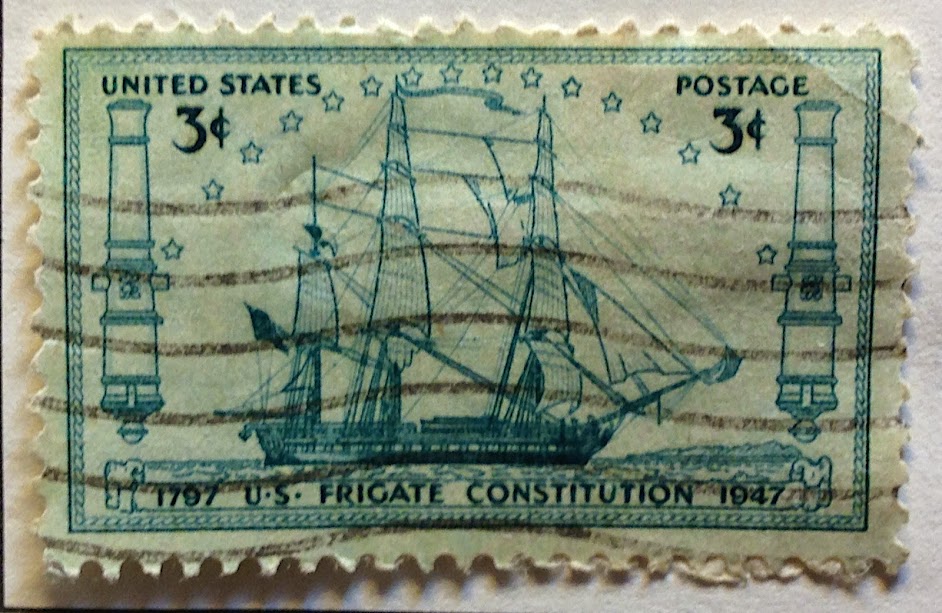
On 21 October 1797, Boston witnessed the launching of the USS Constitution, which remains "the oldest commissioned warship in the world."


Here she is, depicted on the 150th anniversary commemorative stamp, which proved to be both very popular and unexpectedly controversial (naval aficionados did not think the depiction was sufficiently active and heroic).

As I noted in my recent post on the fiftieth anniversary of the National Historic Preservation Act (October 1966-2016), it was an innovative decision on the part of the US Postal Service to depict historic resources other than buildings on the stamps issued for the fifth anniversary of the law: a San Francisco cable car, and the whaling ship Charles W. Morgan of Mystic Seaport.

The inclusion of ships raises intriguing question about, first, what should be preserved, and second, what "preservation" means in the case of resources such as ships, whose material is constantly being replaced. The "Constitution" has undergone a number of major restorations, but the latest (2007-10) was intended not only to preserve the ship, and also to bring it back to the state of 1812, when it achieved its greatest fame (context and overview; individual aspects of the project).

* * *

from the vaults (2010): backgrounder and summary on the "Constitution" and challenges of maritime historic preservation:

21 October 1797: Launching of USS Constitution; the need for preservation and interpretation continues


Sunday, October 16, 2016

Happy Dictionary Day, 2016

"Dictionary Day" honors lexicographer Noah Webster, born October 16, 1758, and celebrated for his pioneering work in both documenting and defining the emergent American language.


Webster is most often associated with Connecticut--New Haven, because he studied at Yale and spent his later years in that city (though his 1823 house was moved to Henry Ford's Greenfield Village in Michigan, in order to prevent its impending demolition)--and West Hartford, where his birthplace is today a museum and educational center dedicated to his legacy. In addition, however, he spent a crucial phase of his life (1812-22) in Amherst where he was actively involved in civic affairs (including the founding of Amherst Academy and Amherst College) as well as work on his dictionary.

Webster owned a large farm in what is now the center of town.

1920s map of Webster's holdings (Jones Library Special Collections) [placeholder]
His house no longer survives, but was located where the late nineteenth-century "Lincoln Block" now stands, across from Town Hall.


From the vaults:

• 2008: New England Celebrates Noah Webster 250th

• 2010: Well, where are you? Celebrating Noah Webster's Birthday and Searching for Remains of His Property


15 October 1830: Helen Fiske (Helen Hunt Jackson) born in Amherst

On October 15, 1830, Helen Fiske was born in Amherst. The friend of Emily Dickinson, who was born two months later (the arrival of both children is entered on the same page in Dr. Isaac Cutler's "baby book," or record of deliveries) became an author in her own right. Unlike Dickinson, Helen Hunt (Helen Hunt Jackson after widowhood and remarriage) chose to make a career of her writing.

She also became devoted to the cause of Native American rights. Her best known works are
 A Century of Dishonor: A Sketch of the United States Government's Dealings with Some of the Indian Tribes (1881) and the novel, Ramona (1884), which she hoped would be a Native American pendant to Uncle Tom's Cabin.

Jackson is prominently depicted on the Amherst History Mural (2005) by David Fichter, in the 1730 West Cemetery. Although the wall on which the mural is painted will fall to the wrecking ball when the former motel building is replaced by a large new mixed-use development, the developers have contracted with the artist to repaint the mural in full scale on a more suitable surface as part of the new building.


• From the vaults: More background on Jackson, her home, and the Amherst Writers' Walk.
Biographical sketch from "Mass Moments," a this-day-in-history service of the Massachusetts Foundation for the Humanities

Rosetta and Maria Mitchell: Pioneering Astronomer from Massachusetts

The timing of the end of the Rosetta mission--the first spacecraft sent to rendezvous with a comet--was fortuitous. On September 30, after two years' study of 67P/Churyumov–Gerasimenko, the European Space Agency's orbiter joined the lander module Philae on the surface.

The following day, October 1, was the anniversary of an earlier astronomical milestone. On that date in 1847, 29-year-old Maria Mitchell became the first woman to make a telescopic sighting of a comet. She did so from the roof of the Pacific Nantucket Bank, where her family resided  while her father was chief cashier. Mitchell had learned astronomy from her father, a talented amateur scientist himself, and from the study that she had undertaken on her own, working as a librarian at the Nantucket Atheneum next door.

In 1840, William Mitchell laid out the town's meridian line, marked with stone posts on the sidewalk in front of the bank.


Maria Mitchell's discovery brought her fame and helped to launch a new career: she became the first female member of both the American Academy of Arts and Sciences (1848) and the American Association for the Advancement of Science (1850), as well as one of the first professors hired at the newly founded Vassar College (1862). A feminist, she became  president of the American Association for the Advancement of Women in 1875.

Today the family's 1790 house, operated by the Maria Mitchell Association, preserves many of her possessions and celebrates her legacy. In 2010, Heather Huyck, editor of  Women's History: Sites and Resources, listed the house among her ten favorites.


Friday, December 25, 2015

Traditions of Christmas Past: from boisterous to banned to bourgeois

From the vaults, via last year's Tumblr post:


“‘At Home’ in the Nursery, or The Masters and Misses Twoshoes Christmas Party,” by George Cruikshank (1792-1878)
{enlarge}
Etching with hand coloring.
Image dimensions: c. 214 x 267 mm (approx.  8.4 x 10.5 inches)
Signed in the plate, “G Cruishank fect” (left) and “Pubd. Augt 1st 1835, by Thos McLean, 26, Haymarket.” (right)

This is the second issue. The print first appeared in the 1826 collection, Holiday Scenes, published by Samuel Knight (active 1805-41). Thomas McLean (1788-1875) reissued it 9 years later in Cruikshankiana, an assemblage of the most celebrated works of George Cruikshank. He largely effaced the original Knight signature, but it survives as a ghost imprint above his own, at lower right:

“London Pubd Jany 3d 1826 by S Knight, 3 Sweetings Alley [{Roy[a] X'Change’}]
image
{enlarge}
Not yet "Victorian” in the strict (or any other) sense, the etching nonetheless lacks the ribaldry or bite of Cruikshank’s other early (especially political) work: it manages to be satirical and sentimental at once. We can already recognize in it our received image of Christmas as domestic idyll, familiar from Dickens to “The Nutcracker” (though the evolution of the latter is a tale in itself).

The fourteen (count 'em!) children–this, at a time when the average British family size peaked at around 6 children (1, 2)–play with a mixture of sedate enjoyment and abandon as a stout serving-woman brings in a tray of treats. The image is rich in period detail, from the toys and the copy of the Eaton [sic] Latin Grammar abandoned on the floor, to the delicate jelly-glasses (whatever possessed the parents of that day to put them in the hands of youngsters?) and the faux-bamboo “fancy chairs” on which the children sit or climb.

The etching also also suggests why the Calvinists and their American descendants held no truck with Christmas. Theologically, it was a problem for them because its celebration was not biblically mandated, and the date of Jesus’ birth was in any case unknown. The holiday was moreover associated with revelry–whether heavy drinking by adults or just boisterous behavior, as shown in our print–that seemed incommensurate with the spirit of a holy festival.

Such was certainly the attitude here in Massachusetts, where Christmas celebrations were banned in 1659, as the legislature put it: “For preventing disorders … by reason of some still observing such ffestivalls as were superstitiously kept in other countrys, to the great dishonnor of God & offence of others.” The state lifted the ban in 1681, but it took more than a century and a half before things really began to change. Under the influence of shifting national tastes, Christmas began to assume its familiar lineaments of wholesome domesticity and consumption. (In Massachusetts, Irish immigration also contributed to the shift.) The 1855 Christmas celebration at the Worcester Free Church under minister and abolitionist Thomas Wentworth Higginson was a symbolic turning point. The following year, Henry Wadsworth Longfellow observed, “We are in a transition state about Christmas here in New England. The old Puritan feeling prevents it from being a cheerful hearty holiday; though every year makes it more so,” and the legislature officially recognized the holiday.

Monday, December 7, 2015

Is Your Restaurant Breeding Bolsheviks?

When we visited Boston earlier this fall for a little family gathering, we stayed, for sentimental as well as practical reasons, at the classic Parker House (now, technically, Omni Parker House).


As I had my breakfast and glanced across the room at a couple of the friendly and accomplished restaurant staff, I could not help but wonder what brought them here and where they might end up in 20 or 30 years.


Home of . . .?

The Parker House, founded in 1855 and now celebrating its 160th anniversary, is famous for many things, from the foods that it introduced to the American table (Parker House rolls, Boston Creme Pie, Boston sc[h]rod) to its distinguished clientele: from the "Saturday Club" of Emerson, Longfellow, Holmes, Agassiz, Dana, et al., to occasional visitors such as Charles Dickens.

However, I could not help but think of the famous figures who worked there long before they attained world renown: namely, two of the most influential radicals of the twentieth century. Future Vietnamese communist leader Ho Chi Minh worked there as a baker from 1911 to 1913, and in the early 1940s, Roxbury resident Malcolm Little worked there as a busboy. It was only after going to prison in 1946 that he converted to Islam and became Malcolm X.


A kind of long but indeterminate period of time which will live in infamy?

Because it's December 7 today: Admittedly, the Omni Parker House website screws things up, saying, "Malcolm X was a busboy in the early 1940's during the Pearl Harbor invasion." Sorry: there was a Pearl Harbor attack on one Sunday morning, but the Japanese invasion--as I thought everyone knew--failed to materialize. There is after all a reason that we still use FDR's phrase, "a date which will live in infamy." Not a week or a couple of months or several years. A date.


"So Ho Chi Minh conceivably could've baked a Boston Cream Pie?"

Just before Thanksgiving, even CBS News alluded to the political connection:
"Malcolm X was a busboy," he said. "Ho Chi Minh worked in the bake shop."

"So Ho Chi Minh conceivably could've baked a Boston Cream Pie?"

"Yes, he could." And Malcolm X presumably could've cleaned up after somebody that had just eaten one.
Who's biding his or her time in the restaurant that you patronize, while dreaming of greater things? Treat them respectfully and tip generously. It's the right thing to do. And besides: who knows?


Tuesday, November 17, 2015

An Old Picture About Race in Amherst

A year ago today, I put up a little post about a picture involving attitudes toward race in Amherst.

With renewed discussion of problems of race and race relations on our college campuses among other places (e.g. 1, 2, 3, 4), it still seems relevant.


Monday, August 31, 2015

Town Meeting Follies. The New Hampshire View (2): Quaint Characters

As noted in the previous post, a chance historic preservation and genealogy conversation on Twitter some years ago about antiquated New England town offices led me to a humorous piece on the character of town meeting in New Hampshire Magazine. As I also mentioned, the URL for that piece has vanished, a victim of link rot. But, as they say, when God shuts a door, he opens a window: and so, my recent, unsuccessful search for that piece brought me not only further information on weird and vanished town offices, but also more commentary on the institution of town meeting.

The article is entitled, "Town Meeting and Other Relevant NH Government Relics" and moreover has the descriptive and charming subtitle, "Like programs on the History Channel, some civic traditions are profound while others are ridiculous, and just like the folks who preserve them, they all have stories to tell."

As I said last time: to share this material is not to voice an opinion on the move for a "Charter vote" that would conceivably abolish Amherst Town Meeting (and my own prestigious and lucrative position on the Select Board: as former Chair Stephanie O'Keeffe used to say on bad days: "82 cents a day."). The purpose is only to share more comparative material on our civic and political institutions. On the whole, I think Amherst comes off looking pretty good. As I like to say: "it could always be worse."

Still, you may see some things that you recognize here. Take a look at this "Town Meeting Cast and Crew" and see what you think. Any familiar types?


Saturday, August 8, 2015

23 July 1793: Fall of the Mainz Republic (you haven't heard of it?)

You haven't heard of this? Neither had I, at first.

When I was a student at the University of Wisconsin, I was a history major, but I had the de facto equivalent of minors in French and German literature, with undergraduate and later graduate course work in both.

I was--although I considered myself reasonably well-educated for a midwestern yokel--struck by the title of a book by one of my German professors, Jost HermandVon Mainz nach Weimar (1793-1919) Studien zur deutschen Literatur (From Mainz to Weimar (1793-1919) Studies on German Literature). I of course understood the reference to the founding of the Weimar Republic. But Mainz? What was it doing in a history of German literature and democracy? As far as I knew it: the site of some great medieval edifices and home to Gutenberg. What was it doing here?

As I soon learned, it was the "first republic on German soil," proclaimed by local revolutionaries (under the auspices of French forces) on March 18, 1793, and extinguished in the summer of 1793. (And I don't think I would have learned that even if I had taken a formal course on the French Revolution rather than just "read around" in that literature on my own.) The fall of Mainz, along with the assassination of Marat and other setbacks, was one of the factors that prompted the introduction of the so-called "Terror."

Here, a depiction of the Liberty Tree erected by German revolutionaries:

Hand-colored engraving:
"Depiction of the Liberty Tree and the pikes, planted
at Mainz on 13 January 1793.
[at left:] Scale: 1 inch to 6 feet." Actual size of image: 3 x 5 inches)
Rituals and symbols were important, and the new iconography of the Revolution appeared even in the more mundane domain of the economy. Prussian Coalition forces besieged the city beginning on 31 March, and in early May, when it became clear that the crisis was going to continue, the French created special siege money:

Some examples of coins and currency over on the tumblr.


More on the Mainz Republic and its significance.

Tuesday, July 21, 2015

Moon Landing Anniversary (and animation, space toilets, and cheese)

If it's July 20, it's time to haul out my old post, which combines lunar exploration, zero-gravity toilets, animation humor, and the Jeffersonian politics of cheese.

But I also realized that the old posts did not include any images directly related to the moon landing, so I will redress that omission with the Apollo moon landing stamp.