Tuesday, August 25, 2015

August 2002: Julia Child's Kitchen Becomes Historical. And stray thoughts on the period room (not necessarily in that order)

Traditional "period rooms," once a staple feature of the museum of history or fine arts, fell into disrepute in recent years for a variety of reasons. As one curator puts it, they often incoherently (re)presented "decorative arts displays" or "local history" or "confusing combinations of both approaches." Still, there is certainly a value to preserving the individually significant interior as well as the exemplary collection for the study of material culture in general.

In its original incarnation as the spanking new but architecturally retrograde Museum of History and Technology (1964), the National Museum of American History (as it is now known) still featured old-fashioned period rooms (e.g. for showing off the dresses of First Ladies), considered at the time "a certain crowd-puller."


"history happens in parlors and kitchens as well as in the halls of Congress"

Still, this is not to say that everything was choked in conceptual cobwebs. My favorite example: in 1963, activists saved an 18th-century Ipswich, Massachusetts, house from demolition literally at the last moment by arranging to have the Smithsonian acquire it. So, instead of yet another Colonial period room, we have an entire home (the largest--some say: greatest--artifact in the collection) which tells the story of both structure and inhabitants from its origins to its abandonment. As the Smithsonian puts it, "The five families whose stories are told here were not famous, but they remind us that history happens in parlors and kitchens as well as in the halls of Congress." In the most recent interpretation (2002), portions of the walls have been opened up to reveal the timber-frame structure, thus doing justice to the original focus on the evolution of technology.


The Museum continues to think innovatively in its acquisition and interpretation practices regarding historic interiors and objects. To be sure, you can still find such things as a 17th-century chair-table (nothing wrong with that!)--but also Archie and Edith Bunker's chairs, from the TV series, "All in the Familly"--which a curator boldly calls "the equivalent of the "Appomattox chairs" used by Grant and Lee when the Confederacy surrendered.

Equally interesting are the larger interior ensembles. For me, one of the most memorable and moving is the famed Greensboro desegregation lunch counter. As of 2008, it is also part of a new series of "landmark objects" anchoring and highlighting the themes of a given wing.


One kitchen that made history

As the Smithsonian says of the Ipswich House, "history happens in parlors and kitchens as well as in the halls of Congress." And so, it seemed but fitting that at least a portion of another Massachusetts house should enter those galleries. It didn't make the cut as a "landmark object," it didn't date back to the 18th century, and it didn't play a role in the triumph of human rights, but it did change America in its own way, from foodways to women's history, and it has proven extremely popular. I am speaking of Julia Child's kitchen.

It opened at the Smithsonian on August 19, 2002, only shortly after the updated installation of the Choate House from Ipswich. When Julia Child (1912-2004) decided to relocate from Cambridge, Massachusetts to her native California at the end of her public career, she gave her kitchen to the Smithsonian.

"A Place for Everything"

"While kitchens of the 1950s and 1960s were often designed to keep everything hidden from view, Julia and Paul preferred to hang their pots and pans on a pegboard for quick and easy access. Nor would there be any confusion about where that pan belonged after it had been used, thanks to the outlines Paul traced on the pegboard. Later, for the benefit of student and guest cooks working in the kitchen with Julia, snapshots were added." (Smithsonian)
"Work zones"

"Julia organized her kitchen around work zones, making sure tools and equipment were placed near the surfaces where they would be used. Her pots, pans, and utensils are near the stove, her knives are near the sink, and her small appliances are set on solid work surfaces, ready to use." (Smithsonian)

As Mass Moments puts it:
Designed by her husband Paul in 1961, the room was specially tailored to his wife's particular needs, with high countertops to accommodate her six-foot two-inch frame. In her ten cookbooks and eight television programs, several of which were filmed in her own kitchen, Julia Child demystified French cooking for American audiences. She became, in the words of the New York Times, "the French chef for a Jello nation." The exhibit is titled "Bon Appétit!" — as she signed off at the end of every show she hosted during her 38 years as a television icon.
Viewers of the film, "Julie and Julia" (the former was a whining Amherst College graduate: nuff said) will be familiar with the backstory behind the first great cookbook, but just in case, Mass Moments explains:
She fell in love with French food and enrolled in the prestigious Cordon Bleu culinary school. In 1952 she and two Frenchwomen formed a cooking school and began writing a French cookbook for American readers.

In 1956 the Childs returned to the U.S. and settled in Cambridge, Massachusetts. Julia Child continued work on the book, communicating frequently with her French partners. When Mastering the Art of French Cooking was published in 1961, with 734 pages of detailed but unintimidating recipes, it was a critical and popular success. In an era when American "cuisine" consisted of cake mixes, TV dinners, and health food crazes, the book made sophisticated French food not only appealing but accessible. Child ignored fads, and Americans embraced her "cuisine soignée: long, caring cooking."

My mother was a good cook, but by no means a gourmet. Still, Julia Child's first great book was one of the main cookbooks in our kitchen. I believe it was a present from my father.

When I learned to cook (mostly while I was a grad student: it seemed preferable to bankruptcy or starvation), I bought myself a copy, too. (Later, my mother gave me more recent Julia Child books as presents.)


The original installation, pictured above, closed in early 2012 and, to mark the centennial of Child's birth, was reinterpreted later that year as the focus of a new exhibition, "FOOD: Transforming the American Table 1950-2000."

It seems fitting: just as the Choate house chronicled the lives and material culture of ordinary people "who were not famous," so, too, her kitchen helps to chronicle the transformation of the way that all of us eat and think about food.  There is more than one way for history to happen in the kitchen.

Bon appétit.


Footnote:

Local connection: The pioneering chef was a graduate of Smith College (history major, I am proud to say), which celebrates a Julia Child Day. In fact, I recall meals at the former Faculty Club where we were served a special "Julia Child" label house wine.

Resources

• Bon Appétit! Julia Child's Kitchen at the Smithsonian
• 10 Crucial Facts About the Julia Child's Kitchen Exhibit, Reopening Tomorrow, Washington Eater staff, 14 August 2012 (includes video of the conservation and reinstallation process)

[updated 26 August; full piece did not post the first time]

Prerequisite to World War II: the Nazi-Soviet Nonaggression Pact

Any commemoration of the anniversary of the outbreak of World War II would be incomplete if it neglected the sordid bargain that preceded and enabled it.

On August 23, 1939, Nazi Germany and the Soviet Union stunned the world by signing a ten-year nonaggression pact. The overnight and shocking shift among erstwhile bitter enemies provided the background for similar episodes in George Orwell's 1984.

Those who pay attention to history are aware of the shameful agreement. Yet I would wager that even many of them are less than well informed about the immediate consequences: we always speak of Germany invading Poland on September 1, 1939--but how many of us know that Soviet forces entered on September 17 and occupied the eastern portion of the country? It's a question that I always raise when I teach twentieth-century European history, as I will again in the spring.

Ironies abound. On the one hand, the pact stands as the epitome of cynical (as opposed to naïve) deal-making with Hitler. On the other hand, contrary to the intentions of those behind it, it saved as well as took innocent lives: those in the eastern occupation zone who did not fall victim to Soviet terror escaped Nazi rule in 1939, and some, by one means or another and with a great deal of luck, were thus also able to do so after 1941.


Some in the "West" broke with the Communist Party over this apparent betrayal of principle. Others rationalized it.

The pact exposed the hypocrisies and fault lines on the left. Some in the "West" broke with the Communist Party over this apparent betrayal of principle. Others rationalized it.

My mother recalled that, when she was a student at Hunter College after the outbreak of World War II, fellow student and obnoxious Stalinist "activist" (as we would call her nowadays) and future Congresswoman Bella Abzug was running around, loudly defending the Pact and proclaiming, "The Yanks Aren't Coming!" For the Stalinist apologists, World War II was a war between imperialist rivals in which right-thinking socialists could have no righteous part. Of course, that eventually changed. When the inevitable German attack came in the summer of 1941, Stalin, having refused to heed the warnings from his own spies, was caught unawares (1, 2). And so, the communist loyalists and fellow travelers in the West suddenly discovered that the War was a worthy cause, after all. Nick Cohen adduces a host of examples from the UK and eviscerates that slavish mentality, adding: "The echoes of our own day when so many on the liberal-left go along with Islamo-fascists are chilling and fascinating."

Following are some graphic reactions from the time.


The above image, by progressive cartoonist Daniel Robert Fitzpatrick, cites Isaiah 21:11 to convey the concern over the storm on the horizon. Two-time Pulitzter Prize winner D. R. Fitzpatrick (as he was most commonly known) was, I am pleased to say, a Wisconsin native who worked first for the Chicago Daily News and then the St. Louis Post Dispatch (1913-58), for which he produced this and other famous pieces.


This piece, by contrast, makes a more explicitly political statement about the Nazis and Soviets, as such.

Both images come from a World War II scrapbook that I acquired a good many years ago. I don't know anything about its origins, but the American owner religiously clipped and saved brief press reports, photographs, and cartoons from the early days of the War.

They are powerful. Another image (not from the scrapbook) hints at the ultimate consequences of the pact. This photograph was taken moments after the delegates to the Twenty-first Zionist Congress, meeting in Geneva in August, 1939, heard the news.


The late Conor Cruise O'Brien, who had the interesting fate of serving as Irish Ambassador to the UN--and was thus literally caught between the Iraqi and Israeli delegates in the General Assembly--comments, in his book The Siege (from which this photo comes):
The Twenty-first Congress broke up earlier than planned because of the announcement of the Hitler-Stalin Pact (August 23, 1939). There is a photograph of the Congress platform, taken just after the news of the pact broke. In a small group--the copy before me shows twelve heads fully--four, including Weizmann, have a hand over their face or their head. Ben-Gurion, beside Weizmann, has his head bowed over his hands, which are crossed on his chest. They do not look like people who have just heard a piece of political news. They look like people who have heard a death sentence pronounced on members of their family. (p. 242)


{erroneously posted under a previous date; updated: images}


Monday, August 24, 2015

Getting the Select Board's Town Manager Evaluation Wrong

Reviewing books or reporting the news must be among the most unenviable tasks: no matter how hard one works to get things right, one will inevitably be accused from all quarters of having gotten things totally wrong (often as not, with base motives imputed).

That said, journalists often do, objectively speaking, get things wrong. There are causes apart from mere carelessness: the pressure of deadlines and the stringent limits on space no doubt cause many an error or oversimplification. I understand all this and take it in stride, so I normally don't bother to comment publicly on journalists' mistakes regarding my individual or collective civic role. (There has been the occasional exception.) However, it struck me that the coverage of the Select Board's annual review of Town Manager John Musante might give rise to some false impressions, so I would like to correct them.


The Town Manager Review Process: a long timeline, a lot to digest

The Select Board is the Town's collective chief executive. Under the Town Government Act and Massachusetts General Law, we five members of the Select Board, as the "chief elected officials," hire and review the performance of the Town Manager, who is the "chief administrative and fiscal officer."

Former Select Board Chair Stephanie O'Keeffe led the way in developing a notably robust and rigorous review process. Each year, the Select Board and Town Manager agree on a set of performance goals for the coming year. The Town Manager reports periodically on his progress toward attaining those goals, and then a detailed timeline takes us through the actual process, running to almost four months, from June through September. The initial result is a set of our five individual assessments of 15 rubrics: based on our day-to-day experience of working with the Town Manager, his self-evaluation, and the officially solicited input of Town employees and the general public. Then, in late August, in public session, we spend an hour or more reading one another's evaluations for the first time (yes, it makes for thrilling television, but this is one of the consequences of the State's Open Meeting Law) and, finally, discuss them and respond to a summary compiled by the Chair (the only person to have seen all five in advance of the meeting).

Admittedly, it is a lot to digest in short order--nearly 100 pages of material: 74 pages of individual assessments by Select Board members (Alisa Brewer: 29; Connie Kruger, 8; Doug Slaughter, 7; Andy Steinberg, 10; Jim Wald, 20), plus a 6-page composite grid of ratings compiled from the preceding, along with the 11-page draft evaluation memo by Chair Alisa Brewer. One does not envy the reporter faced with the challenge of getting out a coherent, well-integrated story within 24 (not to mention, 2 or 3) hours. That said, that draft evaluation memo plus the oral discussion provide the bedrock for any story, and then the reporter (in my experience) goes through the individual evaluations, pulling out (one hopes) representative quotes from each Select Board member in order to lend the whole an air of comprehensiveness, real or feigned.


Accurate facts, fragments, impressions

The task of the journalist, like that of the historian, is not simply to share a set of facts, but also to select them systematically and place them in an appropriate analytical or interpretive framework. It is admittedly a subjective task, and yet there are ways to judge its success or failure. Often, it is a matter of emphasis or completeness rather than factual truth or error, as such.

Blogger Larry Kelley (who often beats the mainstream media to the punch and got this piece out in a hurry) fastened on the negative aspects of the evaluation:
interesting criticism from the two most experienced members of our executive branch -- Chair Alisa Brewer and Jim Wald.

Ms. Brewer gave Mr. Musante "unsatisfactory" a total of nine times (out of possible 44) while Mr. Wald checked it off five times.

Brewer and Wald were in unanimous agreement in response to goal #5, "Relationship With the Select Board"  by giving him "unsatisfactory" to the same five of eight statements. Ouch!
It was in many ways understandable: criticism by nature calls more attention to itself than does expected praise for a job well done and thus might seem more "newsworthy." Of course this is not the whole story: the post dwelled only on the negative and merely cited the categories rather than the actual substance of the evaluation; a reader would have to click through to the actual document. In part, Kelley's emphasis on the ratings grid was intended to create a contrast to a similar, recently completed process for School Superintendent Maria Geryk, who received only one "unsatisfactory" ranking from 13 evaluators. Still, the title "Troubles at the top?" overdramatized the situation.

The reports in the traditional papers by veteran beat reporters Scott Merzbach of the Hampshire Gazette and Diane Lederman of The Republican/Masslive.com were likewise about what we have come to expect.

Both Merzbach's and Lederman's pieces on the whole aptly summarized our work under the respective titles, "Amherst board praises Musante’s fiscal management, criticizes communication" and "Amherst Town Manager John Musante receives favorable review, concerns cited."

Both, rather than just citing the handful of negative rankings, also identified some reasons.

Merzbach:
But both Wald and Brewer criticized Musante in the area of maintaining “a professional and effective relationship” with the elected board.

They both cited Musante’s comments on election night, during an interview broadcast on Amherst Media, that the proposed solar project on the former landfill was dead, which caught board members by surprise.

They also didn’t like that details about a settlement with former high school math teacher Carolyn Gardner, who filed a Massachusetts Commission Against Discrimination lawsuit, were revealed in the Gazette before any executive session was held.

“The potential settlement figure in the Gardner MCAD complaint was never discussed with the Select Board. The Select Board was shocked to find out a settlement had been reached by reading about it in the newspaper,” Brewer wrote.
By contrast, some other topics and quotations seemed almost chosen at random or at least taken out of context. Just one example: Andy Steinberg's affirmation of the value of diversity of opinion on Town boards was unexceptionable but by itself unintelligible to someone not reading the entire evaluation.

Lederman simply devoted the bulk of her piece to raw quotations from the evaluation, connected by brief explanatory passages. However, the quotations at least provided the rationale for the negative assessments of the aforementioned cases:
"It seems clear that you have no intention of withholding information from the Select Board, but rather that it simply does not occur to you to share it," according to the memo.
 "We can't provide input on either straightforward or complex policy and practice initiatives and changes before they are implemented if we don't know they exist.
"Finding out about them in the newspaper or other media is simply unacceptable. Most egregiously, we did not hear about the end of the old landfill lawsuit, the end of the solar farm project, nor the resolution of the town-schools MCAD complaint, from you.
"While this "saved" us having to hold Executive Sessions, it significantly damaged our credibility in the community.
"We also cannot effectively represent our community's values when we are presented with and expected to act on issues immediately without having had any opportunity for thoughtful deliberation in an open meeting or other potential for public [input]."
No single piece thus quite captured the full nature of the evaluation with the precision and thoroughness that one might have hoped for. Still, each offered something and, taken together, the three would enable a reader to grasp the nature of our criticism.

The editorial in the Amherst Bulletin was another matter.


Editorial license

Under the title, "Two Amherst leaders get a bit of homework," the editors commented on the evaluations of both Superintendent Geryk and Town Manager Musante (School year's about to begin: grades, homework. Get it?) The gist was that both leaders received generally high marks but also a few low or failing ones--and that, in our political system, this criticism was properly public and on the record, rather than private and behind-the-scenes. Right on the mark. So far, so good.

However, when it came to our actual criticisms, the piece missed the point by a mile:
Alisa Brewer, chairwoman of the Select Board, told Musante in an evaluation summary that she and others “look forward to your continued success in so many critical areas.” But they also want action on aspects of his job “that truly need more of your attention.” Chief among them: communication with other town leaders, particularly members of the Select Board. In this area, he earned ratings of “unsatisfactory” and “needs improvement.” Brewer and board member James Wald faulted Musante for not maintaining “a professional and effective relationship” with their panel. That’s at odds with other aspects of Musante’s review. Select Board member Connie Kruger called him “professional, considerate, fair and very good at managing multiple agendas. He remains calm during a crisis and instills confidence.” The dissonance may stem from ongoing policy disagreements in Amherst, including friction over the impact of development projects downtown.

If Musante was a mayor, he’d have to answer to voters about such matters. But as a town manager, his constituency is the Select Board.

Communications issues are far less tangible than the areas the board praised — particularly fiscal management. But if the Select Board feels it is not getting enough advance information from Musante on major policy matters, that’s a problem he must address.

Even so, this is a fuzzy area. Select Board members didn’t like that they heard first through the media about some things, including the fate of a solar project and a legal settlement with a teacher. But in both instances, Musante was sharing information with town residents — and that counts as communication. The board should not be asking him to curtail comments to the media.
This is all so wrong that one can only shake one's head in dismay.


 • To imply that Ms. Brewer's and my sharp criticism of the Town Manager under "Relationship with the Select Board" is in any way "at odds with other aspects of Musante’s review" is nonsense. First, it stands to reason that the two most senior members of the body (8 and 5 years' service, respectively), encountering a recurrent problem under one particular rubric, would be more pointed and insistent in their criticism than those who joined in only the past 1 to 2 years. Second: elsewhere in the document, as in last year's evaluation, we individually and collectively praise the Town Manger for his consummate professionalism and the professional expertise of his overall performance, particularly in the financial domain. The official evaluation is about the overall picture: greater than the sum of individual ratings. This is why, as Chair Brewer says, we do not issue a numerical score. Or, as I sometimes put it: it's not the SAT.

• The only thing loopier than the editors' making the preceding charge is concocting an explanation out of thin air: "The dissonance may stem from ongoing policy disagreements in Amherst, including friction over the impact of development projects downtown."

Huh? They couldn't have asked us? There is zero evidence for such a hypothesis. Ms. Brewer noted a desire for better communication regarding upcoming zoning articles, but this was about process, not development, as such. In fact, some of the criticism that Mr. Musante received from the citizenry was for publicly taking a stand and voting the same way as the Select Board on zoning articles. All five members of the Select Board moreover gave Mr. Musante a "satisfactory" rating for pursuit of economic development opportunities.

• But most dismaying of all is the final section: On the one hand, the editors say, if Mr. Musante has not been giving advance notice of decisions to the Select Board, "that's a problem he must address." Indeed. But immediately afterwards, they go on to say the equivalent of "oh, never mind":
Musante was sharing information with town residents — and that counts as communication. The board should not be asking him to curtail comments to the media.
Um, no it doesn't, and no we weren't. The issue being evaluated here was specifically and exclusively "Relationship with the Select Board." (Under the separate rubric of "actively engage the community and the media," the Town Manager received four "satisfactory" ratings and one "needs improvement.")

The editors here completely miss the point of the sharpest and most consistent criticism that we gave the Town Manager. The presumed choice between his informing the Select Board and informing the public is a false one, and no action or announcement flagged here was so urgent that it could not have allowed time for consultation.

This goes to the heart of our system of government. Town Meeting is the legislative branch. The Select Board is the collective chief executive. The Town Manager is the chief administrator, not the mayor: he reports to us. We have the power to hire, fire, and evaluate him. We set his salary. How can we work in partnership with him and explain Town policies and his actions to the public if he does not inform us about them?

Clear, one would think.


Conclusion: a strong relationship

To summarize: there is no crisis, but neither should one casually dismiss our criticism. Fortunately, that criticism focused on some delimited problems that are in principle easily rectifiable. The members of the Select Board, individually and collectively, hold Mr. Musante in high esteem: we greatly respect his professionalism and skills, we enjoy working with him.

There are thus no "troubles at the top." What there is is honesty and due diligence--and work to be done. A truly healthy and respectful relationship allows for strong criticism, offered in a constructive and collegial spirit. The Town Manager took it as such, and it is a shame that the Gazette chose to trivialize it, in the process distorting the larger picture of how we work.

Would the editors and public have been happier if we had simply checked all the ratings as "commendable" (the highest option) and confined our comments to generic praise and trivial critiques? It certainly would have saved us a lot of time. But it would not have been responsible, and it would not have been good governance.


Thursday, August 20, 2015

‘This is a good Jap–a dead one" - "The armed forces disapprove strongly of this sort of thing."

Lest one conclude, from recent posts, that the emphasis here should be exclusively on Japanese atrocities and fanaticism: on the contrary. The intensity of the animosities and combat also elicited behaviors from US forces that we nowadays find hard to contemplate.

For example, the previous post dealt with the rescue of civilians--including a child--from mass suicide attempts that the Japanese military either encouraged or compelled. But as combat dragged on and intensified, US forces became less cautious in the application of force. The Wikipedia entry for the battle of Okinawa--a site from which a great many Americans will presumably get their information--cites this recollection by a soldier:
There was some return fire from a few of the houses, but the others were probably occupied by civilians – and we didn't care. It was a terrible thing not to distinguish between the enemy and women and children. Americans always had great compassion, especially for children. Now we fired indiscriminately.
Earlier this year, I noted here a piece posted on the tumblr about one of the most notorious images of US World War II photojournalism. Because we are now marking the anniversary of the atomic bomb and the end of the Pacific War, I'll reproduce it here:

The Bloodiest Battlefield Mementos: Even the “Good War” Had Its Bad Side


Although all war is terrible and we may recoil at the scenes that we see on our televisions and computer screens, the shock is the result of both greater moral sensitivity and continual and less inhibited flow of information (including that from nongovernmental and nonprofessional sources). As I noted in the previous post, we therefore find it all the more difficult to imagine the wars of the past, which were often both more bloody and less explicitly reported.
Even during World War II–the so-called “Good War”–US troops at times engaged in behavior that would by our standards (or even those of that day) be considered barbaric.
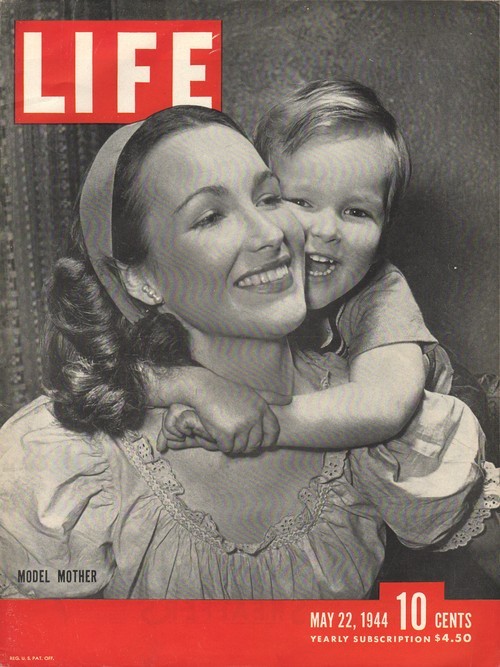
Occasionally, the façade cracked. Consider, for example, the May 22, 1944 issue of Life Magazine (the leading US photojournalism periodical). The typical American man or woman settling in for a spell of leisure reading found on its cover a heartwarming tale of professional success and domesticity.

image 

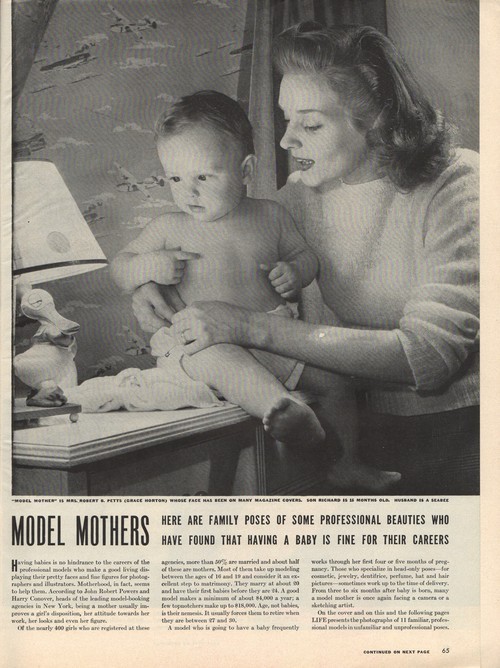
As the title story on page 65 explained, photogenic young women were finding no contradiction–and indeed, many rewards–in combining motherhood with modeling. (This was apparently the 1940s privileged version of “having it all.”).

image 
 [enlarge]

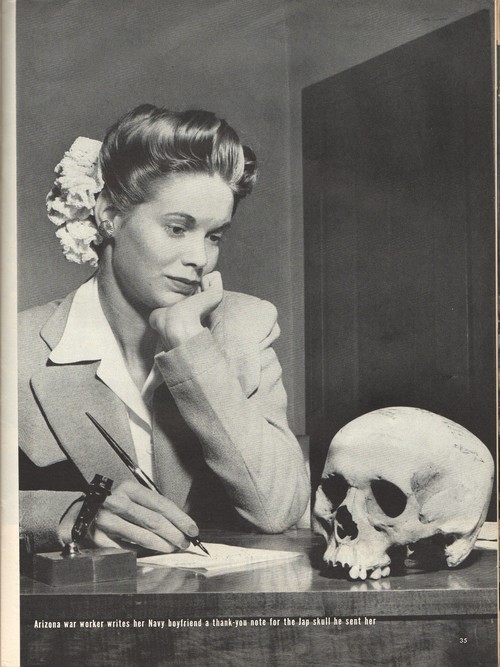
If that reader passed too quickly over page 35, he or she might have been forgiven for assuming it was part of the title story. It, too, featured a photograph of a similarly attractive young woman. It’s just that, rather than holding her baby, she happens to be holding a pen while contemplating a human skull. The homemaker as Hamlet–but evidently without the self-scrutiny.

image 
 [enlarge]


The caption of this “Picture of the Week” read:
When he said goodby two years ago to Natalie Nickerson, 20, a war worker of Phoenix, Ariz., a big handsome Navy lieutenant promised her a Jap. Last week Natalie received a human skull, autographed by her lieutenant and 13 friends. and inscribed: ‘This is a good Jap–a dead one picked up on the New Guinea beach.’ Natalie, surprised at the gift, named it Tojo. The armed forces disapprove strongly of this sort of thing.
As John Dower wrote in his War Without Mercy: Race and Power in the Pacific War (1987), “Life treated it as a human-interest story, while Japanese propagandists gave it wide publicity as a revelation of the American national character.” (65) It was the more ironic given that American propagandists made much of the sixteenth-century Japanese Hideyoshi’s “ear mound” of 40,000 pickled noses and ears in the wake of war with Korea. (20, 28, 65) As Dower says, Japanese atrocities accounted for some of the behavior of the US forces, though not all. In his words:
     On the Allied side, some forms of battlefield degeneracy were in fact fairly well publicized while the war was going on. This was especially true of the practice of collecting grisly battlefield trophies from the Japanese dead or near dead, in the form of gold teeth, ears, bones, scalps, and skulls… . [64]
  Despite the attention given in Allied propaganda to Hideyoshi’s three-and-a-half-century-old ear mound, in the current war in Asia it was Allied combatants who collected ears. Like collecting gold teeth, this practice was no secret. “The other night,” read an account in the Marine monthly Leatherneck in 1943, “Stanley emptied his pockets of 'souvenirs’–eleven ears from dead Japs. It was not as disgusting, as it would be from a civilian point of view. None of us could get emotional over it.” Even as battle-hardened veterans were assuming that civilians would be shocked by such acts, however, the press in the United States contained evidence to the contrary. In April 1943, the Baltimore Sun ran a story about a local mother who had petitioned authorities to permit her son to mail her an ear she had cut off a Japanese soldier in the South Pacific. She wished to nail it to her front door for all to see. On the very same day, the Detroit Free Press deemed newsworthy the story of an underage youth who had enlisted and 'bribed’ his chaplain not to disclose his age by promising him the third pair of ears he collected. [65]
Dower goes on to say that “Scalps, bones, and skulls were somewhat rarer trophies, but the latter two achieved special notoriety in both the United States and Japan” in two cases: first, when a soldier sent FDR a letter opener made from Japanese bones (the President rejected the gift), and the second, the aforementioned picture in Life. As Dower further explains:
     Most combatants did not engage in such souvenir hunting, and Leatherneck itself published a cartoon which expressed contempt and pity for all scavengers of the dead. At the same time, most fighting men had personal knowledge of such practices and accepted them as inevitable under the circumstances. It is virtually inconceivable, however, that teeth, ears, and skulls could have been collected from German or Italian war dead and publicized in the Anglo-American countries without provoking an uproar; and in this we have yet another inkling of the racial dimensions of the war. [66]
War is still hell, but at least this is a circle that we visit less frequently.

Monday, August 17, 2015

Background to Hiroshima and V-J Day: Death and Life on Okinawa, AP Wirephoto

Among the first little historical curiosities that I collected as a high school student was a group of World War II Associated Press Wirephotos found among the random stuff in the bins of a Wisconsin antiques store. (I seem to recall that there were other subjects and I simply picked out the few wartime shots as most suited to my interests and budget.)

Accustomed as we now are to being able to receive the news in live time, most of us have no idea what the classic AP "Wirephoto" service was: how it functioned , and how it revolutionized journalism by transmitting images with unprecedented speed, thus enabling them to become news in their own right.

As this retrospective nicely explains, a transmitter, equipped with a sort of early optical scanner, converted a photo to electrical signals, sent via "10,000 miles of leased telephone lines – the wires," to a receiver, where they were "converted back into light, which was then recorded onto the negative, reproducing the original image." (The "Wirephoto" still exists, but in digital form since 1989.)


World War II, understandably enough, greatly increased the demand for photographic reportage, and the US Army Signal Corps developed its own radiophoto service, a matter of particular importance and difficulty in the Pacific theater.

The battle for Okinawa was one of the greatest land and sea engagements of the war, as well as one of the fiercest, lasting for three months, from 23 March to 23 June 1945. US deaths were at least 12,520 killed in action, while estimates of Japanese losses range from around 77,000 to 110,000. Above and beyond that, anywhere from 42,000-150,000 Okinawan residents (out of a total of some 435,000) perished. Total deaths thus arguably exceed the combined toll of Hiroshima and Nagasaki.

The heavy losses on both sides are generally said to have played a role in the US decision to use the atomic bomb in hopes of avoiding an even bloodier invasion of the Japanese home islands. Of particular concern to the Americans were the mass suicides of Okinawan civilians: on the one hand, natural cause for humanitarian empathy, on the other, presumed proof of Japanese "fanaticism" and the resistance they could expect in "Operation Downfall."

This photo remains one of the most moving pieces of World War II memorabilia in my small and eclectic collection.

 enlarge
CHILD RESCUED FROM MASS SUICIDE--
A SMALL CHILD, RESCUED BY TROOPS OF THE U.S. 77TH INFANTRY

The appended fuller description reads:
CHILD RESCUED FROM MASS SUICIDE... A small child,
rescued by troops of the U.S. 77th Infantry Div. who braved Jap
machine gun fire to frustrate an attempted mass suicide on
Tokashiki Shima in the opening stages of the battle for
Okinawa. ( Nestled in the arms of 1st/Sgt. John S.Evens [sic],
of Springfield, S.C.)
The child appears placid, yet questioning, cautious, The unshaven soldier appears gentle but fatigued. That he does not look directly into the camera allows us to speculate: presumably he is not indifferent, and rather, weary, contemplating what he has experienced. The eyes have that familiar wartime look of having seen too much. Yet we know that on April 4, the land battle had gone on for only 4 days, whereas 80 more remained.

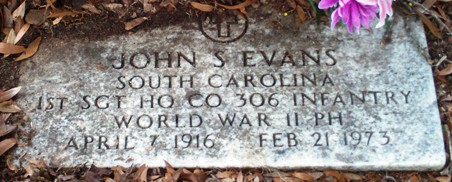
We also know that Sgt. Evans of the 306th Regiment survived the war. Apparently, he died in 1973 and was buried in his home town.


Famed war correspondent Ernie Pyle was not as fortunate: he was killed by machine gun fire while at the front with the 77th on April 18.


The mass suicides remain controversial to this day. Some civilians evidently killed themselves because they believed atrocity stories about the Americans that the authorities told them, but in other cases, the Japanese military forced civilians to commit suicide (e.g. 1, 2, 3). Either way, the Imperial Japanese government and military bore the responsibility, but as in other cases of wartime atrocities, conservative forces in contemporary Japan have attempted to erase or rewrite the history. (It is hard to imagine what is more painful to an elderly man: the memory of having beaten his mother, brother, and sister to death because he believed the propaganda--or that the textbooks suddenly portray this as a voluntary act, committed in a vacuum.)

Reviewing a book of Japanese testimony about the civilian experience on Okinawa (2014), Jonathan Mirsky explains that he has gone from childhood belief in the conventional US narrative to acceptance of the view of "liberal and leftist Americans: that the reasons given for dropping the bombs—among them, above all, that the Japanese would never surrender unless pulverized—were self-serving and false." But "Because of this new book I am thinking again."  He concludes:

In early 1945, the Japanese prime minister had recommended that the war be brought to an end, but as Ealey and McLauchlin [the editors of the volume under review] write, Hirohito believed that one last military success “would force the United States and its allies to offer peace terms that would allow Japan to maintain its national polity, which of course hinged on the status and institution of the emperor.“ Had the prime minister’s advice been followed, they observe, “there may never have been a Battle of Okinawa, or atomic bombs dropped on Hiroshima or Nagasaki.” Indeed. General Douglas MacArthur urged that the emperor’s status be preserved, and there is a memorable photograph of the two recent adversaries standing side by side in Tokyo not long after the war ended. Hirohito’s descendants have remained on the throne to this day. What we learn from this profoundly disturbing and enlightening book is that tens of thousands of misled Okinawans died for nothing. 
This photo is a reminder. It continues to haunt me.


Resources 

Roy E. Appleman, James M. Burns, Russell A. Gugeler, and John Stevens Okinawa: The Last Battle (Washington, DC: Center of Military History United States Army, 1948)


Previous Wirephoto: Potsdam Conference

Sunday, August 16, 2015

Background to Hiroshima and V-J Day: Potsdam Conference, AP Wirephoto

Among the first little historical curiosities that I collected as a high school student was a group of World War II Associated Press Wirephotos found among the random stuff in the bins of a Wisconsin antiques store. (I seem to recall that there were other subjects and I simply picked out the few wartime shots as most suited to my interests and budget.)

Accustomed as we now are to being able to receive the news in live time, most of us have no idea what the classic AP "Wirephoto" service was: how it functioned , and how it revolutionized journalism by transmitting images with unprecedented speed, thus enabling them to become news in their own right.

As this retrospective nicely explains, a transmitter, equipped with a sort of early optical scanner, converted a photo to electrical signals, sent via "10,000 miles of leased telephone lines – the wires," to a receiver, where they were "converted back into light, which was then recorded onto the negative, reproducing the original image." (The "Wirephoto" still exists, but in digital form since 1989.)


World War II, understandably enough, greatly increased the demand for photographic reportage, and the US Army Signal Corps developed its own radiophoto system. This Wirephoto depicts a US security checkpoint on the eve of the Potsdam Conference.

MPs CHECK VEHICLES IN CONFERENCE AREA--MILITARY POLICE OF THE 713TH MP BATTALION CHECK VEHICLES AND PERSONNEL AT A ROAD BARRIER IN THE AMERICAN COMPOUND OF THE POTSDAM CONFERENCE AREA, JULY 15. (AP WIREPHOTO FROM SIGNAL CORPS RADIOPHOTO FROM PARIS)

The 713th Military Police Battalion was responsible for security in the US sector of nearby Berlin. The Signal Corps radiophoto above features in Robert L. Gunnarsson's history of American Military Police in Europe.

The meeting (July 17- August 2, 1945) is of course best known for mandating the shared occupation and denazification of recently defeated Germany, as well as endorsing the redrawing of the Soviet-Polish-German borders and, more controversially, permitting the expulsion of ethnic Germans from the former occupied territories of Central Europe.

But the Conference also had a bearing on the war in the Pacific and the dropping of the atomic bomb, treated in a recent post. The official declaration demanded unconditional surrender of Japan, lest she suffer "the inevitable and complete destruction of the Japanese armed forces and just as inevitably the utter devastation of the Japanese homeland." There was no mention of the atomic bomb, as such (tested in secret just as the conference began), but it did figure in a now-famous conversation between Truman and Stalin.

As the US Department of Energy aptly summarizes:
During the second week of Allied deliberations at Potsdam, on the evening of July 24, 1945, Truman approached Stalin without an interpreter and, as casually as he could, told him that the United States had a "new weapon of unusual destructive force."  Stalin showed little interest, replying only that he hoped the United States would make "good use of it against the Japanese."  The reason for Stalin's composure became clear later: Soviet intelligence had been receiving information about the atomic bomb program since fall 1941.
The nuclear arms race was already beginning.


Next Wirephoto:  Okinawa

Recalling the Limited Nuclear Test Ban Treaty


In arguing in favor of the nuclear deal with Iran, President Obama cited President Kennedy and moreover copied his predecessor by choosing to make his principal statement on the agreement at American University where, in June 1963, Kennedy had delivered a major address on foreign policy and nuclear arms control.  In that address, Kennedy announced the resumption of negotiations over arms control.

In the tense era of the Bay of Pigs fiasco and new Berlin crisis, both the US and USSR had resumed nuclear testing. The narrow avoidance of war during the Cuban Missile Crisis prompted them to reconsider.

The result was the Limited Nuclear Test Ban Treaty, which, as  summarized by the Kennedy Presidential Library:
    prohibited nuclear weapons tests or other nuclear explosions under water, in the atmosphere, or in outer space
    allowed underground nuclear tests as long as no radioactive debris falls outside the boundaries of the nation conducting the test
    pledged signatories to work towards complete disarmament, an end to the armaments race, and an end to the contamination of the environment by radioactive substances.

The US, UK, and USSR (the only nuclear powers at the time, aside from France, which continued to test) signed the Treaty on August 5, 1963, a day before the anniversary of the Hiroshima attack. The Senate  ratified the treaty on September 23, and President Kennedy signed it on October 7.


On October 23, 1964, the United Nations released this stamp marking the occasion (one  of five commemoratives that year). Designed by Ole Hamann of Denmark, it was issued in a run of 2,600,000 copies.

If one pauses to consider even just the date of the treaty--1963--it was an impressive achievement: only 18 years after the first use of nuclear weapons against Japan, 14 years after the first Soviet nuclear test, and 10 years after the Soviets tested the first deployable hydrogen bomb.

Ironically, though, on October 16, 1964, exactly a week before the stamp was issued, the People's Republic of China tested its first nuclear weapon.

V-J Day or VFE Day? August 10 or August 15?

In the previous post, I described how my parents learned about the atomic bomb and victory over Japan.

In the course of writing up that story, I was reminded that the things we take for granted were sometimes more complicated and interesting.

Two examples: I mentioned that my father's diary recorded "VFE celebrations"--that is, victory celebrations--already on August 10, 1945. As noted there, this was the date on which the Japanese government in fact offered to surrender, but it took several more days for the US to decide that acceding to the Japanese request to leave Emperor in place was compatible with the Allied demand for unconditional surrender. The official decision to surrender was not announced until August 14 (15), and the actual surrender ceremony took place only on September 2, aboard the battleship "Missouri" in Tokyo Bay. 

And VFE? People alive at the time will never forget "V-E" and "V-J" Day: Victory in Europe and Victory Over Japan. These are the terms by which historians, too, know those momentous occasions. In fact, however, the terminology for the latter was not set, at least in the United Kingdom.

An Australian paper that I came across in my research (thanks to "Trove," the outstanding digital newspaper collection of the National Library of Australia), nicely tells the story of both the anticipatory celebration and the name. The Advertiser of Adelaide reported on August 11:

CHEERING CROWD IN LONDON

Gaiety in Piccadilly Circus

Australian Associated Press And Our Special Representative 
LONDON, August 10.

Although more cautious Londoners telephoned to newspaper offices asking whether the reported Japanese surrender was correct, the mass of civilians and members of the services, especially Americans, did not wait for confirmation, but began celebrations.

Piccadilly Circus and nearby streets soon became packed with cheering revelers strewing paper and streamers and flying flags. Office windows opened up all over London, and torn-up paper began to flutter down. Many a card index system was torn up and flung out into the streets.


Before long, groups of servicemen and civilians carrying the flags of the United Nations were marching up and down, cheering and singing. The crowd looked at them happily, and cheered, too. Two Chinese officers were picked up and carried shoulder high through Piccadilly. Someone called for three cheers for China, and Piccadilly rang with the applause.

American sailors joined in the celebrations, dancing up and down and shouting, "We're going home! We're going home!" American sailors made "whoopee." They climbed the boardings hiding the site of the statue of Eros and drank bottles of beer in the streets. Traffic was slowed down to a crawl. Oxford street was similarly crowded and strewn with paper almost throughout its length.

Victory sirens and hooters and railway whistles shrieked from the blitzed eastern London dockside. . All the afternoon long flags fluttered to the mastheads and over the roofs of the metropolis, with the Hammer and Sickle renewing its pride of place alongside the Union Jack and the Stars and Stripes.

Most workers later quietly went back to their offices. Holiday makers returned to the pubs to discuss atom bombs. Only in Piccadilly Circus and a few centres frequented by US and Australian servicemen did the celebrations continue.

Jubilation was shown by the staff of Australia House, who bestrewed the streets beside their building with papers. One of the officials said:—"Most Australians here are thinking of the 18.000 Australian war prisoners, and of the strain which their country has gone through during the period in which it was directly menaced for the first time in its history."
And as for the name:
Preparations have already been made for celebrating the end of the Pacific War. although it has not yet been decided how the occasion will be designated.
Titles so far suggested are VFE (Victory Far East) Day and VJ (Victory Against Japan) Day. It is expected that official celebrations will include two and possibly three days' public holiday, except for public utilities; broadcasts by His Majesty the King; and Mr. Attlee thanking Britain, the Empire and the United Nations for their efforts; the Queen will broadcast to the women of the world, and Princess Elizabeth will broadcast to the children of the world. There will be a Victory March In London in which troops of the Red Army will possibly take part. Public buildings will be decorated and floodlit and church bells will be rung throughout the country. Parliament's plans will be kept fluid.
August 10 vs. August 15? VFE Day vs. V-J Day? All minor historical points, but points of entry into the past, and among the small instructive pleasures of research.

Saturday, August 15, 2015

How My Parents Learned About the Atomic Bomb

If it's early August, it must be time for the obligatory reflection on the dropping of the atomic bomb, a doubly topical subject this year, given that we mark the 70th anniversary even as we debate the efficacy of the recently concluded agreement to control the Iranian nuclear program.

And so, columnists return to the eternal questions: Was the use of the "The Bomb" necessary? Could the US not have demonstrated it first? Was it racism that prompted the US to use the bomb against Japan? Or, did the US really drop it in order to overawe the Soviets in the incipient Cold War? (Okay, in the current debased intellectual climate, that latter issue has pretty much dropped out of a picture oversimplified by both the know-nothing right and the identity-fixated left.) And so on and so on and so forth, covering all the topics that we rehearsed and rehashed in grad school.


The classic argument and the counterargument

The classic argument for the use of the bomb, of course, was that, given the tenacity with which the Japanese defended such outposts as Iwo Jima (circa 6,800 US dead) and Okinawa (circa 14,000 US dead), an invasion of Mainland Japan might have cost 250,000 US lives (estimates varied widely: from several tens of thousands to half a million or even 800,000, depending on the logic and the assumed length of the operation). Recall that the costs of the invasion of Europe were far lower: 4,413 total Allied dead on D-Day itself, and in the subsequent Battle of Normandy, 53,714. (For comparison, US dead in Operation Iraqi Freedom, 2003-10: 4,424. Vietnam War: 58,220.) On the assumption that the Japanese population as well as the military would fight ferociously to defend the homeland, US sources also predicted high civilian losses: by the top estimate, five to ten million dead. Among the counter-arguments: Japan was already beaten and knew it, but the US was not sufficiently forthcoming in recognizing this in formulating its demands for unconditional surrender--or, was simply determined to use the bomb at all costs for extrinsic reasons.

Bret Stephens of the Wall Street Journal recently summarized the classic argument, citing cultural critic Paul Fussell's 1981 essay, "Thank God for the Atom Bomb." Fussell's point was simple: as a combat infantryman, he had survived the war in Europe and seen his friends killed beside him (he dedicated his great book on World War I to one of them), only to learn that he was about to be sent to the Pacific to take part in the invasion of Japan. In his view, that of the ordinary soldier, the atomic bomb saved his life and that of thousands or millions of US and Japanese. By contrast, a distinguished historian of Japan once told me he considered the essay a dangerous piece of writing because the author made the case seem irrefutably compelling to the general reader.

(more on this stamp)

Debating Hiroshima over dessert

One of the most memorable if low-key debates about the atomic bomb that I can recall took place many years ago in a most unusual setting: dinner at the home of Japanese-American friends of my parents'. Both members of the couple had been interned in U.S. camps during the war. The father nonetheless reluctantly accepted the use of the bomb, arguing that the fascist-militarist Japanese regime would not otherwise have surrendered. The children were against it on abstract moral principle. I had always emotionally been on their side, although I understood the arguments on the other. The discussion underscored for me, as a rising history major, the role of generational experiences and perspectives--as well as evidence. In the intervening years, I've come to see more of the nuances.

It's not that I have changed my general attitude toward deliberate bombing of large civilian populations (what was accepted practice then would, thankfully, be considered a clear-cut war crime in today's climate). Rather, it is that, as a historian, I am more aware of the complexities of the historical situation. Many factors, military and other, went into the decision to use the bomb. Mentalities different from our own were at work. Stephens cites Fussell's admonition, "Understanding the past requires pretending that you don’t know the present. It requires feeling its own pressure on your pulses without any ex post facto illumination.” He continues in his own words, "Historical judgments must be made in light not only of outcomes but also of options. Would we judge Harry Truman better today if he had eschewed his nuclear option in favor of 7,000 casualties a week; that is, if he had been more considerate of the lives of the enemy than of the lives of his men?" Difficult, unanswerable questions.


So, what did people actually think back then?

How did people think about the bomb at the time? Amidst all the predictable and mostly banal or maudlin commemorative pieces (variously self-accusing or self-exculpatory--some manage to be both at once) this August, at least a few instead address this more interesting question.

Writing in The Atlantic, Paul Ham, in a piece subtitled, "How committee meetings, memos, and largely arbitrary decisions ushered in the nuclear age," reconstructs the logic behind the choice of Hiroshima as the first target. NPR touches on the same subject more briefly. Stephen Harding explains that continuing attacks by Japanese aviators after the surrender offer but before the arrival of the Japanese negotiating team nearly provoked a full-scale resumption of hostilities. The Economist simply republishes "Victory in the East" from August 18, 1945. Most of the article is concerned with the modalities of peacemaking--from a new great-power arrangement to demilitarization and reconstruction of the defeated nations--but it begins with a reflection on the bomb and its meaning:
THE war is won. Within four months of Germany's final surrender, the Japanese have laid down their arms. This is the moment for which the world has long been waiting. Now the carnage and the destruction can cease. The creative energies of mankind can be withdrawn from slaughter and battle and be devoted to the rebuilding of a decent world.

It is because this task is so vast and the implications of failure so terrifying that most  people are facing victory not only with profound relief and thankfulness, but also with a sense of uneasiness and awe. The bombs which wiped out Hiroshima and Nagasaki stopped the war. But they started something else, a new age in human history, in which the issue of peace and war is literally the issue of extermination or survival. Who can fail under those circumstances to approach the task of making peace with passionate hope and anxiety?
There is no self-flagellation, no moral hand-wringing: just a somber awareness of the task ahead in light of the implications for any future conflict. It is a useful reminder.

I don't remember my parents taking a direct part in the above dinner-table debate (after all, they were guests, and it was a sensitive intra-family discussion), so I tried to recall whether they had addressed the topic on other occasions. I had certainly learned about it at home and in school. They had a copy of John Hersey's 1946 Hiroshima on the bookshelf in the living room (an early edition, as I recall, if not a first printing), which I read in junior high or high school.

I don't recall my father saying much explicitly about the bomb: One might assume that, as a member of the military during the war, he would have been for it--but that might be to assume too much. I clearly recall critical remarks about the firebombing of Dresden, the undisciplined mass expulsions of ethnic Germans from East Central Europe, and similar wartime actions that entailed a high cost in civilian life or suffering arguably beyond the demands of justice or military necessity. (The war in Europe was, naturally, the focus of his reflections.) By contrast, my mother certainly did speak of it occasionally, noting the fears for the future she felt at the time. She also told me about the visit of the Hiroshima Maidens to the United States in the 1950s.

One always wishes that one had asked one's parents more questions while one still had the chance. But I did not. So I went back to the sources, such as they are.


A laconic wartime diary

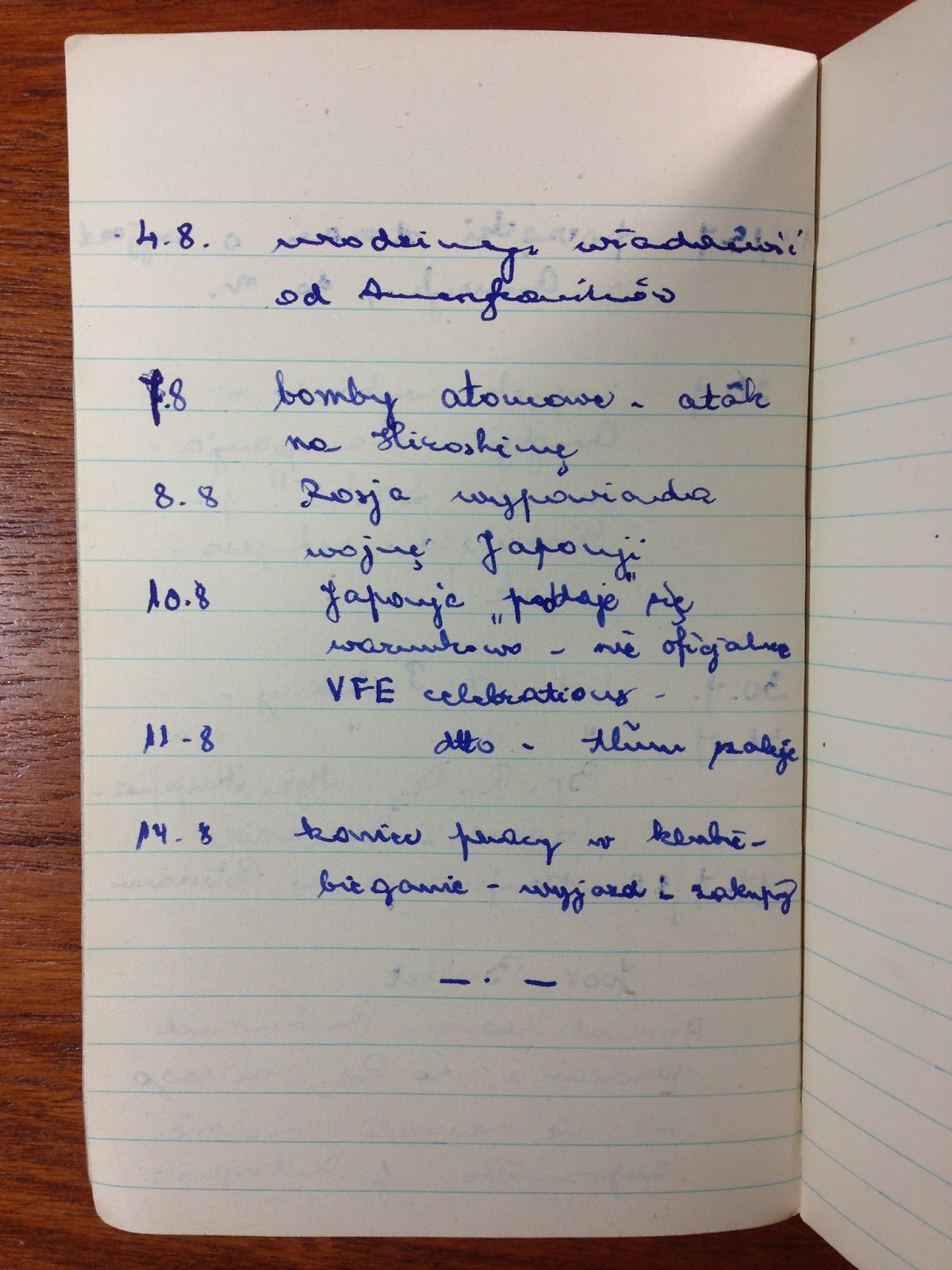
In my father's case, I had only a little war diary. He was in London, still serving in the Polish Army but employed on the British home front at the time.


The entries are in his usual laconic fashion: just an annotation of events or places and the like, as an aid to memory. Even so, they may prove informative, at the least as a reminder of how news of the final phase of the war reached the public, which by definition lacked our knowledge of the course and duration of the endgame.

Under 7 August--written over 6 August, perhaps distinguishing between the date of the event and the majority of the press coverage(?), we find:
atom bombs [sic: plural] -- attack on Hiroshima
Under 8 August:
Russia declares war on Japan
This may seem an anticlimax today, but the Soviet declaration of war was headline material: one of the outcomes of the Yalta Conference, urgently sought by the US, given the anticipated cost of the invasion of the Japanese home islands. Again, no one could be sure the dropping of the atomic bomb(s) would bring about Japanese surrender. And of course, given the great secrecy that had enshrouded the whole development process, no one outside the highest circles knew that the U.S. had only two of the devastating weapons (though there were plans to rush ten more into production, for a total of twelve).

Curiously, there is no mention of the Nagasaki bomb on 9 August. Perhaps the entry for the 7th was written retroactively, as he caught up with events, and intended to cover both air attacks (thus the odd plural: "bombs"), or perhaps, in the rush of events, Nagasaki was simply eclipsed by the greater news of Soviet entry into this theater of war and then, immediately thereafter, of an impending end to the war itself.

Under 10 August:
Japan to "surrender" conditionally  -- unofficial
The term, "conditionally," is striking but in fact historically accurate because, although the Japanese message to the Allies spoke of accepting the terms of the Potsdam Declaration, mandating unconditional surrender, it also contained the qualifier: provided "said Declaration does not comprise any demand which prejudices the prerogatives of His Majesty as sovereign ruler.” In point of fact, although President Truman ordered a halt to bombing (even as the Soviet campaign continued), discussions continued for several days until the Emperor made an unprecedented radio broadcast and announced the surrender.

Although that occurred only on August 15, the news of 10 August proved good enough for the general public.  The diary records:
VFE celebrations
"VFE" here stands for "Victory in the Far East." This in itself is interesting, for it reminds us that even the name of the holiday (actual or anticipated) was not yet set: (see the next post). The formal surrender ceremony of course took place only on 2 September aboard the battleship "Missouri" in Tokyo harbor.


A memoir of old age

My mother described her situation in one of the essays that she produced for her writing group, in her final years. It is thus from long after the fact, but is in accord with what she had told me long before.

In April 1945, with defeat of Germany on the horizon, she had just completed a Master's thesis on modern German history at Columbia when she was offered a fellowship to continue graduate work in ancient history. She reluctantly turned town the offer because she had already made a commitment for the coming years: denazification work with the US military government in occupied Germany. It was a moral and political priority for her. (Nowadays a student would turn to "activism" and seek out an NGO. In this case, the work was done through the US government and had the power to make a difference.) She had in effect been training for this work without knowing it, for she helped to put herself through school by working as a censor of German POW letters: the government needed people who not only spoke German but could read the peculiar cursive script and were moreover familiar with the geography and culture.

She arrived in Europe in June 1945, as part of a Civil Censorship Division (CCD) team assigned to set up offices in a given locale and then move on to the next. Her second post was in Bremen, an American enclave within the British occupation zone:
Parts of the center of the city, the bank, the stock exchange etc. had been bombed, but fortunately not the beautiful old Rathaus [Town Hall], the “Dom,” i.e. the Cathedral. The famous statue of Roland had early on been moved to a place of safety.  Part of the Rathaus was turned into a Red Cross Club, where we could find refuge in a comfortable, relaxed setting, drinking coffee or tea, listening to a small German orchestra play light classical music, or even dancing a little.  It was at the Rathaus that we heard, in hushed silence, the news that an atomic bomb had been dropped on Hiroshima!  People were incredulous, also shocked.  Did this mean that Japan had given up, surrendered? We learned of course that the Japanese had not done so, and that a second atomic bomb, this time dropped on Nagasaki, did result in surrender and an end to war in the Pacific.  Everyone was jubilant, but even on August 6, 1945, the events at Hiroshima left me ambivalent: what did this mean for future wars, and to the people of all nations?
Relief, then, but not without a sense of foreboding or concern for the future. That seems about right.

* * *

Resources

New York Times coverage of the dropping of the atomic bomb

2015 Pew Research poll: 70 years after Hiroshima, opinions have shifted on use of atomic bomb

Saturday, August 8, 2015

Robespierre: It Takes a Tender Man to Lead the Terror (with a nod to Mike Huckabee)

And  . . . having noted the murder of Jean-Paul Marat by Charlotte Corday (1, 2), it would not be appropriate to neglect the anniversary of the fall of the Revolutionary leader Maximilien Robespierre--"The Incorruptible."

So, I had planned to write something about this anyway, but I never thought that Republican presidential candidate Mike Huckabee would provide the added hook.


It's not often one hears the term, "Supreme Being," used in modern political discourse. It was a name for the divine favored by Enlightenment deists who rejected "revealed religion," and is thus not part of the vocabulary of a Christian conservative such as Huckabee. Presumably, he just needed the parallel construction in order to drive home his anti-government message.

And how is all this connected with Robespierre?

He was a far more complex figure than the caricature propagated by his enemies would suggest.  For example: although opposed, with the majority of the revolutionaries, to any social or political role for the Church, he considered it tamed by the early reforms, and condemned the extreme "de-Christianizers" who pursued policies ranging from destruction of religious art and architecture to slaughter of priests and nuns. He did not see the individual believer as a threat, and on the contrary, successfully advocated for freedom of worship, arguing that mindless persecution of the religious would only revive the mindless fanaticism that the Revolution had sought to eliminate.

For Robespierre, atheism was an aristocratic affectation, at odds with both democracy and the emotional needs of the populace. Belief in a deistic divine presence ensuring the reward of virtue and punishment of vice was central to his worldview.

Belief in a Supreme Being had been part of the French Constitution since April 1793, but Robespierre sought to restore cultural peace and unity by clarifying and formalizing the consensus belief. He set forth his ideas in the Report to the National Convention on the Connections of Religious and Moral Ideas with Republican Principles, & on National Festivals on 18 Floréal, Year II (May 7, 1794)

Robespierre's Report, published by order of the Convention
at the National Printing Works in Paris: in-octavo, 45 pages

Following the political and philosophical exposition, the Report set forth a 15-point decree on the cult and its festivals.


{enlarge} 

First Article.

  The French people recognizes the existence of the Supreme Being, and the immortality of the soul.

II.

  It recognizes that the manner of worship worthy of the Supreme Being is the practice of the duties of man.

III.

  It places chief among these duties: to detest bad faith and tyranny, to punish tyrants and traitors, to assist the unfortunate, to respect the weak, to defend the oppressed, to do all the good that one can to others, and to be unjust toward no one. . . .

It concluded with the outline of a Festival of the Supreme Being, proposed by the artist Jacques-Louis David, to be held on 20 Prairial Year II (June 8, 1794)


Festival of the Supreme Being, from Charles François Gabriel Levachez, and Son, and
Jean Duplessi-Bertaux, Tableaux historiques de la Révolution Française, 1798-1804

Whereas Robespierre viewed the Festival as a crucial last attempt to reinvigorate the Revolution, both contemporaries and modern scholars have seen it as one of the factors that contributed to his downfall. It alienated both de-Christianizers and more traditional deists; critics accused him of megalomania and seeking to set himself up as  a new "pope" or "Mahomet" (Muhammad).

A contemporary account described him as "dressed in a sky-blue coat, with exquisite ruffles of lace, and holding a bunch of flowers, fruit, and ripe wheat in his hand."

from the first edition of Alphonse de Lamartine's History of the Girondists. The work ran to 61 "books" divided among 8 volumes, whose publication (Paris: Furne et Cie.,1847-50) coincided with the outbreak of a new revolution, in which the Romantic poet and liberal politician himself briefly played a key part. It was accompanied by 39 steel engravings of Revolutionary figures, along with a portrait of the author. The plates, drawn by Denis August Marie Raffet (1804-60), engraved by various artists, and printed by Plon, were issued separately in 13 installments costing 1 franc each, from 1848 to 1850 (sheet size: c. 19.5 x. 25.7 cm)

This hostile engraving from the mid-nineteenth century is arguably intended to convey that view of the priggish and arrogant Robespierre. At the same time, in retrospect it perhaps inadvertently humanizes him by presenting him in a manner to which we are unaccustomed.


The rather soft-looking Frank Perdue may have laughed all the way to the bank on the slogan, "It takes a tough man to make a tender chicken."

Well, the Robespierre corollary is: it took a tender man to lead the Terror.