Tuesday, November 11, 2014

The Lighter Side of the Fall of the Wall (1)


Although contemporaries immediately recognized the historical significance of the opening of the Berlin Wall, comics were almost as quick to find material in the event.  Some pretty good stuff emerged in the coming weeks and months.

Here, a few selections from The Late Night with David Letterman Book of Top Ten Lists (Pocket Books, 1990):

Top Ten Things Overheard at the Berlin Wall
10. "I came for the political freedom--I'm staying for the McRibs!"
9. "Is this the line for Batman?"
8. "So many Bennetons!"
7. "As long as you're already in the trunk, let's go to a drive-in."
6. "We're coming to save you, Zsa Zsa!"
5. "Here in the West, we don't have to pay a lot for our muffler."
4. Finally I can realize my lifelong dream to attend a taping of the PTL Club."
3. "Let's stay at Dave's house!"
2. "This ought to scare the crap out of the French."
1. "We're going to Disney World."

(FWIW: Personally, I think # 10 is a lot better than 8 and 9, for example. Or 3 and 4, for that matter. But 1 and 2 are good.)

Sunday, November 9, 2014

Fall of the Wall Disclaimer


Today of course marks the 25th anniversary of the opening/fall of the Berlin Wall.

It was a striking event for those of us who watched the scenes play out across our television screens, the more so for those of us with personal or professional connections to Germany and German history.

However, because every major news organization will be covering the anniversary in full--indeed, ad nauseam, I've decided to limit my own posting here and just follow the conversation. Be prepared: most of the commentary will not be from the most sophisticated perspective (expect lots of triumphalism, sweeping generalization, and banalities that pass for profundity, but amidst all the empty chatter, there will be a few morsels of insight.

I will post a few smaller items, some serious, others--not so much.

Meanwhile, keep an eye on the tumblr for images associated with the event (#fall of the wall; #Mauerfall)


[updated image]

Friday, November 7, 2014

What Would You Put On a New Historic Preservation Stamp?


October 29 is the anniversary of the US Historic Preservation Stamps. What Does Historic Preservation Mean to You Today?


On 15 October 1966, President Lyndon Johnson signed into law the National Historic Preservation Act,  (NHPA; Public Law 89-665; 16 U.S.C. 470 et seq.), the landmark legislation that, in the words of the National ParkService, “established the framework that focused local, state, and national efforts on a common goal – preserving the historic fabric of our nation."

Among the results was the creation of the Advisory Council on Historic Preservation, the National Register of Historic Places, and enabling legislation for preservation funding, as well as measures that facilitated the creation of local historic districts.

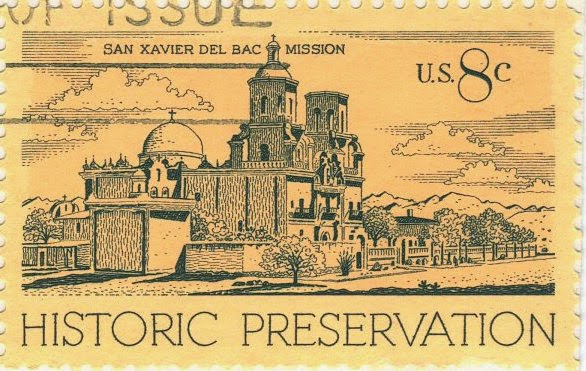
To mark the fifth anniversary, the US Postal Service issued a set of four postage stamps on October 29, 1971.


Designer: Melbourne Brindle
Printing: 150 million in sheets of 32
Decatur House (Washington, DC)

The 1818 building was a fitting choice in several ways. A private domicile, built for the famed American naval hero in the new national “Federal” style in the nation’s capital, it is one of only 3 extant houses by Benjamin Henry Latrobe, architect of the US Capitol. It may have been a more fitting choice than the designers realized: Given to the National Trust in 1956, it acquired landmark status in 1976. Today, as the National Center for White House History, it includes event space for rental as well as commemoration of the enslaved African-Americans who worked and lived here. We thus find here on one site the evolving spectrum of US preservation concerns: historical and architectural significance, cultural diversity and difficult histories, and adaptive reuse.


The last surviving wooden whaling ship, and a highlight of the historic ensemble of Mystic, CT. An icon of American economic development and technological achievement.

The iconic local transportation system, which began in 1873 as a creative response to the uniquely hilly terrain. After World War II, the city planned to eliminate them when the bus emerged as a more efficient alternative. Citizen activism saved them from destruction on the grounds of charm and historic resonance in 1947.


Reflecting a distinctive blend of aesthetic influences from Spain, New Spain, and indigenous traditions, it is the oldest preserved European structure (1783-97) in Arizona, granted landmark status in 1963. Today, we are more willing to acknowledge the exploitative nature and destructive consequences of the Spanish missionary work among the Native Americans (1, 2). More generally, we realize that our image of the old Spanish west derives more from the romanticzing impulses of the late nineteenth and early twentieth century than from history itself.


I always show these images at the start of my historic preservation class—not only as an ice-breaker or eye candy, but with a further purpose. I ask students to imagine why these images might have been chosen. That is: what do they tell us about what was valued then?

I have always been intrigued by the possible logic.  There are two sites each from the east and west coast—though nothing in between (not barn or a Sullivan skyscraper or a Prairie School house from my native Midwest). The inclusion of the mission broadens the customary scope of preservation concerns to include the Spanish Colonial heritage and moreover adds a religious structure to the mix. I have always found it noteworthy that, despite the common tendency to associate historic preservation with architecture, half of the images are not of buildings.

Preservation in the United States, as is well known, began with sites of historical importance to our civic-national narrative and grew to embrace exemplars of architectural distinction. The NHPA formalized the beginning of a greatly expanded, long-overdue notion of preservation going beyond major landmarks. As the amended law and practice have evolved, we have come to take a much broader view of resources and our mission. We preserve vernacular as well as exalted architecture, we preserve whole neighborhoods as well as individual structures. We preserve cultural landscapes as well as buildings. We save not only Civil War battlefields, but also once-“futuristic” 1960s gas stations and an early McDonald’s restaurant.

Sometimes (as in the past, no doubt), our efforts seem to outpace public understanding. We have begun to consider 1950s asphalt parking lots as cultural landscapes. Preservation of a chain link fence in Alexandria, VA became a source of outrage and the butt of jokes not long ago.

Indeed, as I noted in one of my earliest posts here, the preservation of the modern has become the most complex and controversial field. Traditionally, preservation regulations come into effect when a resource is at least 50 years old. However, given that the middle of the twentieth century witnessed a building boom and the proliferation of new architectural styles, a vast stock of modernist structures was or remains unprotected. The fact that many of these styles lack a popular constituency and that the structures themselves are anything but energy-efficient puts them in particular jeopardy. The National Park Service decided that restoration of the landscape of Gettysburg Battlefield trumped preservation of Richard Neutra’s modernist Cyclorama visitor center.  Protests of architects notwithstanding, the idiosyncratic Prentice Women’s Hospital in Chicago, too, came down.

On the other hand, whereas concerns over energy efficiency at times feed the urge for demolition, they now also contribute to a countervailing trend, as preservationists ally themselves with environmentalists and sustainability advocates under the mantra, “the greenest building is one that has already been built.” We have risen up to defend the much-maligned traditional window against the onslaught of the replacement window industry. The notion of “adaptive reuse” is saving many a building that might otherwise have fallen to the wrecking ball, even as it prompts us to let go of purist or absolutist notions of preservation and allow greater changes to structures. (One might perhaps discern a resemblance to the notion of "letting go" and "shared authority" now in vogue in the world of museums and public history.) Often as not, we now speak of “sustainable preservation" as well as “historic" preservation.

So here’s my question. The fortieth anniversary of the NHPA was cause for both celebration and deliberation. 2016 will mark the fiftieth anniversary. If we were to issue new preservation stamps two years from now, what iconic American subjects would you have them depict?


or ….?

Please post your answers in the comment section below. I’m eager to see what, collectively, we come up with.

Even Scarier Than Halloween Bad History: Everyday Ignorance

Both kidding and serious concerns about bad documentaries notwithstanding: I know that, were I to lay out the reasons that "The Burning Times" is an atrocious travesty of history, I could have an intelligent discussion with my Hampshire College classes.

Sometimes we forget how lucky we here in the Five College Consortium are, privileged to work with students who are on the whole smart and well educated or at least educable.

Not everyone is as lucky.

Consider, for example, this footage from Texas Tech.

Sure, sure, these things have a sensationalistic "gotcha" quality about them and may well not be representative. Still, can you imagine how any American claiming to be educated could not know who won the Civil War? or even what the two sides were? See for yourself.


(h.t. wj)

Pandering ghost tours and bad witchcraft documentaries pale in comparison.

Be afraid. Be very afraid.


Thursday, November 6, 2014

And You Thought Halloween Was Scary? How About Teaching Bad History About Witchcraft??


Often as not it's bad history rather than scary costumes that forces historians to turn away and scream in terror every Halloween.

I was dismayed to see that Hampshire College--admittedly, the Spiritual Life Center and Community Partnerships for Social Change, rather than an academic class--was sponsoring a screening of one of the worst pseudohistorical documentaries for the occasion.

"The Burning Times" is a 1990 piece in the National Film Board of Canada's "Women and Spirituality" series. It has developed a popular following for all wrong reasons, which will become immediately obvious:
This documentary takes an in-depth look at the witch hunts that swept through Europe. False accusations and trials led to massive torture and burnings at the stake, and ultimately to the destruction of an organic way of life. The film questions whether the widespread violence against women and the destruction of the environment today can be traced back to those times. 
The intention of my Hampshire colleagues was good, I am sure: to add some intellectual content to a holiday long known here for its substance- and sex-related excesses, to highlight the historical oppression of women, and to acknowledge neo-paganism within the scope of spiritualities in the college community.

Unfortunately, the film is a slick and sloppy New Age compilation of errors, half-truths, omissions, and exaggerations.

Given that "The Burning Times" describes the city of Trier as "French" even though all the signs on the buildings shown are in German and it belonged to France only briefly--from 1794 to 1815, never during the Middle Ages--an attentive viewer might think to question the film's larger claims such as the characterization of the witch hunts as "the women's Holocaust" (at 14:19).

I remember one colleague here in the Five College Consortium lamenting to me that whenever students saw "The Burning Times," it took him at least half a semester to unteach the idiocy they had absorbed. Some years ago, when I saw that WGBY, the local Public Television station, was showing this sorry film during a pledge drive (adding insult to injury), I went so far as to call them up and explain that I was therefore not going to donate any money that year.

Yes, it's that bad.


The work of any professional historian will suggest how much more complex the reality was.

Even a glance at David Hall's appropriately titled essay on "Witchcraft and the Limits of Interpretation" (New England Quarterly, 1985) should make anyone pause before making sweeping generalizations covering many centuries and countries.  But his piece is rather heavy going.


For those seeking the bird's eye view, Brian Pavlac, author of Witch Hunts in the Western World, helpfully lists:
Ten Common Errors and Myths about the Witch Hunts, Corrected and Commented
  1. The Witch Hunts were an example of medieval cruelty and barbarism.
  2. The Church was to blame for the Witch Hunts.
  3. The Witch Hunts specifically targeted women.
  4. The Witch Hunts were an attempt at "femicide" or "gendercide," meaning the persecution of the female sex, equivalent to genocide.
  5. The Witch Hunts were all alike.
  6. Millions of people died because of the Witch Hunts.
  7. People condemned during the Witch Hunts were burned at the stake.
  8. During the time of the Witch Hunts, witches actually existed and worked magic.
  9. In modern usage, the term "Witch Hunt" can be applied to any persecution of a group of people.
  10. Modern witchcraft/magick/wicca is a direct descendent of those practices done by people during the Witch Hunts of 1400-1800.
(detailed explanation of each here on his Women's History Resource Site).

Ontario Consultants on Religious Tolerance deal specifically with the film:

Overview:

We are not going to win many friends in the Neopagan communities with the following essay. However, we believe it to be accurate. It is a story that needs to be told.

The facts are that almost all of the information that is generally accepted as truth by the Neopagan community about the "burning times" is wrong:
  • The total number of victims was probably between 50,000 and 100,000 -- not 9 million as many believe. 
  • Although alleged witches were burned alive or hung over a five century interval -- from the 14th to the 18th century -- the vast majority were tried from 1550 to 1650. 
  • Some of the victims worshiped Pagan deities, and thus could be considered to be indirectly linked to today's Neopagans. However most apparently did not. 
  • Some of the victims were midwives and native healers; however most were not. 
  • Most of the victims were tried executed by local, community courts, not by the Church. 
  • A substantial minority of victims -- about 25% -- were male. 
  • Many countries in Europe largely escaped the burning times: Ireland executed only four "Witches;" Russia only ten. The craze affected mostly Switzerland, Germany and France. 
  • Eastern Orthodox countries had few Witch trials.[....]
  • Most of the deaths seem to have taken place in Western Europe in the times and areas where Protestant - Roman Catholic conflict -- and thus social turmoil -- was at its maximum.


Any questions?

If there's a lesson to be learned, it's that changing historical facts is no way to redress historical injustice or bring about historic change. Even would-be radicals need to do their homework.


Wednesday, November 5, 2014

And You Thought Halloween Was Scary? How About Historians Giving in to the Ghosts?

Halloween brings its share of inanity and insanity, ranging from offensive costumes to drunkenness and vandalism. Still, my pet peeve is all the bad history.

One  topic of perennial concern to people in the museum and historic preservation world is: ghosts. Do we prostitute ourselves when we indulge the public taste for these apparition-oriented events?

There is a range of opinion, from those who pander, to those who categorically shun any such programming. Most of us, I think, hold to a middle stance: it is fine to have programs that engage or teach about local supernatural legends, it's really bad (certainly: cheesy) to do events that feature ghostly special effects (a house museum is not a funhouse), and it's absolutely unacceptable to endorse and enable pseudoscience such as so-called paranormal research.

Tennessee archivist Gordon Belt (@GordonBelt) wrote a classic piece on the dilemma of "haunted history" and "heritage tourism" a couple of years back. In a very different vein, "anarchist house museum" guru Franklin Vagnone (@FranklinVagnone) argues that a good-natured embrace of the ghost-hunting fad--here, by the Morris Jumel Mansion--can be worthwhile:


Two curious things about that: (1) although the historic Morris Jumel house serves as the setting, it is not mentioned by name in the film  (2) and indeed, the skit describes the action as taking place in "Amherst, Massachusetts." Alas, there is no structure as grand as that in our fair town. Not the first time people found the good Amherst name worth appropriating, though. You may recall that the fake documentary about the "Blair Witch" (fake) documentary included an interview with a fictional "Charles Moorhouse, Professor of Folklore, Hampshire College."

The Morris Jumel House, perhaps more controversially, also opened its doors to the Travel Channel's "Ghost Adventures" program. Two clips (1, 2) and, if you prefer, the whole:


Ghost Adventures S09E03 George Washington Ghost by horror_motion

It's certainly free publicity that the site would not otherwise get. Is that nonetheless too high a price to pay? You be the judge.

By the way, it's good to be reminded that there are practical downsides to going for the ghosts: a student who worked in one major house museum told me that visitors broke at least one object object while trying to navigate the darkened edifice on one such "ghost tour." Not what we call responsible collection management. Forewarned is forearmed.

Speaking of forearms, I was taken aback to see that the National Museum of Civil War Medicine, is prominently featuring a severed arm reputed to come from the battlefield of Antietam in its "Behind the Screams" (yes, really) Halloween tour.


"But," they assure us, "it's not just a marketing gimmick." Yeah, right.

Still, I was shocked to see the museum opening its door to paranormal researchers and allowing these frauds to spend the night--though for a healthy fee, of course. A museum of science, of all places? (admittedly, it's called "the most haunted place in Frederick" Maryland, but I have no idea how many others there are or how haunted they may be).

Do those who give in to the ghosts prostitute themselves? Perhaps. But then, maybe they're just coolly calculating their interests and laughing all the way to the bank.

Tuesday, November 4, 2014

Women in Massachusetts Elections Then and Now: What a Difference a Century Makes

Women's votes: from our house to the State House

If you don't keep up with the Massachusetts past, you at least learned this at the Amherst Educational Foundation Trivia Bee last week:

In 1879, Massachusetts made it legal for women to vote in school committee elections. In 1880, Louisa May Alcott was the first to register to vote in Concord. As Mass Moments recounts, "When the day came, a group of 20 women, "mostly with husbands, fathers or brothers" appeared, "all in good spirits and not in the least daunted by the awful deed about to be done." When the votes were cast, she later reported, "No bolt fell on our audacious heads, no earthquake shook the town." 


 Orchard House, home of the Alcott family in Concord from 1858 to 1877.
In the latter year, Louisa May Alcott and her father Bronson joined her sister
Anna in a house on Main Street.
Postcard from the Valentine-Souvenir Co., NY (active 1914-1923)

Flash forward a generation: Still no votes for women in the larger electoral landscape.

On November 2, 1915, Massachusetts voters failed to pass a referendum that would have given women the ballot across the board. Oddest of all, as Mass Moments explains, some women played an active role in that defeat:
In spite of its leading role in the nineteenth-century woman's rights movement, Massachusetts was the first state to organize an association of women opposed to suffrage. Known as the "Antis," these women believed that they could be better, more effective citizens without the ballot. Many of the "Antis" were active in Progressive era causes; they feared that involvement in electoral politics would erode their influence. For over 30 years, they and their male allies succeeded in keeping Massachusetts women out of the voting booth. But ultimately they lost the fight. On this same day in 1920, Massachusetts women cast their votes in a federal election for the first time. 

Flash forward 99 years:

Today, on November 4, 2014, two women are contenders for the top positions in the state:  Martha Coakley for Governor, and Maura Healey for Attorney General.

Coakley was widely criticized for running a poor and ultimately unsuccessful Senate campaign against Scott Brown (who is today running for Senate in New Hampshire--got that?). Although listed in some polls as trailing opponent Charlie Baker, she insists she is "absolutely not" the underdog, claiming "This race is essentially tied."

The Boston Globe endorsed Baker for Governor and Healey for Attorney General. In western Masachusetts, the Daily Hampshire Gazette and Berkshire Eagle endorsed both Coakley (1, 2) and Healey. (1, 2)


Update Tuesday afternoon: just heard Tom Bevan and Washington Bureau Chief Carl Cannon discussing Coakley and the Massachusetts election on "Real Clear Politics" (Sirius XM Satellite Radio):
Q: Should she be looking for a different line of work?
A: I don't think that will be up to her.
One of the hosts, speaking as an avowed Democrat, called her terrible campaigner lacking in warmth, and said he'd rather have a beer with Baker than lunch with Coakley. Ouch.

By tonight, we'll know what her career plans will or will not include.


Sunday, October 26, 2014

October anniversaries: Happy Birthday, USS "Constitution"

October 21 is the anniversary of the launching of the USS "Constitution," which earned the nickname "Old Ironsides" during the War of 1812, whose bicentennial we are still marking. The "Constitution," as Mass Moments reminds us, is the "oldest commissioned warship in the world." (basic story here)


• Date of issue: Oct. 21, 1947
• Place of issue: on the deck of the Constitution, Boston Naval Yard
• Printing: 131,488,000


The average person would never guess from looking at it that this rather understated stamp could give rise to controversy, but that's just what happened when some naval aficionados and historical enthusiasts first laid eyes on it. As Arago, the online resource site of the US Postal Museum, explains, experienced Boston Naval architect Andrew Hepburn "designed the stamp after considerable historical research." And yet:
The stamp received criticism for ignoring the ship's grandeur and thereby under-representing the role it played in building America. While many stamp designs have been challenged and criticized over the years, the uproar over Old Ironsides was one of the loudest ever. Typical of the very strong criticisms was that of Elmer C. Pratt, the stamp columnist for Camden, New Jersey's Courier-Post. "The idea of showing that great fighting hero as a mimbly-pimbly boat sailing along in a light wind . . . when all her life she was a fighting ship full of fight. She should have been shown in a heavy wind, with full sails set, in a heavy sea, going someplace where she should be going, often did and as a rule won the day-into a well fought and victorious battle."
The controversy notwithstanding, the stamp was quite popular with the public. Arago tells us that first-day sales amounted to "An unusually high" figure of 4,700,000, including almost 700,000 first-day covers.

The storm over the stamp was of course a tempest in a teacup compared, as an earlier post shows, with the competition between New England cities to claim the title of birthplace of the US Navy. In addition, the ship itself poses some interesting problems of historic preservation. On that subject: more in the next post.

Previous and related stories:

• (2010) 21 October 1797: Launching of USS Constitution; the need for preservation and interpretation continues
• (2011) July Anniversaries: Wooden Whaling Ship "Charles W. Morgan" Celebrates 170th Birthday, 21 July


Thursday, October 16, 2014

Happy Dictionary Day

Dictionary Day is the anniversary of Noah Webster's birthday, for good reason.

I am remiss in not having gotten my full-fledged post up for Mr. Webster's birthday (it turned out some extra work is required), but in order to honor (or placate) his spirit, I have uploaded a large new scan of a portrait engraving from his lifetime, over on the Tumblr.

Stay tuned for more in the near future.

Monday, October 13, 2014

Removing Columbus from the Calendar


Ironically, as I noted in an old post, the cancellation on this stamp honoring Christopher Columbus and


the "discovery" of America obscures the figure of the putative hero. It could serve as a metaphor for his fate in recent years.

The reaction against the glorification of Columbus advances a bit further this fall as the government of the city of Seattle today--on the federal holiday of "Columbus Day"--signs a measure mandating the celebration of the second Monday in October as Indigenous Peoples' Day.

Nothing of the sort planned in Amherst yet. (Select Board signed the fall Town Meeting warrant a week ago.)

My 2012 roundup of stories on changing attitudes toward the explorer and his holiday. covered a lot of ground, so I won't try to do the equivalent here again. (I think there was some pretty good stuff there: check it out.)

Instead, I'll just note that the Harvard Crimson got into the game this year with the brief and light-hearted Even People in the 1400s Agreed Columbus Was An Asshole.


Update, Oct. 27: belatedly came across this from John Patrick Leary's Tumblr, which chronicles and dissects the language of inequality. In this one, he describes the anachronistic appropriation of Columbus:
Happy Imperialist #Leadership Day from the Keywords #Team!

This Columbus Day offers some of the less historically (to say nothing of morally) inclined out there to draw fatuous links between the contemporary cult of entrepeneurship and the legacy of Christopher Columbus’ conquest—err, acquisition—of America some 500 years ago. (read the rest)