The promised longer report on the events surrounding the talk by IDF Sergeant Benjamin Anthony of "Our Soldiers Speak," will indeed follow, probably late tonight.
I'm behind schedule because we're still coping with the aftereffects of the Blizzard of Oz (no, not that one; this one) and a backlog of real work (you know: that pesky day job). Also discovered I needed to fix a few typos and other details.
In the meantime:
It was noteworthy that, on the morning after the event, Hampshire College President Marlene Fried issued a statement informing the community of the disruptions and affirming the need to be able to conduct "open dialogue and discussion" on controversial issues.
Monday, February 7, 2011


Friday, February 4, 2011
Hey, Mom, We're No. 2! Hampshire College only second school to disrupt talk by Israeli speaker
We may be only # 119 on the US News and World Report overly influential and basically bogus ranking of American colleges (though, all the quibbles notwithstanding, for a small, recently founded liberal arts college with no endowment to speak of, it's a pretty good number out of a data set of 1400).
I'm more proud that we, fortunately, rank higher in other measures: a Sierra Club "top ten cool school," one of the listed green schools, and one of the top-20 gay-friendly schools.
Tonight we earned a new distinction.
We're number two! I'd be tempted to have bumper stickers printed up, except that it's not a list we really want to be on.
As noted in the last post, Reserve Sergeant Benjamin Anthony of the Israel Defense Forces (IDF) gave a talk here on the experience of military service in one of the world's most controversial conflict zones.
The Hampshire College administrators involved in multicultural affairs did our institution proud tonight. In the introductory remarks, Special Presidential Assistant for Diversity (and professor of computer science) Jaime Dávila, who had already taken the initiative in starting programs for intergroup dialogue, and Assistant Dean of Students for Community Advocacy Amnat Chittaphong, spoke forcefully and eloquently in support of open and honest dialogue. They explained that this was a setting for education, which in this case consisted in listening respectfully and asking questions in the same spirit when the talk was over.
The pro-Palestinian activists in the audience (anywhere between a third and half, I would estimate) did not accept these ground-rules. They frequently interrupted the talk with hisses, catcalls, heckling, blowing of whistles, and other demonstrations.
The event was not canceled, but after repeated disruptions, Sgt. Anthony said that he would skip the remainder of his prepared remarks and, after a few concluding observations, devote all the remaining time to question-and-answer.
One woman, affirming the need to address both "narratives" of the conflict, expressed regret that the Sergeant had not been allowed to speak, and asked whether he had spoken anywhere where a civil and respectful conversation had taken place. Yes, he replied, many times. He had in fact given his talk in over 120 locales around the world without serious incident. On only one other occasion had the disruption been so serious, and in that case, he had been physically threatened.
A heckler shouted out, "Welcome to Hampshire!"
Indeed.
(full report to follow soon)
I'm more proud that we, fortunately, rank higher in other measures: a Sierra Club "top ten cool school," one of the listed green schools, and one of the top-20 gay-friendly schools.
Tonight we earned a new distinction.
We're number two! I'd be tempted to have bumper stickers printed up, except that it's not a list we really want to be on.
As noted in the last post, Reserve Sergeant Benjamin Anthony of the Israel Defense Forces (IDF) gave a talk here on the experience of military service in one of the world's most controversial conflict zones.
The Hampshire College administrators involved in multicultural affairs did our institution proud tonight. In the introductory remarks, Special Presidential Assistant for Diversity (and professor of computer science) Jaime Dávila, who had already taken the initiative in starting programs for intergroup dialogue, and Assistant Dean of Students for Community Advocacy Amnat Chittaphong, spoke forcefully and eloquently in support of open and honest dialogue. They explained that this was a setting for education, which in this case consisted in listening respectfully and asking questions in the same spirit when the talk was over.
The pro-Palestinian activists in the audience (anywhere between a third and half, I would estimate) did not accept these ground-rules. They frequently interrupted the talk with hisses, catcalls, heckling, blowing of whistles, and other demonstrations.
The event was not canceled, but after repeated disruptions, Sgt. Anthony said that he would skip the remainder of his prepared remarks and, after a few concluding observations, devote all the remaining time to question-and-answer.
One woman, affirming the need to address both "narratives" of the conflict, expressed regret that the Sergeant had not been allowed to speak, and asked whether he had spoken anywhere where a civil and respectful conversation had taken place. Yes, he replied, many times. He had in fact given his talk in over 120 locales around the world without serious incident. On only one other occasion had the disruption been so serious, and in that case, he had been physically threatened.
A heckler shouted out, "Welcome to Hampshire!"
Indeed.
(full report to follow soon)
Thursday, February 3, 2011
The Arab-Israeli Conflict at Home: Struggling for Civility on Campus

Amidst all the recent despair over the apparent collapse of peace negotiations between Palestinians and Israelis came a surprise last week: a New York Times Op-Ed piece—”Good News From the Middle East (Really)”—that expressed optimism rather than pessimism. The identities of the co-authors may have been almost as surprising: Jeffrey Goldberg, a Jewish journalist at The Atlantic, and Hussein Ibish, an Arab-American academic and a Senior Research Fellow at the American Task Force on Palestine.
Naturally, the essay aroused controversy of all sorts. Some at each end of the conflict spectrum regarded the views of the one author or the other as a betrayal of their respective integral positions. Many disagreed with various specifics. And even many of those who agreed with the sentiments could not accept the rosy prognosis. All that was to be expected.
The piece is full of policy proposals and urges various sorts of concrete cooperation between the two sides on the economic, political, and security levels. However, it was the closing sections that really caught my attention. In order to “reignite hope,” the authors say, both sides need to make clear their long-term intentions. “Polls show that a majority of Israelis and Palestinians say they both want a two-state solution, but also say they believe the other side is lying. Peace will not come if politicians refuse to prepare their citizens for it through clear and consistent language.”
Hard to argue with that—or this: Ibish and Goldberg insist that, although practical rapprochement is needed, the other requirement is therefore trust and empathy, “the softening of heart”: the ability to understand (even if not fully accept) the position of the interlocutor. They conclude:
The two of us have been following the Middle East peace talks for years, and we are not naïve about the chances for peace. We disagree on a dozen aspects of this conflict, which is not surprising for an Arab and a Jew. But we also know that giving up or walking away is not an option, because the alternative to compromise is the abyss.Say what one will about the specifics of the piece and its prescriptions: Arab and Jew walking together rather than walking away, knowing that the choice is between “compromise” and the “abyss”—it is a lesson and a model for the people in the region and for those watching with concern from afar. It’s also a model that seems very far away here on the American academic scene, where the Arab-Israeli conflict has become arguably the single most polarizing political issue.
In particular, it is because the so-called “Boycott, Sanctions, Divestment” (BDS) movement directed against Israel has come to monopolize the Palestinian activist scene. It is among the approaches that Ibish and Goldberg find unhelpful:
THERE are, however, Palestinian initiatives that are completely counterproductive. Continued threats to unilaterally declare independence are pointless and provocative. Support for boycotts against all Israeli products and companies also serve only to convince Israel and its supporters that the Palestinians seek its elimination. Israel is a member of the United Nations and must not be delegitimized. It is understandable that Palestinians are supporting boycotts of products made in settlements, however, since the settlements are illegitimate and must not be legitimized.Law of unintended consequences: One of the ironies of the intensified activism is that the majority of students, who have no preconceived notions or vested interest in the Arab-Israeli conflict, tend to run from it like the plague. To them, it connotes polarization and confrontation here at home, something to be avoided rather than studied. That is a shame in more ways than one.
Far more regrettable than indifference has been a coarsening of tone, a decline in civility, an erosion in trust and feeling of community. Anger has replaced inquiry—and diatribe, dialogue.
As those who have followed events at Hampshire will know, our campus has been wracked by controversies over the Middle East, notably reactions to the fighting in Gaza in late 2008 and early 2009, followed in February by a failed attempt by the BDS advocates of Hampshire College Students for Justice in Palestine (SJP) to bring about divestment from Israeli holdings.
Since then, the atmosphere around the issue has become positively toxic. To be sure, I should stress, academic life continues as normal: most students and faculty just keep their heads down and get on with their work—perhaps an effective coping strategy, but no solution in the long term. Noting the problem, the administration, through the offices of the President, Dean of Faculty, and Special Assistant to the President for Diversity and Multicultural Affairs, has begun a series of initiatives to promote dialogue and civility. A group of faculty, as well as staff from the Office of Spiritual Life, had in the meantime begun its own informal conversations. It was none too soon.
Fear of conversation has in at least one case given way to fear for one's safety. Toward the end of last semester, a student who had expressed sympathetic views toward Israel received anonymous messages described as death threats. This was unprecedented. The College administration promptly issued a strong condemnation. Soon thereafter, a group of eight faculty members involved in Middle Eastern affairs (I among them) issued a statement of support for the President’s letter. (The signatories included faculty associated with Students for Justice in Palestine.)
In the meantime, one of our students has arranged for a talk by a member of the Israel Defense Forces (IDF), part of the “Our Soldiers Speak” initiative that seeks to explain “what transpires on the front lines of battle as well as the context from which the media extracts military events.” Students for Justice in Palestine has now responded with an open letter to the President, both taking issue with her condemnation of the harassment last semester and criticizing the appearance of the IDF soldier.
The event takes place tonight.
* * *
1) Administration Letter
Friday, December 17, 2010
Dear Members of the Hampshire Community,
We are dismayed to learn of recent incidents where students on this campus have been subjected to physical, verbal, and written harassment, threats, and intimidation because of their political views in support of the state of Israel. The College has received several reports recently involving such acts of bullying. In one particular case, repeated acts of physical and verbal harassment have been followed by a threatening letter directed at an individual on our campus. These actions are in clear violation of our Norms for Community Living and will be investigated with appropriate sanctions administered in accordance with our policies.
These incidents represent a clear violation and they also come in a context of other identity-based interactions on our campus that are of concern. One of Hampshire's priorities is to work towards building a campus where people of all identities feel welcomed. While conversations around Israel and Palestine are often loaded with emotions, it is our responsibility to ensure that they take place in an environment of respect and care for all members of our community. At different times, we both have had the benefit of participating in conversations that have been honest, personal, academic, and hard. It is also evident to us, though, that not all of the interactions around these topics that take place on our campus are positive.
At Hampshire we are committed to open dialogue and protest. However, we will not tolerate attacks and discrimination in any form against any individual or group. The instances of vandalism against the property of students who identify either with Israel, Judaism, or who express particular opinions about the Israel/Palestine situation in the Middle East, go against the values of inclusiveness that we want to foster in our community.
We encourage everyone on campus to participate in the many programs that engage with conversations around this topic from varying points of view. These conversations are not always easy, and on occasion will stir strong emotions within us. Still, we urge open discussion and participation even when it requires us to dialogue appropriately with people with whom we might have differences, and even strong disagreements. There will always need to be space for dissenting voices. Allowing space for those voices while appropriately incorporating our own will bring us closer to the goals of inclusiveness that we hope continue to remain at the center of our values.
Sincerely,
Marlene Gerber Fried
Acting President
Jaime Dávila
Special Presidential Assistant for Diversity and Multicultural Education
2) Faculty Letter (signed by eight professors)
To The Hampshire Community:
As members of the faculty whose teaching and scholarly work intersect with the issue of Palestine and Israel, we would like to express our complete support for President Marlene Fried's statement of December 17. We join with her in saying: "At Hampshire we are committed to open dialogue and protest. However, we will not tolerate attacks and discrimination in any form against any individual or group. The instances of vandalism against the property of students who identify either with Israel, Judaism, or who express particular opinions about the Israel/Palestine situation in the Middle East, go against the values of inclusiveness that we want to foster in our community." Intimidation, threats and harassment have no place at Hampshire.
3) SJP Letter
Students for Justice in Palestine reflections on Dec 17th 2010 letter from Acting President Fried and Special Presidential Assistant Davila in Response to Threatening Incidents on Campus
On January 17, President Marlene Freid [sic] and Dean Jaime Davila wrote a statement to the campus reporting incidents of threats and personal violence to students who identify politically with the state of Israel. As a politically-engaged student group that is predicated on principles of social justice, we find it necessary to condemn alarming acts like these that have been recently directed at individuals on our campus. Personal attacks against students regardless of their political association is inappropriate, futile and does not progress any sort of vision of social justice that we strive to realize. While we are still not fully informed about the specific incidents that took place, there were allusions to the reported incidents stemming from anti-Jewish hatred. We sincerely hope these conclusions came from a critical examination by the administration of the difference between anti-Jewish intolerance and opposition to Zionism, which is the predominant ideology behind political support for the state of Israel. In light of that, Students for Justice in Palestine (SJP) would like to take the opportunity to state unequivocally: we stand against anti-Semitism alongside all other forms of racism and cultural oppression. We consider anti-Semitism to be linked to the genesis of the system of injustices we are working to uproot in solidarity with Palestinians.
However, what is very clear to us is that the letter issued to every member of the Hampshire community was not primarily concerned with acts of anti-Semitism, but with vocal opposition towards expressions of Zionism. The letter included elusive suggestions to a conflation of personal Jewish identity and Zionist identity. The reference by the President and Dean's language in the letter to such issues as “identity-based interactions” purports that "political support for the state of Israel" is primarily an issue of identity. Consequently, President Freid [sic] and Dean Davila propose it should be treated with the same amount of sensitivity that the school treats people's identification with a specific cultural heritage, religion, race, gender, or sexuality. Historically, Hampshire has recognized a need to intervene in “identity-based interactions” after significant pressure from students, staff, or faculty to address forms of racism, classism, sexism, or trans/homophobia. In this situation, however, Hampshire is choosing to create a safety net for people whose political beliefs are actively being called into question on campus; not because of their general marginalization but because of their actual impact in being linked to the racial oppression of the Israeli occupation.
To understand someone's identification as Zionist, one must understand the current and historical political context for Zionism's impact on Palestinians as the main victims of Israel's policies of oppression. For one to claim their identity as Zionist, they are professing a loyalty to the state of Israel's institutionally racist Jewish-only laws, its illegal expansionist occupation of Palestinian land, the apartheid-like separation wall carving up the West Bank, and the systematic practice of displacement and ethnic cleansing that has affected Palestinian history for more than sixty years. A declared identity as Zionist therein carries responsibility for the consequences of this ideology and the policies which it dictates. This fundamentally includes an adherence to a settler-colonial state engaged in attempts to effectively remove all Palestinians from the hyper-imposed borders of Israel. The Palestinian struggle is one of the last anti-colonial movements of our time and requires our solidarity. It is paramount for our community to reconsider how it understands the politics of Zionism and the Israeli occupation without confusing matters of personal identity with systemic political oppression.
For the open letter to propose inclusive conversation regarding this issue insinuates an equivalence between the reality of those living under the illegal occupation in Palestine and the occupier themselves – Israel. According to PACBI (Palestinian Campaign for the Academic and Cultural Boycott of Israel), “any presumed parity between Israel and the Palestinians ignores the concrete reality of Israel's colonial oppression... [Conversations] premised on such symmetry between the "two sides" are therefore detrimental to the application of international law and the pursuit of justice."1 Discourses about Israel/Palestine on Hampshire's campus nearly always center on the dominant Zionist narrative because broad support for the state of Israel allows for Palestinian voices to be silenced or marginalized and almost entirely excluded from this campus.
On Thursday, February 3rd 2011, an Israeli soldier is being brought to campus in an attempt to justify his participation in the brutal occupation of the Palestinian people. We find it reprehensible that at a time in which Hampshire is calling for increased 'civility' in our political discourse, a representative of the Israeli 'Defense' Forces would come to our campus in an attempt to garner sympathy for the 'hardship' he endured while serving his time. We do not think his presence is justifiable on our campus by any means and encourage those attending the event to remain critical of rhetoric often used to sanitize the destruction of Palestine. We sincerely hope the administration, students, staff, and faculty will consider their role on Hampshire's campus to separate one's affinity for the state of Israel as it comes into question and that of one's professed identity.
Sincerely,
Hampshire College Students for Justice in Palestine
For more information concerning the occupation and Palestinian solidarity, please see:
mondoweiss.com
electronicintifada.net
thoughtsonpalestine.wordpress.com
http://josephdana.com/
* * *
I was about to say, “The administration, to its credit”—but fortunately, I stopped myself in time. Thanking a college administration for defending academic freedom and civil debate should be like thanking a historian for getting the facts right: superfluous. As the saying goes, “accuracy is a duty, not a virtue.”
What will happen at tonight’s event is anyone’s guess.
Stay tuned.
Wednesday, February 2, 2011
Whiz Kids (Pissed Off)
Colleagues occasionally describe petty academic rivalries as a pissing contest. Now you know why:
Welcome to my world. Some days, it's not pretty.
(HT: YM)
(01-27) 05:04 PST San Fernando, Calif. (AP) --
A California university professor has been charged with peeing on a colleague's campus office door.
Prosecutors charged 43-year-old Tihomir Petrov, a math professor at California State University, Northridge, with two misdemeanor counts of urinating in a public place. Arraignment is scheduled Thursday in Los Angeles County Superior Court in San Fernando.
Investigators say a dispute between Petrov and another math professor was the motive.
The Los Angeles Times says Petrov was captured on videotape urinating on the door of another professor's office on the San Fernando Valley campus. School officials had rigged the camera after discovering puddles of what they thought was urine at the professor's door.
Welcome to my world. Some days, it's not pretty.
(HT: YM)
Sunday, January 30, 2011
29 January 1963: Death of Robert Frost (and a reminder about his presence in western Massachusetts)
The Mass Moments post for today discusses his career as a whole, in a narrative arc that moves from early literary struggles and disappointment to triumph and canonization.As it puts it, "success was a long time in coming" to the man who eventually became "the most popular and renowned American poet of the twentieth century." He was very much of our region but inspired and nourished rather than limited by it:
Given that the entry bases its geographical tag on a crucial phase of Frost's life rather than the place of his death, one could make a far better argument for western Massachusetts. In between his adolescence and his death, he spent much time in New Hampshire and Vermont (where he is buried), and of course, also in Amherst.He taught at Amherst College in 1916–20, 1923–24, and again, 1927–1938. Frost is among the figures depicted on the Amherst Community History Mural in the historic 1730 West Cemetery, created in 2005 by David Fichter under the auspices of the Historical Commission.In 2009, in conjunction with its 250th anniversary celebrations, Amherst undertook further steps to celebrate Frost's presence here. In the spring, Town Meeting voted to allocate Community Preservation Act funds for the Historical Commission's "Writer's Walk", a series of markers at the homes of literary figures, among them, the house at 43 Sunset Avenue, where Frost lived from 1931 to 1938. The request for proposals for fabrication of the signs is now in preparation.

It was in 1938 that Frost's beloved wife, Elinor, died of a heart attack in Florida ("Together Wing to Wing and Oar to Oar," reads the inscription on the gravestone). Frost subsequently moved to Boston and acquired his now-famous summer home in Ripton, Vermont, but the connection to Amherst did not end then.
In the fall of 2009, Friends of LIbraries USA (FOLUSA) honored the Jones Library with a plaque for its work in preserving the legacy of Frost. The collection, which now includes some 12,000 items, was unusual in that it began in Frost's own lifetime, and enjoyed his cooperation. As the finding aid puts it,
One further connection to literary sites: In 1940, Frost bought a South Miami farm, which he named, "Pencil Pines," and began to winter there. As noted in a recent post, he was also among the prominent writers who visited fellow author Marjorie Kinnan Rawlings in her North Florida home at Cross Creek.
During these New England winters—and especially, the unusually snowy one we are having this year—a Florida refuge surrounded by an orange grove sounds pretty good. But then again, who would want to be deprived of "Stopping By Woods on a Snowy Evening," which Frost himself called "my best bid for remembrance"?
The sounds he expressed in his poetry were the cadences and rhythms of New Englanders' everyday speech. Frost found his poetic voice listening to, and then writing about, the working people of New England. But Robert Frost was not a regional poet. As one reviewer put it, Frost was to New England as Dante was to Florence: an artist able to express universal themes in local stories.and
Frost credited his success to the simplicity of both the subject and style of his poems. He liked to write about the everyday objects and landscapes of New England. Frost's style drew from the artless cadences and sounds of New Englanders' speech. He liked to "speak" his poetry to audiences, to draw attention to the artistry in the sound of the human voice. "The ear does it," he wrote; "the ear is the only true writer and the only true reader."The geographical tag for this entry somewhat peculiarly says, "This Mass Moment occurred in the Northeast region of Massachusetts."Uh, not quite. Today's Moment refers to his death. Frost, who was born in San Francisco, died in Boston (for Mass Moments, that would be "the Greater Boston region").Presumably, the entry lists "northeast" region because of the decisive role of Frost's youth in Lawrence. Although he briefly attended Dartmouth College, he never completed his studies there (which didn't prevent him from getting two honorary doctorates there later; evidently, there is hope for everyone). Instead (as the entry puts it), he recalled, "My year and a half of the [Lawrence] district school, and my four years in the Lawrence High School were the heart of my education.They suited me perfectly."
Given that the entry bases its geographical tag on a crucial phase of Frost's life rather than the place of his death, one could make a far better argument for western Massachusetts. In between his adolescence and his death, he spent much time in New Hampshire and Vermont (where he is buried), and of course, also in Amherst.He taught at Amherst College in 1916–20, 1923–24, and again, 1927–1938. Frost is among the figures depicted on the Amherst Community History Mural in the historic 1730 West Cemetery, created in 2005 by David Fichter under the auspices of the Historical Commission.In 2009, in conjunction with its 250th anniversary celebrations, Amherst undertook further steps to celebrate Frost's presence here. In the spring, Town Meeting voted to allocate Community Preservation Act funds for the Historical Commission's "Writer's Walk", a series of markers at the homes of literary figures, among them, the house at 43 Sunset Avenue, where Frost lived from 1931 to 1938. The request for proposals for fabrication of the signs is now in preparation.

It was in 1938 that Frost's beloved wife, Elinor, died of a heart attack in Florida ("Together Wing to Wing and Oar to Oar," reads the inscription on the gravestone). Frost subsequently moved to Boston and acquired his now-famous summer home in Ripton, Vermont, but the connection to Amherst did not end then.

In the fall of 2009, Friends of LIbraries USA (FOLUSA) honored the Jones Library with a plaque for its work in preserving the legacy of Frost. The collection, which now includes some 12,000 items, was unusual in that it began in Frost's own lifetime, and enjoyed his cooperation. As the finding aid puts it,
This collection represents not just Frost's life as a professional poet, but also his life as a public figure. In particular, the collection documents Frost's nearly lifelong connection with the town of Amherst both as a professor at Amherst College and as a part-time resident.Even at the end of his life, the connection was strong, in retrospect tinged with tragedy and symbolism. As Mass Moments puts it:
In 1961 an aging Robert Frost braved the frigid weather to read a poem at the inauguration of John F. Kennedy. He died in Boston on January 29, 1963. At the memorial service at Amherst College, over 700 guests listened to readings of Frost's poetry. Later that year, President Kennedy paid tribute to the poet at the groundbreaking for the Robert Frost Library at Amherst College. Frost had achieved his often-stated ambition of "lodging a few poems where they can't be gotten rid of easily."The speech was far more than a perfunctory one, for, taking Frost as an example, it called for "full recognition of the place of the artist in society." That was on October 26. Less than a month later, Kennedy himself was killed in Dallas. In 1965, President Lyndon Johnson created the National Endowment for the Arts.
One further connection to literary sites: In 1940, Frost bought a South Miami farm, which he named, "Pencil Pines," and began to winter there. As noted in a recent post, he was also among the prominent writers who visited fellow author Marjorie Kinnan Rawlings in her North Florida home at Cross Creek.
 |
| the guest bedroom at Cross Creek |
 |
| bookshelf, displaying works by authors who stayed in the guest room: among them, Frost's Complete Poems |
Monday, January 24, 2011
Current and Coming Openings on Amherst Boards and Committees
The Select Board and Town Manager encourage civic-minded members of the Amherst community to apply for voluntary service on one of the Town of Amherst’s many committees, boards, or commissions. These volunteer public bodies are the lifeblood of our Town and do an impressive amount of work for our community. Many of these public bodies have extensive material about their work posted on the Town website.
As of January 24, 2011 the public bodies listed below have one or more vacancies [appointing authority= (SB: Select Board, TM: Town Manager, M: Town Meeting Moderator)]
As of January 24, 2011 the public bodies listed below have one or more vacancies [appointing authority= (SB: Select Board, TM: Town Manager, M: Town Meeting Moderator)]
Committee on Homelessness (SB)In addition to those vacancies, other public bodies that may have vacancies effective July 1, 2011 include:
Finance Committee (M)
Housing Partnership/Fair Housing Committee (SB)
Human Rights Commission: one high school or college student to serve for one (1) academic school year (SB)
Kanegasaki, Japan Sister City Committee (SB)
La Paz Centro, Nicaragua Sister City Committee (SB)
Leisure Services & Supplemental Education Commission (TM)
Nyeri, Kenya Sister City Committee (SB)
Personnel Board (SB)
Planning Board (TM)
Public Art Commission (SB)
Public Transportation & Bicycling Committee (SB)
Recycling & Refuse Management Committee (TM)
Town/Commercial Relations Committee (SB)
Amherst Cultural Council (SB)If you have interest in applying to join any of the above, please complete a Citizen Activity Form (CAF) for the committee/board/commission of your choice online at as soon as possible. You may also stop by the Town Manager/Select Board Office on the Mezzanine Floor at Town Hall, 4 Boltwood Avenue, or you may call that office at 413-259-3001 to request the CAF be mailed to you. Town offices are generally open to the public Monday - Friday 8 am - 4:30 pm, except for Thursday mornings (opening at noon). Please remember that we keep your CAF on file for at least a year, in case any openings occur throughout the year.
Audit Committee (SB)
Board of Assessors (TM)
Community Development Committee (SB)
Community Preservation Act Committee (SB)
Council on Aging (TM)
Conservation Commission (TM)
Design Review Board (SB)
Disability Access Advisory Committee (TM)
Hampshire Regional Emergency Planning Committee (SB)
Historical Commission (TM)
Munson Memorial Building Trustees (TM)
Public Shade Tree Committee (SB confirms Conservation Commission nomination)
Registrar of Voters (SB)
Zoning Board of Appeals (SB)
Friday, January 21, 2011
Surname Update: geographical distribution of names in the United States
Serendipity again.
Not what's in a name? but: where's that name?
As a nice follow-up to my recent post on Jewish surnames, I can point readers to James Cheshire's post (his blog invariably offers intriguing material) on National Geographic's interactive map of US surnames.
Not what's in a name? but: where's that name?
As a nice follow-up to my recent post on Jewish surnames, I can point readers to James Cheshire's post (his blog invariably offers intriguing material) on National Geographic's interactive map of US surnames.
Wednesday, January 19, 2011
19 January 1749: Birthday of Isaiah Thomas: Patriot, Printer, Founder of American Antiquarian Society
Mass Moments tells us:
Thomas performed yet another great service for the region and the nation. As Mass Moments puts it:

Among the names (for membership was by invitation only, and restricted to notables and distinguished men of learning), we find:

Several items may be of particular interest: The books are a miscellaneous lot; we find one incunable, a 1487 Venetian Bible. Among the periodicals is a collection of the Massachusetts Spy, donated by Thomas himself.
Most noteworthy, perhaps, are materials from the personal library of the Mather family of distinguished Massachusetts clergymen (pp. 23-25): a major portion of the books, and among the manuscripts, "Upwards of 900 single sermons," as well as sermon notes, diaries, and other writings. Indeed, the AAS can today boast of the "preeminent" collection of works by the Mathers.

Among the manuscript material (p. 25) we also find "Compilation of Historical Tracts, in British America, written above 100 years ago," by the "Hon. Thomas Jefferson of Monticello." One longs to know whether Mr. Jefferson (a busy man, by all accounts), read the publication and noted, barely two inches below his own name:
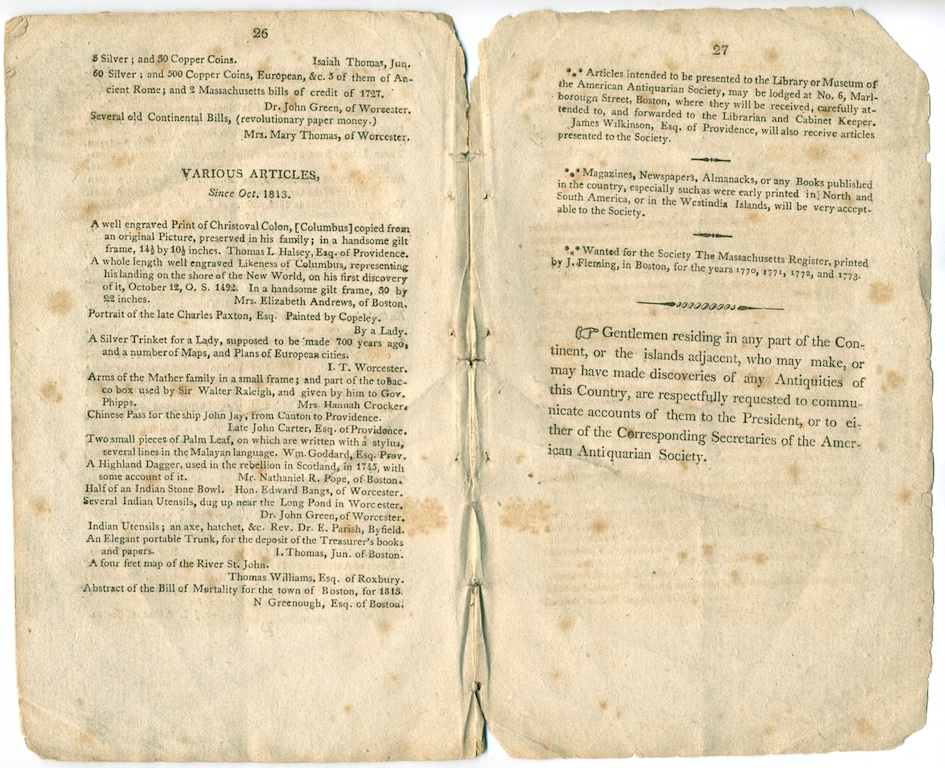
Finally, we encounter the odds and ends: "Coins, Medals, and Paper Money," and the (for modern librarians and archivists) most dreaded "Various Articles" (pp. 25-27).

To be sure, there are the expected sorts of items: engravings of Columbus and a depiction (medium not identified) of the Mather arms, various "Indian Utensils," and the like.
Then there are the some unexpected and intriguing items: "A Silver Trinket for a Lady, supposed to have been made 700 years ago" (this, donated by Thomas himself), "part of the tobacco box used by Sir Walter Raleigh," "Two small pieces of Palm Leaf, on which are written with a stylus, several lines on the Malayan language," and "A Highland Dagger, used in the rebellion in Scotland, in 1745."
The mention of a twelfth-century piece of metalwork or a dagger associated with Bonnie Prince Charlie naturally quickens my pulse. The palm leaf manuscripts also pique my interest: were they collected as mere curios (and how?), or was there some specific interest in the content or their significance for the field of linguistics or paleography? We have no idea. All we know is that the AAS was stuck with them, along with other and sundry objects, including some 800 coins from various regions and epochs, acquired since October 1813. And that was when the AAS was only two years old.
One wonders how the previous owners acquired the artefacts and why they thought a new institution dedicated to "the literature of liberty" in the United States would want or need them. The real question, then, is: do they belong there? In fact, it sounds all too familiar: as anyone involved with libraries, archives, museums, and historical societies knows, one of the biggest challenges is determining what is kept, finding the space for it, and arranging for its appropriate display and/or preservation. All too often, these institutions—especially the small, local-oriented ones—became dumping grounds, the equivalent of the town's attic or junk drawer. Many institutions have had to contend with numerous worthless gifts, but even intrinsically signficant ones (who wouldn't want a piece of medieval silver?) can be a problem if they are not in harmony with an institution's core mission or if the institution cannot properly care for them. As a result, there is new emphasis on developing appropriate collections policies (e.g. 1, 2, 3 ). And, understandably but more controversially, deaccessioning policy is also one of the hottest topics in the museum and library field.
And so, from a small and humble document, a glimpse into the intellectual world of the early republic that reminds us how much has changed and how much has not. Mr. Jefferson's doubts notwithstanding, we have an African-American president (which is not to say that our racial problems have disappeared). And, as Jefferson, the inveterate accumulator of books and much else, would have understood, collections management, too, remains a challenge.
Then as now, the American Antiquarian Society was an elite organization whose membership was small and included only the prominent.Fortunately, the collections and programs of the AAS are open to the general public and have become a chief resource for scholars of print culture as well as New England and American history. It is home to the Program in the History of the Book in American Culture and hosts numerous other programs, seminars, and public lectures. Among the many online resources are the Catalogue of American Engravings and the 19th Century American Children's Book Trade Directory. Just this past year, Cheryl Harned, one of the students in our UMass/Five College History Graduate Program, created a web site on the history of reading in order to make additional resources from the collections more widely available.
It's well worth a visit, whether on the web or in person.I think Isaiah Thomas would be proud.
On this day...in 1749, the Patriot printer Isaiah Thomas was born. In 1770, Thomas established the Massachusetts Spy, the first newspaper aimed at middle-class readers. While other papers were happy with 400 subscribers, the Spy had a circulation of 3,500. Thomas used the Spy to rally support for the cause of independence. Targeted by the British, he smuggled his press out of Boston to Worcester a few days before the Battle of Lexington and Concord. There, he continued publishing his newspaper. After the war, Thomas became the foremost publisher and printer in America. In 1812, he established the American Antiquarian Society, which today is one of the nation's most complete collections of printed work. (read the rest)As both printer and patriot, Thomas was indeed a major figure in the history of Massachusetts and the early Republic. (for further information on Thomas and a copy of the paper, see this post from last summer) was a factor in the Revolution and carried an early account of the battles of Lexington and Concord. Thomas's History of Printing in America (1810) remains a valued and still reprinted reference work.
Thomas performed yet another great service for the region and the nation. As Mass Moments puts it:
In 1812, he used his considerable wealth to establish a society dedicated to preserving the "literature of liberty"— the newspapers, broadsides, books, pamphlets, and letters that had shaped public opinion during the revolutionary period. He donated his private library and a generous endowment. Then he personally visited newspaper offices and purchased as many back issues as he could. He believed that newspapers were the single best records of the thoughts and actions of common people — the people who made the revolution a success.Here, my battered but treasured copy of the List of Officers and other members from 1814, when the Society was but two years old.
Located in Worcester, Thomas's American Antiquarian Society is today the most complete private repository of American printed works through 1876 and a lasting tribute to one man's passionate faith in the power of the printed word.

Among the names (for membership was by invitation only, and restricted to notables and distinguished men of learning), we find:
Hon. John Adams, L.L.D. Quincy, late President of the United States.Our town is represented in the person of:
Hon. John Quincy Adams, L.L.D., Boston, Minister to the Court of Russia.
Hon. Dewitt Clinton, L.L.D. Newyork.
Rev. Timothy Dwight, D.D. L.L.D. President of Yale College, Connecticut.
Hon. Christopher Daniel Ebeling, Professor, Hamburgh, Europe.
Rev. Ebenezer Fitch, D.D. President Williams College, Williamstown.
Hon. Thomas Jefferson, L.L.D. late President of the United States, Monticello, Virginia.
Hon. John Marshall, L.L.D. Chief Justice, U.S. Virginia.
Hon. Gouverneur Morris, Morrisiana, Newyork.
Major General Thomas Pinckney, Charleston, S.C,.
Hon. Bushrod Washington, Judge Supreme Court U. States, Mount Vernon, Virginia
Hon. Daniel Webster, Portsmouth, Newhampshire.
Noah Webster, Amherst.The document includes a record of "Articles Presented to the Society." The list begins by noting Thomas's founding donation of 8,000 volumes from his personal library and then records acquisitions of the past year.

Several items may be of particular interest: The books are a miscellaneous lot; we find one incunable, a 1487 Venetian Bible. Among the periodicals is a collection of the Massachusetts Spy, donated by Thomas himself.
Most noteworthy, perhaps, are materials from the personal library of the Mather family of distinguished Massachusetts clergymen (pp. 23-25): a major portion of the books, and among the manuscripts, "Upwards of 900 single sermons," as well as sermon notes, diaries, and other writings. Indeed, the AAS can today boast of the "preeminent" collection of works by the Mathers.

Among the manuscript material (p. 25) we also find "Compilation of Historical Tracts, in British America, written above 100 years ago," by the "Hon. Thomas Jefferson of Monticello." One longs to know whether Mr. Jefferson (a busy man, by all accounts), read the publication and noted, barely two inches below his own name:
Original Copy of an Almanack, for 1792, in the hand writing of the author, a negro man, in Maryland, by the name of Banniker.In any case, the Sage of Monticello had become acquainted with that book and its author nearly a generation earlier, for it is of course the work of none other than the many-talented Benjamin Banneker (1731-1806). It is ironic in more ways than one. Among Banneker's numerous achievements was assisting in surveying the land for the creation of the nation's capital in 1791. As PBS explains,
A notice first printed in the Georgetown Weekly Ledger and later copied in other newspapers stated that Ellicott was "attended by Benjamin Banneker, an Ethiopian, whose abilities, as a surveyor, and an astronomer, clearly prove that Mr. Jefferson's concluding that race of men were void of mental endowments, was without foundation."And the very manuscript preserved in the AAS collections likewise played a role in that early debate over race:
In 1792, Banneker published an almanac, based on his own painstakingly calculated ephemeris (table of the position of celestial bodies), that also included commentaries, literature, and fillers that had a political and humanitarian purpose. The previous summer, he had sent a copy of the ephemeris to Thomas Jefferson, along with a letter in which he challenged Jefferson's ideas about the inferiority of blacks.Banneker declared it self-evident
that we are a race of beings, who have long labored under the abuse and censure of the world; that we have long been looked upon with an eye of contempt; and that we have long been considered rather as brutish than human, and scarcely capable of mental endowments.Counting on Jefferson's reputation for being more liberal-minded in this regard,
I apprehend you will embrace every opportunity, to eradicate that train of absurd and false ideas and opinions, which so generally prevails with respect to us; and that your sentiments are concurrent with mine, which are, that one universal Father hath given being to us all; and that he hath not only made us all of one flesh, but that he hath also, without partiality, afforded us all the same sensations and endowed us all with the same faculties ; and that however variable we may be in society or religion, however diversified in situation or color, we are all of the same family, and stand in the same relation to him.The lengthy letter deserves to be read in its entirety. Thanking Banneker for the gift and the sentiments, Jefferson replied:
no body wishes more than I do to see such proofs as you exhibit, that nature has given to our black brethren, talents equal to those of the other colours of men, & that the appearance of a want of them is owing merely to the degraded condition of their existence both in Africa & America. I can add with truth that no body wishes more ardently to see a good system commenced for raising the condition both of their body & mind to what it ought to be, as fast as the imbecillity of their present existence, and other circumstance which cannot be neglected, will admit. I have taken the liberty of sending your almanac to Monsieur de Condorcet, Secretary of the Academy of sciences at Paris, and member of the Philanthropic society because I considered it as a document to which your whole colour had a right for their justification against the doubts which have been entertained of them. I am with great esteem, Sir, Your most obedt. humble servt. Th. JeffersonIt's a virtual parallel to the debates over Jewish emancipation (1, 2) unfolding concurrently in Europe. Condorcet urged the abolition of slavery during the French Revolution, though his gradualist stance on emancipation remains the subject of debate. In any case, a serendipitous pairing of documents as we embark upon the celebration of Black History Month.
Finally, we encounter the odds and ends: "Coins, Medals, and Paper Money," and the (for modern librarians and archivists) most dreaded "Various Articles" (pp. 25-27).
To be sure, there are the expected sorts of items: engravings of Columbus and a depiction (medium not identified) of the Mather arms, various "Indian Utensils," and the like.
Then there are the some unexpected and intriguing items: "A Silver Trinket for a Lady, supposed to have been made 700 years ago" (this, donated by Thomas himself), "part of the tobacco box used by Sir Walter Raleigh," "Two small pieces of Palm Leaf, on which are written with a stylus, several lines on the Malayan language," and "A Highland Dagger, used in the rebellion in Scotland, in 1745."
The mention of a twelfth-century piece of metalwork or a dagger associated with Bonnie Prince Charlie naturally quickens my pulse. The palm leaf manuscripts also pique my interest: were they collected as mere curios (and how?), or was there some specific interest in the content or their significance for the field of linguistics or paleography? We have no idea. All we know is that the AAS was stuck with them, along with other and sundry objects, including some 800 coins from various regions and epochs, acquired since October 1813. And that was when the AAS was only two years old.
One wonders how the previous owners acquired the artefacts and why they thought a new institution dedicated to "the literature of liberty" in the United States would want or need them. The real question, then, is: do they belong there? In fact, it sounds all too familiar: as anyone involved with libraries, archives, museums, and historical societies knows, one of the biggest challenges is determining what is kept, finding the space for it, and arranging for its appropriate display and/or preservation. All too often, these institutions—especially the small, local-oriented ones—became dumping grounds, the equivalent of the town's attic or junk drawer. Many institutions have had to contend with numerous worthless gifts, but even intrinsically signficant ones (who wouldn't want a piece of medieval silver?) can be a problem if they are not in harmony with an institution's core mission or if the institution cannot properly care for them. As a result, there is new emphasis on developing appropriate collections policies (e.g. 1, 2, 3 ). And, understandably but more controversially, deaccessioning policy is also one of the hottest topics in the museum and library field.
And so, from a small and humble document, a glimpse into the intellectual world of the early republic that reminds us how much has changed and how much has not. Mr. Jefferson's doubts notwithstanding, we have an African-American president (which is not to say that our racial problems have disappeared). And, as Jefferson, the inveterate accumulator of books and much else, would have understood, collections management, too, remains a challenge.
Then as now, the American Antiquarian Society was an elite organization whose membership was small and included only the prominent.Fortunately, the collections and programs of the AAS are open to the general public and have become a chief resource for scholars of print culture as well as New England and American history. It is home to the Program in the History of the Book in American Culture and hosts numerous other programs, seminars, and public lectures. Among the many online resources are the Catalogue of American Engravings and the 19th Century American Children's Book Trade Directory. Just this past year, Cheryl Harned, one of the students in our UMass/Five College History Graduate Program, created a web site on the history of reading in order to make additional resources from the collections more widely available.
It's well worth a visit, whether on the web or in person.I think Isaiah Thomas would be proud.
Update on Architecture and Preservation
The post on "Historic Preservation and the Modern" will be back up soon: there were some adjustments at the host site for the full piece, so I am waiting until the page is up again and I can provide a stable URL.
Monday, January 17, 2011
Coming (Back) Soon
As I finish up a forthcoming blog post on historic preservation for the Public Humanist, I realize that several recent contributions for this site have been languishing as drafts during my absence from town since I updated texts or images. They will return shortly, and fresh pieces will appear, as well.
Subscribe to:
Posts (Atom)