Showing posts with label Politics. Show all posts

Friday, December 16, 2016

Hampshire Flag Watch: Going, going, . . .gone?! and . . . now back?


By now practically everyone in the country has heard the story, regardless of whether you read the New York Times or watch Fox News. It was with a mixture of fascination and horror that I watched the slow-motion political train wreck that was the Hampshire College flag controversy unfold over more than a month. 

Another metaphor that we use for a self-inflicted, completely avoidable disaster is: own goal.


For anyone who has been in a coma or perhaps just shell-shocked by the Trump victory and therefore unable to read a newspaper, watch TV, or surf the web, here's the elevator-speech version.


Take Down the Flag!

Hampshire student chalk protest: Take Down the Flag
The election of Donald Trump as President on November 8 prompted some Hampshire College students to express their opposition to the institution’s flying the US flag, which they denounced as a symbol of racism and oppression. College President Jonathan Lash listened politely but did not act on their demand. The next night, a group of students lowered the US flag to half-staff. On the night of 10 November, parties unknown burned the flag. It was the eve of Veterans Day. On November 12, the Trustees, having restored the flag, announced that they would fly it again at half-staff in deference to student concerns: “both to acknowledge the grief and pain experienced by so many and to enable the full complexity of voices and experiences to be heard.”

It was immediately clear to me it was an untenable policy: it simply could not last. I decided to watch what happened, for the historical record.

Day 3 (14 November)


For Day 4, the middle of the first week, I thought three shots were in order: 
general, close-up and night-time


Day 5 (16 November)


Day 6 (17 November)


Day 7 (18 November)


This is the only "dialogue" or "conversation" about the flag that I personally witnessed. (Evidently, the promised process happened in a series of "focus groups," but the vast majority of us were not involved. I certainly heard nothing.)


Negative space

Well, that didn't take long. The only thing more peculiar than the decision to fly the flag at half-staff for an extended period was the policy that soon replaced it. After only a week, on 18 November, the College announced, “we will not fly the U.S. flag or any other flags at Hampshire for the time being.” This, we were told, was so that we could discuss the meaning of the flag without the disturbing presence of (wait for it . . . ): the flag.


19 November: naked and alone


Raise the Flag!

A few days later, the press descended on the College.

November 22: filming an absence


When the outside world learned of the decision, the most common reaction was one of anger and incomprehension. The only surprising thing was that the College, with all its intellectual wattage, was, well . . . surprised. Any ordinary person would have seen this coming.

Amherst’s Veterans of Foreign Wars Post 754 organized a mass protest on the Hampshire College campus on 27 November, the Sunday after Thanksgiving. People from around New England--particularly but not exclusively veterans--gathered at the entrance to the College on Route 116. The organizers estimated attendance at over 1,500 to 2,000: which is to say, greater than the typical annual enrollment at the College.

The event was nonpartisan in intention (and largely in practice) and the speakers included several left-liberal Democrats. I attended the rally to observe for myself. Although some subsequent press reports described at least one confrontation involving aggressive or offensive behavior, what I saw was by and large respectful and disciplined. The organizers stressed the need for civility and made a point of thanking the College for allowing them to meet on campus property. They offered to provide microphone time to the President or any other administrators who might be present (none were).


Press coverage, both local and national, was heavy.


The College soon faced a torrent of abuse in the form of angry phone calls and emails, as well as far harsher talk on social media--much like what the Town itself has experienced in the wake of controversies over flying the 9-11 commemorative flags or other contentious debates.


November 29: I have no idea what these temporary fences near the flag were intended to accomplish.


Back to normal?

On 2 December, the the College suddenly announced that the flag was being returned to its customary position on the main campus flagpole. Crisis over, but no problems solved.


After I took my pictures, a woman passing by said, "a lot of people doing that today."


There is a well known political dictum: when you're explaining, you're losing. The College has created a dedicated web page to explain its recent flag policy to the public.


* * *


Coming attractions 

- photos of the protest rally against the College
- a more detailed look at the controversy


Friday, December 2, 2016

Civic Forum: The Velvet Revolution of November 1989 and Beyond

Because I'm teaching my course on modern East Central Europe again this fall, it seems an appropriate time to remember the so-called "Velvet Revolution" (a sappy term I never liked) in the course of which dissidents peacefully forced the hard-line Czechoslovak communist regime from power in 1989.

The driving force behind the revolution were the dissidents such as Václav Havel, associated with the Charter 77 human rights movement. As the spirit of protest spread throughout the bloc in the fall of 1989, they organized themselves as  the "Civic Forum" (Občanské fórum, OF).


I acquired this small--I guess you would call it a (?)--mini-placard some years ago in a Prague antiquariat. It displays the name of the organization against the background of the Czechoslovak flag. It is the size of a small bumper sticker (193 x 63 mm.) but is printed on stiff (now yellowed) pasteboard and thus lacks adhesive, which makes me wonder what its intended use was: for display in apartment or store windows? (After all, Havel's famous essay on "the power of the powerless" anchors its notion of "living in truth" in the story of those who agree vs. decline to accede to the regime's supposedly meaningless and harmless demand that they place its propaganda signs in their windows.) For display in an automobile? And when? The dampstaining at the bottom suggests that it was actually placed in a window where it would have been subject to condensation arising from a heated interior in cold weather.

It is at once an inspiring and a sad memento. Although Czechoslovakia had been an island of liberal democracy among the post-World War I successor states that drifted toward authoritarianism, it became one of the most hardline communist states after 1948, and indeed, its leaders (in contrast to those of Hungary and Poland) refused even to nod to the de-Staliniziation "thaw" in the wake of Krushchev's denunciation of Stalin's crimes in 1956. Following the short-lived and optimistic episode of the "Prague Spring," crushed by Warsaw Pact tanks in August 1968, the regime pursued a quietly brutal policy of "normalization."
Despite this long history of resistance to reform, the communist regime collapsed in only ten days in 1989 in the face of determined citizens jingling their keys and refusing any longer to be afraid. Former dissident Václav Havel became president at the end of December 1989.

By 1991, however, the movement split into conservative-capitalist and liberal factions. The latter triumphed in the elections of 1992, and the latter passed from the scene.  A cautionary tale about politics in more ways than one.

Monday, November 28, 2016

My Little Book-Historical Connection to Alice's Restaurant

This book is my copy of the English edition of Ernst von Salomon's bestselling Fragebogen (The Questionnaire [1951]).


Von Salomon (1902-72) was a German right-wing extremist of the interwar years, implicated in several acts of political violence, including the assassination of German Prime Minister Walther Rathenau. Though he never gave up his extremist beliefs, he moved in heterodox arch-conservative circles and claimed that he never became a Nazi. He was nonetheless briefly imprisoned as one after the War. Several years after his release, he published his memoirs, for which he sarcastically employed the format of the lengthy questionnaire (Fragebogen) on past political activity that the Allied occupation forces used to implement their de-Nazification policy.

The translator is the World War II intelligence officer and novelist Constantine Fitzgibbon, who also produced the English version of the memoirs of Auschwitz Commandant Rudolf Höss. Ironically, his half-brother Louis Fitzgibbon became a noted Holocaust denier. 

The late Robert Wistrich was unsparing in his portrait of von Salomon as a typical "noble fascist" (as the German term has it): a violent extremist who had contributed to the death of German democracy and then claimed to have moral or practical qualms about the vulgar Nazis and their terror, yet profited from the regime and its backing, and after the war was unrepentant, drawing a false moral equivalence between Nazism and Allied occupation. The book, he said, "was a bitter, cynical personal testament, which exposed his utter indifference to questions of guilt and repentance."

The blurbs on the back cover, among my all-time favorites in this genre, are in the same spirit as Wistrich's sketch. (Hugh Trevor-Roper was the historian of Tudor-Stuart England who, while working as an intelligence officer in 1945, was tapped to write the account of The Last Days of Hitler [1947].)


I acquired this at Paul's Books, one of the great used bookstores in Madison, WI (I went to school with the kids and knew the late owner, as well as his widow, who maintained the store and always greeted me effusively whenever I returned in later years). I bought it because I was taking classes and doing research on Nazism. It turned out to command my interest for other reasons, as well.

It has to be one of the more unusual items in my library: because it is an "association copy," valued for the connection to the author or owner rather than for its intrinsic nature. In this case what makes the book unusual is not just the fact that it made its way from the northeast to the midwest, but the "Alice's Restaurant" connection. How it got to Paul's bookstore, I have no idea.

Alice's Restaurant

Many (particularly those who lived through or developed an affection for the era of the counterculture) will know this modern folk classic and the backstory. If not, the Massachustetts Cultural Council's "Mass Moments" explains:
[On November 28, 1965] 20-year-old Arlo Guthrie was convicted of littering in the Berkshire County town of Stockbridge, and the song "Alice's Restaurant Massacree" was born. The son of legendary musician Woody Guthrie, Arlo and a friend were spending Thanksgiving with Alice and Ray Brock at the couple's home in a former church. Alice asked the boys to take a load of trash to the town dump. When they arrived, they found that the dump was closed, so they threw the trash down a nearby hillside. Guthrie turned the story of their subsequent arrest and court appearance into a best-selling record.

The story of "Alice's Restaurant" begins and ends at a church in Great Barrington, Massachusetts. By the 1960s, the small, pine Gothic Revival building had lost its congregation. The Episcopal diocese put the building up for sale, and in 1964, Alice and Ray Brock purchased it. After a formal de-consecration ceremony, the young couple moved in.

The Brocks were a creative and charismatic pair who had been influenced by Jack Kerouac and other members of the Beat Generation. Ray was an architect and woodworker, Alice a painter and designer. Both worked at a private school in nearby Stockbridge. They transformed the former church into a quirky but welcoming place where their students and other young people could find refuge from "establishment pressures," especially the Vietnam War and the draft.

Ray and Alice served as surrogate parents for the young women and men who camped out, sometimes for weeks at a time, at the church. The neighbors were not happy about the arrangement. They viewed the Brocks and their guests as drug-using, long-haired hippies. Agitated residents honked their car horns and yelled as they drove past; they wrote letters to the editor protesting the presence in their community of what they called a "beatnik commune."

It was in this context that police officer Bill Obanhein reacted so strongly when the church group was implicated in the Thanksgiving trash dump. That evening, the Brocks received a call from Obanhein. He had spent "two very unpleasant hours" going through the debris until he found an envelope with the Brocks' name. Alice confirmed that Arlo and his friend were the culprits. Obanhein summoned the boys to the police station.

"Officer Obie" later admitted that he had no sympathy for longhaired, nonconformist teenagers, although he conceded that they were basically "good kids." He decided to give them a scare and make an example of them so that the town would have no more trouble with hippies. He arrested the pair and put them in a jail cell until a furious Alice Brock bailed them out. Two days later, they appeared before a blind judge and his Seeing Eye dog, who "viewed" Obanhein's photo evidence of the trash dumping and convicted the two young men of littering. He fined them $25 each and ordered them to clean up the trash.

After paying the fine and completing the cleanup, Arlo Guthrie began composing what would take up one entire side of his first album. Eventually 18 minutes long, "Alice's Restaurant Massacree" evolved slowly over the next two years. The first verses written recounted the events of Thanksgiving 1965. Later Arlo added lyrics critical of the Vietnam War. When Alice Brock opened a restaurant in Stockbridge in early 1969, the song found its refrain, "You can get anything you want at Alice's Restaurant." Then, finally, there was the draft. Called before his New York City draft board for a hearing on his fitness for military service, Arlo faced a final question: "Have you ever been arrested?" In the song, his conviction for littering saves Arlo Guthrie from the draft. In reality he was classified 1A, but his lottery number never came up.
I first learned of the incident when I was in middle school. We were having a sleepover at a friend's house, and when we got up the next morning, my friend's mother said, "Alice's Restaurant is on." Because her name was Alice, I at first thought she was just referring to her breakfast menu, but then she played the album in its final version with the Vietnam lyrics, and I made another step forward in my cultural literacy.


A Birthday in Massachusetts

Back to the book. The owner, whose rather conventional bookplate graces the inside cover, wrote a long inscription on the flyleaf, recounting bicycle travels in Massachusetts with friends, culminating in a birthday celebration at which several friends signed the volume.


The last two names are those of Ray and Alice Brock. Not a book I would ask my close friends to sign, and an odd circumstance for future hippies, perhaps, but such are the discreet charms of book history.


Resources

"51 things about Arlo Guthrie’s ‘Alice’s Restaurant’ on its 51st anniversary" (Boston Globe)

Saturday, May 28, 2016

Town Meeting: purest participatory democracy--or "mental torture, in which the victim actively collaborates"?


"Town Meeting was absolutely awful last night."
"How bad was it?
"It was SO bad that...."

Town Meeting under the magnifying glass

It reads like a corny joke, but it was in fact a conversation I had many times last week, and there was nothing funny about it.

Like many other Amherst and New England residents, I've occasionally poked good-natured fun at this venerable democratic institution because it is so much a part of our culture and identity: it reveals our essential nature, brings out the best, the worst, and the silliest in us.

The issue has become more acute, though, since voters this spring approved a Charter Commission to review the form of Town government, a process that could result in any of several recommendations, including abolition of Town Meeting. Some would relish that outcome, others would fight it to the death. Part of the decision may turn on how effective Town Meeting proves to be under the magnifying class of increased scrutiny in the coming year. The omens are not good. In the past, I thought, the prospect of a Charter vote forced residents to be on their best behavior. Not this time. If anything, the atmosphere is more charged than ever.

The previous Town Meeting sessions this spring already displayed a few foibles and failures (1, 2, 3), but May 16 far surpassed anything we had seen. For a variety of reasons, the debate degenerated into unadulterated nastiness.


The no-go zone

The warrant article itself was simple and straightforward: The Jones Library, using money voted by a previous Town Meeting, is preparing a proposal for a building expansion in a highly competitive state grant program. It requested that the Amherst Historical Society (on whose board I serve), located next door in the Amherst History Museum, sell it a small piece of property that would facilitate this expansion. However, because a change in the dimensions of the Museum property, still zoned residential (a historical anachronism), would bring the remaining lot out of compliance with the zoning bylaw, it needs to be rezoned as business, the same as the Library (and rest of the block). This was the only question before Town Meeting: a vote on a zoning change to the Museum property, necessitated by technical requirements of the bylaw itself.


The Library made a political faux pas in bringing a large contingent
to the stage at Town Meeting, though only a few actually spoke to
the article (here: architect John Kuhn)
But (as they say on late night infomercials), Wait! There's more. The turmoil in Town Meeting was not about the technical zoning fix, as such, and instead, about the motivations behind it and the possible consequences.

Opposition derived from:
  1. Hope of using this article to block the Library expansion plan.
  2. Concern that the rezoning, although required by law, might trigger undesirable further sale/commercial development of the History Museum property (a chimera: the Museum would never allow that to happen).
  3. Blowback against the Town Meeting Moderator (he had provided an unusually wide latitude for discussion of a similarly narrow article the previous week, so his attempt to limit discussion to the zoning change, without reference to the merits of the Library expansion plan that occasioned it, struck many in the chamber as inconsistent and unfair).
The article attained a vote of only 93-91, nowhere near the required two-thirds majority.


No, really: how bad was it?

How bad was it? People who read the newspaper accounts (1, 2) asked what in the world had happened, and I told them that "deeply divided and often contentious" could not begin to communicate the atmosphere and tone.

I have never seen so many protesting "points of order," even in this body known for its love of that that parliamentary procedure. (One senior, very dignified and polite member of the body later joked to me that we should just charge a fee for each point of order, so as to discourage the practice--or raise needed revenue.) In clear violation of the rules of the house, speakers interrupted and argued with the Moderator, signaled their approval or disapproval of statements by means of applause, hissing, catcalls, or other audible interjections, and impugned one another's motives and character.

One really has to watch the entire session to get the feel of the nastiness.


But this excerpt--in which a comment, limited by the rules of the house to 3 minutes, dragged on for 13 as a result of disagreement between speaker and Moderator--conveys the frustrating nature of the exchanges.


One observer charged that the "display of churlishness, no-nothingness, scorn, mockery and outright lies" would have been more appropriate to the Nazi Reichstag or the French Revolutionary legislature under The Terror. I actually received a number of sympathy notes from Town Meeting members as well as the general public. Even some of those on the winning side were embarrassed by the behavior of their allies.


Institutional suicide on live TV?

As I have more than once explained, I have always had mixed feelings about Town Meeting:

• On the one hand, real pride in our centuries-old democratic traditions, and real personal as well as political appreciation of the opportunity to learn the views of the most politically engaged fellow citizens.

• On the other hand, frustration with the process, by which I mean less the length and inefficiency of Town Meeting (which is the deliberately crafted curse of most democracy--here taken to an extreme, to be sure), and rather, the increasing difficulty of tackling any complex legislation in a body of some 250 people.

If it disappeared, I would, quite honestly, miss it: both because of the decline in participatory government, and because I genuinely enjoy the debate.

Whenever people talk about getting rid of Town Meeting, as I noted several years ago, I hear the voice of Michael Cann, a refugee from Nazi Germany and an ardent Town Meeting supporter. He had no illusions about the flaws of the institution but cautioned against abandoning it as earlier generations had overthrown "messy" democracy in the name of fascist "efficiency." Each step away from broad-based democracy, he warned, reduced the opportunities for public participation in government--and in the process, citizen interest in public affairs. We had already gone from a town meeting open to all, to an elected representative town meeting of 240, and now what: a council of a dozen or fewer members?

Michael died four years ago, and I was sad because I had lost a friend. It was sad but not tragic: part of the natural and inevitable order of things. By contrast, what we witnessed last week was both sadder and more tragic because it was unnecessary and entirely avoidable: a self-inflicted death. I am afraid that we saw Amherst Town Meeting commit political suicide on live television. It is hard to imagine how anyone watching could conclude this is a desirable or even functional form of government. The irony is that the people responsible for this spectacle thought they were saving the institution by fulfilling what they see as its aggressive watchdog role.


And the future: return to sanity or renewed mental torture?

Although this week's Town Meeting sessions included the remainder of the most controversial articles--even one directly opposing Library expansion (1, 2)--which generated their share of heat as well as light (and yes, just sheer wackiness), the conversation was nonetheless more civil and restrained. Several people I spoke with, who had been about to despair last week--even some harsh critics of Town Meeting--felt encouraged and buoyed as the night drew to a close on Wednesday. Perhaps there was hope after all. Others warned that the optimists were deluding themselves.

Was the bedlam of that Monday night an aberration or a glimpse of the future? I could not help but think of "The Fallen Sparrow" (1943), an underappreciated anti-fascist film about a Spanish Civil War veteran pursued by Nazis. In one of the most chilling scenes, the evil Dr. Skaas explains the essence of torture to the protagonist, who had experienced it firsthand in Spain. He contrasts the mere physical torture of the Ancients with the more sophisticated cruelty of Asia, epitomized by the infamous water torture, which combines the mental with the physical:
Dr. Skaas: Then—and here is the principle of all modern torture—release is given: the dripping is stopped, the victim is revived, just at the borderline of sanity. Then: ah, then, comes an interval during which the victim tortures himself—waiting, knowing that the operation will be repeated, and it is repeatable, most assuredly, with perhaps several new variations. You see the point?
Barby [the protagonist's girlfriend]:  How perfectly ghastly!
Dr. Skaas: You see the beauty of the idea? Mental torture, in which the victim actively collaborates.


Town Meeting, too, "will be repeated . . . with perhaps several new variations." But which is the real Town Meeting? Is the torment really over, or was that just a momentary respite? I want to hope for the best, but in the meantime, we wait and worry.


Friday, April 1, 2016

Liberty, Government, and the Press in One Sentence

In the course of working on a revised version of an older essay on the history of periodicals, I had occasion to consider what sorts of documents or objects might illustrate it, so I'll share a few here.

* * *


“Where liberty does not reign, it is fear that governs”

autograph sentiment, 1878, from journalist and publisher Émile de Girardin (1802-81), whose conservative La Presse (1836) introduced the penny newspaper to France. He later moved toward the center of the political spectrum, turning against Napoleon III and opposing the forces of reaction under the Third Republic.

Wednesday, December 9, 2015

Trump and Perverse Pearl Harbor Analogies

Normally, I would reserve the time around the anniversary of Pearl Harbor for posting about the attack itself, rather than the dismaying consequences for US domestic history (there is plenty of time for that at other times of year, especially the Japanese American Day of Remembrance).

However, I'll bend that rule this year.

In the wake of Donald Trump's demand that the government "shut down" entry to the US by Muslims (see previous post), some of his enthusiastic supporters helpfully sought to justify the proposal by likening it to the internment of Japanese-Americans during World War II. Pressed on the matter, Trump, who usually doubles down on every claim, only half-owned this position, citing FDR's anti-naturalization proclamations against German and Italian as well as Japanese aliens. Pressed still further, Trump waffled. When asked whether he was praising the World War II internment camps for Japanese Americans, he told both Joe Scarborough and George Stephanopoulos that he was not, but he was less definitive in replying to the question from Time:  "I certainly hate the concept of it. But I would have had to be there at the time to give you a proper answer."

In point of fact, of course, the issue turns less on the treatment of enemy aliens than of American citizens whose ethnicity was their only link to the Axis powers. And here, our citizens were treated very differently. Although the large German and Italian American populations had significant elements sympathetic to fascism, whereas--in the words of the Japanese American Relocation Digital Archives--"No Japanese American or Japanese national was ever found guilty of sabotage or espionage," it was the latter who were singled out for collective internment.

That didn't turn out very well.

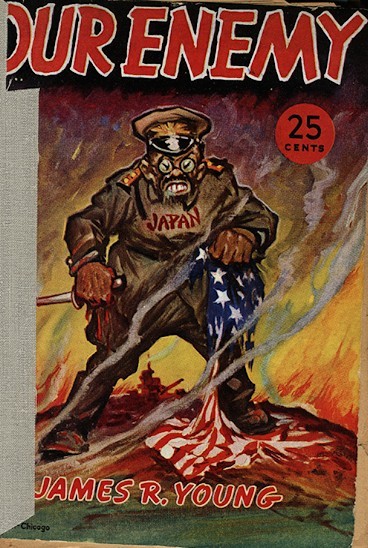
Whether you are familiar with the story or need a refresher, here's a little piece from the vaults, discussing the climate of fear that led to the internment order and caused many Americans to applaud or at least acquiesce in it.


* * *

Other posts on the Japanese American internment camps and related topics.

Monday, August 31, 2015

Town Meeting Follies. The New Hampshire View (2): Quaint Characters

As noted in the previous post, a chance historic preservation and genealogy conversation on Twitter some years ago about antiquated New England town offices led me to a humorous piece on the character of town meeting in New Hampshire Magazine. As I also mentioned, the URL for that piece has vanished, a victim of link rot. But, as they say, when God shuts a door, he opens a window: and so, my recent, unsuccessful search for that piece brought me not only further information on weird and vanished town offices, but also more commentary on the institution of town meeting.

The article is entitled, "Town Meeting and Other Relevant NH Government Relics" and moreover has the descriptive and charming subtitle, "Like programs on the History Channel, some civic traditions are profound while others are ridiculous, and just like the folks who preserve them, they all have stories to tell."

As I said last time: to share this material is not to voice an opinion on the move for a "Charter vote" that would conceivably abolish Amherst Town Meeting (and my own prestigious and lucrative position on the Select Board: as former Chair Stephanie O'Keeffe used to say on bad days: "82 cents a day."). The purpose is only to share more comparative material on our civic and political institutions. On the whole, I think Amherst comes off looking pretty good. As I like to say: "it could always be worse."

Still, you may see some things that you recognize here. Take a look at this "Town Meeting Cast and Crew" and see what you think. Any familiar types?


Town Meeting Follies. The New Hampshire View (1): "I Hate Town Meeting"

Given that we have launched into the great debate over the proper form of local government, I am hauling pertinent past posts (or parts of them) out of the vaults.

Several years ago, in the course of a Twitter conversation with a fellow historic preservationist about obscure or obsolete New England town offices (the one in question was that of "hog reeve"), I came across this humorous portrayal of a mildly undemocratic, corrupt, and dysfunctional town meeting. It was originally published in New Hampshire Magazine back in 2008, and the URL appears to be a victim of proverbial "link rot," so I am glad I grabbed a portion of the text at the time and can share it here again.

Lest anyone leap to any invidious conclusions: I am doing so simply to illustrate the range of character of and opinion about New England town meetings. As one of the labels for the post should suggest, we in Amherst are fortunate to have a Town Meeting that--whatever one thinks of the views expressed at any given time--is serious, ethical, and managed by skilled Moderators. We should be grateful for that, because: "it could always be worse."

Still, you may see a few traits that you recognize.

Enjoy.

I hate town meeting.

Town meeting is a laboratory sink for psychologists.

Every dreadful facet of human nature reveals itself at these gatherings. One must have the emotions of a sociopath to escape town meeting with one's soul intact.

I remember a town meeting in Temple years ago where the Police Chief, Russ Tyler, was attacked for using his cruiser too much. Poor Chief Tyler used his own car as the cruiser. He saved the town a lot of money using his own car.

But the mob at the meeting was sure he was getting away with something.

I remember thinking, "You people are crazy to be yelling at the Chief like this. He has a gun."

But Chief Tyler also had great heart. He was a straight shooter and a nice guy (although he did look like that sheriff in the old TV ad who says, "Boy, you're in a heap of trouble.")

In the end, the meeting vented itself and the Chief got his budget. But what heroic self-restraint that man showed.

Towns are made up of people who do not trust one another. It is and has always been "us and them."

The "new" people settle here with an idyllic view of living in a small town. They come from places where no one knows each other. Here they expected to find love.

What they find, of course, is resentment. The old Yankees don't trust the newcomers. Usually the newcomers are Democrats.

Some newcomer always stands up at the meeting and says something like, "My name is Ralph Lumpman and Loraine and I moved up here last fall from Darien. We bought the old Cosgrove place on Swamp Road. And I'd like to say that our moderator tonight is doing a bang-up job and I think we should give him a round of applause."

Then all the people, who recently moved to town, clap.

And there is always someone who informs the moderator that the flag is on the wrong side of the stage.

Town meeting gives people license. No one is expected to practice restraint.

Everyone is there to tell it like it is.

For 24 years of my life I was a small-town newspaper reporter and did news on the radio station in Peterborough.

I have attended over three hundred town meetings.

In my 50-plus years of going to town meetings I've seen a lot of changes. Years ago most towns were controlled by the families who owned the mills. In Milford it was Charlie Emerson; in Jaffrey it was D.D. Bean; in Wilton it was the Abbots; in Dublin, Robb Sagendorph.

If you didn't work for these men, someone in your family did. I used to watch D. D. Bean sit in the front of the hall at the Jaffrey Town Meeting.

Mr. Bean owned the match factory, in Jaffrey. When an article important to him came up he would turn and look back over his seat and note who voted "for" and who voted "against" the article.

Robb Sagendorph was the publisher of Yankee magazine and the Old Farmer's Almanac up in Dublin and he had double clout. Robb Sagendorph was also the moderator. If he didn't like an article he would close down discussion.

"We have had enough jawing about this matter," he'd say. "It's time to vote." 

Saturday, August 29, 2015

And so it begins: Charter proponents seek change in the form of Town government

On Thursday afternoon, members of a new group, whose existence had long been predicted, rumored, or mentioned in hushed conversation, came out into the open. "Amherst for All" officially announced its presence by filing papers for a ballot initiative that would create a Charter Commission to review and (presumably) change our form of town government.

Charter supporters gather before visiting the Town Clerk (blogger Larry Kelley at right)
Front row: Yuri Friman, Michael Alpert, Andrew Churchill, Niels la Cour (and son: behind, left), Adam Lussier (with clipboard), John Kuhn, Richard Morse
Rear row: Jerry Guidera, Jackie Churchill, Peter Vickery
at the Town Clerk's office
Town Clerk Sandra Burgess explains the signature-gathering process

Poll positions

Town Clerk Sandra Burgess took the time to explain in great detail to the group (joined by Town Meeting member Clare Bertrand, who arrived later) what constitutes a legal and verifiable resident signature. 3,215 such signatures would be required to get this measure on the ballot next year. As Larry Kelley notes: last time, that took nearly two years, whereas this time, the organizers are shooting for the spring election, which is but seven or eight months away. But as he also notes, we now live in the age when internet access is taken for grant and new social media amplify and speed up the conversation.

A side-issue is the date of the spring election: traditionally, it takes place between the last days of March and the opening days of April, but this year, another option is to make it coincide with the presidential primary, whose date of March 1 is mandated by State law. There are arguments on both sides. Some think it would make sense to combine them, for the sake of efficiency and better turnout. Clerk Burgess expressed strong support for keeping the two elections separate, arguing that combining them would (because of the technical requirements of local and state ballots) in fact not result in any monetary savings and, rather, simply overstress Town staff. (The last time such elections coincided was in November 2008, when, however, the presidential contest caused more residents to volunteer at polling places.) The issue will soon come before the Select Board, which has the authority to set the date.


Scrap Town Meeting or throw all the bastards out?

Everyone "knows" that this pro-Charter movement is primarily an anti-Town Meeting movement, and that it would replace our current system of government with a mayor and city council, right? The first is clear. The latter, not so much. 

The desiderata, according to the website, are:
Accountability, Representation, and Year-Round Decision-Making.
The last of these looms largest in the explanation, but the former two are the proverbial elephant in the room. Clearly, Town Meeting is the main target of all three:
Our government structure isn’t built to keep up with these challenges and maintain our great quality of life. We have a Town Meeting that meets twice a year.  We have a five-member Select Board and a Town Manager.  Too many issues have to wait until the next Town Meeting to be addressed – and if a proposed solution needs some tweaking, maybe the next Town Meeting after that. 
Another passage at least implicitly references former Select Board Chair Stephanie O'Keeffe's editorial on the problem of executive authority and accountability:
with leadership diffused across the Select Board and Town Manager, it’s hard to know who’s in charge.  Who represents us with the state, the colleges, businesses, and citizens?  Who can we hold accountable for meeting the many challenges of maintaining our quality of life?
On the other hand, the organizers claim to be agnostic about the precise nature of the alternative arrangement:
We don’t know what the right government structure is for Amherst.  That’s why we support electing a representative study group to take a look at it.  Whatever the final proposal looks like, we think it should meet a few clear standards – it should be year-round, representative, and accountable.
I think we can take them at their word. We should after all remind ourselves that the last (unsuccessful) Charter proposal indeed proposed replacing Town Meeting and the Select Board with a mayor and council--but also retained the institution of a professional, appointed Town Manager, which Amherst has had since 1954.


What are the issues?

I wouldn't presume to analyze this in depth here: just a snapshot and some guesses.

We've been through this before, in 2003 and 2005, when Charter initiatives came within a hairsbreadth of winning. Many of the underlying issues are the same, though the dynamics as well as the players are, I suspect, somewhat different.

Last time, it seemed, Town Meeting was the focus of much of the dissatisfaction. Critics charged, for example that it was inefficient, consumed with process and deliberation rather than action (and too eager to take on issues beyond the local realm). The Select Board was unpopular in many quarters, as well. Critics accused it of the double sin of inefficiency and intrusiveness: it was seen as meddling and micromanaging.

This time, I think, the active hostility is directed principally at Town Meeting. There is the perennial complaint that it spends too much time talking and is too slow to reach decisions, but I think it is more about the substance. In the last three to five years, Town Meeting has become increasingly polarized around a set of issues that could be broadly grouped under the rubric of "development": from zoning changes to the permitting of major new downtown construction projects (and of course, the ill-conceived and stillborn "Retreat" proposal for commercial student housing). Only the zoning changes strictly fall within the remit of Town Meeting, but ill will over the other issues clearly shapes the course and character of our debates.

At the risk of oversimplifying for the sake of clarity:

One faction sees large new downtown construction projects and measures promoting greater density in village centers as jeopardizing Amherst's comfortable "rural" or "small-town" feel. It accuses Town Hall (especially the Planning Department, and to some extent the Town Manager) of turning a deaf to ear to residents' fears over loss of neighborhood character and instead catering to the interests of developers. The role of the University and the problem of off-campus student housing is a closely related concern. Among some, the distrust extends to all at the "front of the table"--i.e. the appointed Planning Board and Finance Committee and elected Select Board--accused of thinking and voting in lockstep. As a result, this faction sees Town Meeting as a watchdog that should view major planning and economic development proposals with great skepticism, and in many cases, block them.

The other faction sees economic development and increased density in village centers as a form of smart growth: the only way to begin to shift more of our tax base from residential (currently: 90%) to commercial property and to address the housing shortage that is pricing many would-be residents--including young families--out of town. It sees the other faction as creating a toxic atmosphere characterized by incivility and lack of trust between residents and government. As a result, it despairs over the possibility of change, believing it has become nearly "impossible to get anything done," meaning, for example: pass comprehensive as opposed to incremental legislation in crucial areas such as planning and zoning.

As a result, following last spring's Annual Town Meeting, one heard increasing concerns that our system of government was caught in a sort of gridlock with no solution in sight.

Obviously, Town Meeting encompasses a wide variety of individuals and people, including many who belong to no "faction," and even those associated with one of the aforementioned groupings do not necessarily vote together on all issues. Still, these seem to be the dynamics driving much of the renewed interest in a Charter vote.

Then again, I am not part of this Charter movement, so you'd have to ask them. I'm sure we'll soon find out.


I don't intend to provide detailed coverage of the issue in these pages (hyperlocal blogger Larry Kelley seems to be taking care of that). Rather, I just want to note it, because I've been talking about Town government, and this could radically affect what all of us do in the civic realm (including my own post as an elected official).

For the record: no one on the five-member Select Board has publicly discussed or taken a position on this initiative. We have been elected to carry out the duties of our office, we have a great deal of work to do, and it is on that work that we are focused.

*  *  *

Fun facts to know and tell:

Contrary to concerns raised in a recent op-ed piece by veteran Finance Committee member Marylou Theilman, the Town would not be obligated to pay present Town Manager John Musante half a million dollars (or whatever fearsome sum some have in mind) in the event that a Charter change occurs. Town Counsel confirmed to the Select Board, and we stated in our press release on his contract renewal and salary, that our original interpretation of the original 2010 contract holds: 9 months' severance pay if the contract is terminated.

So, at least you can cross that issue off your list as you ponder the change in form of government. Debate away, in the confidence that the determining factor will be the effectiveness of government rather than the bottom line.


Footnote (can't help myself):

Props to the Amherst for All website designer (whoever he or she may be) for a clean aesthetic and good navigation (you can't always take those essentials for granted, even nowadays)--and some interesting image choices.

Start with the organization's logo:


Smart choice: not just the iconic 1889 Town Hall (as both landmark and seat of government, with the word, "Amherst," mostly but not entirely below it), but also individual houses: underscores the "for all" and "for everyone" message. And, given that much debate in and around Town meeting has focused on both affordable housing and the threats posed to existing neighborhoods by predatory rental conversions, it reminds us of the substantive issues under debate.

Finally, although the length of the image series is dictated by the need to match that of the text below, there is just something about the two-tiered horizontality of the icons that to me subtly underscores the message, "for all" and "everyone."

(Of course, one might instead choose to read the Town Hall and houses as the Town Manager and five Select Board members, since that's one theoretical outcome of a Charter Commission, as well. Okay, clearly time to stop this.)


Another example: the top of the page borrows from the Town's promotional slogans: a great place to live, study, work, play.

But for "a great place to study," the image used is that of the beloved Jones Library, thus referencing a Town civic institution rather than having to choose between the University of Massachusetts and the private Amherst and Hampshire Colleges. Smart move.

On the other hand, inclusion of that atrocious hippie-flavored student mural near Rao's and the Bangs Center (admittedly, I think I know some people who took part in creating it) toward the bottom of the page? Not so much. Or maybe that is a very subtle way of indicating the need for a break from the ways of the past?


{corrected; apologies: a trackpad error caused the post to go up before it was complete}

Thursday, August 27, 2015

Follow-up on the Town Manager Evaluation

Citizen blogger Larry Kelley was kind enough to respond to my piece on the Town Manager evaluation (since I had referenced his).

I started a long reply, but then it occurred to me that both halves of the exchange might serve the public better as a separate post.  So here goes.


Larry Kelley said...

Well I did use a question mark with my title "Trouble at the top?"; and notice I went out of my way to find a photo where both the Town Manager and SB Chair Alisa Brewer seem to be sharing a lighthearted moment.

A fighter pilot is trained to scan the horizon and ignore everything that should be there making it easier to spot a tiny dot -- enemy fighter or incoming missile -- that should NOT be there.

When LBJ won the NH primary in 1968 by 49% to 42% over Eugene McCarthy, the headlines could have stated: "LBJ wins by decent margin" or "Is LBJ in trouble?". I of course would have used the latter.

After the tumultuous years for the Select Board during the reign of Anne Awad and Gerry Weiss the institution has become, for lack of a better word, boring (other than the 9/11 commemorative flag fiasco of course). So any hint of discord or friction is made even more newsworthy.

If UMass or Amherst College were to suddenly address grade inflation with new stricter criteria it would shock the first transitional generation of students to come under the new evaluation methods.

Perhaps now that average citizens and town employees know the Select Board takes its job of evaluating the Town Manager so seriously, and that he is not above criticism, the number of people submitting evaluations will increase next year.

* * *

Citizen Wald replies:

 
No problem, Larry. As I said, I assumed you stressed the negative because it was more newsworthy (dog bites man is not much of a story).

the options should not be just either a pat on the back or a pink slip

I just wanted to clarify for the public that the Town Manager (unlike LBJ) was not in trouble, for that's the point: the options should not be just either a pat on the back or a pink slip. The possibility for strong, constructive criticism should be something that we accept as normal and healthy. In fact, it also lends more weight to the positive things we have to say. 
 

Amherst has been served well by the institution of Town Manager--and the evaluation process

Speaking more generally, I might add: Amherst has been served well by the institution of Town Manager ever since it was introduced in 1954. The evaluation process is intended to ensure that this continues to be the case.

Since you bring it up: I would like to stress that, in each of the six years during which I have been involved in the process, the evaluation was performed with great care and seriousness. Obviously, the views and manner of expression of each Select Board member will vary. It is, for example, quite possible that one member issues a "needs improvement" rating while another chooses "satisfactory," and yet they may be offering much the same judgment in their prose remarks.

This is why it is so important that residents consider the full evaluation process and documentation and not just the composite grid, which can give a false sense of numerical precision. Now, obviously, not everyone has the time or inclination to read the (this year) 11-page Evaluation Memo or even to watch the discussion on television, not to mention, plow through 91 pages of total material. And that is why we look to the press to provide thorough and nuanced coverage.

These newspaper reports are pretty much bare-bones stuff. As I said, I completely understand the pressure to get out a prompt summary of the evaluation text and meeting: that is the nature of the trade. But does that have to be the end of the story?

Consider these numbers: Scott Merzbach's piece on the Town Manager evaluation came out with characteristically admirable promptness and clocked in at around 950 words. By contrast, Matt Vautour's piece on the UMass basketball team's trip to Europe (and I like basketball and the Eiffel Tower as much as the next guy) ran to about 1100 words, and Cheryl Wilson's nice feature on the renovation of the landscape at Edith Wharton's home, "The Mount" (you all know I am a fan of both gardens and historic preservation) weighed in at almost 1700 words.

Given the importance of the role of the Town Manager in our political system, would it not be helpful to have a follow-up on the evaluation, which, written without the pressure of the looming deadline, could use a few more column-inches to add some depth and detail?

PS As for the Select Board being boring, I take that as a compliment: as I tell people, that's the way we like it. We should not be the news.


[correct text: accidentally had two editing panes open before]

Monday, August 24, 2015

Getting the Select Board's Town Manager Evaluation Wrong

Reviewing books or reporting the news must be among the most unenviable tasks: no matter how hard one works to get things right, one will inevitably be accused from all quarters of having gotten things totally wrong (often as not, with base motives imputed).

That said, journalists often do, objectively speaking, get things wrong. There are causes apart from mere carelessness: the pressure of deadlines and the stringent limits on space no doubt cause many an error or oversimplification. I understand all this and take it in stride, so I normally don't bother to comment publicly on journalists' mistakes regarding my individual or collective civic role. (There has been the occasional exception.) However, it struck me that the coverage of the Select Board's annual review of Town Manager John Musante might give rise to some false impressions, so I would like to correct them.


The Town Manager Review Process: a long timeline, a lot to digest

The Select Board is the Town's collective chief executive. Under the Town Government Act and Massachusetts General Law, we five members of the Select Board, as the "chief elected officials," hire and review the performance of the Town Manager, who is the "chief administrative and fiscal officer."

Former Select Board Chair Stephanie O'Keeffe led the way in developing a notably robust and rigorous review process. Each year, the Select Board and Town Manager agree on a set of performance goals for the coming year. The Town Manager reports periodically on his progress toward attaining those goals, and then a detailed timeline takes us through the actual process, running to almost four months, from June through September. The initial result is a set of our five individual assessments of 15 rubrics: based on our day-to-day experience of working with the Town Manager, his self-evaluation, and the officially solicited input of Town employees and the general public. Then, in late August, in public session, we spend an hour or more reading one another's evaluations for the first time (yes, it makes for thrilling television, but this is one of the consequences of the State's Open Meeting Law) and, finally, discuss them and respond to a summary compiled by the Chair (the only person to have seen all five in advance of the meeting).

Admittedly, it is a lot to digest in short order--nearly 100 pages of material: 74 pages of individual assessments by Select Board members (Alisa Brewer: 29; Connie Kruger, 8; Doug Slaughter, 7; Andy Steinberg, 10; Jim Wald, 20), plus a 6-page composite grid of ratings compiled from the preceding, along with the 11-page draft evaluation memo by Chair Alisa Brewer. One does not envy the reporter faced with the challenge of getting out a coherent, well-integrated story within 24 (not to mention, 2 or 3) hours. That said, that draft evaluation memo plus the oral discussion provide the bedrock for any story, and then the reporter (in my experience) goes through the individual evaluations, pulling out (one hopes) representative quotes from each Select Board member in order to lend the whole an air of comprehensiveness, real or feigned.


Accurate facts, fragments, impressions

The task of the journalist, like that of the historian, is not simply to share a set of facts, but also to select them systematically and place them in an appropriate analytical or interpretive framework. It is admittedly a subjective task, and yet there are ways to judge its success or failure. Often, it is a matter of emphasis or completeness rather than factual truth or error, as such.

Blogger Larry Kelley (who often beats the mainstream media to the punch and got this piece out in a hurry) fastened on the negative aspects of the evaluation:
interesting criticism from the two most experienced members of our executive branch -- Chair Alisa Brewer and Jim Wald.

Ms. Brewer gave Mr. Musante "unsatisfactory" a total of nine times (out of possible 44) while Mr. Wald checked it off five times.

Brewer and Wald were in unanimous agreement in response to goal #5, "Relationship With the Select Board"  by giving him "unsatisfactory" to the same five of eight statements. Ouch!
It was in many ways understandable: criticism by nature calls more attention to itself than does expected praise for a job well done and thus might seem more "newsworthy." Of course this is not the whole story: the post dwelled only on the negative and merely cited the categories rather than the actual substance of the evaluation; a reader would have to click through to the actual document. In part, Kelley's emphasis on the ratings grid was intended to create a contrast to a similar, recently completed process for School Superintendent Maria Geryk, who received only one "unsatisfactory" ranking from 13 evaluators. Still, the title "Troubles at the top?" overdramatized the situation.

The reports in the traditional papers by veteran beat reporters Scott Merzbach of the Hampshire Gazette and Diane Lederman of The Republican/Masslive.com were likewise about what we have come to expect.

Both Merzbach's and Lederman's pieces on the whole aptly summarized our work under the respective titles, "Amherst board praises Musante’s fiscal management, criticizes communication" and "Amherst Town Manager John Musante receives favorable review, concerns cited."

Both, rather than just citing the handful of negative rankings, also identified some reasons.

Merzbach:
But both Wald and Brewer criticized Musante in the area of maintaining “a professional and effective relationship” with the elected board.

They both cited Musante’s comments on election night, during an interview broadcast on Amherst Media, that the proposed solar project on the former landfill was dead, which caught board members by surprise.

They also didn’t like that details about a settlement with former high school math teacher Carolyn Gardner, who filed a Massachusetts Commission Against Discrimination lawsuit, were revealed in the Gazette before any executive session was held.

“The potential settlement figure in the Gardner MCAD complaint was never discussed with the Select Board. The Select Board was shocked to find out a settlement had been reached by reading about it in the newspaper,” Brewer wrote.
By contrast, some other topics and quotations seemed almost chosen at random or at least taken out of context. Just one example: Andy Steinberg's affirmation of the value of diversity of opinion on Town boards was unexceptionable but by itself unintelligible to someone not reading the entire evaluation.

Lederman simply devoted the bulk of her piece to raw quotations from the evaluation, connected by brief explanatory passages. However, the quotations at least provided the rationale for the negative assessments of the aforementioned cases:
"It seems clear that you have no intention of withholding information from the Select Board, but rather that it simply does not occur to you to share it," according to the memo.
 "We can't provide input on either straightforward or complex policy and practice initiatives and changes before they are implemented if we don't know they exist.
"Finding out about them in the newspaper or other media is simply unacceptable. Most egregiously, we did not hear about the end of the old landfill lawsuit, the end of the solar farm project, nor the resolution of the town-schools MCAD complaint, from you.
"While this "saved" us having to hold Executive Sessions, it significantly damaged our credibility in the community.
"We also cannot effectively represent our community's values when we are presented with and expected to act on issues immediately without having had any opportunity for thoughtful deliberation in an open meeting or other potential for public [input]."
No single piece thus quite captured the full nature of the evaluation with the precision and thoroughness that one might have hoped for. Still, each offered something and, taken together, the three would enable a reader to grasp the nature of our criticism.

The editorial in the Amherst Bulletin was another matter.


Editorial license

Under the title, "Two Amherst leaders get a bit of homework," the editors commented on the evaluations of both Superintendent Geryk and Town Manager Musante (School year's about to begin: grades, homework. Get it?) The gist was that both leaders received generally high marks but also a few low or failing ones--and that, in our political system, this criticism was properly public and on the record, rather than private and behind-the-scenes. Right on the mark. So far, so good.

However, when it came to our actual criticisms, the piece missed the point by a mile:
Alisa Brewer, chairwoman of the Select Board, told Musante in an evaluation summary that she and others “look forward to your continued success in so many critical areas.” But they also want action on aspects of his job “that truly need more of your attention.” Chief among them: communication with other town leaders, particularly members of the Select Board. In this area, he earned ratings of “unsatisfactory” and “needs improvement.” Brewer and board member James Wald faulted Musante for not maintaining “a professional and effective relationship” with their panel. That’s at odds with other aspects of Musante’s review. Select Board member Connie Kruger called him “professional, considerate, fair and very good at managing multiple agendas. He remains calm during a crisis and instills confidence.” The dissonance may stem from ongoing policy disagreements in Amherst, including friction over the impact of development projects downtown.

If Musante was a mayor, he’d have to answer to voters about such matters. But as a town manager, his constituency is the Select Board.

Communications issues are far less tangible than the areas the board praised — particularly fiscal management. But if the Select Board feels it is not getting enough advance information from Musante on major policy matters, that’s a problem he must address.

Even so, this is a fuzzy area. Select Board members didn’t like that they heard first through the media about some things, including the fate of a solar project and a legal settlement with a teacher. But in both instances, Musante was sharing information with town residents — and that counts as communication. The board should not be asking him to curtail comments to the media.
This is all so wrong that one can only shake one's head in dismay.


 • To imply that Ms. Brewer's and my sharp criticism of the Town Manager under "Relationship with the Select Board" is in any way "at odds with other aspects of Musante’s review" is nonsense. First, it stands to reason that the two most senior members of the body (8 and 5 years' service, respectively), encountering a recurrent problem under one particular rubric, would be more pointed and insistent in their criticism than those who joined in only the past 1 to 2 years. Second: elsewhere in the document, as in last year's evaluation, we individually and collectively praise the Town Manger for his consummate professionalism and the professional expertise of his overall performance, particularly in the financial domain. The official evaluation is about the overall picture: greater than the sum of individual ratings. This is why, as Chair Brewer says, we do not issue a numerical score. Or, as I sometimes put it: it's not the SAT.

• The only thing loopier than the editors' making the preceding charge is concocting an explanation out of thin air: "The dissonance may stem from ongoing policy disagreements in Amherst, including friction over the impact of development projects downtown."

Huh? They couldn't have asked us? There is zero evidence for such a hypothesis. Ms. Brewer noted a desire for better communication regarding upcoming zoning articles, but this was about process, not development, as such. In fact, some of the criticism that Mr. Musante received from the citizenry was for publicly taking a stand and voting the same way as the Select Board on zoning articles. All five members of the Select Board moreover gave Mr. Musante a "satisfactory" rating for pursuit of economic development opportunities.

• But most dismaying of all is the final section: On the one hand, the editors say, if Mr. Musante has not been giving advance notice of decisions to the Select Board, "that's a problem he must address." Indeed. But immediately afterwards, they go on to say the equivalent of "oh, never mind":
Musante was sharing information with town residents — and that counts as communication. The board should not be asking him to curtail comments to the media.
Um, no it doesn't, and no we weren't. The issue being evaluated here was specifically and exclusively "Relationship with the Select Board." (Under the separate rubric of "actively engage the community and the media," the Town Manager received four "satisfactory" ratings and one "needs improvement.")

The editors here completely miss the point of the sharpest and most consistent criticism that we gave the Town Manager. The presumed choice between his informing the Select Board and informing the public is a false one, and no action or announcement flagged here was so urgent that it could not have allowed time for consultation.

This goes to the heart of our system of government. Town Meeting is the legislative branch. The Select Board is the collective chief executive. The Town Manager is the chief administrator, not the mayor: he reports to us. We have the power to hire, fire, and evaluate him. We set his salary. How can we work in partnership with him and explain Town policies and his actions to the public if he does not inform us about them?

Clear, one would think.


Conclusion: a strong relationship

To summarize: there is no crisis, but neither should one casually dismiss our criticism. Fortunately, that criticism focused on some delimited problems that are in principle easily rectifiable. The members of the Select Board, individually and collectively, hold Mr. Musante in high esteem: we greatly respect his professionalism and skills, we enjoy working with him.

There are thus no "troubles at the top." What there is is honesty and due diligence--and work to be done. A truly healthy and respectful relationship allows for strong criticism, offered in a constructive and collegial spirit. The Town Manager took it as such, and it is a shame that the Gazette chose to trivialize it, in the process distorting the larger picture of how we work.

Would the editors and public have been happier if we had simply checked all the ratings as "commendable" (the highest option) and confined our comments to generic praise and trivial critiques? It certainly would have saved us a lot of time. But it would not have been responsible, and it would not have been good governance.