Showing posts with label Historic Preservation. Show all posts

Monday, November 28, 2016

My Little Book-Historical Connection to Alice's Restaurant

This book is my copy of the English edition of Ernst von Salomon's bestselling Fragebogen (The Questionnaire [1951]).


Von Salomon (1902-72) was a German right-wing extremist of the interwar years, implicated in several acts of political violence, including the assassination of German Prime Minister Walther Rathenau. Though he never gave up his extremist beliefs, he moved in heterodox arch-conservative circles and claimed that he never became a Nazi. He was nonetheless briefly imprisoned as one after the War. Several years after his release, he published his memoirs, for which he sarcastically employed the format of the lengthy questionnaire (Fragebogen) on past political activity that the Allied occupation forces used to implement their de-Nazification policy.

The translator is the World War II intelligence officer and novelist Constantine Fitzgibbon, who also produced the English version of the memoirs of Auschwitz Commandant Rudolf Höss. Ironically, his half-brother Louis Fitzgibbon became a noted Holocaust denier. 

The late Robert Wistrich was unsparing in his portrait of von Salomon as a typical "noble fascist" (as the German term has it): a violent extremist who had contributed to the death of German democracy and then claimed to have moral or practical qualms about the vulgar Nazis and their terror, yet profited from the regime and its backing, and after the war was unrepentant, drawing a false moral equivalence between Nazism and Allied occupation. The book, he said, "was a bitter, cynical personal testament, which exposed his utter indifference to questions of guilt and repentance."

The blurbs on the back cover, among my all-time favorites in this genre, are in the same spirit as Wistrich's sketch. (Hugh Trevor-Roper was the historian of Tudor-Stuart England who, while working as an intelligence officer in 1945, was tapped to write the account of The Last Days of Hitler [1947].)


I acquired this at Paul's Books, one of the great used bookstores in Madison, WI (I went to school with the kids and knew the late owner, as well as his widow, who maintained the store and always greeted me effusively whenever I returned in later years). I bought it because I was taking classes and doing research on Nazism. It turned out to command my interest for other reasons, as well.

It has to be one of the more unusual items in my library: because it is an "association copy," valued for the connection to the author or owner rather than for its intrinsic nature. In this case what makes the book unusual is not just the fact that it made its way from the northeast to the midwest, but the "Alice's Restaurant" connection. How it got to Paul's bookstore, I have no idea.

Alice's Restaurant

Many (particularly those who lived through or developed an affection for the era of the counterculture) will know this modern folk classic and the backstory. If not, the Massachustetts Cultural Council's "Mass Moments" explains:
[On November 28, 1965] 20-year-old Arlo Guthrie was convicted of littering in the Berkshire County town of Stockbridge, and the song "Alice's Restaurant Massacree" was born. The son of legendary musician Woody Guthrie, Arlo and a friend were spending Thanksgiving with Alice and Ray Brock at the couple's home in a former church. Alice asked the boys to take a load of trash to the town dump. When they arrived, they found that the dump was closed, so they threw the trash down a nearby hillside. Guthrie turned the story of their subsequent arrest and court appearance into a best-selling record.

The story of "Alice's Restaurant" begins and ends at a church in Great Barrington, Massachusetts. By the 1960s, the small, pine Gothic Revival building had lost its congregation. The Episcopal diocese put the building up for sale, and in 1964, Alice and Ray Brock purchased it. After a formal de-consecration ceremony, the young couple moved in.

The Brocks were a creative and charismatic pair who had been influenced by Jack Kerouac and other members of the Beat Generation. Ray was an architect and woodworker, Alice a painter and designer. Both worked at a private school in nearby Stockbridge. They transformed the former church into a quirky but welcoming place where their students and other young people could find refuge from "establishment pressures," especially the Vietnam War and the draft.

Ray and Alice served as surrogate parents for the young women and men who camped out, sometimes for weeks at a time, at the church. The neighbors were not happy about the arrangement. They viewed the Brocks and their guests as drug-using, long-haired hippies. Agitated residents honked their car horns and yelled as they drove past; they wrote letters to the editor protesting the presence in their community of what they called a "beatnik commune."

It was in this context that police officer Bill Obanhein reacted so strongly when the church group was implicated in the Thanksgiving trash dump. That evening, the Brocks received a call from Obanhein. He had spent "two very unpleasant hours" going through the debris until he found an envelope with the Brocks' name. Alice confirmed that Arlo and his friend were the culprits. Obanhein summoned the boys to the police station.

"Officer Obie" later admitted that he had no sympathy for longhaired, nonconformist teenagers, although he conceded that they were basically "good kids." He decided to give them a scare and make an example of them so that the town would have no more trouble with hippies. He arrested the pair and put them in a jail cell until a furious Alice Brock bailed them out. Two days later, they appeared before a blind judge and his Seeing Eye dog, who "viewed" Obanhein's photo evidence of the trash dumping and convicted the two young men of littering. He fined them $25 each and ordered them to clean up the trash.

After paying the fine and completing the cleanup, Arlo Guthrie began composing what would take up one entire side of his first album. Eventually 18 minutes long, "Alice's Restaurant Massacree" evolved slowly over the next two years. The first verses written recounted the events of Thanksgiving 1965. Later Arlo added lyrics critical of the Vietnam War. When Alice Brock opened a restaurant in Stockbridge in early 1969, the song found its refrain, "You can get anything you want at Alice's Restaurant." Then, finally, there was the draft. Called before his New York City draft board for a hearing on his fitness for military service, Arlo faced a final question: "Have you ever been arrested?" In the song, his conviction for littering saves Arlo Guthrie from the draft. In reality he was classified 1A, but his lottery number never came up.
I first learned of the incident when I was in middle school. We were having a sleepover at a friend's house, and when we got up the next morning, my friend's mother said, "Alice's Restaurant is on." Because her name was Alice, I at first thought she was just referring to her breakfast menu, but then she played the album in its final version with the Vietnam lyrics, and I made another step forward in my cultural literacy.


A Birthday in Massachusetts

Back to the book. The owner, whose rather conventional bookplate graces the inside cover, wrote a long inscription on the flyleaf, recounting bicycle travels in Massachusetts with friends, culminating in a birthday celebration at which several friends signed the volume.


The last two names are those of Ray and Alice Brock. Not a book I would ask my close friends to sign, and an odd circumstance for future hippies, perhaps, but such are the discreet charms of book history.


Resources

"51 things about Arlo Guthrie’s ‘Alice’s Restaurant’ on its 51st anniversary" (Boston Globe)

Tuesday, November 15, 2016

November 11, 1920: Interment of the British Unknown Soldier

The mass slaughter of the Great War prompted contemporaries to find new ways to remember and mourn. The fact that many of the millions of fallen remained unidentified led to the suggestion one of their number be honored at a national commemorative site. The tombs of both the British and French Unknowns were dedicated on the anniversary of the Armistice in 1920, the former at Westminster Abbey (pointedly placing the commoner alongside the kings), the latter at the Arc de Triomphe. (The US Unknown was interred in Arlington Cemetery a year later.)

This card dates from the dedication of the British tomb.


The Christian symbolism so often associated with national memory is evident on the exterior, which seems to feature forget-me-nots and/or violas rather than the poppy, which acquired its iconic commemorative status (reproduced in silk) the following year.


Pictured at left of the interior is the Cenotaph (commemorating the war dead but containing no body) in Whitehall by Sir Edwin Luytens, dedicated on the same occasion. It replaced a temporary structure that he had designed for the Victory (Peace) Parade in 1919. The Poetry Library lists the poem among its "lost quotations," whose source remains to be identified.

The anniversary of the end of the war, originally called Armistice Day, became Remembrance Day (the closest Sunday to November 12; since 1945) in the Commonwealth and Veterans Day (1954) in the US.

Friday, October 21, 2016

October 21: "Old Ironsides" Celebrates Another Birthday

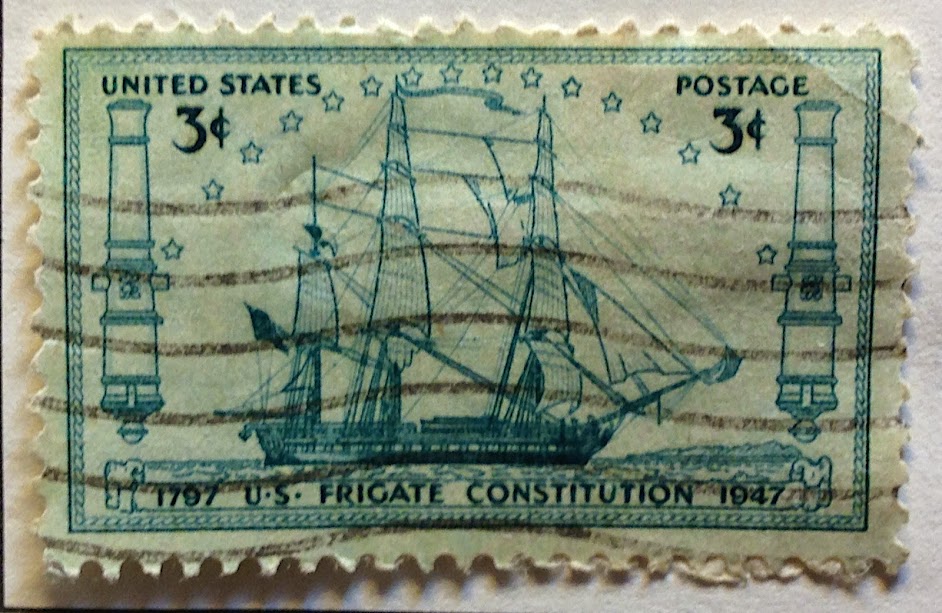
On 21 October 1797, Boston witnessed the launching of the USS Constitution, which remains "the oldest commissioned warship in the world."


Here she is, depicted on the 150th anniversary commemorative stamp, which proved to be both very popular and unexpectedly controversial (naval aficionados did not think the depiction was sufficiently active and heroic).

As I noted in my recent post on the fiftieth anniversary of the National Historic Preservation Act (October 1966-2016), it was an innovative decision on the part of the US Postal Service to depict historic resources other than buildings on the stamps issued for the fifth anniversary of the law: a San Francisco cable car, and the whaling ship Charles W. Morgan of Mystic Seaport.

The inclusion of ships raises intriguing question about, first, what should be preserved, and second, what "preservation" means in the case of resources such as ships, whose material is constantly being replaced. The "Constitution" has undergone a number of major restorations, but the latest (2007-10) was intended not only to preserve the ship, and also to bring it back to the state of 1812, when it achieved its greatest fame (context and overview; individual aspects of the project).

* * *

from the vaults (2010): backgrounder and summary on the "Constitution" and challenges of maritime historic preservation:

21 October 1797: Launching of USS Constitution; the need for preservation and interpretation continues


Sunday, October 16, 2016

Happy Dictionary Day, 2016

"Dictionary Day" honors lexicographer Noah Webster, born October 16, 1758, and celebrated for his pioneering work in both documenting and defining the emergent American language.


Webster is most often associated with Connecticut--New Haven, because he studied at Yale and spent his later years in that city (though his 1823 house was moved to Henry Ford's Greenfield Village in Michigan, in order to prevent its impending demolition)--and West Hartford, where his birthplace is today a museum and educational center dedicated to his legacy. In addition, however, he spent a crucial phase of his life (1812-22) in Amherst where he was actively involved in civic affairs (including the founding of Amherst Academy and Amherst College) as well as work on his dictionary.

Webster owned a large farm in what is now the center of town.

1920s map of Webster's holdings (Jones Library Special Collections) [placeholder]
His house no longer survives, but was located where the late nineteenth-century "Lincoln Block" now stands, across from Town Hall.


From the vaults:

• 2008: New England Celebrates Noah Webster 250th

• 2010: Well, where are you? Celebrating Noah Webster's Birthday and Searching for Remains of His Property


15 October 1817: Death of Revolutionary Tadeusz Kościuszko

199 years ago, on 15 October 1817, Tadeusz Kościuszko, hero of the American and Polish Revolutions, died in exile in Switzerland.

This substantial piece from the newsletter of the Mickiewicz Institute nicely delineates the high points and significance of his career: he arrived in the new United States in 1776, and during the war, he designed the fortifications at West Point and was responsible for the American campaign at Saratoga, which was decisive for the success of the Revolution, not least because it moved the French to lend their full backing to the new nation's struggle. In Poland, he famously led his nation's forces in the revolutionary struggles of 1791 and 1794. Although Kościuszko is celebrated for his dedication to the rights of peasants and Jews, his equally passionate commitment to the rights of enslaved Africans and Native Americans in the new United States is less well known. (more on the latter topic here)

In Philadephia, the house where he resided has been preserved and turned into the Thaddeus Kosciuszko National Memorial, operated by the National Park Service.
He is commemorated at West Point with a monument by John Latrobe (1828; incorrectly labeled a tomb in the engraving below), to which a statue was added in 1913.


Kościuszko became an international hero and a cult figure for Polish patriots, celebrated in images and on monuments, whenever political conditions permitted.


Marker in the main square in Kraków, at the spot from which Kościuszko announced the revolution in 1794.


Kościuszko monument by Leonard Marconi and Antoni Popiel (1900) outside the Wawel royal castle, Kraków. The Austro-Hungarian monarchy forbade such commemorations, so it was erected only during the interwar years. The Nazi occupiers, who located their headquarters in the castle, destroyed the statue. The 1960 reproduction now on the site was a gift of reconciliation from Dresden, East Germany.


Kościuszko's tomb, in the crypt of the cathedral, Wawel royal castle, Kraków. His body was moved from Switzerland a year after his death.


15 October 1830: Helen Fiske (Helen Hunt Jackson) born in Amherst

On October 15, 1830, Helen Fiske was born in Amherst. The friend of Emily Dickinson, who was born two months later (the arrival of both children is entered on the same page in Dr. Isaac Cutler's "baby book," or record of deliveries) became an author in her own right. Unlike Dickinson, Helen Hunt (Helen Hunt Jackson after widowhood and remarriage) chose to make a career of her writing.

She also became devoted to the cause of Native American rights. Her best known works are
 A Century of Dishonor: A Sketch of the United States Government's Dealings with Some of the Indian Tribes (1881) and the novel, Ramona (1884), which she hoped would be a Native American pendant to Uncle Tom's Cabin.

Jackson is prominently depicted on the Amherst History Mural (2005) by David Fichter, in the 1730 West Cemetery. Although the wall on which the mural is painted will fall to the wrecking ball when the former motel building is replaced by a large new mixed-use development, the developers have contracted with the artist to repaint the mural in full scale on a more suitable surface as part of the new building.


• From the vaults: More background on Jackson, her home, and the Amherst Writers' Walk.
Biographical sketch from "Mass Moments," a this-day-in-history service of the Massachusetts Foundation for the Humanities

Rosetta and Maria Mitchell: Pioneering Astronomer from Massachusetts

The timing of the end of the Rosetta mission--the first spacecraft sent to rendezvous with a comet--was fortuitous. On September 30, after two years' study of 67P/Churyumov–Gerasimenko, the European Space Agency's orbiter joined the lander module Philae on the surface.

The following day, October 1, was the anniversary of an earlier astronomical milestone. On that date in 1847, 29-year-old Maria Mitchell became the first woman to make a telescopic sighting of a comet. She did so from the roof of the Pacific Nantucket Bank, where her family resided  while her father was chief cashier. Mitchell had learned astronomy from her father, a talented amateur scientist himself, and from the study that she had undertaken on her own, working as a librarian at the Nantucket Atheneum next door.

In 1840, William Mitchell laid out the town's meridian line, marked with stone posts on the sidewalk in front of the bank.


Maria Mitchell's discovery brought her fame and helped to launch a new career: she became the first female member of both the American Academy of Arts and Sciences (1848) and the American Association for the Advancement of Science (1850), as well as one of the first professors hired at the newly founded Vassar College (1862). A feminist, she became  president of the American Association for the Advancement of Women in 1875.

Today the family's 1790 house, operated by the Maria Mitchell Association, preserves many of her possessions and celebrates her legacy. In 2010, Heather Huyck, editor of  Women's History: Sites and Resources, listed the house among her ten favorites.


Saturday, October 15, 2016

Happy Birthday, National Historic Preservation Act! What should we do for the next 50 years?

October 15 marks the fiftieth anniversary of the National Historic Preservation Act (NHPA), one of the most significant steps in the protection of our built environment and cultural landscapes.

What has preservation become?

Commemorations and celebrations abound. But this time, even more than on the fortieth anniversary, it is an occasion for reflection and speculation rather than just self-congratulation. When I teach my preservation course, I explain not only current preservation practice, but also the evolution of the field, beginning with the American idea of preservation in the nineteenth century. To say that the preservation movement has always reflected the concerns and biases of its era is a truism, but that does not make it any less important: we do not have to indulge in condescending dismissals of all our forebears in order to accept that simple historical fact. Today, the preservation movement faces new opportunities and challenges, as concepts and law struggle to keep pace with an ever more rapidly evolving society:
  • New questions about the definition of historicity: half a century later, is the notion that things become potentially "historical" after half a century outmoded? That fifty-year moving window failed to capture many modernist works, which are falling prey to the wrecking ball or other depredations. On the other hand, would narrowing that window lead to unintended consequences, e.g. encouraging indiscriminate restrictive policies on the part of amateur civic bodies, which block necessary change and development?
  • New values and ideas about what deserves to be preserved: not just the quotidian and the vernacular rather than the elite and unique, and not just the collectivity rather than the individual edifice, but also things other than buildings
  • New questions about the relation between preservation professionals and ordinary citizens, from would-be grass-roots activists to those who worry about negative effects of preservationist initiatives in their neighborhoods
  • New dilemmas in balancing competing agendas and priorities: many important works of the modernist or postmodernist era were not built for the ages and are not energy-efficient. At what price, preservation?
  • New opportunities for alliances between preservation and environmentalism in the age of smart growth and global warming, which, on the one hand, argue for keeping more old structures (e.g. through adaptive reuse) but in some cases, at the price of more aggressive interventions for the sake of energy efficiency or other extra-historical claims
  • New demands for including a "social justice" component in our thinking about both preservation and sustainability

What would you put on a historic preservation stamp today?

Two years ago, I wrote about a little exercise that I use at the start of my preservation class. In 1971, to mark the fifth anniversary of the NHPA, the US Postal Service issued a set of four postage stamps celebrating historic preservation. It depicts an eclectic mix of subjects: the Decatur House in Washington, DC; the whaling ship, "Charles W. Morgan," in Mystic, CT; a San Francisco cable car; and the San Xavier Del Bac Mission in Arizona.


I had had the first-day-of-issue cover and many mint copies of the stamp in my collection for years, but it wasn't until I became more formally involved in actual historic preservation work that I began to wonder: what possible logic lay behind such an odd combination? And then: what might one instead depict today, reflecting our contemporary values and concerns? I ask my students to work through those same two questions.

Here's the full article, from the vaults.


Now it's your turn

When I wrote that post two years ago, I asked friends and followers to tell me what they would put on a new set of stamps if we designed one today. In particular, what might reflect the way that the theory and practice of preservation have evolved in this half-century?

I got little formal response at the time (probably, I was jumping the gun), but maybe this time will be different. Please share your thoughts in a comment. It's our golden anniversary: if not now, when?

Saturday, June 18, 2016

18 June 1942: Heydrich Assassins Killed in Prague Church

Following the assassination of the "Reichsprotektor" of Bohemia and Moravia, Reinhard Heydrich, the members of the Czechoslovak paratroop teams went to ground as the Nazis frantically searched for the killers. By mid-June, the Germans were getting desperate: neither the manhunt nor the vicious reprisals, such as the destruction of the village of Lidice, had succeeded in bringing forth the necessary information.

Realizing that the terror might be having the opposite of the intended effect, the more shrewd among the authorities made a final offer, guaranteeing immunity for anyone who came forward by a final deadline of 18 June. A flood of statements came in, including one that identified the assassins by name. The anonymous author was one of the paratroopers, Karel Čurda. Still the Nazis could not find the killers. On 16 June, Čurda went in person to Gestapo headquarters and turned himself in. Although he did not know the hiding place of the assassins, he did reveal the existence of safe houses that had aided the paratroopers. Under torture, the confessions of one of the adolescent residents mentioned the Orthodox cathedral of Saints Cyril and Methodius in downtown Prague. Early on the morning of the 18th, the Nazis surrounded the church. In the course of a lengthy battle, all seven paratroopers there fell in combat or committed suicide. (details in an archived post here)


Since the fall of communism, the cathedral has officially and publicly commemorated the terrible events. In 2002, the Memorial to the Victims of the Heydrich Terror became "A National Memorial to the Heroes of the Heydrich Terror--a Place of Reconciliation." Each year, on the anniversary of the battle, a national commemoration takes place  on the street in front of a memorial plaque on the bullet-pocked wall.


To the accompaniment of martial music and the Czech and Slovak national anthems, soldiers lay wreaths dedicated by a succession of persons, from major political figures and dignitaries to veterans and their families or ordinary citizens.

Here, Czech soldiers practice wreath-laying gestures before the ceremony, 2011.


Here, an honor guard of Czech soldiers lines up in preparation for the ceremony, 2011.


By the end of the ceremony, the sidewalk is covered with flowers and inscribed ribbons.

The event concludes with a brief mass in the church, after which the exhibit hall and the memorial in the crypt, are opened to the public, free of charge. Despite the awkward location, in a narrow and busy urban space, it is one of the simplest but most moving memorial ceremonies that it has been my privilege to attend.


[updated video, stills]

Wednesday, June 8, 2016

Ramadan Kareem


To my friends and readers:


Ramadan Kareem


"The Minarets at the Bab Zuweyleh, and entrance to the Mosque of the Metwalis, Cairo," by David Roberts (1856), from my collection. (details: from a previous post).


Roberts's view of the "Interior of the mosque of the Metwalys" (1846-49)
(New York Public Library Digital Collections)


• Last year's Ramadan post:
A Tale of Interfaith Cooperation and Historic Preservation from Old Jerusalem


Ramadan posts from all previous years

Tuesday, May 31, 2016

30-31 May 1942: First Thousand-Bomber Raid on Germany (and an early infographic)

Serendipity is a pleasing thing. Several days ago, one of my tweeps*, looking ahead to this year's anniversary of the first thousand-bomber raid in world history, drew my attention to a New York Times Op-Ed piece marking the fiftieth. As it happened, I had for other reasons been sorting through my old World War II periodicals and came upon coverage of the event in the Illustrated London News (ILN; a popular periodical that celebrated its centennial in 1942 and managed to cling to life till 2003). A few days later, a modern poster in turn raised a connection to the ILN story. So it goes.


"1,046 Bombers but Cologne Lived"?

The contrast in the coverage is instructive. There is nothing objectively incorrect about the Times piece by Max G. Tretheway, a World War II Australian flight instructor, who notes that some of his students took part in the raid. Still, there is nothing new, either, and the message is both intellectually and morally banal. Its perspective is the typical modern one of presumably sophisticated irony, as can be seen from the title: "1,046 Bombers but Cologne Lived." The irony derives from the gap between expectations and consequences. Like many modern commentators, Tretheway points to the exaggerated hopes of air force men in the ability of strategic bombing to determine the outcomes of wars. It might be news to the average reader of the Times--but not historians.

Even though the raid and resultant 5,000 fires destroyed "90 percent of the central city" (he tells us) killing 474 (actually a stunningly low figure, given the primitive technology of the day and compared with later missions), wounding 5,000, and leaving 45,000 people homeless:
When survivors of the world's first 1,000-bomber raid ventured warily out of their shelters, there before their unbelieving eyes, towering majestically above the hellish carnage stood their beloved cathedral - superficially damaged, but with its twin spires still silhouetted defiantly against the bomber's moon.
This miraculous sight strengthened the people's morale and determination through the rest of the war, as the Allies continued to pound an already flattened city long after any real targets remained.
He goes on to cite more statistics, leading to his inevitable conclusion:
The Allies released an incredible total of 1,996,036 metric tons of bombs on Germany and German-occupied Europe, more than half of which fell on cities and communication facilities. Some 593,000 civilians were killed, and 3.3 million dwellings were destroyed, leaving 7.5 million people homeless.

The most frequently bombed city was Berlin; many other urban areas were close behind.

And yet it was necessary for the Allies to invade the Continent, and to fight to the very gates of the capital before Germany finally capitulated in May 1945, three years after the first saturation bombing of Cologne.  
Nothing that would have surprised Churchill, Roosevelt, or Stalin. (They did not improvise D-Day or "the Battle for Berlin" at the last minute because the air campaign did not work out). Amidst all the talk of much more sophisticated "smart bombs" and "shock and awe" during the two US wars with Iraq, we also saw other commentators remind us that the war is not really over until the victor has boots on the ground (to use that hackneyed phrase) and enjoys a drink in the officer club of his foe. What the extreme critics of air power neglect to acknowledge is its success. To say the Allied air campaigns did less than had been hoped to damage either production or morale is not to say that they were completely ineffectual: they also forced the diversion of vital resources from the front, and in the latter phases of the war, the Allies enjoyed complete superiority in the air, which greatly aided the campaign on the ground. And, although most Germans refused to be bombed into despair or revolt against the regime, a surprising number began to regard the Allied air campaign as the punishment by Providence for their crimes, including the Holocaust: a self-pitying attitude motivated by fear rather than guilt, to be sure, but remarkable nonetheless.

But how did the British press see the event at the time? The Illustrated London News coverage--addressed to a British population suffering under the onslaught of Nazi bombers--sought to provide readers with hope: "Here was terrible proof of the growing power of the Royal Air Force. 'This proof,' in the words of the Prime Minister, 'is also herald of what Germany will receive, city by city, from now on.'"


The profile of Air Marshal Arthur "Bomber" Harris contains the sorts of unfortunate hyperbolic claims that Tretheway and historians nowadays like to mock:
were it possible to put 1000 bombers over Germany night after night, the war would be over by autumn. It is another of his beliefs that were it possible to send over 20,000 'planes to-day the war would be over tomorrow.

At the time, of course, no one really knew. It had never been tried. Advocates believed in their ability to deliver devastating blows from the air in part because they feared the enemy's capacity to do so. The bombing campaigns were terrible, but the cost was infinitesimal in comparison with what had been anticipated. The British expected that the German assault from the air would cause 2 million casualties in two months. In fact, the death toll from German air raids during the entire war was only 60,000.

the cathedral, virtually unscathed amidst the ruins
(from the RAF report on the raid)
And whereas Tretheway presents the survival of the Cologne Cathedral--an icon of German national identity--as some sort of miraculous survival or even rebuke to the raiders, the ILN correctly explains that it "was deliberately left unscathed by our armada in the great raid."

Twisting the knife a wee bit, the magazine notes that the cathedral, at least in its present form, is not so old anyway, having been completed only in the late nineteenth century.


Just to make things clear, the magazine contrasts the scrupulous policy of RAF toward cultural heritage with that of the Luftwaffe and its so-called "Baedeker Raids" (1, 2, 3; the name derives from the popular German tourist guidebooks of the day) deliberately targeting cultural heritage--including many cathedrals older than that of Cologne.


Indeed, it presents the German bombing of historic Canterbury as deliberate and unjustified vengeance for the Cologne raid.


Aviation infographics then and now

Oh--and that infographic?

When visiting friends for a party on this Memorial Day, I saw hanging on the wall a striking poster depicting US naval aviation resources, the work of a French geographer.

[enlarge]
It reminded me of what I had seen in the ILN the day before. In order to give the public an impression of the size and power of a 1,000-bomber raid, the publication produced this forerunner of the infographic.

[actual figures from RAF]

Not bad. Not bad at all.

* * *

• h.t. @B36Peacemaker for prompting me to write about this in the first place
• and follow @airminded who knows more about all this than I ever will (I assume he will correct me if I have made any gross errors here)

Saturday, May 28, 2016

Town Meeting: purest participatory democracy--or "mental torture, in which the victim actively collaborates"?


"Town Meeting was absolutely awful last night."
"How bad was it?
"It was SO bad that...."

Town Meeting under the magnifying glass

It reads like a corny joke, but it was in fact a conversation I had many times last week, and there was nothing funny about it.

Like many other Amherst and New England residents, I've occasionally poked good-natured fun at this venerable democratic institution because it is so much a part of our culture and identity: it reveals our essential nature, brings out the best, the worst, and the silliest in us.

The issue has become more acute, though, since voters this spring approved a Charter Commission to review the form of Town government, a process that could result in any of several recommendations, including abolition of Town Meeting. Some would relish that outcome, others would fight it to the death. Part of the decision may turn on how effective Town Meeting proves to be under the magnifying class of increased scrutiny in the coming year. The omens are not good. In the past, I thought, the prospect of a Charter vote forced residents to be on their best behavior. Not this time. If anything, the atmosphere is more charged than ever.

The previous Town Meeting sessions this spring already displayed a few foibles and failures (1, 2, 3), but May 16 far surpassed anything we had seen. For a variety of reasons, the debate degenerated into unadulterated nastiness.


The no-go zone

The warrant article itself was simple and straightforward: The Jones Library, using money voted by a previous Town Meeting, is preparing a proposal for a building expansion in a highly competitive state grant program. It requested that the Amherst Historical Society (on whose board I serve), located next door in the Amherst History Museum, sell it a small piece of property that would facilitate this expansion. However, because a change in the dimensions of the Museum property, still zoned residential (a historical anachronism), would bring the remaining lot out of compliance with the zoning bylaw, it needs to be rezoned as business, the same as the Library (and rest of the block). This was the only question before Town Meeting: a vote on a zoning change to the Museum property, necessitated by technical requirements of the bylaw itself.


The Library made a political faux pas in bringing a large contingent
to the stage at Town Meeting, though only a few actually spoke to
the article (here: architect John Kuhn)
But (as they say on late night infomercials), Wait! There's more. The turmoil in Town Meeting was not about the technical zoning fix, as such, and instead, about the motivations behind it and the possible consequences.

Opposition derived from:
  1. Hope of using this article to block the Library expansion plan.
  2. Concern that the rezoning, although required by law, might trigger undesirable further sale/commercial development of the History Museum property (a chimera: the Museum would never allow that to happen).
  3. Blowback against the Town Meeting Moderator (he had provided an unusually wide latitude for discussion of a similarly narrow article the previous week, so his attempt to limit discussion to the zoning change, without reference to the merits of the Library expansion plan that occasioned it, struck many in the chamber as inconsistent and unfair).
The article attained a vote of only 93-91, nowhere near the required two-thirds majority.


No, really: how bad was it?

How bad was it? People who read the newspaper accounts (1, 2) asked what in the world had happened, and I told them that "deeply divided and often contentious" could not begin to communicate the atmosphere and tone.

I have never seen so many protesting "points of order," even in this body known for its love of that that parliamentary procedure. (One senior, very dignified and polite member of the body later joked to me that we should just charge a fee for each point of order, so as to discourage the practice--or raise needed revenue.) In clear violation of the rules of the house, speakers interrupted and argued with the Moderator, signaled their approval or disapproval of statements by means of applause, hissing, catcalls, or other audible interjections, and impugned one another's motives and character.

One really has to watch the entire session to get the feel of the nastiness.


But this excerpt--in which a comment, limited by the rules of the house to 3 minutes, dragged on for 13 as a result of disagreement between speaker and Moderator--conveys the frustrating nature of the exchanges.


One observer charged that the "display of churlishness, no-nothingness, scorn, mockery and outright lies" would have been more appropriate to the Nazi Reichstag or the French Revolutionary legislature under The Terror. I actually received a number of sympathy notes from Town Meeting members as well as the general public. Even some of those on the winning side were embarrassed by the behavior of their allies.


Institutional suicide on live TV?

As I have more than once explained, I have always had mixed feelings about Town Meeting:

• On the one hand, real pride in our centuries-old democratic traditions, and real personal as well as political appreciation of the opportunity to learn the views of the most politically engaged fellow citizens.

• On the other hand, frustration with the process, by which I mean less the length and inefficiency of Town Meeting (which is the deliberately crafted curse of most democracy--here taken to an extreme, to be sure), and rather, the increasing difficulty of tackling any complex legislation in a body of some 250 people.

If it disappeared, I would, quite honestly, miss it: both because of the decline in participatory government, and because I genuinely enjoy the debate.

Whenever people talk about getting rid of Town Meeting, as I noted several years ago, I hear the voice of Michael Cann, a refugee from Nazi Germany and an ardent Town Meeting supporter. He had no illusions about the flaws of the institution but cautioned against abandoning it as earlier generations had overthrown "messy" democracy in the name of fascist "efficiency." Each step away from broad-based democracy, he warned, reduced the opportunities for public participation in government--and in the process, citizen interest in public affairs. We had already gone from a town meeting open to all, to an elected representative town meeting of 240, and now what: a council of a dozen or fewer members?

Michael died four years ago, and I was sad because I had lost a friend. It was sad but not tragic: part of the natural and inevitable order of things. By contrast, what we witnessed last week was both sadder and more tragic because it was unnecessary and entirely avoidable: a self-inflicted death. I am afraid that we saw Amherst Town Meeting commit political suicide on live television. It is hard to imagine how anyone watching could conclude this is a desirable or even functional form of government. The irony is that the people responsible for this spectacle thought they were saving the institution by fulfilling what they see as its aggressive watchdog role.


And the future: return to sanity or renewed mental torture?

Although this week's Town Meeting sessions included the remainder of the most controversial articles--even one directly opposing Library expansion (1, 2)--which generated their share of heat as well as light (and yes, just sheer wackiness), the conversation was nonetheless more civil and restrained. Several people I spoke with, who had been about to despair last week--even some harsh critics of Town Meeting--felt encouraged and buoyed as the night drew to a close on Wednesday. Perhaps there was hope after all. Others warned that the optimists were deluding themselves.

Was the bedlam of that Monday night an aberration or a glimpse of the future? I could not help but think of "The Fallen Sparrow" (1943), an underappreciated anti-fascist film about a Spanish Civil War veteran pursued by Nazis. In one of the most chilling scenes, the evil Dr. Skaas explains the essence of torture to the protagonist, who had experienced it firsthand in Spain. He contrasts the mere physical torture of the Ancients with the more sophisticated cruelty of Asia, epitomized by the infamous water torture, which combines the mental with the physical:
Dr. Skaas: Then—and here is the principle of all modern torture—release is given: the dripping is stopped, the victim is revived, just at the borderline of sanity. Then: ah, then, comes an interval during which the victim tortures himself—waiting, knowing that the operation will be repeated, and it is repeatable, most assuredly, with perhaps several new variations. You see the point?
Barby [the protagonist's girlfriend]:  How perfectly ghastly!
Dr. Skaas: You see the beauty of the idea? Mental torture, in which the victim actively collaborates.


Town Meeting, too, "will be repeated . . . with perhaps several new variations." But which is the real Town Meeting? Is the torment really over, or was that just a momentary respite? I want to hope for the best, but in the meantime, we wait and worry.


Friday, February 19, 2016

Save the Fort: a textbook illustration of how historic preservation can link past and present

It was a distinctive sight: early nineteenth-century fortifications overlooking the Mississippi and Minnesota rivers on what was once the frontier. The greatest and most iconic remnant was the great Round Tower, said to be the oldest surviving building in Minnesota. It was moreover a sight I saw every week as a child, when my parents drove from suburban Bloomington to Saint Paul.


The Tower was so iconic in part because it was one of the few well-preserved parts of the original Fort. Added to and used continuously through World War II, the site deteriorated thereafter. Although designated a National Landmark, the Upper Post was, as I noted some years ago, placed on the list of "most endangered" historic sites in 2006.

There is a new call to restore and rehabilitate the Fort in time for its bicentennial in 2020, and the reasons are powerful. The editors of Minneapolis Star Tribune this week made a good case for this major effort and expenditure, citing, as I did several years ago, the striking range of historical episodes that the site witnessed, though these associations are unfortunately anything but common knowledge. It is logical for preservationists and public historians to concentrate on early history--the firsts--but if we do so at the expense of all that came afterward, we do both history and the present an injustice:
But representation of what came before and after the fort’s first decade would be added. There’s a rich story to tell: the long Dakota ties to the spot and the tragedy of the 1862 Dakota War; the fur trade of the 17th century; the fort’s significance to U.S. westward expansion; the presence of African-American slaves, including Dred Scott, and the contributions to two world wars. Attention would be paid to the fort’s role in diversifying Minnesota’s population, society CEO Stephen Elliott promises. For example, the fort’s use as an intelligence training center for Japanese-American troops during World War II led to the state’s first sizable Japanese-American settlement.

Telling more of Fort Snelling’s story should allow more people to see themselves in Minnesota’s past. That in turn should deepen their connection to this state and its future. The Legislature must act this year to make that vision a reality in time for the fort’s 2020 bicentennial. They shouldn’t let that chance slip away
This is exactly what historic preservation should be about.

What first prompted me to write about the Fort back in 2010 and 2011 was another childhood memory--or rather, a romantic legend. I had learned that Count Zeppelin made his first balloon ascent from Fort Snelling's Round Tower while serving as an observer with the Union troops during the Civil War. According to that scenario, he was hooked on aeronautics and the rest, as they say, is history. Or was it? Read on.

h.t. National Trust for Historic Preservation.


Tuesday, August 25, 2015

August 2002: Julia Child's Kitchen Becomes Historical. And stray thoughts on the period room (not necessarily in that order)

Traditional "period rooms," once a staple feature of the museum of history or fine arts, fell into disrepute in recent years for a variety of reasons. As one curator puts it, they often incoherently (re)presented "decorative arts displays" or "local history" or "confusing combinations of both approaches." Still, there is certainly a value to preserving the individually significant interior as well as the exemplary collection for the study of material culture in general.

In its original incarnation as the spanking new but architecturally retrograde Museum of History and Technology (1964), the National Museum of American History (as it is now known) still featured old-fashioned period rooms (e.g. for showing off the dresses of First Ladies), considered at the time "a certain crowd-puller."


"history happens in parlors and kitchens as well as in the halls of Congress"

Still, this is not to say that everything was choked in conceptual cobwebs. My favorite example: in 1963, activists saved an 18th-century Ipswich, Massachusetts, house from demolition literally at the last moment by arranging to have the Smithsonian acquire it. So, instead of yet another Colonial period room, we have an entire home (the largest--some say: greatest--artifact in the collection) which tells the story of both structure and inhabitants from its origins to its abandonment. As the Smithsonian puts it, "The five families whose stories are told here were not famous, but they remind us that history happens in parlors and kitchens as well as in the halls of Congress." In the most recent interpretation (2002), portions of the walls have been opened up to reveal the timber-frame structure, thus doing justice to the original focus on the evolution of technology.


The Museum continues to think innovatively in its acquisition and interpretation practices regarding historic interiors and objects. To be sure, you can still find such things as a 17th-century chair-table (nothing wrong with that!)--but also Archie and Edith Bunker's chairs, from the TV series, "All in the Familly"--which a curator boldly calls "the equivalent of the "Appomattox chairs" used by Grant and Lee when the Confederacy surrendered.

Equally interesting are the larger interior ensembles. For me, one of the most memorable and moving is the famed Greensboro desegregation lunch counter. As of 2008, it is also part of a new series of "landmark objects" anchoring and highlighting the themes of a given wing.


One kitchen that made history

As the Smithsonian says of the Ipswich House, "history happens in parlors and kitchens as well as in the halls of Congress." And so, it seemed but fitting that at least a portion of another Massachusetts house should enter those galleries. It didn't make the cut as a "landmark object," it didn't date back to the 18th century, and it didn't play a role in the triumph of human rights, but it did change America in its own way, from foodways to women's history, and it has proven extremely popular. I am speaking of Julia Child's kitchen.

It opened at the Smithsonian on August 19, 2002, only shortly after the updated installation of the Choate House from Ipswich. When Julia Child (1912-2004) decided to relocate from Cambridge, Massachusetts to her native California at the end of her public career, she gave her kitchen to the Smithsonian.

"A Place for Everything"

"While kitchens of the 1950s and 1960s were often designed to keep everything hidden from view, Julia and Paul preferred to hang their pots and pans on a pegboard for quick and easy access. Nor would there be any confusion about where that pan belonged after it had been used, thanks to the outlines Paul traced on the pegboard. Later, for the benefit of student and guest cooks working in the kitchen with Julia, snapshots were added." (Smithsonian)
"Work zones"

"Julia organized her kitchen around work zones, making sure tools and equipment were placed near the surfaces where they would be used. Her pots, pans, and utensils are near the stove, her knives are near the sink, and her small appliances are set on solid work surfaces, ready to use." (Smithsonian)

As Mass Moments puts it:
Designed by her husband Paul in 1961, the room was specially tailored to his wife's particular needs, with high countertops to accommodate her six-foot two-inch frame. In her ten cookbooks and eight television programs, several of which were filmed in her own kitchen, Julia Child demystified French cooking for American audiences. She became, in the words of the New York Times, "the French chef for a Jello nation." The exhibit is titled "Bon Appétit!" — as she signed off at the end of every show she hosted during her 38 years as a television icon.
Viewers of the film, "Julie and Julia" (the former was a whining Amherst College graduate: nuff said) will be familiar with the backstory behind the first great cookbook, but just in case, Mass Moments explains:
She fell in love with French food and enrolled in the prestigious Cordon Bleu culinary school. In 1952 she and two Frenchwomen formed a cooking school and began writing a French cookbook for American readers.

In 1956 the Childs returned to the U.S. and settled in Cambridge, Massachusetts. Julia Child continued work on the book, communicating frequently with her French partners. When Mastering the Art of French Cooking was published in 1961, with 734 pages of detailed but unintimidating recipes, it was a critical and popular success. In an era when American "cuisine" consisted of cake mixes, TV dinners, and health food crazes, the book made sophisticated French food not only appealing but accessible. Child ignored fads, and Americans embraced her "cuisine soignée: long, caring cooking."

My mother was a good cook, but by no means a gourmet. Still, Julia Child's first great book was one of the main cookbooks in our kitchen. I believe it was a present from my father.

When I learned to cook (mostly while I was a grad student: it seemed preferable to bankruptcy or starvation), I bought myself a copy, too. (Later, my mother gave me more recent Julia Child books as presents.)


The original installation, pictured above, closed in early 2012 and, to mark the centennial of Child's birth, was reinterpreted later that year as the focus of a new exhibition, "FOOD: Transforming the American Table 1950-2000."

It seems fitting: just as the Choate house chronicled the lives and material culture of ordinary people "who were not famous," so, too, her kitchen helps to chronicle the transformation of the way that all of us eat and think about food.  There is more than one way for history to happen in the kitchen.

Bon appétit.


Footnote:

Local connection: The pioneering chef was a graduate of Smith College (history major, I am proud to say), which celebrates a Julia Child Day. In fact, I recall meals at the former Faculty Club where we were served a special "Julia Child" label house wine.

Resources

Bon Appétit! Julia Child's Kitchen at the Smithsonian
10 Crucial Facts About the Julia Child's Kitchen Exhibit, Reopening Tomorrow, Washington Eater staff, 14 August 2012 (includes video of the conservation and reinstallation process)

[updated 26 August; full piece did not post the first time]