Showing posts with label Historical Anniversaries. Show all posts

Thursday, December 22, 2016

Human Rights Day 2016

This year, as every year, Amherst celebrated Human Rights Day, marking the anniversary of the promulgation of the Universal Declaration of Human Rights (10 December 1948).

Members of the Amherst Select Board have few ceremonial duties, none of them obligatory. Still, I do relish the ones that have both historical and civic meaning. Participating in this commemoration, like those held on Veterans Day, Memorial Day, and the 9-11 anniversary, is among such quasi-obligations that I value most. The others are held in spring or summer weather. This one, by contrast, is the most universal in significance but the least well attended, held on what invariably proves to be one of the most frigid days in December, as we remind ourselves that winter has not even begun. The fact that the event usually takes place after dark, by electric candle light, only adds to the sense that we are doing something important, keeping something very important alive.


"Many of the assumptions about who wrote the Universal Declaration of Human Rights are wrong"

Attendance is also low, however, because, whereas the other dates are established US holidays, this one is not. Few of us know of the Declaration, and even among those who are familiar with it, few are aware of the real story. At best, we "know" that Eleanor Roosevelt had something to do with it. Well, not that much, and she certainly was not the only one.  I always refer people to an admirable article by the equally admirable and courageous Gita Sahgal, a founder of the Centre for Secular Space. She reminds us of two crucial points:

(1) "Many of the assumptions about who wrote the Universal Declaration of Human Rights are wrong. The less known story of the men and women who wrote this foundational, emancipatory and anti-colonial document must be told in today's world."


(2) That in turn should serve as a rebuke to those on both right and left who dismiss the notion of human rights as, respectively, a sign of liberal elitist weakness or a reactionary bourgeois affectation, not to mention those who claim an exemption from these universal standards for a particular culture or faith.


Universal Human Rights--and now, more than ever, the rights of immigrants

This year's ceremony was a little bit different. Because the anniversary fell on a weekend, Human Resources and Human Rights Director Deborah Radway and the Human Rights Commission decided to begin in the afternoon and daylight, at 4:00 p.m.


And, given the toxic climate surrounding the recent presidential campaign and the rise of new nativist, anti-immigrant sentiment, the Select Board proclamation of the holiday explicitly reaffirmed the Town's decision (represented by a Town Meeting vote of 2012) to do the utmost to protect the rights of immigrants, including the undocumented, from what was regarded as unnecessary and excessively aggressive government intervention:
Key excerpt:


Then THEREFORE, BE IT RESOLVED that the Town of Amherst and its officials and employees,

to the extent permissible by law, shall not participate in federal law enforcement programs relating to immigration enforcement, including but not limited to, Secure Communities, and cooperative agreements with the federal government under which town personnel participate in the enforcement of immigration laws, such as those authorized by Section 287(g) of the Immigration and Nationality Act. Should the Commonwealth of Massachusetts enter into an agreement or Memorandum of Agreement regarding Secure Communities, the Town of Amherst shall opt out if legally and practically permissible. To the extent permissible by law, immigration detainer requests will not be honored by the Amherst Police Department. Municipal employees of the Town of Amherst, including law enforcement employees, shall not monitor, stop, detain, question, interrogate, or search a person for the purpose of determining that individual’s immigration status. Officers shall not inquire about the immigration status of any crime victim, witness, or suspect, unless such information is directly relevant to the investigation, nor shall they refer such information to federal immigration enforcement authorities unless that information developed is directly relevant. The use of a criminal investigation or arrest shall not be used as a basis to ascertain information about an individual’s immigration status unless directly relevant to the offenses charged.”


(Full text here)


Above: Amherst political notables take part in the reading of the Declaration. At left: Select Board Member Andy Steinberg, State-Representative-elect Solomon Goldstein-Rose, Town Manager Paul Bockelman.

For the record, this is the first time that I (or anyone else, as far as I can tell) can recall a Town Manager taking part in this event: big props to Paul, who doesn't even live here yet on a permanent basis and is still commuting from Somerville.

Human Rights Commission Chair Matthew Charity gives the nod to the next reader.


Amherst Health and Community Services Director Julie Federman and Amherst Survival Center Director Mindy Domb read the first two articles of the Declaration.


Resources

Human Rights Day in Amherst: the 2015 post, describing the origins of the Declaration, with still and video footage from Amherst commemorations, 2011-2014.

18 December 1916: Battle of Verdun Ends

The Battle of Verdun, which had begun on 21 February 1916, at last came to an end on 18 December. The meat-grinder, as it came to be known, occasioned some 700,000 to 900,000 French and German casualties--among them at least 300,000 dead.

The medal below was issued by the city to the defenders. As historian and security expert John Schindler notes in a piece written on this week's centennial: because of the French system of rotating units in and out of Verdun, "virtually every division in the French army fought at Verdun at some point in 1916."


Details in the post from the February anniversary.


* * *


Resources

"The Butcher’s Bill of 1916: Europe’s Blood-Drenched Year of Horror:
A century ago, Europe was busy killing itself—a nightmare we still live with today," Observer, 17 Dec. 2016

John Schindler (@20committee) places the Battle of Verdun in the context of other bloody operations of 1916, including the Somme (intended to relieve the pressure on France arising from Verdun), and the lesser known battles in other theaters: Isonzo, on the Italian Alpine front, and Russia's Brusilov offensive against Austria-Hungary.

Wednesday, December 7, 2016

Army Diary, 7 December 1941: "Ill tidings from the Far East"

From my father's World War II diary, written in Scotland:


7.XII.            News from the Pacific
                       Pearl Harbour - Guam - Philippines
                       Ill tidings [literally: Job's message/tidings] from the Far East

9.XII.            Roosevelt's Speech 
The reasons for the dating are unclear: The early morning attack on Pearl Harbor is listed under 7 December, as one would expect. Although the news appeared in The Scotsman and other papers on 8 December, the BBC announced it on radio on the day of the event. President Roosevelt delivered his "Infamy" speech to a joint session of Congress at 12:30 p.m. on 8 December, so the entry under 9 December (assuming it is not just a scribal error) may, given the time difference and schedule of the army day, reflect the fact that the diarist got the news from the papers rather than the wireless.

It certainly would have been grim news: Since the start of November, the British had lost the aircraft carrier "Ark Royal" and the battleship "Barnham." In Africa, the Nazis briefly crossed the Egyptian frontier, while in Europe, they advanced to the gates of Moscow (though the Soviets launched a counteroffensive on 5 December).

Grim news, to be sure, but in the long run a positive development to the extent that it finally brought the United States into the war and brought badly needed support to Britain on the western front.


December 7 1941: "AIRRAID ON PEARL HARBOR X THIS IS NOT DRILL"

This simple message announced the attack on Hawaii 75 years ago.

The Library of Congress reproduces the document in its post for the anniversary:


"A hurried dispatch from the ranking United States naval officer in Pearl Harbor, Admiral Husband Edward Kimmel, Commander in Chief of the United States Pacific Fleet, to all major navy commands and fleet units provided the first official word of the attack at the ill-prepared Pearl Harbor base. It said simply: AIR RAID ON PEARL HARBOR X THIS IS NOT DRILL"


As chance would have it, when I shared this post on Twitter, one of my tweeps informed me that the Museum of World War II in Natick also has a version of the document in its collections. (Another destination to add to my list.) It would be interesting to know how many others are extant.


Among other items mentioned in the LOC blog post:

• an annotated script from the NBC news broadcast on that day

• a description of folklorist Alan Lomax's response to the crisis. Best known today as a collector and chronicler of folk music, he put his ethnographic bent to work in the service of oral history, recording the reactions of ordinary people across the country.

The post includes this sample:

My first thought was what a great pity that… another nation should be added to those aggressors who strove to limit our freedom. I find myself at the age of eighty, an old woman, hanging on to the tail of the world, trying to keep up. I do not want the driver’s seat. But the eternal verities–there are certain things that I wish to express: one thing that I am very sure of is that hatred is death, but love is light. I want to contribute to the civilization of the world but…when I look at the holocaust that is going on in the world today, I’m almost ready to let go…”

Sunday, December 4, 2016

2 December 1805: Battle of Austerlitz. Mementos of the killing field.

On the first anniversary of the creation of the Empire, Napoleon won "the greatest battle of [his] career" when he defeated the forces of Austria and Russia at Austerlitz (Slavkov) near Brünn (Brno) in Moravia. The triumph was so decisive that it ended the War of the Third Coalition and forced Austria to sue for peace.


The Emperor's encampment at Austerlitz after a drawing made on the scene the morning of the battle

Battle of Austerlitz: The Emperor gives his orders to the Marshals

General Rapp brings the Emperor news of the victory at Austerlitz

The above engravings are from Abel Hugo, France militaire. Histoire des armées françaises de terre et mer de 1792 à 1837, 5 vols. (Paris: Delloye, 1838)

Pictured here are pieces of ammunition recovered from the battlefield.


• Iron canister shot: a tin of 112 balls (61 for a four-pounder gun) could be used with devastating effectiveness against infantry at a range of some 300-500 meters

• Lead musket ball

One has to pause to remind oneself of the terrible damage that such large but low-velocity projectiles did, especially in the absence of modern medicine and sanitation.
Casualties amounted to one eighth of the French forces and one third of the Austro-Russian.


Saturday, December 3, 2016

3 December 1800: Battle of Hohenlinden

The Battle of Hohenlinden east of Munich in 1800 was in some sense the predecessor of the later battle of Austerlitz (1805). The great victory at the latter ended the War of the Third Coalition by forcing Russia to withdraw its forces and Austria to sue for peace, leaving England to fight alone.

In the campaign of 1800, Napoleon's victory at Marengo (June 14) stands out as the stuff of legend but, despite the initiation of peace talks with Austria, the war continued. It was in fact the great victory by General Moreau at Hohenlinden near Munich half a year later that turned the tide of the war. His subsequent advance threatened Vienna, which signed an armistice on Christmas Day. Subsequent French gains in Italy led to the defeat of the Second Coalition and the Peace of Lunéville in February of the following year.


Map from Abel Hugo, France militaire. Histoire des armées françaises de terre et mer de 1792 à 1837, 5 vols. (Paris: Delloye, 1838)


Jean Victor Marie Moreau (1863-1813)

There is another connection between Marengo and Hohenlinden. The former was Bonaparte's first major victory after assuming power, and he was determined to aggrandize his role--even to the point of rewriting history--at the expense of the commanders who actually saved the day. He therefore resented Moreau's fame after the German battle, viewing the general as a potential rival. The latter was foolish enough to contemplate such a role for himself and became embroiled in a royalist plot that led to his imprisonment and then exile in the United States in 1804. Historical opinion today is more inclined to affirm Moreau's essentially republican sentiments but fault him for his bad judgment and political ambition (the latter driven in part by his wife). He fell at the Battle of Dresden, fighting with the Russian forces in the Wars of Liberation against Napoleon.


[added image]


Saturday, November 26, 2016

Post-Thanksgiving Book History Post

What to do on that long Thanksgiving weekend after you've eaten your fill and watched too much TV? Turn to your books (or collections).

In this case, it's the ex libris, or bookplate: an interesting testimonial to evolving habits of book ownership, and since the late nineteenth century, a profitable and collectible small graphic genre (1, 2) in its own right.

This one was created by the Massachusetts Society of Mayflower Descendants (not my ancestors, God knows--though I do know more than one student who can claim membership in that elite club). Founded in 1896, the organization soon decided that it needed an ex libris to accompany donations it made.

An "American Letter" by Charles Dexter Allen of Hartford (Nov. 9, 1897) in the British Journal of the Ex Libris Society announced a competition:
The Society of Mayflower Descendants offers two prizes, one of fifty dollars and the other of twenty dollars, for a book-plate design. The plate is to be 4 1/2 by 3 inches, and the design in the centre should be 2 1/4 by 1 3/8 inches. Above this should be the title, "Society of Mayflower Descendants in Massachusetts," and at the bottom, "Presented by," with space for date and name of donor. The office of the Society is in the Tremont Building, Boston.
--Vol. 7 (1897): 178-79, quotation from 178
The following year, Allen reported on the winners. He began with an apology for his long silence:
So many months have gone by without a communication from the American correspondent, that I feel assured these present lines will be read as a decided novelty, and I am not certain that an introduction is not in order ! But really during the hot and hottest months there seemed little doing in matters of interest to book-plate collectors, though, in fact, discoveries were being made, new plates were being designed and engraved, and the ongo of matters was not wholly interrupted. But with the return of weather that makes one think of the fireside and indoor delights, correspondence is resumed and matters of general interest are passed about from one to another.
He reported on the creation of the smallest bookplate in the world (for a miniature book), and then, not bothering with a transition, launched into an update on the Mayflower contest:
Within a few months a competition for a bookplate was advertised by the Society of Mayflower Descendants in Massachusetts, and at a meeting held last March the first prize, fifty dollars, was awarded to Mr. Charles E. Heil, of Jamaica Plain, and the second, twenty dollars, to Mr. Theodore Brown Hapgood, jun., of Boston. At this meeting the sixty-eight designs submitted in competition were exhibited. The successful design has been printed in black with red capitals, and makes a very showy appearance. The lettering is good, and the pictorial design represents two Puritans, one in the layman's dress and one in the soldier's, standing by the sea-shore. At a little distance rides the Mayflower. Mr. Hapgood's design, printed wholly in black, represents the Puritan and his wife en route to church along the bleak shore, gun on shoulder, and clad in the sombre habiliments of the day. The old-style lettering and ornamentation are very pleasing, and one is impressed with the spirit of the design, which is in complete harmony with the picture and with the traditions the Mayflower Society endeavours to keep alive.
--Journal of the Ex Libris Society, 8 (1898): 171-72; here 172
Heil (1870-1950), a member of the newly founded Boston Society of Arts and Crafts (1897; today, the oldest such organization in the nation) came to be best known for his ornithological painting and has been called a second Audubon. Hapgood (1871-1938), by contrast, devoted more time to the world of book art, from binding design, title pages, and illustrations, to the ex libris (along the way finding time for ecclesiastical vestments and other artistic pursuits).

Below is Heil's winning design, from my small collection. The reddish ink has a metallic cast, which, viewed from some angles, causes it to reflect light. The back is gummed.


Reviewing a bookplate exhibition by the Boston Arts and Crafts Society at Copley Hall in 1899, the journal of the Berlin Ex-libris association called this piece "a very beautiful plate!"

I might quibble with that. Even aside from the generally retrograde aesthetic (the minimal nod to modish art nouveau taste in the left marginal column notwithstanding) and corresponding social-political doctrines, the highlighting of the key initial letters on the left is bizarrely violated by the awkward breaking of the word, "Descendants." It is jarring, conflicts with the supreme principle of legibility.

Still, I am very glad to have this historically significant piece in my collection. I don't have a copy of the second-place design, but one day ... who knows?

Thursday, November 24, 2016

Thanksgiving 2016: Link Dump and From the Vaults


I tend to post something about Thanksgiving every year, so, rather than writing up a long new piece, I'll just share some items in this week's news, along with links to older posts.


In the news:

• From the Library of Congress: Thanksgiving at the end of World War I, ranging from President Wilson's proclamation ("This year we have special and moving cause to be grateful and to rejoice. God has in His good pleasure given us peace.") to posters.

• From Tablet: Ed Simon, "Thanksgiving, the Pilgrims’ American Jewish Holiday: How the biblical narrative of Exodus helped shape the founders’ idea of a secular nation with liberty for all"

• From New England Historical Society: "New England’s First Thanksgiving – Maine Style:
New England’s first Thanksgiving celebrated by European colonists (the American Indians had harvest celebrations of their own long before) came in 1607 in Popham, Maine."

• From Business Insider: Jeremy Bender, "How Thanksgiving took the place of an awesome military celebration" [British evacuation of New York, 1783]

• From Smithsonian (2011): Lisa Bramen, "Thanksgiving in Literature: Holiday readings from Louisa May Alcott, Mark Twain, Philip Roth and contemporary novels that use Thanksgiving as the backdrop for family dysfunction"

• From Scientific American: Dana Hunter, "The Real Story of Plymouth Rock. Learn about the erratic past of one of America's most famous rocks" [history, mythology, geology]

• From Pilgrim Hall Museum: More Thanksgiving Recipes from America's Past (1671 through World War II) 

• And finally, since half of the seasonal articles about Thanksgiving present manifest untruths and distortions of history, while the other half take as their task the correction of these errors (in the process committing more of their own), former Chief Curator of Plimoth Plantation Jeremy Bangs offers, via History News Network (from 2005):

"The Truth About Thanksgiving Is that the Debunkers Are Wrong."


* * *

From the vaults:


• 2008 The Inevitable Thanksgiving Piece : focusing on food and fable as well as historiography: how the holiday came to assume its familiar form. Among my minor favorites are the mystery of the cranberry (pregnant insects?! wtf?) and Pilgrim drinking habits (a shot and a brew).

• 2009 Thanksgiving Day (Thanksgiving Again): brief piece with focus on historiography--contrasting historical approaches of the focus on material culture and the larger narrative (including the long-term consequences), exemplified by James and Patricia Deetz on the one hand and Nathaniel Philbrick, on the other (with links to a variety of topics, from the date of the holiday to presidential turkey pardons and the relation between poultry and dinosaurs).

• 2010 (a) The Annual Thanksgiving History Buffet: a smorgasbord of topics, starting with foodways (eels and sweet potato) and moving on to the conservative canards about Pilgrims, socialism, and capitalism.

• 2010 (b) Thanksgiving Miscellany: e.g. never rocked to the Turkey Gobbler's Ball? Here's your chance.

• 2010 (c) (I must have been on a roll that year): 13 December 1621: The "Fortune" Sails from Plymouth to England (and why the Pilgrims were neither "socialists" nor "capitalists")

• 2012: 22 December 1620: Pilgrims Land at Plymouth Rock (and post-Thanksgiving postprandial link dump)
• 2014 Post-Thanksgiving Digestif (cheers and fears): Emily Dickinson, historic beverages, the turkey industry, Black Friday and late capitalism


Tuesday, November 15, 2016

November 11, 1920: Interment of the British Unknown Soldier

The mass slaughter of the Great War prompted contemporaries to find new ways to remember and mourn. The fact that many of the millions of fallen remained unidentified led to the suggestion one of their number be honored at a national commemorative site. The tombs of both the British and French Unknowns were dedicated on the anniversary of the Armistice in 1920, the former at Westminster Abbey (pointedly placing the commoner alongside the kings), the latter at the Arc de Triomphe. (The US Unknown was interred in Arlington Cemetery a year later.)

This card dates from the dedication of the British tomb.


The Christian symbolism so often associated with national memory is evident on the exterior, which seems to feature forget-me-nots and/or violas rather than the poppy, which acquired its iconic commemorative status (reproduced in silk) the following year.


Pictured at left of the interior is the Cenotaph (commemorating the war dead but containing no body) in Whitehall by Sir Edwin Luytens, dedicated on the same occasion. It replaced a temporary structure that he had designed for the Victory (Peace) Parade in 1919. The Poetry Library lists the poem among its "lost quotations," whose source remains to be identified.

The anniversary of the end of the war, originally called Armistice Day, became Remembrance Day (the closest Sunday to November 12; since 1945) in the Commonwealth and Veterans Day (1954) in the US.

Friday, October 21, 2016

October 20, 1880: Death of Lydia Maria Child

Most Americans of all ages are familiar with Lydia Maria Child's work even if they have never heard her name. Her 1844 poem, “Over the River and Through the Wood," is the  anthem of Thanksgiving, popular long before that holiday was even officially established.

Less well known is her long and active career as feminist, abolitionist, and advocate of Native American rights. Still less well known is the fact that she lived here in the Pioneer Valley from 1838 to 1841.

Here is a fragment of one of her letters from my collection.


Of more interest to me than the signature (apart from proof of authorship) is the fragment of the actual letter on the other side of the paper, which tantalizingly alludes to the prospects of women authors in the mid-nineteenth-century literary-journalistic marketplace.

One longs to know who or what is at issue here. Child was well acquainted with the press and competition. She had to earn a living by her pen, but already in the 1830s, her increasingly outspoken abolitionism alienated some of her readers. The National Women's History Museum observes, her radicalism "created an uproar among family friends, who bankrupted Child’s magazine by cutting off their children’s subscriptions to Juvenile Miscellany . . . sales of her work in other areas suffered from the controversy over slavery."

Still, she had a following, and by the time of the Civil War, when this document was gifted to an admirer, opposition to slavery was national policy rather than political eccentricity. The common but barbarous practice of clipping pieces from famous writers' manuscripts and distributing them as souvenirs--or holy relics, like hairs from Peter the Hermit's donkey--drives historians and archivists to distraction, but is as good a proof as any of the new-found status of the author in the nineteenth century.

The Women's History Museum notes, laconically, "She joined her husband during the late 1830s in an agrarian enterprise doomed to fail; like Louisa May Alcott, whose writing supported her father’s family while he experimented with utopian agronomy, Lydia Child soon needed income. In 1841, she moved to New York and edited the weekly National Anti-Slavery Standard . . . ."

This is the story that Steve Strimer of the David Ruggles Center addressed in today's talk at the Amherst History Museum on utopianism in the nineteenth-century Northampton area. Child and her husband David joined abolitionist friends here in an attempt to cultivate sugar beets.

She didn't much enjoy her surroundings:
I never was in a place that I liked less that Northampton, nor have I ever in my life spent so unhappy a year as I spent there. Nature has been lavish of beauty, but the human soul is stagnant there. My strong love of freedom could ill endure the bigotry and intolerance that prevails. (June 9, 1839)

As for the Connecticut Valley, I dislike it more and more, every week I live. If I buy a pound of butter, it is sure to fall short an ounce … Calvinism sits here enthroned, with high ears, blue nose, thin lips, and griping fist. I would I had lived in an age when the gaunt spectre had done his mission. (to Ellis Gray Loring, February 9, 1841)
In the meantime, the Calvinism is long gone, and Child might finally feel at home in the Pioneer Valley.

October 21: "Old Ironsides" Celebrates Another Birthday

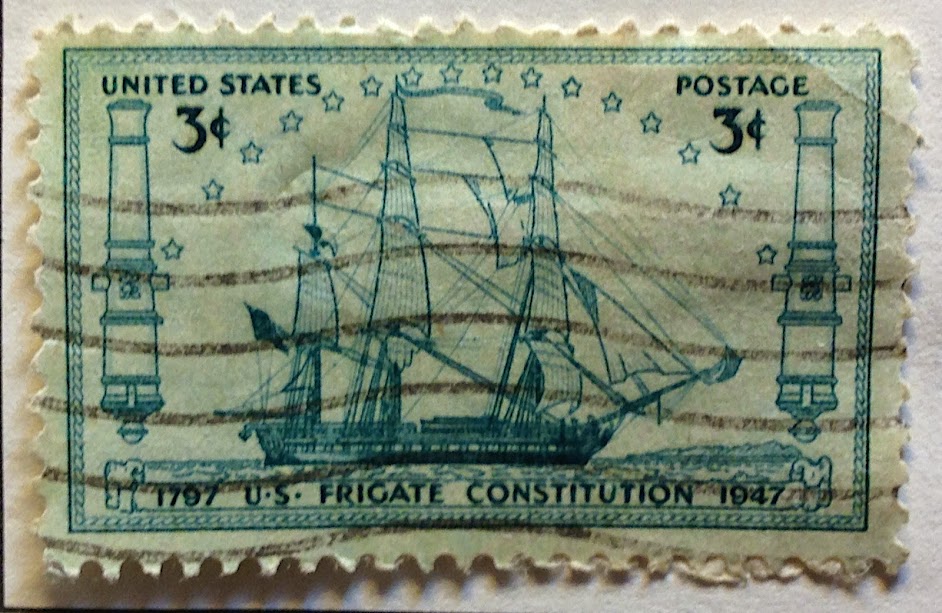
On 21 October 1797, Boston witnessed the launching of the USS Constitution, which remains "the oldest commissioned warship in the world."


Here she is, depicted on the 150th anniversary commemorative stamp, which proved to be both very popular and unexpectedly controversial (naval aficionados did not think the depiction was sufficiently active and heroic).

As I noted in my recent post on the fiftieth anniversary of the National Historic Preservation Act (October 1966-2016), it was an innovative decision on the part of the US Postal Service to depict historic resources other than buildings on the stamps issued for the fifth anniversary of the law: a San Francisco cable car, and the whaling ship Charles W. Morgan of Mystic Seaport.

The inclusion of ships raises intriguing question about, first, what should be preserved, and second, what "preservation" means in the case of resources such as ships, whose material is constantly being replaced. The "Constitution" has undergone a number of major restorations, but the latest (2007-10) was intended not only to preserve the ship, and also to bring it back to the state of 1812, when it achieved its greatest fame (context and overview; individual aspects of the project).

* * *

from the vaults (2010): backgrounder and summary on the "Constitution" and challenges of maritime historic preservation:

21 October 1797: Launching of USS Constitution; the need for preservation and interpretation continues


Thursday, October 20, 2016

October 20, 1803: Ratification of Louisiana Purchase

The Library of Congress explains:

On October 20, 1803, the Senate ratified the Louisiana Purchase Treaty by a vote of twenty-four to seven. The agreement, which provided for the purchase of the western half of the Mississippi River basin from France at a price of $15 million, or approximately four cents per acre, doubled the size of the country and paved the way for westward expansion beyond the Mississippi.

Spain had controlled Louisiana and the strategic port of New Orleans with a relatively free hand since 1762. However, Spain signed the Treaty of San Ildefonso in 1800 under pressure from Napoleon Bonaparte, a secret agreement retroceding the territory of Louisiana to France.

News of the agreement eventually reached the U.S. government. President Thomas Jefferson feared that if Louisiana came under French control, American settlers living in the Mississippi River Valley would lose free access to the port of New Orleans. On April 18, 1802, Jefferson wrote a letter to Robert Livingston, the U.S. minister to France, warning that, “There is on the globe one single spot, the possessor of which is our natural and habitual enemy. It is New Orleans…”

Napoleon, faced with a shortage of cash, a recent military defeat in Santo Domingo (present-day Haiti), and the threat of a war with Great Britain, decided to cut his losses and abandon his plans for an empire in the New World. In 1803, he offered to sell the entire territory of Louisiana to the United States for $15 million.

Robert Livingston and James Monroe, whom Jefferson had sent to Paris earlier that year, had only been authorized to spend up to $10 million to purchase New Orleans and West Florida. Although the proposal for the entire territory exceeded their official instructions, they agreed to the deal. The Louisiana Purchase Treaty was dated April 30 and formally signed on May 2, 1803.

This souvenir card issued by the Bureau of Engraving and Printing for the New Orleans Philatelic Exhibition (NOPEX) of 1972 shows, at top, the 150th anniversary commemorative stamp issued of 1953 (depicting negotiators Monroe, Livingston, and Barbe-Marbois), and in the background, the centennial stamps of 1904.


Sunday, October 16, 2016

Happy Dictionary Day, 2016

"Dictionary Day" honors lexicographer Noah Webster, born October 16, 1758, and celebrated for his pioneering work in both documenting and defining the emergent American language.


Webster is most often associated with Connecticut--New Haven, because he studied at Yale and spent his later years in that city (though his 1823 house was moved to Henry Ford's Greenfield Village in Michigan, in order to prevent its impending demolition)--and West Hartford, where his birthplace is today a museum and educational center dedicated to his legacy. In addition, however, he spent a crucial phase of his life (1812-22) in Amherst where he was actively involved in civic affairs (including the founding of Amherst Academy and Amherst College) as well as work on his dictionary.

Webster owned a large farm in what is now the center of town.

1920s map of Webster's holdings (Jones Library Special Collections) [placeholder]
His house no longer survives, but was located where the late nineteenth-century "Lincoln Block" now stands, across from Town Hall.


From the vaults:

• 2008: New England Celebrates Noah Webster 250th

• 2010: Well, where are you? Celebrating Noah Webster's Birthday and Searching for Remains of His Property


15 October 1817: Death of Revolutionary Tadeusz Kościuszko

199 years ago, on 15 October 1817, Tadeusz Kościuszko, hero of the American and Polish Revolutions, died in exile in Switzerland.

This substantial piece from the newsletter of the Mickiewicz Institute nicely delineates the high points and significance of his career: he arrived in the new United States in 1776, and during the war, he designed the fortifications at West Point and was responsible for the American campaign at Saratoga, which was decisive for the success of the Revolution, not least because it moved the French to lend their full backing to the new nation's struggle. In Poland, he famously led his nation's forces in the revolutionary struggles of 1791 and 1794. Although Kościuszko is celebrated for his dedication to the rights of peasants and Jews, his equally passionate commitment to the rights of enslaved Africans and Native Americans in the new United States is less well known. (more on the latter topic here)

In Philadephia, the house where he resided has been preserved and turned into the Thaddeus Kosciuszko National Memorial, operated by the National Park Service.
He is commemorated at West Point with a monument by John Latrobe (1828; incorrectly labeled a tomb in the engraving below), to which a statue was added in 1913.


Kościuszko became an international hero and a cult figure for Polish patriots, celebrated in images and on monuments, whenever political conditions permitted.


Marker in the main square in Kraków, at the spot from which Kościuszko announced the revolution in 1794.


Kościuszko monument by Leonard Marconi and Antoni Popiel (1900) outside the Wawel royal castle, Kraków. The Austro-Hungarian monarchy forbade such commemorations, so it was erected only during the interwar years. The Nazi occupiers, who located their headquarters in the castle, destroyed the statue. The 1960 reproduction now on the site was a gift of reconciliation from Dresden, East Germany.


Kościuszko's tomb, in the crypt of the cathedral, Wawel royal castle, Kraków. His body was moved from Switzerland a year after his death.


Friday, June 10, 2016

Lidice Shall Live: Anniversary Postal Covers Commemorating the 1942 Massacre.

One of the most notorious of the many Nazi crimes of World War II was the liquidation of the (innocent) village of Lidice, on 9-10 1942, in retaliation for the assassination of the "Reichsprotektor" of Bohemia and Moravia, Reinhard Heydrich, by Czechoslovak paratroopers.

(Main post and background)

After the war, the Czechoslovak government decided to rebuild the village, which has also become a memorial and a center for peace and reconciliation. The massacre has been commemorated in the philatelic and numismatic realm. In particular, for example, the government issued special stamps on the major anniversaries of the tragedy. Here are commemorative covers from the fifth and fifteenth anniversaries.


Fifth anniversary, 1942-1947


The cachet at left combines local and national motifs: the miner's lamp, representing the occupation of many of the residents, illuminates both the village at left and the Czech patriotic symbol of the linden leaf, at right with the message, "Lidice Shall Live." The stamp is one of three, in different denominations, issued for the occasion. The first two, identical in design except for the denomination, represent a weeping mother. This one, the highest denomination, signifies hope and rebuilding. The special cancellation echoes one of the iconic memorials, with its wreath of barbed wire (like a crown of thorns) on a cross symbolizing both death and resurrection--but here with the addition of the national linden leaves.


Fifteenth anniversary, 1957


Since 1955, when British group, "Lidice Shall Live," realized the dream of creating a Garden of Peace and Friendship, the rose has been a special symbol for Lidice.


Older posts on the Heydrich assassination and reprisals, and Lidice.

Wednesday, June 8, 2016

8 June 1794: Robespierre Presides Over the Festival of the Supreme Being

On 8 June 1794, Maximilien Robespierre presided over the Festival of the Supreme Being, the inauguration of a new civil religion that was to be a high point of the remaking of France in accordance with the principles of revolutionary reason. Instead, it proved to be a foreshadowing of his downfall.


a belief in some divine presence was essential to the philosophical and social order

Contrary to the popular stereotype, Robespierre was not some bloodthirsty monster: in fact, he tried to rein in the "enragés" and "terrorists" who, oblivious to political reality, insisted on implementing ultra-radical policies and carried out murderous and indiscriminate retribution against any presumed "counterrevolutionary" elements of the population. For Robespierre, the so-called "Terror" was just "prompt, severe, inflexible” justice unique to revolutionary situations.

Part of his opposition to the "enragés" also derived from their radical atheism, which struck out against religion, the religious, and monuments of religious cultural heritage alike and did not scruple at the casual murder of priests and nuns. Although Robespierre had no use for the traditional church, he condemned  the radical "de-Christianizers" and upheld freedom of worship. For him, as a disciple of Rousseau, a belief in some divine presence was essential to the philosophical and social order, which, he believed, rested on the moral and spiritual certainty of reward and punishment.

"The day forever fortunate has arrived, which the French people have consecrated to the Supreme Being"

The Declaration of the Rights of Man and the Citizen appended to the radical French Constitution of April 1793 acknowledged the existence of Supreme Being. Attempting to address the twin crises of the Revolutionary war and the internal divisions of the Revolutionary camp the following spring, Robespierre sought to institutionalize this belief. He delivered a Report to the National Convention on the Connections of Religious and Moral Ideas with Republican Principles, & on National Festivals on 18 Floréal, Year II (7 May 1794).

The day forever fortunate has arrived, which the French people have consecrated to the Supreme Being. Never has the world which He created offered to Him a spectacle so worthy of His notice. He has seen reigning on the earth tyranny, crime, and imposture. He sees at this moment a whole nation, grappling with all the oppressions of the human race, suspend the course of its heroic labors to elevate its thoughts and vows toward the great Being who has given it the mission it has undertaken and the strength to accomplish it.

Is it not He whose immortal hand, engraving on the heart of man the code of justice and equality, has written there the death sentence of tyrants? Is it not He who, from the beginning of time, decreed for all the ages and for all peoples liberty, good faith, and justice?
He did not create kings to devour the human race. He did not create priests to harness us, like vile animals, to the chariots of kings and to give to the world examples of baseness, pride, perfidy, avarice, debauchery, and falsehood. He created the universe to proclaim His power. He created men to help each other, to love each other mutually, and to attain to happiness by the way of virtue.
It is He who implanted in the breast of the triumphant oppressor remorse and terror, and in the heart of the oppressed and innocent calmness and fortitude. It is He who impels the just man to hate the evil one, and the evil man to respect the just one. It is He who adorns with modesty the brow of beauty, to make it yet more beautiful. It is He who makes the mother's heart beat with tenderness and joy. It is He who bathes with delicious tears the eyes of the son pressed to the bosom of his mother. It is He who silences the most imperious and tender passions before the sublime love of the fatherland. It is He who has covered nature with charms, riches, and majesty. All that is good is His work, or is Himself. Evil belongs to the depraved man who oppresses his fellow man or suffers him to be oppressed.
The Author of Nature has bound all mortals by a boundless chain of love and happiness. Perish the tyrants who have dared to break it!
Republican Frenchmen, it is yours to purify the earth which they have soiled, and to recall to it the justice that they have banished! Liberty and virtue together came from the breast of Divinity. Neither can abide with mankind without the other.
O generous People, would you triumph over all your enemies? Practice justice, and render the Divinity the only worship worthy of Him. O People, let us deliver ourselves today, under His auspices, to the just transports of a pure festivity. Tomorrow we shall return to the combat with vice and tyrants. We shall give to the world the example of republican virtues. And that will be to honor Him still.
[source]
Following the political and philosophical exposition, the Report set forth a 15-point decree on the cult and its festivals.


    First Article.

      The French people recognizes the existence of the Supreme Being, and the immortality of the soul.

    II.

      It recognizes that the manner of worship worthy of the Supreme Being is the practice of the duties of man.

    III.

      It places chief among these duties: to detest bad faith and tyranny, to punish tyrants and traitors, to assist the unfortunate, to respect the weak, to defend the oppressed, to do all the good that one can to others, and to be unjust toward no one.

    IV.

      Festivals shall be instituted to remind men of the Deity and of the dignity of their state....

It concluded with the outline of a Festival of the Supreme Being, proposed by the artist Jacques-Louis David, to be held on 20 Prairial Year II (June 8, 1794)


On 4 June 1794, Robespierre was elected President of the Convention (=legislature), and on 8 June, he presided over the Festival of the Supreme Being, according to the aforementioned mise-en-scène.

Festival of the Supreme Being, from Charles François Gabriel Levachez, and Son, and
Jean Duplessi-Bertaux, Tableaux historiques de la Révolution Française, 1798-1804
(folio engraving; image size: c. 190 x 250 mm)

Unlike the more shallow, who felt the need to prove their revolutionary bona fides through ostentatiously "populist" dress and demeanor, Robespierre saw no contradiction in combining the most radical principles with traditional sartorial propriety: he was a fastidious dresser who still wore a powdered wig and silk stockings. A contemporary account described him as presiding over the festival "dressed in a sky-blue coat, with exquisite ruffles of lace, and holding a bunch of flowers, fruit, and ripe wheat in his hand."

The hostile image below, from a nineteenth-century history, conveys the stereotypical view of him: murderous monster as fastidious prig.


from the first French edition of Alphonse de Lamartine's Histoire des Girondins (History of the Girondists--the moderate left-center faction in the Revolution). The work ran to 61 "books" divided among 8 volumes, whose publication (Paris: Furne et Cie.,1847-50) coincided with the outbreak of a new revolution, in which the Romantic poet and liberal politician himself briefly played a key part. It was accompanied by 39 steel engravings of Revolutionary figures, along with a portrait of the author. The plates, drawn by Denis August Marie Raffet (1804-60), engraved by various artists, and printed by Plon, were issued separately in 13 installments costing 1 franc each, from 1848 to 1850 (sheet size: c. 19.5 x. 25.7 cm). This engraving is by one Bosselman, active in the first half of the nineteenth century.


All did not go as planned, either. When he symbolically set fire to the statue of Atheism to reveal the statue of Wisdom rising form its ashes, the latter emerged rather scorched. Whereas Robespierre viewed the Festival as a crucial last attempt to reinvigorate the Revolution, both contemporaries and modern scholars have seen it as one of the factors that contributed to his downfall. It alienated both de-Christianizers and more traditional deists; critics accused him of megalomania and seeking to set himself up as  a new "pope" or "Mahomet" (Muhammad).

When despite the new military victory of Fleurus (26 June), which seemed to secure the Republic's fate, Robespierre insisted on ratcheting up the Terror against internal enemies, both left and right, he found that he longer had a base of support and fell victim to his foes on both extremes a month later. The radical Revolution died with him.

Saturday, June 4, 2016

June 1942: Rommel and Heydrich in the News


On June 6,1942, the Illustrated London News ran a little feature on "British and German Personalities in the Public Eye To-Day."


The two "German personalities" were General Erwin Rommel and Reinhard Heydrich, Reichsprotektor of Bohemia and Moravia, and the emerging stories would become among the most important of the war.

Rommel was "again in the news" because he had "launched his long-awaited offensive against the Allies in Libya." Already a week earlier, the New York Times headline announced, "Nazi Tanks Push Toward Tobruk." Rommel's forces captured the crucial port on 20 June, taking over 33,000 Allied prisoners. The victory earned him promotion to Field Marshal.

The Heydrich story was more dramatic news: an assassination attempt, which, the magazine observed with satisfaction, meant that he had "reaped his just deserts." Like most  reports on the attack, this one was based on speculation or fragmentary and often inaccurate information. The magazine explains that Heydrich was wounded on 27 May but describes the incident as a shooting by a Czech patriot, implying a local resistance fighter. In fact, he was the victim of a bomb attack by Czechoslovak paratroopers. Because so little was known, the report hedges its bets by adding, "some say by Nazis." Although the assertion had no basis in fact, it was not quite as far-fetched as it sounds. The ruthless Heydrich had many enemies, and given the failure of the authorities to make any progress in tracking down the assailants, some Germans began to murmur that they must have come from within the Nazi hierarchy.

The report correctly notes Heydrich's role as Himmler's protégé and his reputation for brutality. Indeed, in February, his portrait was featured on the cover of Time magazine, surrounded by hangman's nooses.


However, the report incorrectly ascribes to him the creation of Dachau concentration camp. In fact, Heydrich's role in the Nazi terror apparatus was far greater. As head of the Reich Main Security Organization, not only was he responsible for the operations of the Security Service and Security Police: he also played a crucial role in the emerging Holocaust, a story that was not yet known and as yet had no name. In January, Heydrich had secretly convened a conference of top German officials, which decreed the extermination of the European Jews.

By the time the report appeared, Heydrich was in fact already dead, having succumbed to his wounds on 4 June. The vicious reprisals that followed would be a bigger news story than the assassination itself.


Further pieces on the Heydrich assassination