Showing posts with label Valley Surreality. Show all posts

Friday, December 16, 2016

Rally Against Veterans' Flag Convoy and in Support of Hampshire College.

As noted in the previous post, Hampshire College's decision to resume flying the American flag in the wake of the protest by a veterans' group led the organizers to cancel the  second demonstration scheduled for a week later. However, another group, the "American Flag and Thin Blue Line Convoy," decided to go ahead with their showing of the flag along a route running from UMass via Amherst College to Hampshire. In the meantime, a group of leftist Pioneer Valley activists hurriedly organized a counter-demonstration on the Amherst Common.


Raise our struggle! (We have markers)

Both events were small. The Convoy claimed just over 200 participants. The counter-demonstration was even smaller. When I arrived fewer than 10 minutes before the announced start time of 10:00, there were only three people there, just starting to make signs. "We have magic markers if you want to help," one of them told me ("and glitter," another helpfully added). Even when the event got going, between 10:15 and 10:30, there were only between about two and three dozen people present. By the end, the total was over 100, and perhaps around 150 by my count--still a far cry from the 1500 that the organizers claimed for their veterans' protest at Hampshire a week earlier.


Whereas the veterans' protest was sharply focused on a single issue and a  clear outcome --"Raise the Flag!"--the program of the present event, called "Raise Our Struggle," might best be called eclectic: a counter-demonstration against the convoy, combined with wide-ranging demands for social justice and denunciation of the bigotry and racism associated with the election campaign of Donald Trump, as well as a call for "hands off Hampshire College," in response to the abuse that the latter was suffering for its flag policy.

The event announcement epitomized the grab-bag approach and generalized, flailing, post-election anguish:
A rally and gathering in defense of our plural and diverse communities in Amherst and beyond.

In Amherst and communities across Western Massachusetts, some of us are proud of our country and the flag, and others are not, but all of us recognize that Hampshire College has been subject to an unprecedented attack on their community's autonomy and character as a progressive and critical space. Reactionary nationalist forces have invaded their community with direct racist and xenophobic threats to impose a political vision that erases the experiences, voices, and history of immigrants, people of color, women, LGBTQ communities, youth, Muslims, indigenous people, Jews, other marginalized and oppressed communities, and the working class. Elected officials and politicians, from local Democrats to Donald Trump have spurred on and defended this assault, more concerned about the American flag than the proliferation of hate crimes and open bigotry in our communities.

This is not about any symbol. This is about human beings. The assault will not stop at Hampshire College. The same forces want to lay siege to communities of color, college campuses, and progressive institutions of the marginalized and the working class. They fly the thin blue line and celebrate the police, not for their own safety or peace, but to shield police and the state from scrutiny, from checks on the violence daily inflicted on black, brown, and working class neighborhoods. Forces of reaction wish to wrench apart our communities , not in the name of freedom, liberty, or patriotism, but dominance, blind authority, vulgar power, and profit.

We humbly recognize that we are on stolen land, and we need to respond with stewardship in solidarity with indigenous peoples, not to reclaim territory for nationalism and imperialism. We must do our part in Amherst, but free our hearts, minds, and bodies to support the struggles of frontline communities across this country and the world. We will not forget our past, our history, our struggles for liberation and freedom.

An Injury to one is an injury to all!
The first remarks by a Springfield activist addressed the theme of social justice in the age of Trump.


"What do we want? Free speech!"


About 20 minutes later, demonstrators took up positions along the sidewalk and in the crosswalk at the intersection of Pleasant and Spring Streets as the convoy approached.


The convoy organizers had asked "that there only be american flags, thin blue line pro police flags, gadsen [sic] flags, or flags pertaining to any branch of military. No confederate flags."

Blocking the street (a violation of the law) in order to stop the convoy, they shouted, "What do we want? Free speech!" (Other chants included: "No Trump, no KKK, no fascist USA.")


A sheriff's car accompanying the convoy (a service the convoy organizers paid for) halted and prudently allowed the protest to go on for a few moments. Frustrated, the convoy participants made u-turns and found an alternate route. A moment later, an Amherst police vehicle arrived. The officer advised the demonstrators that they were not allowed to block a public way, and they returned to the Common.


"We're badass!"

Jubilantly proclaiming that they were "badass" for having briefly interrupted the progress of convoy, they continued with their program.

School Committee member Vira Douangmany Cage, the only Amherst elected official to participate (though in a private capacity), spoke of social justice, denounced the outside politicians who had taken part at the Hampshire College protest last week, and criticized Amherst's government for not intervening.

(The Business Improvement District had nothing to do with the rally.
The sign was presumably left over from the "Merry Maple" celebration.)


"Hands off Hampshire College"


Hampshire College professor Uditi Sen (my colleague in history) defended the institution's decision to remove the flag, offering what might be characterized as the predominant view among the faculty and administration.


Few outside the academy may share this view (or even understand the argument that she was trying to make), and that is their right--but the nature of that disagreement makes all the difference.

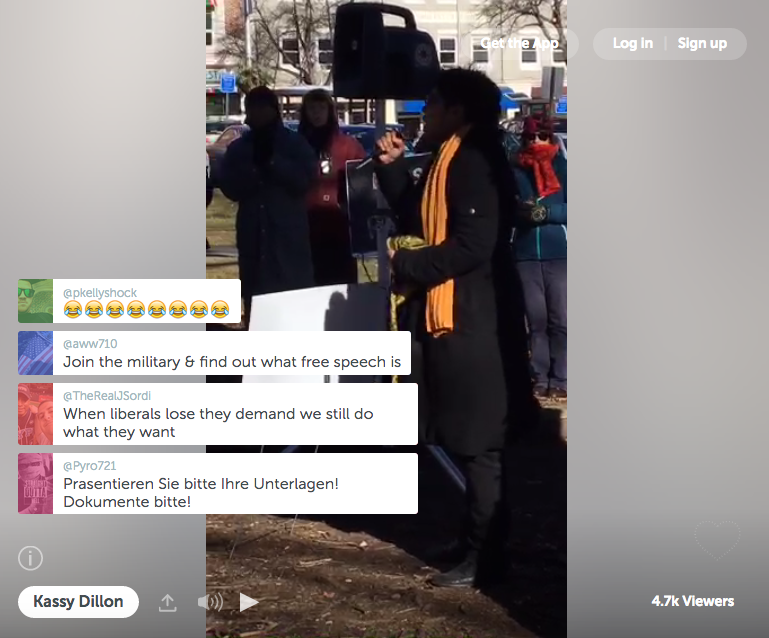
Mount Holyoke student and conservative activist Kassy Dillon covered the convoy and the demonstration on the Common on social media, mocking the College and the protesters. That, of course, is her right, as well. Part of her coverage included live commentary of the rally via Periscope.


Unfortunately, some of the respondents to the feed chose to offer particularly hateful responses (for which, it should be stressed, one cannot hold Ms. Dillon responsible). They ranged from the childish to the racist and full-blown neo-Nazi.


It was a perfect illustration of the toxic political landscape at the intersection of internet journalism and social media. Often it's not even so much the actual reports as the unmoderated responses and "talkbacks" that are the problem. Here, the problem is all too evident.

And 2017 is not even upon us.

* * *

Press coverage

In contrast to the brief and bland report on WLLP Channel 22, the Springfield Republican's Mary Serreze (@maryserreze) did a notably thorough job of covering the event from the standpoint of both parties.


From the Protest Rally Against the Hampshire College Flag Policy


In response to students' anger and fear in the wake of the presidential election and their protests that the American flag represented racism and oppression, Hampshire College controversially decided on a temporary removal of the national symbol in hopes of calming the situation and fostering dialogue.


The public reaction surprised the College (but hardly anyone else): incredulity and outrage.


"Peaceful Demonstration of Freedom--Stand With Old Glory"

Amherst’s Veterans of Foreign Wars Post 754 organized a mass protest on the Hampshire College campus for the Sunday after Thanksgiving (November 27). A large crowd from around New England--particularly but not exclusively veterans and their families--gathered at the entrance to the College on Route 116. Although the press put the size of the crowd at around 400, the organizers, who issued over 5,000 invitations via social media, estimated attendance at 1,500 to 2,000: which is to say, greater than the annual enrollment at the College.

I was present, along with a few other members of the faculty and student body.


 Veterans represented multiple generations and wars.


Not exactly the alt-right

In the wake of the presidential election and the tensions that it engendered, many in the Hampshire and wider Amherst community (who did not bother to attend or were scared to do so) leaped to the conclusion that the event was a gathering of right-wing extremists and hatemongers. On the contrary, the organizers took care to avoid giving the formal program any particular political slant. In fact, the most prominent speakers were centrist or left-liberal Democratic politicians: State Rep. John Velis (Westfield), Springfield Mayor Domenic Sarno and Councillor Kateri Walsh, and Northwestern District Attorney David Sullivan. Several of the speakers were non-white and immigrants. A member of the local veterans' color guard was transgender.

not exactly the "alt-right"

Outside interference?


The presence of the regional political figures caused no little consternation among the Hampshire faculty, who complained in high dudgeon that outsiders were interfering in our internal affairs and attempting to intimidate the College. It is an ironic argument. The politicians were simply exercising the same right of free speech about an issue of deep concern as the students who burned the flag and the President who banned it. (And, for the record: in my many years of working here, I had never known the College to bow to the wishes of any outside force, least of all, provincial politicos.)

Still, even neutral outsiders remarked on the unusual presence of these visitors. (Most expressions of surprise focused on the presence of Mayor Sarno, who, as a friend of mine from beyond the walls of the academy drily observed, "has never even come to pee in Amherst.") The most parsimonious explanation is, however, generally the most plausible. (It is possible to overthink an issue.) The cynical consensus among outside observers was that the aim was grandstanding rather than intimidation. Seeking to score easy points with their base is, after all, what politicians do. But politicians also have convictions. The idea that the flag had powerful emotional meaning for them, and that they therefore cared sincerely and deeply about its presence or absence, is a difficult one for the academic mind to grasp.

Rep. Velis is not just a politician from the Pioneer Valley, but also an Afghanistan veteran. As for DA Sullivan, he is a frequent attendee at events in Amherst, and he moreover has extensive professional experience in military affairs, having served as a civilian lawyer for service personnel and most recently, working to establish a new veterans' court providing treatment for trauma disorders and substance abuse. Mayor Sarno, too, paid tribute to the veterans, but he explained that the flag had further personal significance for him.


The flag of a nation of immigrants

Sarno was one of several speakers who highlighted the role of immigrants. The flag had special meaning for him as the son of Italian immigrants who had experienced Fascism and survived the Nazi occupation of Italy in hiding. To them it had been a symbol of hope and freedom.


Event organizer Victor A. Nunez Ortiz came to the United States when his family fled the Salvadoran civil war. He served in the Marines even before becoming a US citizen. He refers to this experience when introducing the next speaker.


Another veteran who had served in the US military as an immigrant non-citizen was Veasna Roeun of Connecticut: a survivor of the Cambodian genocide.


A Progressive Speaks


Here, well known local civic and political figure Bonnie MacCracken speaks. She read a poem about Blue Star Mothers. Bonnie, a candidate in the recent Democratic primary election for state representative from the third Hampshire district, is a member of the Democratic State Committee and has long been active on behalf of progressive social causes, among them racial and economic justice (especially housing issues) and early education.


And the right?


The red meat right-wing exception in this program was the brief address by Mount Holyoke student and conservative activist Kassy Dillon, who focused her remarks on a critique of the College and its students. She explained, "I wrote the first story" about the flag flap, adding that the Hampshire student who had passed on the news to her was now "being bullied by other students."


Racism and extremism?

Despite repeated assertions that Confederate flags and other racist symbols were on display, neither I nor anyone I subsequently spoke with saw them--and no one has to date produced any photographic proof. It does not seem unreasonable to conclude--given the nature of the controversy, and what I saw--that many in the crowd were to the right of center, but that is not the same thing as "alt-right" "white supremacists."

To be sure, there were a few displays that I could I could have done without: this anti-UN flag, for example (though without talking to the owner, it was impossible to tell whether it represented standard arch-conservative gripes about "anti-American" multilateralism or something notably more rancid).


I also spotted several "Don't Tread On Me" flags. The right-wing "Tea Party" movement adopted the Gadsden Flag (as it is more properly called) in 2010, though as everyone should know (and Mount Holyoke historian Joseph Ellis explains), it is a venerable emblem of the American Revolutionary era, appropriated in the meantime by various groups as a symbol of protest.


On the whole, the tone was respectful of the College. Of course, the organizers could not regulate who showed up, and a few of the signs were obnoxious and juvenile. One placard (referring to Vladimir Putin or just left over from the Cold War?) advised Hampshire students: if you don't like it here, go get an education in Russia. Another, in what the creators no doubt considered a masterpiece of wit, relied on hackneyed scatological imagery.


By contrast, this sign, playing on the Hampshire College motto, took a lighter approach, and was perhaps marginally more effective.


The organizers had stressed the need for civility prior to the event:
this a PEACEFUL DEMONSTRATION OF FREEDOM as citizens of our United States of America. . . Families will be present and order is to be expected.
At the rally itself, they reiterated this request and moreover made a point of thanking the College for allowing them to meet on campus property. Here, veteran and Purple Heart recipient Micah Welintukonis of Connecticut, who presided over much of the event, offers to provide microphone time to the President or any other administrators who might be present (none were) and then leads the crowd in the chant, "Raise that flag!"


A confrontation

At one point, though, one saw how things might have taken a more dangerous turn. Toward the end of the event, the organizers wanted the participants to assemble near the large Hampshire College sign for a group photo that they hoped would go viral. As they asked people to move away from the sign so that the wording would be visible, we saw a young man sitting on the ledge in front of it, giving people the finger with both hands. The organizers, at first thinking he was one of their own, mocking Hampshire College, chided him for his vulgarity. It turned out, however, that he was a Hampshire student flipping off the demonstrators rather than the College and seeking to spoil their photo op. The crowd became more agitated. Several people seemed prepared to remove him by force and others tried holding a flag in front of him to block him from view but the speaker urged them to remain peaceful and let the campus police provide order. The speaker engaged in some mild taunting of the hapless student but also offered him the microphone. After a few minutes of this standoff, things quieted down. Subsequent press reports described some uglier aspects of the confrontation, but from where I was standing at the time, near the podium, I could see and hear none of that.


Coming to a close

As the rally wound down, attendees sang "God Bless America."


In the low-key conclusion to the event, the speaker reminded attendees that "we are all Americans" and urged them to tell the College: "raise our flag!"


Postscript


The veterans had planned to return a week later for a second rally, but when the College suddenly announced on December 2 that the flag was going back up, they canceled the event as what they called an "act of faith":


Indeed, the best outcome of this sorry mess would be a dialogue between veterans and campus community, and there are some signs that this may in fact occur.

Hampshire Flag Watch: Going, going, . . .gone?! and . . . now back?


By now practically everyone in the country has heard the story, regardless of whether you read the New York Times or watch Fox News. It was with a mixture of fascination and horror that I watched the slow-motion political train wreck that was the Hampshire College flag controversy unfold over more than a month. 

Another metaphor that we use for a self-inflicted, completely avoidable disaster is: own goal.


For anyone who has been in a coma or perhaps just shell-shocked by the Trump victory and therefore unable to read a newspaper, watch TV, or surf the web, here's the elevator-speech version.


Take Down the Flag!

Hampshire student chalk protest: Take Down the Flag
The election of Donald Trump as President on November 8 prompted some Hampshire College students to express their opposition to the institution’s flying the US flag, which they denounced as a symbol of racism and oppression. College President Jonathan Lash listened politely but did not act on their demand. The next night, a group of students lowered the US flag to half-staff. On the night of 10 November, parties unknown burned the flag. It was the eve of Veterans Day. On November 12, the Trustees, having restored the flag, announced that they would fly it again at half-staff in deference to student concerns: “both to acknowledge the grief and pain experienced by so many and to enable the full complexity of voices and experiences to be heard.”

It was immediately clear to me it was an untenable policy: it simply could not last. I decided to watch what happened, for the historical record.

Day 3 (14 November)


For Day 4, the middle of the first week, I thought three shots were in order: 
general, close-up and night-time


Day 5 (16 November)


Day 6 (17 November)


Day 7 (18 November)


This is the only "dialogue" or "conversation" about the flag that I personally witnessed. (Evidently, the promised process happened in a series of "focus groups," but the vast majority of us were not involved. I certainly heard nothing.)


Negative space

Well, that didn't take long. The only thing more peculiar than the decision to fly the flag at half-staff for an extended period was the policy that soon replaced it. After only a week, on 18 November, the College announced, “we will not fly the U.S. flag or any other flags at Hampshire for the time being.” This, we were told, was so that we could discuss the meaning of the flag without the disturbing presence of (wait for it . . . ): the flag.


19 November: naked and alone


Raise the Flag!

A few days later, the press descended on the College.

November 22: filming an absence


When the outside world learned of the decision, the most common reaction was one of anger and incomprehension. The only surprising thing was that the College, with all its intellectual wattage, was, well . . . surprised. Any ordinary person would have seen this coming.

Amherst’s Veterans of Foreign Wars Post 754 organized a mass protest on the Hampshire College campus on 27 November, the Sunday after Thanksgiving. People from around New England--particularly but not exclusively veterans--gathered at the entrance to the College on Route 116. The organizers estimated attendance at over 1,500 to 2,000: which is to say, greater than the typical annual enrollment at the College.

The event was nonpartisan in intention (and largely in practice) and the speakers included several left-liberal Democrats. I attended the rally to observe for myself. Although some subsequent press reports described at least one confrontation involving aggressive or offensive behavior, what I saw was by and large respectful and disciplined. The organizers stressed the need for civility and made a point of thanking the College for allowing them to meet on campus property. They offered to provide microphone time to the President or any other administrators who might be present (none were).


Press coverage, both local and national, was heavy.


The College soon faced a torrent of abuse in the form of angry phone calls and emails, as well as far harsher talk on social media--much like what the Town itself has experienced in the wake of controversies over flying the 9-11 commemorative flags or other contentious debates.


November 29: I have no idea what these temporary fences near the flag were intended to accomplish.


Back to normal?

On 2 December, the the College suddenly announced that the flag was being returned to its customary position on the main campus flagpole. Crisis over, but no problems solved.


After I took my pictures, a woman passing by said, "a lot of people doing that today."


There is a well known political dictum: when you're explaining, you're losing. The College has created a dedicated web page to explain its recent flag policy to the public.


* * *


Coming attractions 

- photos of the protest rally against the College
- a more detailed look at the controversy


Saturday, May 28, 2016

Town Meeting: purest participatory democracy--or "mental torture, in which the victim actively collaborates"?


"Town Meeting was absolutely awful last night."
"How bad was it?
"It was SO bad that...."

Town Meeting under the magnifying glass

It reads like a corny joke, but it was in fact a conversation I had many times last week, and there was nothing funny about it.

Like many other Amherst and New England residents, I've occasionally poked good-natured fun at this venerable democratic institution because it is so much a part of our culture and identity: it reveals our essential nature, brings out the best, the worst, and the silliest in us.

The issue has become more acute, though, since voters this spring approved a Charter Commission to review the form of Town government, a process that could result in any of several recommendations, including abolition of Town Meeting. Some would relish that outcome, others would fight it to the death. Part of the decision may turn on how effective Town Meeting proves to be under the magnifying class of increased scrutiny in the coming year. The omens are not good. In the past, I thought, the prospect of a Charter vote forced residents to be on their best behavior. Not this time. If anything, the atmosphere is more charged than ever.

The previous Town Meeting sessions this spring already displayed a few foibles and failures (1, 2, 3), but May 16 far surpassed anything we had seen. For a variety of reasons, the debate degenerated into unadulterated nastiness.


The no-go zone

The warrant article itself was simple and straightforward: The Jones Library, using money voted by a previous Town Meeting, is preparing a proposal for a building expansion in a highly competitive state grant program. It requested that the Amherst Historical Society (on whose board I serve), located next door in the Amherst History Museum, sell it a small piece of property that would facilitate this expansion. However, because a change in the dimensions of the Museum property, still zoned residential (a historical anachronism), would bring the remaining lot out of compliance with the zoning bylaw, it needs to be rezoned as business, the same as the Library (and rest of the block). This was the only question before Town Meeting: a vote on a zoning change to the Museum property, necessitated by technical requirements of the bylaw itself.


The Library made a political faux pas in bringing a large contingent
to the stage at Town Meeting, though only a few actually spoke to
the article (here: architect John Kuhn)
But (as they say on late night infomercials), Wait! There's more. The turmoil in Town Meeting was not about the technical zoning fix, as such, and instead, about the motivations behind it and the possible consequences.

Opposition derived from:
  1. Hope of using this article to block the Library expansion plan.
  2. Concern that the rezoning, although required by law, might trigger undesirable further sale/commercial development of the History Museum property (a chimera: the Museum would never allow that to happen).
  3. Blowback against the Town Meeting Moderator (he had provided an unusually wide latitude for discussion of a similarly narrow article the previous week, so his attempt to limit discussion to the zoning change, without reference to the merits of the Library expansion plan that occasioned it, struck many in the chamber as inconsistent and unfair).
The article attained a vote of only 93-91, nowhere near the required two-thirds majority.


No, really: how bad was it?

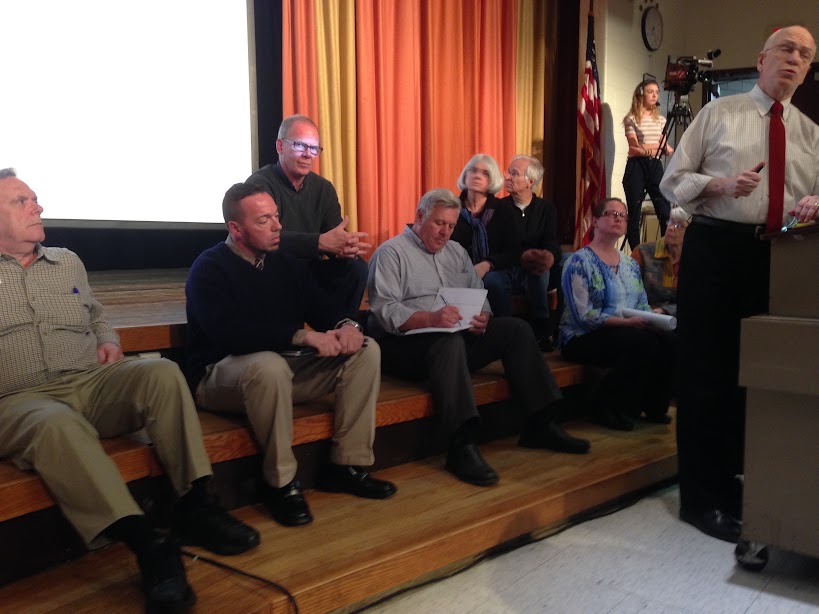
How bad was it? People who read the newspaper accounts (1, 2) asked what in the world had happened, and I told them that "deeply divided and often contentious" could not begin to communicate the atmosphere and tone.

I have never seen so many protesting "points of order," even in this body known for its love of that that parliamentary procedure. (One senior, very dignified and polite member of the body later joked to me that we should just charge a fee for each point of order, so as to discourage the practice--or raise needed revenue.) In clear violation of the rules of the house, speakers interrupted and argued with the Moderator, signaled their approval or disapproval of statements by means of applause, hissing, catcalls, or other audible interjections, and impugned one another's motives and character.

One really has to watch the entire session to get the feel of the nastiness.


But this excerpt--in which a comment, limited by the rules of the house to 3 minutes, dragged on for 13 as a result of disagreement between speaker and Moderator--conveys the frustrating nature of the exchanges.


One observer charged that the "display of churlishness, no-nothingness, scorn, mockery and outright lies" would have been more appropriate to the Nazi Reichstag or the French Revolutionary legislature under The Terror. I actually received a number of sympathy notes from Town Meeting members as well as the general public. Even some of those on the winning side were embarrassed by the behavior of their allies.

Institutional suicide on live TV?

As I have more than once explained, I have always had mixed feelings about Town Meeting:

• On the one hand, real pride in our centuries-old democratic traditions, and real personal as well as political appreciation of the opportunity to learn the views of the most politically engaged fellow citizens.

• On the other hand, frustration with the process, by which I mean less the length and inefficiency of Town Meeting (which is the deliberately crafted curse of most democracy--here taken to an extreme, to be sure), and rather, the increasing difficulty of tackling any complex legislation in a body of some 250 people.

If it disappeared, I would, quite honestly, miss it: both because of the decline in participatory government, and because I genuinely enjoy the debate.

Whenever people talk about getting rid of Town Meeting, as I noted several years ago, I hear the voice of Michael Cann, a refugee from Nazi Germany and an ardent Town Meeting supporter. He had no illusions about the flaws of the institution but cautioned against abandoning it as earlier generations had overthrown "messy" democracy in the name of fascist "efficiency." Each step away from broad-based democracy, he warned, reduced the opportunities for public participation in government--and in the process, citizen interest in public affairs. We had already gone from a town meeting open to all, to an elected representative town meeting of 240, and now what: a council of a dozen or fewer members?

Michael died four years ago, and I was sad because I had lost a friend. It was sad but not tragic: part of the natural and inevitable order of things. By contrast, what we witnessed last week was both sadder and more tragic because it was unnecessary and entirely avoidable: a self-inflicted death. I am afraid that we saw Amherst Town Meeting commit political suicide on live television. It is hard to imagine how anyone watching could conclude this is a desirable or even functional form of government. The irony is that the people responsible for this spectacle thought they were saving the institution by fulfilling what they see as its aggressive watchdog role.


And the future: return to sanity or renewed mental torture?

Although this week's Town Meeting sessions included the remainder of the most controversial articles--even one directly opposing Library expansion (1, 2)--which generated their share of heat as well as light (and yes, just sheer wackiness), the conversation was nonetheless more civil and restrained. Several people I spoke with, who had been about to despair last week--even some harsh critics of Town Meeting--felt encouraged and buoyed as the night drew to a close on Wednesday. Perhaps there was hope after all. Others warned that the optimists were deluding themselves.

Was the bedlam of that Monday night an aberration or a glimpse of the future? I could not help but think of "The Fallen Sparrow" (1943), an underappreciated anti-fascist film about a Spanish Civil War veteran pursued by Nazis. In one of the most chilling scenes, the evil Dr. Skaas explains the essence of torture to the protagonist, who had experienced it firsthand in Spain. He contrasts the mere physical torture of the Ancients with the more sophisticated cruelty of Asia, epitomized by the infamous water torture, which combines the mental with the physical:
Dr. Skaas: Then—and here is the principle of all modern torture—release is given: the dripping is stopped, the victim is revived, just at the borderline of sanity. Then: ah, then, comes an interval during which the victim tortures himself—waiting, knowing that the operation will be repeated, and it is repeatable, most assuredly, with perhaps several new variations. You see the point?
Barby [the protagonist's girlfriend]:  How perfectly ghastly!
Dr. Skaas: You see the beauty of the idea? Mental torture, in which the victim actively collaborates.


Town Meeting, too, "will be repeated . . . with perhaps several new variations." But which is the real Town Meeting? Is the torment really over, or was that just a momentary respite? I want to hope for the best, but in the meantime, we wait and worry.


Thursday, October 15, 2015

Amherst NOT "only the 'h' is silent" caption contest

As almost all readers of this site will know, the unofficial motto of the town, popularized at the time of our 250th anniversary in 2009, and since disseminated throughout the world (well, New England, anyway) on t-shirts and bumper stickers, is:
Amherst, where only the 'h' is silent
a reference to our irrepressible civic spirit and love of democratic debate (some might characterize it slightly differently).

Well, in any case, when I wandered past one of our local establishments this week, this sign caught my eye, and it occurred to me that it, too, might in some small way be representative of our community character (as well as lack of proof-reading ability).


My first reaction was:
Amherst: where not only the 'h' is silent, but also the placement of the possessive apostrophe is completely up to the conscience of the individual believer.
Or how about:
Amherst: Forget chickens. We're so damned liberal that even the apostrophes are free-range.
I'm sure there's more potential out there. Your suggestions?