"In fiction, the principles are given, to find the facts: in history, the facts are given, to find the principles; and the writer who does not explain the phenomena as well as state them performs only one half of his office."
Thomas Babington Macaulay, "History," Edinburgh Review, 1828
Members of the Amherst Select Board have few ceremonial duties, none of them obligatory. Still, I do relish the ones that have both historical and civic meaning. Participating in this commemoration, like those held on Veterans Day, Memorial Day, and the 9-11 anniversary, is among such quasi-obligations that I value most. The others are held in spring or summer weather. This one, by contrast, is the most universal in significance but the least well attended, held on what invariably proves to be one of the most frigid days in December, as we remind ourselves that winter has not even begun. The fact that the event usually takes place after dark, by electric candle light, only adds to the sense that we are doing something important, keeping something very important alive.
"Many of the assumptions about who wrote the Universal Declaration of Human Rights are wrong"
Attendance is also low, however, because, whereas the other dates are established US holidays, this one is not. Few of us know of the Declaration, and even among those who are familiar with it, few are aware of the real story. At best, we "know" that Eleanor Roosevelt had something to do with it. Well, not that much, and she certainly was not the only one. I always refer people to an admirable article by the equally admirable and courageous Gita Sahgal, a founder of the Centre for Secular Space. She reminds us of two crucial points:
(1) "Many of the assumptions about who wrote the Universal Declaration of Human Rights are wrong. The less known story of the men and women who wrote this foundational, emancipatory and anti-colonial document must be told in today's world."
(2) That in turn should serve as a rebuke to those on both right and left who dismiss the notion of human rights as, respectively, a sign of liberal elitist weakness or a reactionary bourgeois affectation, not to mention those who claim an exemption from these universal standards for a particular culture or faith.
Universal Human Rights--and now, more than ever, the rights of immigrants
This year's ceremony was a little bit different. Because the anniversary fell on a weekend, Human Resources and Human Rights Director Deborah Radway and the Human Rights Commission decided to begin in the afternoon and daylight, at 4:00 p.m.
And, given the toxic climate surrounding the recent presidential campaign and the rise of new nativist, anti-immigrant sentiment, the Select Board proclamation of the holiday explicitly reaffirmed the Town's decision (represented by a Town Meeting vote of 2012) to do the utmost to protect the rights of immigrants, including the undocumented, from what was regarded as unnecessary and excessively aggressive government intervention:
Key excerpt:
Then THEREFORE, BE IT RESOLVED that the Town of Amherst and its officials and employees,
to the extent permissible by law, shall not participate in federal law
enforcement programs relating to immigration enforcement, including but
not limited to, Secure Communities, and cooperative agreements with the
federal government under which town personnel participate in the
enforcement of immigration laws, such as those authorized by Section
287(g) of the Immigration and Nationality Act. Should the Commonwealth
of Massachusetts enter into an agreement or Memorandum of Agreement
regarding Secure Communities, the Town of Amherst shall opt out if
legally and practically permissible. To the extent permissible by law,
immigration detainer requests will not be honored by the Amherst Police
Department. Municipal employees of the Town of Amherst, including law
enforcement employees, shall not monitor, stop, detain, question,
interrogate, or search a person for the purpose of determining that
individual’s immigration status. Officers shall not inquire about the
immigration status of any crime victim, witness, or suspect, unless such
information is directly relevant to the investigation, nor shall they
refer such information to federal immigration enforcement authorities
unless that information developed is directly relevant. The use of a
criminal investigation or arrest shall not be used as a basis to
ascertain information about an individual’s immigration status unless
directly relevant to the offenses charged.”
Above: Amherst political notables take part in the reading of the Declaration. At left: Select Board Member Andy Steinberg, State-Representative-elect Solomon Goldstein-Rose, Town Manager Paul Bockelman.
For the record, this is the first time that I (or anyone else, as far as I can tell) can recall a Town Manager taking part in this event: big props to Paul, who doesn't even live here yet on a permanent basis and is still commuting from Somerville.
Human Rights Day in Amherst: the 2015 post, describing the origins of the Declaration, with still and video footage from Amherst commemorations, 2011-2014.
As noted in the previous post, Hampshire College's decision to resume flying the American flag in the wake of the protest by a veterans' group led the organizers to cancel the second demonstration scheduled for a week later. However, another group, the "American Flag and Thin Blue Line Convoy," decided to go ahead with their showing of the flag along a route running from UMass via Amherst College to Hampshire. In the meantime, a group of leftist Pioneer Valley activists hurriedly organized a counter-demonstration on the Amherst Common.
Raise our struggle! (We have markers)
Both events were small. The Convoy claimed just over 200 participants. The counter-demonstration was even smaller. When I arrived fewer than 10 minutes before the announced start time of 10:00, there were only three people there, just starting to make signs. "We have magic markers if you want to help," one of them told me ("and glitter," another helpfully added). Even when the event got going, between 10:15 and 10:30, there were only between about two and three dozen people present. By the end, the total was over 100, and perhaps around 150 by my count--still a far cry from the 1500 that the organizers claimed for their veterans' protest at Hampshire a week earlier.
Whereas the veterans' protest was sharply focused on a single issue and a clear outcome --"Raise the Flag!"--the program of the present event, called "Raise Our Struggle," might best be called eclectic: a counter-demonstration against the convoy, combined with wide-ranging demands for social justice and denunciation of the bigotry and racism associated with the election campaign of Donald Trump, as well as a call for "hands off Hampshire College," in response to the abuse that the latter was suffering for its flag policy.
The event announcement epitomized the grab-bag approach and generalized, flailing, post-election anguish:
A rally and gathering in defense of our plural and diverse communities in Amherst and beyond.
In Amherst and communities across Western Massachusetts, some of us are proud of our country and the flag, and others are not, but all of us recognize that Hampshire College has been subject to an unprecedented attack on their community's autonomy and character as a progressive and critical space. Reactionary nationalist forces have invaded their community with direct racist and xenophobic threats to impose a political vision that erases the experiences, voices, and history of immigrants, people of color, women, LGBTQ communities, youth, Muslims, indigenous people, Jews, other marginalized and oppressed communities, and the working class. Elected officials and politicians, from local Democrats to Donald Trump have spurred on and defended this assault, more concerned about the American flag than the proliferation of hate crimes and open bigotry in our communities.
This is not about any symbol. This is about human beings. The assault will not stop at Hampshire College. The same forces want to lay siege to communities of color, college campuses, and progressive institutions of the marginalized and the working class. They fly the thin blue line and celebrate the police, not for their own safety or peace, but to shield police and the state from scrutiny, from checks on the violence daily inflicted on black, brown, and working class neighborhoods. Forces of reaction wish to wrench apart our communities , not in the name of freedom, liberty, or patriotism, but dominance, blind authority, vulgar power, and profit.
We humbly recognize that we are on stolen land, and we need to respond with stewardship in solidarity with indigenous peoples, not to reclaim territory for nationalism and imperialism. We must do our part in Amherst, but free our hearts, minds, and bodies to support the struggles of frontline communities across this country and the world. We will not forget our past, our history, our struggles for liberation and freedom.
An Injury to one is an injury to all!
The first remarks by a Springfield activist addressed the theme of social justice in the age of Trump.
"What do we want? Free speech!"
About 20 minutes later, demonstrators took up positions along the sidewalk and in the crosswalk at the intersection of Pleasant and Spring Streets as the convoy approached.
The convoy organizers had asked "that there only be
american flags, thin blue line pro police flags, gadsen [sic] flags, or flags
pertaining to any branch of military. No confederate flags."
Blocking the street (a violation of the law) in order to stop the convoy, they shouted, "What do we want? Free speech!" (Other chants included: "No Trump, no KKK, no fascist USA.")
A sheriff's car accompanying the convoy (a service the convoy
organizers paid for) halted and prudently allowed the protest to go on for a few moments. Frustrated, the convoy participants made u-turns and found an alternate route. A moment later, an Amherst police vehicle arrived. The officer advised the demonstrators that they were not allowed to block a public way, and they returned to the Common.
"We're badass!"
Jubilantly proclaiming that they were "badass" for having briefly interrupted the progress of convoy, they continued with their program.
School Committee member Vira Douangmany Cage, the only Amherst elected official to participate (though in a private capacity), spoke of social justice, denounced the outside politicians who had taken part at the Hampshire College protest last week, and criticized Amherst's government for not intervening.
(The Business Improvement District had nothing to do with the rally.
The sign was presumably left over from the "Merry Maple" celebration.)
"Hands off Hampshire College"
Hampshire College professor Uditi Sen (my colleague in history) defended the institution's decision to remove the flag, offering what might be characterized as the predominant view among the faculty and administration.
Few outside the academy may share this view (or even understand the argument that she was trying to make), and that is their right--but the nature of that disagreement makes all the difference.
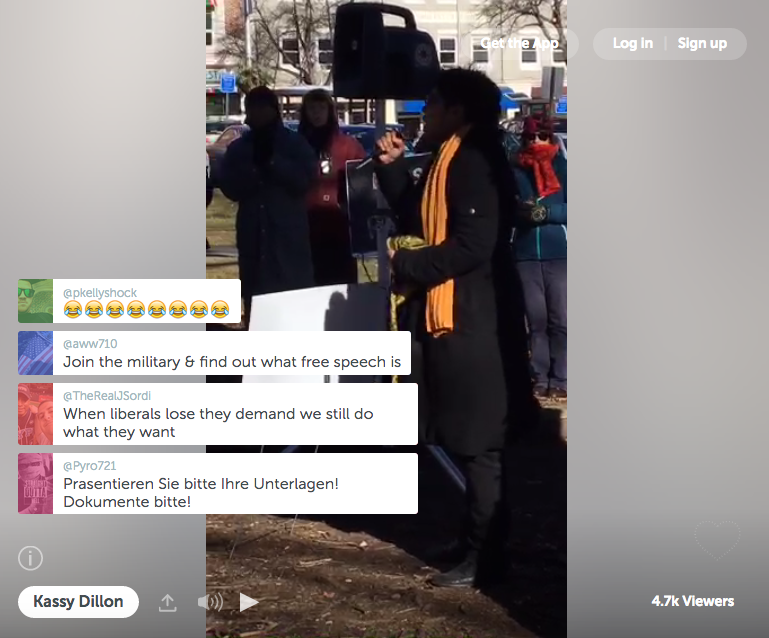
Mount Holyoke student and conservative activist Kassy Dillon covered the convoy and the demonstration on the Common on social media, mocking the College and the protesters. That, of course, is her right, as well. Part of her coverage included live commentary of the rally via Periscope.
Unfortunately, some of the respondents to the feed chose to offer particularly hateful responses (for which, it should be stressed, one cannot hold Ms. Dillon responsible). They ranged from the childish to the racist and full-blown neo-Nazi.
It was a perfect illustration of the toxic political landscape at the intersection of internet journalism and social media. Often it's not even so much the actual reports as the unmoderated responses and "talkbacks" that are the problem. Here, the problem is all too evident.
In response to students' anger and fear in the wake of the presidential election and their protests that the American flag represented racism and oppression, Hampshire College controversially decided on a temporary removal of the national symbol in hopes of calming the situation and fostering dialogue.
The public reaction surprised the College (but hardly anyone else): incredulity and outrage.
Amherst’s Veterans of Foreign Wars Post 754 organized a mass protest on the Hampshire College campus for the Sunday after Thanksgiving (November 27). A large crowd from around New England--particularly but not
exclusively veterans and their families--gathered at the entrance to the College on Route 116. Although the press put the size of the crowd at around 400, the organizers, who issued over 5,000 invitations via social media, estimated
attendance at 1,500 to 2,000: which is to say, greater than the annual enrollment at the College.
I was present, along with a few other members of the faculty and student body.
Veterans represented multiple generations and wars.
Not exactly the alt-right
In the wake of the presidential election and the tensions that it engendered, many in the Hampshire and wider Amherst community (who did not bother to attend or were scared to do so) leaped to the
conclusion that the event was a gathering of right-wing extremists
and hatemongers. On the contrary, the organizers took care to avoid giving the formal program any particular political slant. In fact, the
most prominent speakers were centrist or
left-liberal Democratic politicians: State Rep. John Velis (Westfield), Springfield
Mayor Domenic Sarno and Councillor Kateri Walsh, and Northwestern
District Attorney David Sullivan. Several of the speakers were non-white and immigrants. A member of the local veterans' color guard was transgender.
not exactly the "alt-right"
Outside interference?
The presence of the regional political figures caused no little consternation among the
Hampshire faculty, who complained in high dudgeon that outsiders were interfering in our internal affairs and attempting to intimidate the College. It is an ironic argument. The politicians were simply exercising the same right of free speech about an issue of deep concern as the students who burned the flag and the President who banned it. (And, for the record: in my many years of working here, I had never known the College to bow to the wishes of any outside force, least of all, provincial politicos.)
Still, even neutral outsiders remarked on
the unusual presence of these visitors. (Most
expressions of surprise focused on the presence of Mayor Sarno, who, as a
friend of mine from beyond the walls of the academy drily observed, "has never even
come to pee in Amherst.") The most parsimonious explanation is, however, generally the most plausible. (It is possible to overthink an issue.) The cynical consensus among outside observers was
that the aim was grandstanding rather than intimidation. Seeking to score easy points with their base is, after all, what politicians do. But politicians also have convictions. The idea that the flag had powerful emotional meaning for them, and that they therefore cared sincerely and deeply about its presence or absence, is a difficult one for the academic mind to grasp.
Rep. Velis is not
just a politician from the Pioneer Valley, but also an Afghanistan
veteran. As for DA Sullivan, he is a frequent attendee at events in
Amherst, and he moreover has extensive professional experience in
military affairs, having served as a civilian lawyer for service personnel and most recently, working to establish a new veterans' court providing treatment for trauma disorders and substance abuse. Mayor Sarno, too, paid tribute to the veterans, but he explained that the flag had further personal significance for him.
The flag of a nation of immigrants
Sarno was one of several speakers who highlighted the role of immigrants. The flag had special meaning for him as the son of Italian immigrants who had experienced Fascism and survived the Nazi occupation of Italy in hiding. To them it had been a symbol of hope and freedom.
Event organizer Victor A. Nunez Ortiz came to the United States when his family fled the Salvadoran civil war. He served in the Marines even before becoming a US citizen. He refers to this experience when introducing the next speaker.
Another veteran who had served in the US military as an immigrant non-citizen was Veasna Roeun of Connecticut: a survivor of the Cambodian genocide.
A Progressive Speaks
Here, well known local civic and political figure Bonnie MacCracken speaks. She read a poem about Blue Star Mothers. Bonnie, a candidate in the recent Democratic primary election for state representative from the third Hampshire district, is a member of the Democratic State Committee and has long been active on behalf of progressive social causes, among them racial and economic justice (especially housing issues) and early education.
And the right?
The red meat right-wing exception in this program was the brief address by Mount Holyoke student and conservative activist Kassy Dillon, who focused her remarks on a critique of the College and its students. She explained, "I wrote the first story" about the flag flap, adding that the Hampshire student who had passed on the news to her was now "being bullied by other students."
Racism and extremism?
Despite repeated assertions that Confederate flags and other racist symbols were on display, neither I nor anyone I subsequently spoke with saw them--and no one has to date produced any photographic proof. It does not seem unreasonable to conclude--given the nature of the controversy, and what I saw--that many in the crowd were to the right of center, but that is not the same thing as "alt-right" "white supremacists."
To be sure, there were a few displays that I could I could have done without: this anti-UN flag, for example (though without talking to the owner, it was impossible to tell whether it represented standard arch-conservative gripes about "anti-American" multilateralism or something notably more rancid).
I also spotted several "Don't Tread On Me" flags. The right-wing "Tea Party" movement adopted the Gadsden Flag (as it is more properly called) in 2010, though as everyone should know (and Mount Holyoke historian Joseph Ellis explains), it is a venerable emblem of the American Revolutionary era, appropriated in the meantime by various groups as a symbol of protest.
On the whole, the tone was respectful of the College. Of course, the organizers could not regulate who showed up, and a few of the signs were obnoxious and juvenile. One placard (referring to Vladimir Putin or just left over from the Cold War?) advised Hampshire students: if you don't like it here, go get an education in Russia. Another, in what the creators no doubt considered a masterpiece of wit, relied on hackneyed scatological imagery.
By contrast, this sign, playing on the Hampshire College motto, took a lighter approach, and was perhaps marginally more effective.
this a PEACEFUL DEMONSTRATION OF FREEDOM as citizens of our United States of America. . . Families will be present and order is to be expected.
At the rally itself, they reiterated this request and moreover made a point of thanking
the College for allowing them to meet on campus property. Here, veteran
and Purple Heart recipient Micah Welintukonis of Connecticut, who presided over much of
the event, offers
to provide microphone time to the President or any other administrators
who might be present (none were) and then leads the crowd in the chant,
"Raise that flag!"
A confrontation
At one point, though, one saw how things might have taken a more dangerous turn. Toward the end of the event, the organizers wanted the participants to assemble near the large Hampshire College sign for a group photo that they hoped would go viral. As they asked people to move away from the sign so that the wording would be visible, we saw a young man sitting on the ledge in front of it, giving people the finger with both hands. The organizers, at first thinking he was one of their own, mocking Hampshire College, chided him for his vulgarity. It turned out, however, that he was a Hampshire student flipping off the demonstrators rather than the College and seeking to spoil their photo op. The crowd became more agitated. Several people seemed prepared to remove him by force and others tried holding a flag in front of him to block him from view but the speaker urged them to remain peaceful and let the campus police provide order. The speaker engaged in some mild taunting of the hapless student but also offered him the microphone. After a few minutes of this standoff, things quieted down. Subsequent press reports
described some uglier aspects of the confrontation, but from where I was standing at the time, near the podium, I could see and hear none of that.
Coming to a close
As the rally wound down, attendees sang "God Bless America."
In the low-key conclusion to the event, the speaker reminded attendees that "we are all Americans" and urged them to tell the College: "raise our flag!"
Postscript
The veterans had planned to return a week later for a second rally, but when the College suddenly announced on December 2 that the flag was going back up, they canceled the event as what they called an "act of faith":
Indeed, the best outcome of this sorry mess would be a dialogue between veterans and campus community, and there are some signs that this may in fact occur.
Whereas recognition of the inherent dignity
and of the equal and inalienable rights of all members of the human
family is the foundation of freedom, justice and peace in the world,
Whereas
disregard and contempt for human rights have resulted in barbarous acts
which have outraged the conscience of mankind, and the advent of a
world in which human beings shall enjoy freedom of speech and belief and
freedom from fear and want has been proclaimed as the highest
aspiration of the common people,...
The charge of the Commission is “to ensure that no power goes unchecked, and that all
citizens are afforded equal protection under the law,” specifically: "to insure [sic] that no person, public or private, shall be denied any rights guaranteed pursuant to local, state, and/or federal law on the basis of race or color, gender, physical or mental ability, religion, socio-economic status, ethnic or national origin, affectional or sexual preference, lifestyle, or age."
An earlier version of the statement spoke, rather more ambitiously, of "promot[ing] economic and social justice for all citizens through
means of mediation, education, and enforcement of local, state, federal,
and international human rights laws”--above all, as embodied in the
United Nations Universal Declaration of Human Rights.
Although the Declaration finds no formal resonance in the official documents, it nonetheless embodies the spirit that moves the Commission. Accordingly, it has become our custom for the Select Board each December to issue a proclamation for the celebration of International Human Rights Day, on the anniversary of the promulgation of the Universal Declaration of Human Rights. By tradition, the Human Rights Commission then marks the occasion with a candlelight vigil and reading of the Declaration on the Town Common in the evening (often followed by a thematic presentation on a subsequent day).
Members of the Amherst Human Rights Commission and supporters who celebrated the Declaration last December included Department of Human Resources/Rights Director Deborah Radway, Human Rights Commission Chair Gregory Bascom, Bonnie McCracken, Frank Gatti, Eleanor Manire Gatti, and Robert Pam
***
"Many of the assumptions about who wrote the Universal Declaration of Human Rights are wrong. The less known story of the men and women who wrote this foundational, emancipatory and anti-colonial document must be told in today's world."
Even those familiar with the Declaration probably do not know the
story behind it. Some years back, Gita Sahgal, founder of the Centre for Secular Space,
and the former Head of the Gender Unit at Amnesty International, took on this educational challenge.
These are challenging times, she observed. On the one
hand, modern philosophers reject the whole concept of demonstrable or
natural rights as a throwback to an earlier, naïve age (Alasdair
MacIntyre: “tantamount to belief in witches and unicorns”), while on the
other, some strains of leftism and postmodernism reduce such supposed
“rights” to “the political philosophy of cosmopolitanism” that
“‘constitutionalise[s]‘ the normative sources of Empire.” (I’m feeling
guilty already.) As Sahgal drily observes, those fighting the Bush
administration’s practice of torture and the continued existence of the
Guantanamo detention facility “would be surprised to see themselves as
empire builders,” while the authors of the Declaration, for their part,
would have found "absurd" “The idea that different peoples were endowed
with separate rights,” as exemplified by the attempt to create a
specific Declaration of Human Rights in Islam.
Citing the work of Susan Waltz, she explains that the
origins and character of this fundamental document are both more varied
and more radical than even its admirers realize. For example, it is
commonly attributed to Eleanor Roosevelt because she chaired the
drafting committee, yet she contributed little to the concept or the
content. (The idea in fact originated with the President of Panama.) The
notion that “western” powers were responsible for the sections on civil
and political rights, and the Soviet Union, for those on social and
economic ones, is also a gross oversimplification.
The desire for emancipation of all, emphasizing that rights applied to
everyone everywhere, emerged as a major concern. Significant additions
were made by newly de-colonized states regarding, slavery,
discrimination, the rights of women, and the right to national self
determination.
A host of countries, not least the smaller or emerging
ones, saw to it that the document addressed social rights as well as the
rights of colonized and other non-self-governing territories. An Indian
activist fought for language referring to rights of ”human beings”
rather than men, lest it be construed as discriminatory against women.
Several Muslim delegates supported the clauses on freedom of religious
choice. The final product was truly a collective one
Fifty nations voted in favor of the Declaration. None dared oppose it, but (big surprise), Saudi Arabia, South Africa, and the Soviet Union abstained. Still explains a lot (plus ça change).
* * *
The Amherst Human Rights vigil on the occasion of the document's anniversary is at once a sobering (not to say: depressing) and an inspiring occasion: sobering because, in this town of nearly 38,000 residents--and some 27,000 students--where (as the expression goes) "only the 'h' is silent," I don't believe I have ever seen more than a dozen citizens from among our self-proclaimed liberals, progressives, radicals, and revolutionaries ever put on a down coat and show up. To be sure it's cold and dark, and yet . . . it is an important symbolic commitment to a vital cause. Again, it can be a lot to ask for a symbolic 30-minute gesture on a frigid December night. (I freely admit that I myself am at times the laziest person in the world.) Still, . . . . you get the point.
I hope that residents, and above all, my fellow members of Town government--employed, elected, and appointed--will in future consider taking part in what for me is one of the most moving political experiences of the year. When we hold the ceremony, we take turns reading from the Declaration, basically one clause/per person at a time. I have to confess that I often have to suppress a shudder when my turn comes, no matter which paragraph is at issue. The preface is a stirring document:
Whereas recognition of the inherent dignity
and of the equal and inalienable rights of all members of the human
family is the foundation of freedom, justice and peace in the world,
Whereas
disregard and contempt for human rights have resulted in barbarous acts
which have outraged the conscience of mankind, and the advent of a
world in which human beings shall enjoy freedom of speech and belief and
freedom from fear and want has been proclaimed as the highest
aspiration of the common people,
Whereas it is
essential, if man is not to be compelled to have recourse, as a last
resort, to rebellion against tyranny and oppression, that human rights
should be protected by the rule of law,
Whereas it is essential to promote the development of friendly relations between nations,
Whereas
the peoples of the United Nations have in the Charter reaffirmed their
faith in fundamental human rights, in the dignity and worth of the human
person and in the equal rights of men and women and have determined to
promote social progress and better standards of life in larger freedom,
Whereas
Member States have pledged themselves to achieve, in co-operation with
the United Nations, the promotion of universal respect for and
observance of human rights and fundamental freedoms,
Whereas
a common understanding of these rights and freedoms is of the greatest
importance for the full realization of this pledge,
Now, Therefore THE GENERAL ASSEMBLY proclaims THIS UNIVERSAL DECLARATION OF HUMAN RIGHTS
as a common standard of achievement for all peoples and all nations, to
the end that every individual and every organ of society, keeping this
Declaration constantly in mind, shall strive by teaching and education
to promote respect for these rights and freedoms and by progressive
measures, national and international, to secure their universal and
effective recognition and observance, both among the peoples of Member
States themselves and among the peoples of territories under their
jurisdiction.
How can a chill not run down one's spine when one contrasts the noble goals and innocent hopes of 1948 with--taking all progress into account--the atrocities of the present day?
Scenes from past vigils
2011
On the evening of December 9, one of the first that felt truly cold in what has been a comparatively mild season, a small group gradually assembled under the guidance of tireless Chair Reynolds Winslow.
Everyone received a candle and a copy of the Declaration, in the form of an illustrated “passport,” produced by Amnesty International.
at right: Bonnie McCracken
As we stood in the cold, many of us attempting to hold both a candle and text in gloved hands, a car with a couple of blonde college-age women in it drove by, and the driver leaned out the window and helpfully shouted, “Hey, what the fuck are you doing?!”
That could have been a metaphor for the problem: ignorance and scorn. We knew exactly what we were doing, yet they had no clue. In a way, it’s understandable: at the end of the college semester, if students venture out into the Friday night cold, it is for physical rather than moral pleasures. And what of the rest of the town? In a community that prides itself on its “activism” and can readily generate a crowd with signs and candles for any “cause,” whether epochal or trivial, it was disappointing to see that we could with difficulty muster only about a dozen participants.
the vigil: Amherst Human Rights/Resources Director Eunice Torres, foreground
As we began to read from the Declaration, the sirens of police and fire vehicles, far more loudly, yet much less offensively, also interrupted the event.
The intense dedication of its participants stood in inverse proportion to the size of the gathering. The nominal membership of the Commission is nine, though at the moment only six seats are filled: three of them, notably, by high school students. Human Rights Director Eunice Torres was there representing Town staff, and I was present on behalf of the Select Board.
A few interested residents rounded out the group. Some were just supportive. Others, including Commission member Mohammed Ibrahim Elgadi, were from our Sudanese community, and brought with them a deep commitment to human rights arising from their own suffering. Mr. Ibrahim, who was tortured for his activism, is the founder and chair of Group Against Torture in Sudan (GATS). Sudan was in fact the focus of last year's program.
An elderly woman from Egypt, wearing a headscarf and speaking in Arabic through a translator, said that she was proud of the changes that her compatriots had accomplished in the past year, and hoped that their example would bring democratic change to the rest of the Africa in the next one. It seemed a fitting way to close.
On Saturday, December 10, the Commission, as is its custom, made a presentation on human rights work to the community, hosted a potluck luncheon, and distributed posters of the Universal Declaration of Human Rights.
This year the presentation was devoted to human rights and relief work in Haiti.
2012
Deborah Radway (Director, Amherst Dept. of Human Resources/Human Rights), Judy Brooks
Judy Brooks and Human Rights Commission Chair Reynolds Winslow read from the Preface
2013
As the preceding photos show, holding the vigil on the corner of the Common at the four-way intersection of Town Hall had the advantage of visibility but the disadvantage of an unprepossessing setting and traffic noise that interrupted the reading. Beginning in 2013, the Commission moved the ceremony a few yards to the southeast, beneath the "Merry Maple" tree and closer to Town Hall.
Update, Oct. 27: belatedly came across this from John Patrick Leary's Tumblr, which chronicles and dissects the language of inequality. In this one, he describes the anachronistic appropriation of Columbus:
Happy Imperialist #Leadership Day from the Keywords #Team!
This Columbus Day offers some of the less historically (to say nothing of morally) inclined out there to draw fatuous links between the contemporary cult of entrepeneurship and the legacy of Christopher Columbus’ conquest—err, acquisition—of America some 500 years ago. (read the rest)
As thousands of refugee children from Latin
America rush to enter the United States and politicians even more hastily rush
to trade accusations about security and humanity, immigration is once again a
hot issue this summer.
Ironically, the country makes a point of holding especially festive citizenship ceremonies for new Americans on the 4th of July. (Here, stories of local immigrants and festivities in the Gazette: 1, 2, 3, 4). As I followed the news stories and prepared for the July 4th weekend, I suddenly realized that it was exactly 65 years ago, in July 1949, that my
father came to America. Three years later, he became a citizen. Those who
arrived here at that time had been fated to live in "interesting times" (as the apocryphal Chinese expression would have it): the European
world that had given birth to them and shaped their identities was destroyed,
yet the new American world did not fully understand them, either.
The following artifacts are a modest
testimony to that experience.
Then, as now, every prospective citizen
had to study to pass a test and qualify for admission. But becoming a citizen
was about acculturation, not just education. Much of the
naturalization process involved teaching the newcomers how to be(come)
American. Just to make sure, the government provided further reading for the time after securing the coveted certificate, as well.
This booklet, written by the Attorney General and Commissioner of the Immigration and Naturalization Service (1951) contained:
The Star-Spangled Banner (text)
Greetings from the President and the Attorney General
The Meaning of American Citizenship, By Argyle R. Mackey, Acting
Commissioner, Immigration and Naturalization Service: no longer a foreign
citizen, but also not "a hyphenated-Amercican."
The Duties of a Citizen [include: obeying laws, voting, informing
oneself about issues on the ballot, paying taxes, jury duty, holding office,
serving in the military, etc.]
Rights and Privileges of a Citizen: basically standard civil and
political rights, derived from the Constitution
Photo of the Declaration of Independence in the National Archives, along
with an "Oath of Allegiance"
The Five Qualities of the Good Citizen
"America" (My country! 'tis of thee; text)
Memories of the Occasion (space for "signatures," "messages of congratulation," and "newspaper clippings")
The "Five Qualities of the Good Citizen":
"cherishes democratic values and bases his actions on them"
"practices democratic human relationship in the family, school,
community, and the larger scenes"
"recognizes the social problems
of the times and has the will and the ability to work toward their
solution"
"is aware of and takes responsibility for meeting basic
human needs"
"possesses and uses knowledge, skills, and abilities
necessary in a democratic society"
Most of this was the standard stuff. The "Five Qualities" are unobjectionable--even admirable. If phrased in the language of a warrant article, they could pass muster even in Amherst Town Meeting. But it
was also the era of McCarthyism, which caused my parents some concern. (More on that on another
occasion, perhaps.) The combination of the hunt for subversives and the dominant doctrine of assimilation could create an atmosphere of uncertainty for even the most well-intentioned of immigrants.
A piece in the booklet by Argyle R. Mackey, Interim Commissioner of the Immigration and Naturalization Service, reflected the combined spirit of democratic hospitality and assimilationist advice:
Today you have become a citizen of the United States of America. You are no longer an Englishman, a Frenchman, an Italian, a Pole. Neither are you a hyphenated-American--a Polish-American, an Italian-American. You are no longer the subject of a government. Henceforth, you are an integral part of this Government--a freeman--a Citizen of the United States of America.
This citizenship, which has been solemnly conferred on you, is a thing of the spirit--not of the flesh. When you took the oath of allegiance to the Constitution of the United States you claimed for yourself the God-given unalienable rights which that sacred document sets forth as the natural right of all men.
One notes that only immigrants from southern and east-central Europe merited the term, "hyphenated." (No one, after all, speaks of an English-American.) Not coincidentally, these were immigrants from the groups whose entry was severely curtailed by the notorious Johnson-Reed Immigration Act of 1924. Its replacement, the likewise restrictive McCarran-Walter Immigration and Nationality Act, aimed particularly against immigrants from "eastern" Europe, passed Congress over President Truman's veto days before my father received his citizenship.
The stress on popular government must have been
empowering. To what extent was it offset in the minds of the newcomer by
the equal stress on assimilation and homogenization? A subtly engaging short film, "The Cummington Story" (1945; score by Aaron Copland) shows how standoffish New Englanders and insecure European refugees right here in western Massachusetts overcame cultural barriers to become friends as well as neighbors.
In 1952, Congress changed the name of the holiday honoring new Americans from "I Am an American Day" to "Citizenship Day" and shifted the date from the third Sunday in May to September 17, the anniversary of the adoption of the Constitution. In accordance with President Truman's declaration, the Mayor of Minneapolis held a reception for the newcomers at City Hall.
My father was selected as one of the two new citizens to speak at the ceremony. The name of the other, "Mrs. H.A. Bullis," is somewhat misleading. She was a fellow Polish refugee, the Countess Maria Smorczewska, who was active in the underground during the war, fled to the US in 1947, and married the widowed Harry Amos Bullis, Chairman of the Board of General Mills, in 1948.
The program of the
ceremony refers to the new Americans receiving four things: "Certificates
of Naturalization," instructions concerning "The Etiquette of the
Flag," "Greeting Cards," and "Citizenship Buttons."
I of course have the
Certificate of Naturalization. Curiously, given that my father was a meticulous
record-keeper (regardless of whether the subject was his travel experiences,
the family budget, the car's gas mileage, or my height and weight as an infant),
I did not find the other items among his papers and memorabilia.
It is possible that the booklet welcoming immigrants to American citizenship constituted the "greeting card," for I found it along with the above program. In any event, I do have
the flag presented at the naturalization ceremony. My parents each had one, and
I recall playing with one as a child.
Here is the other, still striking in its freshness
and simplicity. Protected from the light all these many years, it has
kept its color, which appears to have been stenciled with paint onto the
fabric (presumably linen?). It is less vibrant than today’s flags or
even others of that day, but the muted colors are warm, and the texture
of the natural fabric offer a visual and tactile satisfaction that our
slick modern synthetics simply do not. The effect, whether reflecting
reality or merely a construction of our imagination, evokes a bygone
era.
Back then, of course, the flag had only 48
stars, here in the configuration specified by the Executive Order of President
Taft, 24 June 1912. It did not change until the admission of Alaska and Hawaii
under President Eisenhower, both in 1959.
As I've said before: whatever America's flaws and continuing problems, I'd much rather live in a country that people are fighting to get into rather
than out of. Happy Fourth of July--and a warm welcome to
all those still struggling to join us as citizens of this constantly evolving country.