Showing posts with label Miscellaneous. Show all posts

Sunday, August 16, 2015

Recalling the Limited Nuclear Test Ban Treaty


In arguing in favor of the nuclear deal with Iran, President Obama cited President Kennedy and moreover copied his predecessor by choosing to make his principal statement on the agreement at American University where, in June 1963, Kennedy had delivered a major address on foreign policy and nuclear arms control.  In that address, Kennedy announced the resumption of negotiations over arms control.

In the tense era of the Bay of Pigs fiasco and new Berlin crisis, both the US and USSR had resumed nuclear testing. The narrow avoidance of war during the Cuban Missile Crisis prompted them to reconsider.

The result was the Limited Nuclear Test Ban Treaty, which, as  summarized by the Kennedy Presidential Library:
    prohibited nuclear weapons tests or other nuclear explosions under water, in the atmosphere, or in outer space
    allowed underground nuclear tests as long as no radioactive debris falls outside the boundaries of the nation conducting the test
    pledged signatories to work towards complete disarmament, an end to the armaments race, and an end to the contamination of the environment by radioactive substances.

The US, UK, and USSR (the only nuclear powers at the time, aside from France, which continued to test) signed the Treaty on August 5, 1963, a day before the anniversary of the Hiroshima attack. The Senate  ratified the treaty on September 23, and President Kennedy signed it on October 7.


On October 23, 1964, the United Nations released this stamp marking the occasion (one  of five commemoratives that year). Designed by Ole Hamann of Denmark, it was issued in a run of 2,600,000 copies.

If one pauses to consider even just the date of the treaty--1963--it was an impressive achievement: only 18 years after the first use of nuclear weapons against Japan, 14 years after the first Soviet nuclear test, and 10 years after the Soviets tested the first deployable hydrogen bomb.

Ironically, though, on October 16, 1964, exactly a week before the stamp was issued, the People's Republic of China tested its first nuclear weapon.

Saturday, November 17, 2012

Weird Wild Weather Redux

I was going to mention the following item earlier anyway, but now I have a new and unwelcome reason to do so.  While sorting through some of my old Select Board papers this summer, I came across the October 2011 issue of The Beacon, the monthly publication of the Massachusetts Municipal Association.

A piece by Robert Marinelli of the Massachusetts Interlocal Insurance Association warning of "Dangers associated with storm cleanup" began: "Massachusetts has endured a number of significant storms in 2011 and will certainly see more adverse weather conditions before the year is over. "

Little did we know.

The piece was of course published in September, as a guide to the coming month. The destruction it referred to was thus from the summer tornadoes and Hurricane Irene. Little did we know what we would experience when "Snowtober" hit and crippled the region, leaving many of us without utilities for a week.

At the end of September 2011, I myself was still looking backward (particularly from the standpoint of historic preservation) to the summer emergencies, as well as to the so-called Great Hurricane of '38, the first major tropical cyclone to strike New England since 1869. It even (somewhat perversely, it always seemed to me) lent its name to our local high school sports teams. (I don't think we'll find any Louisiana, New York, or New Jersey varsity teams calling themselves "The Katrinas" or "The Sandys.")


But there was an earlier and even closer precedent. On 10 October 1804, a so-called "Snow Hurricane" struck the Commonwealth. It caused such widespread damage that it rendered parts of the landscape unrecognizable and, by destroying the forests, set back the shipbuilding industry by decades.)

I thought it would be interesting to mention the Beacon piece this year as a way of recalling last year's experience, but as warnings of Hurricane/Tropical Storm Sandy mounted, it came to seem even more eerily and ironically prophetic.
 Fortunately, we in the event dodged a bullet. Damage and disruption from the storm in the town, and in our area in general (vs. even other parts of Massachusetts or Connecticut), were minimal. Still, the fact that my fellow Select Board member Diana Stein lost a tree, which, in falling, in turn caused her to lose a car, reminds us that it doesn't take much to shatter our world of comfort and complacency. And it was in large measure luck as well as geography that spared us from the fate of New York and New Jersey.

The other good news was that the Town demonstrated it had learned from last year's experience. We handled last year's emergencies relatively well but in the process also discovered areas for possible improvement. To be sure, we were not ready to install a new generator at Town Hall this October, but the emergency response team was otherwise fully prepared. Communication, including use of social media and cell phone alerts, was improved. The Department of Public Works promptly cleared roads of fallen trees. And although over 1000 customers lost power, Western Massachusetts Electric Company restored it in all cases by the next morning.

Disaster preparedness remains among the highest priorities for Town administration and government, and we were glad to be able to use this year's scare as a chance to improve response techniques in principle without having to test them in practice as people suffered.


Thursday, September 27, 2012

Talk Like a Pirate Postmortem; But You Can Still Talk Like a Lumberjack!

The Germans and Scandinavians try to ban circumcision, a crazy Copt makes a film attacking Muhammad, and now this: National Geographic is saying that international Talk Like a Pirate Day is based on nothing but myths and movies.

Is nothing sacred?! And on the 10th anniversary, no less!

Some people take our fun much too seriously. As my tweep, ace reporter for the Springfield Republican Patrick Johnson (@paddyJ1325) said,
Leave it to to go all buzzkill on National Talk Like a Pirate Day. Arrr! Shiver me timbers, matey
Of course as another tweep, sharp-eyed Springfield librarian Donna Goldthwaite (@DLGLibrarian) observed, there is also the other extreme of "Taking 'Talk Like a Pirate Day' WAY too seriously." The Daily Beast (citing the Telegraph) reports that an Englishwoman, clearly three sheets to the wind, got it into her head to "commandeer a passenger ferry and ram other watercraft while hollering 'I’m Jack Sparrow' and 'I’m a pirate.'"

The official Talk Like a Pirate organization does not condone such anti-social behavior. (For that matter, I don't think Jack Sparrow would, either.)

For those accustomed to more sedate celebrations, the staid Guardian offered a children's quiz about pirates in stories.

Still, that National Geographic story kind of took the wind out of the sails for many who have come to look forward to this day with holy anticipation each year. Fortunately, even as we are still getting over the disillusionment (next, they will be telling kids that there is no Santa Claus; oops), Lumberjack Day—sometimes also referred to as Talk Like a Lumberjack Day—comes along to revive our spirits.

Ritual and the marking of sacred time are important in all cultures, so just as Easter follows Good Friday, and Yom Kippur follows Rosh Hashanah, Lumberjack Day (September 26) occurs exactly a week after Talk Like a Pirate Day (September 19). There is order in the cosmos.

Of course, this year, those observing Yom Kippur were not able to observe Lumberjack Day in full, having to deprive themselves of all that delicious lumberjack food (some would have had to skip it anyway, due to all that bacon). And it wouldn't be appropriate to "Knock things over all day yelling TIIIIIIIMBER" or even just "just talk really REALLY LOUD!" when you're trying to get God to forgive you for your sins. But everyone else presumably had a roaring good celebration.

As one who comes from a long line of people involved in forestry and the wood-related trades (no pirates, as far as I know), I of course think we should act like lumberjacks and foresters all year 'round.


And we can start by talking like real lumberjacks.

The Lumberjack Day website offers a good selection of lumberjack expressions, but I would like here to draw on my own private stock. My favorite resource is Lumberjack Lingo (Spring Green: Wisconsin House, 1969) a classic in the field, from my native region.


Way back in the 1930s, when working at the logging museum in Rhinelander, Wisconsin (I heartily recommend a visit), Professor L. G. Sorden, University of Wisconsin Extension Service of the College of Agriculture, began to collect loggers' vocabulary, a task that continued for some three decades. The author claims authenticity but not completeness for the list, which doubled to nearly 2,500 terms by the time of the second edition in 1969. The book is ideal for me, for it focuses on terms "used from about 1850 to 1920 and only in the New England states and the Great Lakes area." My treasured copy is autographed by both the midwestern author and the anonymous illustrator, and moreover contains some annotations by a western Massachusetts logger, who ticked off the terms with which he was personally familiar.

I have already regaled my reader with a comparison of mobsters' nicknames with loggers nicknames derived from this book. So, here is a brief selection of basic lumberjack lingo:
  • Alibi Day: Payday in camp when many loggers developed toothaches or other ills requiring trips to town.
  • Bagnio: A girl house. Sometimes called a boarding house. A famous one in the upper peninsula was known as the Klondike, and the ladies were called Klondikes.
  • Ball the Jack: To travel fast.
  • Bark Eater: 1. A lumberjack. 2. A sawmill hand.
  • Belly Burglar: A poor cook. Same as a belly robber
  • Belly Robber: A name often given to the cook, especially if he was a poor one.
  • Cackleberries: Eggs. Same as hen fruit.
  • Cootie Cage: A bunk or bed in camp quarters.
  • Death Warrant: A hospital ticket. The lumberjacks’ “Blue Cross.”
  • Dude: One who starts work in street clothes.
  • Easy as Falling Off a Log: Expression said to have originated with the river pigs who knew how easy it was to get wet in cold water.
  • Fink: Anyone who does not carry an I.W.W. (International Workers of the World red card)
  • Flap Jacks: Pancakes or griddle cakes. Stovelids, flats.
  • Flea Bag: A cheap flophouse, a louse-ridden hotel, often infested with bedbugs.
  • Goldfish: Canned salmon.
  • Got E’er Made: Quitting the job. The lumberjack had his stake made. Saved some money.
  • Gut: Bologna.
  • Hackmatack: The hemlock or larch tree.
  • Hardtail: A mule.
  • Hay: Money in a pay envelope.
  • Indian Silks: Overalls.
  • Ink Slinger: A logging camp timekeeper.
  • Jag: Being drunk.
  • Java: Coffee.
  • Jerk the Hash: Serve the food.
  • Keister: A packsack, same as knapsack, duffle bag, kennebecker, tussock.
  • Kill Dad: An empty tin pail where all lumberjacks threw old and odd pieces of chewing or smoking tobacco. Anyone could borrow from it for his pipe.
  • Lank Inside: Hungry.
  • Logging Berries: Prunes. A cook was once heard to remark, For me, I’ll take the prune; it makes even better apple pies than the peach.
  • Macaroni: Sawdust in big shreds.
  • Makens: Cigarette papers and tobacco. Also spelled makins.
  • N.G.: No good, in reference to some cooks. A poor cook.
  • Nimrod: A popular plug tobacco of loggers.
  • Off His Feed: A lumberjack sick in camp.
  • Old Head: A jack who had been around logging camps many years; an old-timer.
  • Pants Rabbits: Body vermin. Lice, crumbs.
  • Pat Him On The Lip: To thrash or whip a person.
  • Pimp Sticks: Cigarettes. Loggers and lumberjacks despised men who smoked cigarettes, and many foremen would not hire them. Their other names for cigarettes are unprintable.
  • Quinine Jimmy: A camp doctor.
  • Rail Kinker: A Railroad brakeman.
  • Reefing Her: Pushing a boat with a pole.
  • Rest Powder: Snuff.
  • Safety First: A camp welfare man.
  • Salucifer: A match. Same as Lucifer.
  • Sand: Sugar.
  • Swamp Water: Tea. On early camps more tea was used then coffee.
  • Taffle: A cookee, a cook’s helper.
  • Tally Man: One who recorded or tallied the measurements of logs as they were called by the scaler.
  • Teamster: A man who drove a team in a logging operation. Same as hair pounder.
  • Uncle: A superintendent.
  • Up The Pole: A logger on the water wagon, that is, one who did not drink.
  • Van Books: Camp store record books.
  • Wade: One of the early drag saws.
  • Wampus Cat: An imaginary animal to which night noises were attributed.
  • X-Tree: In Colonial days, any tree marked with an X was to be saved as a spar tree for the queen’s navy [sic] and not taken by fallers. Similar to broad arrow mark.
  • Yannigan: A bag in which a lumberjack carried his clothes. A packsack.
  • Yaps: Crazy, out of his mind.
  • Zippo: Corrupt spelling for gyppo. A logger who operated on a small scale. Same as chin-whiskered jobber.
In fact, since I'm having so much fun with this, I may bring you additional lists in the future.


So, go on talking like a pirate, even the lingo is not real. The point is to have fun.

But rest easy: If you want to talk like a lumberjack, you can do so confidently, knowing that this stuff is historian-tested and -approved, guaranteed 100-percent authentic.


Related Posts

• "What's in a Name? Mobsters and Loggers." (27 March 2011)

Wednesday, November 30, 2011

Covering Amherst 100-Percent: With the 99%

As I've mentioned, Sunday, October 16, proved to be a busy day on the civic calendar. While Select Board Chair Stephanie O'Keeffe was serving the "99 percent" by helping to oversee the annual Shelter Sunday fund drive, I was representing the Town before the "1 percent" at the inauguration of the Amherst College President. As it happened, it was also the date of the first "Occupy Amherst" gathering on the Common.

Unwilling to miss two populist opportunities in one day, I headed over to the rally as soon as I could.

I arrived in time to hear the crowd chanting, "We are the 99 percent." It was metaphorical, or a statement of values and desires, of course, for it wasn't much of a crowd: far fewer people than at the inauguration. In fact, there didn't seem to be even 99 individuals there, let alone any significant percentage of the population. But it's the thought that counts.


To be sure, I had no idea what to expect. I had read about the loopiness and extremism of some adherents of the "occupy" movement. So, when I spotted yellow banners with a vertical emblem in the center, I just naturally assumed that they were the flags of Hezbollah (after all, Judith Butler  calls it a "progressive" social movement"). Turned out this was instead a counterdemonstration by the local Tea Party. (Who knew we even had such a thing?)


The Tea Party-ers were a small but dedicated bunch. They came well prepared, with neatly lettered signs and strong messages.


Can't say these people don't know their own minds. (I can say they know nothing about socialism or communism, if that's what they think we have here now.)

They were even passing out free books.


As for the actual "Occupy" rally, it was a sedate and eclectic affair, promoting various causes, from a general longing for social justice to pacifism and local agriculture. One red flag, one American flag. Some gray hair, some pink hair. Something for everyone.
the 99 persons (or close to it)


Food, Not Bombs

Gray Hair, Pink Hair

Dissent IS Patriotic
My Tweep @amymittelman makes a statement


Sunday, September 11, 2011

Earthquake and Hurricane Clean-up

The communities of the northeast are still cleaning up after the flooding that hit parts north and west of here particularly hard. This afternoon, when I was driving to and from Westfield via I-91 and I-90 on the way to the annual "Pyrapalooza" (more on that later), I still saw lighted highway warnings of detours for travelers attempting to head west to destinations such as Shelburne Falls and Savoy. And I spoke with acquaintances who live in New York just west of the Massachusetts border. Both of them work in the public sector and have been involved in clean-up efforts. They told of devastated small-torn centers, with whole rows of buildings either washed away or flooded so badly as to require virtually complete reconstruction if not demolition. The husband had just come off a string of twelve-hour shifts and was exhausted.

Actually, though, my topic today is more figurative than literal.

When the twin disasters struck within days of each other, I was curious to see how many idiotic statements about divine wrath, just punishment, and the like, would crop up.

The answer seems to be: surprisingly few. After all, the earthquake hit hardest in the Washington, DC, area, and the hurricane was particularly destructive in the Northeast. Could it be so hard to see God's hand in the devastation of the heartland of "big government" and the proverbial liberal (Volvo-driving, quiche-eating, etc.) establishment?

To be sure, Michele Bachmann got some grief for remarks she made about two such natural upheavals in quick succession being a wake-up call about out-of-control government spending, but in fairness, she was making a clumsy attempt at humor. She says enough nutty things (especially about American history: 1, 2), that it would be uncharitable as well as unjustified to go after her for this one. It is a "target-rich environment," as they say in the Army.

By contrast, Pat Robertson did not disappoint:
"Ladies and gentlemen I don't want to get weird on this so please take it for what it's worth," Robertson said.

"But it seems to me the Washington Monument is a symbol of America's power, it has been the symbol of our great nation, we look at that monument and say this is one nation under God," he continued.

"Now there's a crack in it, there's a crack in it and it's closed up. Is that a sign from the Lord? Is that something that has significance or is it just result of an earthquake? You judge, but I just want to bring that to your attention," he said.
"It seems to me symbolic," Robinson said. "When Jesus was crucified and when he died the curtain in the Temple was rent from top to bottom and there was a tear and it was extremely symbolic. Is this symbolic? You judge."
Now, the comparison with the Crucifixion seems forced and (although I am perhaps not fully qualified to judge) almost blasphemous. Still, at least the DC damage is verified. According to the Gospels, the Crucifixion was accompanied, as well, by an earthquake and an eclipse. The great historian Edward Gibbon raised some questions about all this in his Decline and Fall of the Roman Empire:
But how shall we excuse the supine inattention of the Pagan and philosophic world, to those evidences which were represented by the hand of Omnipotence, not to their reason, but to their senses? During the age of Christ, of his apostles, and of their first disciples, the doctrine which they preached was confirmed by innumerable prodigies. The lame walked, the blind saw, the sick were healed, the dead were raised, daemons were expelled, and the laws of Nature were frequently suspended for the benefit of the church. But the sages of Greece and Rome turned aside from the awful spectacle, and, pursuing the ordinary occupations of life and study, appeared unconscious of any alterations in the moral or physical government of the world. Under the reign of Tiberius, the whole earth, or at least a celebrated province of the Roman empire, was involved in a preternatural darkness of three hours. Even this miraculous event, which ought to have excited the wonder, the curiosity, and the devotion of mankind, passed without notice in an age of science and history. It happened during the lifetime of Seneca and the elder Pliny, who must have experienced the immediate effects, or received the earliest intelligence, of the prodigy. Each of these philosophers, in a laborious work, has recorded all the great phenomena of Nature, earthquakes, meteors comets, and eclipses, which his indefatigable curiosity could collect. Both the one and the other have omitted to mention the greatest phenomenon to which the mortal eye has been witness since the creation of the globe. A distinct chapter of Pliny is designed for eclipses of an extraordinary nature and unusual duration; but he contents himself with describing the singular defect of light which followed the murder of Caesar, when, during the greatest part of a year, the orb of the sun appeared pale and without splendor. The season of obscurity, which cannot surely be compared with the preternatural darkness of the Passion, had been already celebrated by most of the poets and historians of that memorable age. 
Abridged translation into modern idiom:
Dude! So, there were all these great scientists back then, and none of them, like, noticed any of this?! What's up with that? Just sayin'.
The report went on to conclude that it was unclear why Robertson would want God to damage the National Cathedral, as well. Actually, it's perfectly clear. That ecclesiastical edifice belongs to the Episcopal Church: Aside from the fact that he would have no natural sympathy for a mainline church with liberal proclivities, he was outraged in 2006 at at the appointment of a Presiding Bishop who denied that Jesus was the only path to God (and favored ordination of gays and acceptance of same-sex marriage). Pinnacles were bound to fall off, though why it took five years for the wrath of God to build to this stage, and why it was not more ferocious, well, that may be less than evident. As we say, He works in mysterious ways.


From the vaults:
For the record or the hell of it, here are the posts that I wrote in response to superstitious and nasty verdicts on the Haitian earthquake.

On the Earthquake (13 Jan. 2010)
Who's Being Diabolical Here? Pat Robertson Blames Earthquake on Revolutionary Haiti's Pact With the Devil (13 Jan. 2010)
Haiti Update (8 Feb. 2010)
Chilean Earthquake: The Devil's in the Details, or: Kleist vs. Robertson (resist [P]at answers) (2 March 2010)

Wednesday, August 31, 2011

New Wine in Old Bottles. The Return to School


 It's that season again: the students are returning to town. June and September always bring about a remarkable transformation in Amherst. Between those two points, the place seems to change in character, becoming, if not what it once was before all of us interlopers moved in, at least something a bit more like a typical rural New England town. Many express pleasure at the change, if only because the pace of life seems to slow down—and it's easier to find a parking place. Others are actually and explicitly happy to be rid of the students.

Amherst's permanent residents have something of a love-hate relationship with our students, which I find at once amusing and irritating.

On the one hand, we are proud to be the home of three of the five colleges (which earns us that "book" on the book-and-plow emblem). We certainly value the students as direct contributors to the local economy as well as the people who justify the existence of those colleges, which contribute even more. As our Master Plan puts it, "These institutions offer stable employment levels and have low turnover." (As the Chair of the Comprehensive Planning Committee, I can tell you that the consultants' original draft more bluntly characterized the labor market here as: stable but stagnant. So now you know.)

On the other hand, a certain number of us (and note: usually not the real natives) just don't seem to like students or appreciate their presence. It's a sort of sour and humorless attitude, which at times makes me want to exclaim:  "But you moved to a college town! What did you expect?! I mean, if you don't like young people, maybe you would find Alford—with the highest median age in the Commonwealth—more to your liking." (It's an attitude that the students themselves somewhat awkwardly tried to mock—though incorrectly targeting Town government rather than cranky town residents—in the April Fool's issue of the UMass Collegian last year.)

Still, those objectively cranky folks are probably in the minority.  The more justified concerns involving students really fall into two categories: the increased demand on resources and services, and behaviors ranging from the inconsiderate to the antisocial. This isn't the place for a longer discussion on this important topic, but the Select Board and Town Manager, in partnership with the University, have been making a sustained effort to address all these issues.

That's why one of the performance goals for the Town Manager (whose evaluation we recently completed) reads:
2. The Town Manager shall continue to strengthen relationships with UMass and the Colleges, for concrete progress in areas that improve the community’s quality of life by:
  • a. mitigating the impacts of a significant student population: on neighborhoods, on demand for public safety resources, on parking and traffic issues, and so forth; 
  • b. compensating for the significant amount of non-taxable property; 
  • c. pursuing issues of mutual benefit to the Town and the academic institutions
Booze, Books, and Bylaws

As for the behavioral issues, part of this is just a matter of teaching common courtesy, and the other part is a matter of law enforcement. Both involve good public education and public relations. In order to get the student population to obey our laws, we first have to tell it what they are.


The Police are sending a cover letter and copy of the relevant bylaws to all the local campuses. Ignorance of the law may be no excuse, but it's also no help. [documents added Sept. 1] The "Community and Campus Coalition" focuses on education about responsible attitudes toward alcohol. The "Have a Heart Coalition," a joint effort of Town and University Police, starts from the premise of basic awareness and courtesy: Students need to realize that they are living with and among others, and to respect their needs and sensibilities. Often, students simply aren't aware that their behaviors are problematic or objectionable until someone tells them. We are also facilitating efforts to introduce the local population to students, so it gets to know them as individual people rather than merely a nebulous "problem."

An amusing discussion of the seasonal transformation in the Boston area arose yesterday on Twitter, where contributors proffered a variety of suggestions (earnest or sarcastic) to newly arriving students (#bosfroshadvice). Among my favorites, this one nicely captured the problem of student cluelessness about life in a residential neighborhood: "No need to shovel, your elderly neighbor cherishes that time with nature."

Sometimes, of course, education is not enough, or at any rate, lessons need to be learned another way. The Town recently passed a "nuisance house" bylaw and raised the fines for violations of both noise and open-container laws to the state maximum in order to send the message that we take these things seriously. The police have shifted to a policy of fines rather than arrests for many infractions of the law, which is a win-win situation: It simplifies the process for all parties concerned while sending the same clear message. Although this shift was not intended as a revenue-enhancing measure, receipts from "Fines and Forfeitures," as we learned from the quarterly budget report at Monday night's Select Board meeting, are up by 144% over the past year. (That's a total of $ 74,692 over what was budgeted, because revenue from Library fines decreased by $ 8,600. In this case, at least, booze clearly beat books.)

One of the ways that social scientists distinguish between cultures is by differentiating between those whose norms are based on guilt vs. honor-shame. The latter tended to be more prevalent in non-western or pre-modern western societies. Shaming the violator of community norms can be a means of enforcing them. Since we have abolished the stocks and pillory (though I have occasionally heard Planning Director Jonathan Tucker express a certain nostalgia and desire for their return), citizen-journalist and blogger Larry Kelley has taken it upon himself to call attention to the violators of the "nuisance house" ordinance under his "Party House of the Weekend" rubric.

Although the focus in these discussions of both welcoming the students and regulating student behavior is always on the University—because of its size, location, and the larger share of its students living in off-campus housing—I reminded the Select Board on Monday night that we should direct our messages in equal measure to the populations of Amherst and Hampshire Colleges.

Like it or not, the students are back, as regular as clockwork—for that matter, like my spring and summer pollen allergies, which happen to coincide with their departure and return. Or, as one of my Boston-area Tweeps put it, "I knew it when the cloud of Axe wafted north."

As much as I appreciate the quiet of the summer, I do admit that I in the end always look forward to and enjoy the return of the students and the start of a new academic year.


C.S.I.—O.M.G.

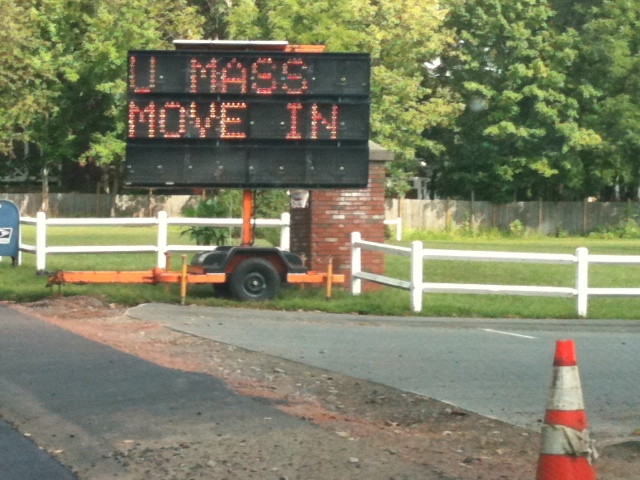
The "move-in" signs were all over town today. I didn't get a picture, but a large highway-style alert board between the apartment complexes on Meadow Street this evening, with lettering spelled out in yellow-orange light bulbs, directed new arrivals to turn right in order to find the campus dorms. [images now added]


 I did get a shot of the more modest Hampshire College welcome sign.


Here at Hampshire College (as at Amherst College), we have a new President. However, over in my building, we also have new signs and a new name. I am based in the (former) School of Social Science. It's a quasi-arbitrary thing, because that's where the position happened to be created way back when. I could as easily be based in Humanities and Arts & Cultural Studies, which also has a history line. Although, as an undergraduate at the University of Wisconsin, I took my history classes in the Humanities Building, I have become accustomed to thinking of myself as based in a school of "social science," to the extent that we attempt to pursue the investigation of culture systematically, and to generalize about historical patterns as well as explore specific cases.

That said, for most of us, the term, "social science" was not terribly congenial.  For me, it was not attractive, but no big deal. I used to joke that I was not a social scientist, but I played one when on the job. For other colleagues who were trained in that actual milieu rather than the humanities or humanistic social sciences, it was deadly serious. They resented the term, which was redolent of the 1950s, "positivism," American imperialism and ethnocentrism, and the military-industrial complex (did I leave anything out?). It smelled of "rats and stats."

I had one reason for objecting, if not to the School name, then at least to its representation: in course numbers, email addresses, campus and external envelope mail codes, and casual conversation, it was always abbreviated to "SS." Now, I did not particularly like having a Nazi acronym attached to my identity to begin with. But particularly when corresponding with German or other European colleagues, it was an embarrassment. In Germany, most public use of former Nazi acronyms—e.g SS, SA (Storm Troopers), NS (National Socialist), etc. etc.—is banned. You cannot even use those abbreviations on license plates, given their abhorrent historical associations. It would be the equivalent of "KKK" here. I occasionally called attention to this issue, but no one cared. (So much for cultural sensitivity and "multiple cultural perspectives.")

At any rate, we all agreed that the old name was neither very imaginative nor very descriptive of what we do, so last year, we again set about discussing alternatives. I'll spare you all the details, but suffice it to say it was an instructive conversation. It was quite interesting to see what terms colleagues cottoned to, rejected, or regarded with indifference. Many rejected the notion of "science," as such, while a few defended it, but that's amatter for another conversation. The debate at times seemed to have as much to do with the quest for a good acronym as a good name, as such. (At one point, in a moment of mild frustration, I suggested: Society, History, Information, and Theory).

At any rate, in the end we settled for Critical Social Inquiry. That gives you: CSI. Get it? Tee hee hee. People were really quite proud of this choice, in large part because of its presumed cleverness. A student intern even generated some signs and posters with a motif copied from crime-scene police tape. Admittedly, it may not help to distinguish us from Cognitive Science (abbreviated CS) when it comes to course listings and mail codes. Acronym fail. And of course, the "cleverness" of the joke may be lost on people five or ten years from now. I'm just glad we weren't doing this when "The Man From U.N.C.L.E." was on the air.

The new name was introduced with festive flair at the end of the spring term. i can even literally claim that I was there, did that, and "got the t-shirt."


Bottom line: Old wine in new bottles, but more honesty in advertising.

Toward the end of the summer, new signs went up, which was a double good: they concretized the change, but in many cases, they also showed up where there had been little, unclear, or no formal "signage" before. At the least, they have made the building easier to navigate and moreover helped to connect these spaces with one another and the rest of the campus through a common aesthetic, using the (relatively new) design standard.


A pity they couldn't do something about that ghastly "mural." (Good intentions do not equate to good art.)


On the other hand, we did get new restroom signs, helping to end the confusion caused by unclear or temporary ones.


Every thing in its place.


[updates: added images and documents]

Updates: press coverage

• Scott Merzbach, "UMass students asked to be good neighbors," Hampshire Gazette, 3 Sept.

Tuesday, August 9, 2011

Backup and Back to Blogging

My employer-owned laptop was damaged right at the start of my European trip this summer, evidently while it went through security at nearby Bradley Airport. I finally got it fully diagnosed and sent off for repairs. Apple received it on Friday and had it back here by today (Monday). Only problem: for some inexplicable reason, they erased the hard drive, even though (1) it was not part of the repair order, and (2) they had an administrator password and thus had access to all programs and functions.

What makes this so bizarre is that this is the second time this has happened to me. The first time, 5 or 6 years ago, they wiped the drive even though the only repair order was for a fan replacement.

This is starting to seem like a recurrent bad dream.

At any rate, thanks to a large external hard drive and reasonably good backup habits, I'm back in business.  As a helpful reminder, some of the clever and kindly folks at Reddit designated March 31 as "World Backup Day," with the slogan, "Don't be an April Fool."  Good advice.

Anyway: after backup (and restoration), back to blogging.

Monday, July 25, 2011

July Anniversaries: Six Months Since the Death of Peace Corps Founding Director Sargent Shriver

I had almost forgotten:  July 18 marked six months since the death of Sargent Shriver (1915-2011), founding Director of the Peace Corps, one of the most admirable legacies of the Kennedy administration, and one of the institutions that invariably presents a positive face of the United States to the rest of the world. The Peace Corps, which, coincidentally, celebrates its fiftieth anniversary this year, has sent over 200,000 volunteers to 139 countries.


I became aware of the date because I was in Washington, DC, for a conference and happened to stroll past the Peace Corps headquarters on my way to a bookstore.

"We must seek, above all, a world of peace,a world in which people dwell together in mutual respect and work together in mutual regard."
John F. Kennedy
"The Peace Corps stands for some, if not all, of the best virtues in this society. It stands for everything that America has ever stood for. It stands for everything we believe in and hope to achieve in the world."
Sargent Shriver
That same morning I noted and was at first surprised at the sight of television trucks and a host of reporters encamped on a sidewalk up the street, apparently awaiting important news or important people, or both. I later realized that, because the building in question was Upshaw Place—the National Football League Players Association union headquarters—the throng was waiting for news of the football lockout (breaking news now suggests that it is about to end).


In retrospect, the attention devoted to the lockout was hardly surprising. Fans wonder whether the season will take place. And there is a lot of money riding on the outcome.

• For the 2011 NFL season, the owners are guaranteed $ 4.5 billion in television revenues, and the players stand to earn $ 4.4 billion in salary and benefits.
• By contrast, in Fiscal Year 2011, the Peace Corps had a budget of $ 400 million.

Of course, the Peace Corps is neither big business nor big news: it has become an accepted part of our daily national life, going about its business without fanfare, crisis, or scandal, accomplishing much with little. Maybe that's the best kind of legacy to leave.

Saturday, July 23, 2011

To Protect—and Serve!

On Friday afternoon, I spent several very pleasant hours at the annual Amherst Town Employees' Annual Picnic, held at Cherry Hill Golf Course.


It's a chance for dedicated servants of the community to socialize and relax. Several of us elected officials attended, as well:  Select Board Chair Stephanie O'Keeffe and member Diana Stein and I were all there (never fear: although three members constitute a quorum, this was not a violation of the Open Meeting Law, which, although now in new and stricter form, does not pertain to social or chance gatherings where business is not deliberated).

It was nice to see such a good turnout on such a hot day (temperatures hit at least 98 degrees while I was there). It's a reflection of our democratic sensibilities that some of the town's leading officials do a stint preparing and serving the food (actually, much like the holiday luncheon at Hampshire College, where the President, Dean of Faculty, and other administrators dish out the meals).


Here, Police Chief Scott Livingstone (center) and Fire Chief Tim Nelson (right) toil at the grill.

Tuesday, April 12, 2011

The Civil War, Massachusetts, New York, and "Ancient Hatreds"

We are about to be inundated with coverage of our Civil War, which took up a mere four years in the history of a country then not even a century old. As recently noted, the origins and consequences of that war still divide us. And yet, there is hope for change.

By contrast, as journalists are constantly reminding us, the world is filled with and vexed by "ancient hatreds" that cannot be so easily cured:

Sunday, April 3, 2011

Hey, Mom! Hampshire College is Totally Unique! In fact: more unique than the 9 other "most unique" colleges in the US!

I was of course delighted to see that  Best Colleges Online ranked Hampshire College the #1 entry among "10 U.S. Colleges That Are Totally Unique":
The search for the perfect college can be overwhelming, but also a lot of fun. Finding schools that mesh with your personality, study habits, educational preparation, and expectations for adventure is satisfying in a holistic sort of way. These schools take that philosophy to the next level. From colleges that cater to students in a particular field like engineering to universities that promote personal enlightenment as much as academics, these are some of the most unique colleges in the U.S.

Hampshire College: Located in Amherst, MA, Hampshire College allows its 1500 students to design their own curriculum. Favoring customized programs instead of "off-the-shelf" majors, Hampshire organizes students into three levels of study rather than categorizing students as freshmen, sophomores, juniors or seniors. Division I introduces students to basic principles and ideas in highly specialized classes, allowing them to experiment before settling into a concentration in Division II. Division III challenges students to complete an individual project and even teach and mentor other students while taking graduate-level courses.
A bit of hyperbole or missed nuance here and there, but basically a sound, accurate description. Fine with me.

However, some readers took umbrage at the piece on the level of language usage rather than content, as such.


Interesting, where the lines diverge.  What bothered me was not "totally unique," and instead: "most unique." The objection is the same, but the aesthetic or vernacular is different.  I myself was willing to give "totally unique" a pass, on the grounds that this was a popular site using a colloquialism: That's, like, the way we talk nowadays.  And who knows? here in New England, we might even—IMHO—be "wicked unique." I could live with that, too. In other words, "totally" here serves as a form of emphasis, rather than as an adverb to be taken in the literal sense.

The underlying issue, of course, is that some regard any modification of "unique" as anathema on the grounds that either something is unique or it is not.  Merriam-Webster's guide to usage predictably and provocatively accepts both the absolute and modified forms as historically justified as well as commonplace. I can understand that on one level. However, it's a bit slippery for my taste, given that "unique" has a clear origin and meaning—according to the Oxford Etymological Dictionary: "sole, alone of its kind." Merriam-Webster's examples (above and beyond the fact that a published author's [mis]use of a term does not necessarily justify it on any other grounds) are not totally compelling. More to the point, perhaps, we have other words that serve just as well for the comparative but not for the absolute. Why not just substitute "distinctive" or a similar traditional modifiable term for the absolute case? Personally, I suspect (though cannot prove) that a lot of modern language slippage is due to a desire for informality and convenience: although both "unique" and "distinctive" are Latinate terms, the former is more familiar and easier to pronounce (in the sense of: speak; fewer syllables, simpler use of the mouth and facial muscles).

None of this is anything to fight and die for, but when we have one word that is reasonably circumscribed in meaning, and a plethora of others that can convey the alternative sense, why do we feel so compelled to blur the distinctions?

Anyway, come to Hampshire, and we'll teach you how to write as well as think.

April Fools Us (but spring is nonetheless here)

I was excited by the arrival of spring weather and sentiments even before the formal onset of the season. Indeed, in the first week or March, it seemed that spring was, de facto, if not de jure, here.

The first harbinger was the arrival of the eagerly awaited garden catalogue from Andrew's Greenhouse, which arrived at the start of March.


It was followed, in short order, by the appearance of daffodils and crocuses.

7 March
17 March
I hoped too soon, of course, for April again proved to be the cruelest month (or at least, to play the cruelest meteorological jokes on us.

1 April

1 April

1 April
Of course, this will no doubt increase our seasonal and chronic misery by feeding the fantasies of climate-change-denying loons, who are unable to distinguish between weather and climate. On the bright side: they are wrong. And: people on all sides of the climate debate could welcome the return of warm and pleasant weather.

What a difference a day makes.  By Saturday, the snow had disappeared, the sun was shining, and the temperature rose above 50 degrees F, the perfect circumstances under which to launch the "Poems Around Town" program of the Emily Dickinson Big Read 2011.

Sunday, March 27, 2011

What's In a Name? Mobsters and Loggers

What's in a name? Earlier this year, I wrote about surnames in both the United States and Central Europe.  i mentioned in passing the distinction between so-called "natural" and "artificial" names. The former are based on personal attributes of the first bearer:  e.g. physical traits, character, occupation, and so forth. Nicknames are not quite the same as natural names, but they, too, often derive from the habits or appearance of the person in question.

The American organized crime world has long been known for colorful nicknames, and so, when there was a major wave of arrests in New York January, Joe Coscarelli of the Village Voice, quite understandably, decided to compile a list of the top 20:
20. VINCENT AULISI, also known as "The Vet"
19. GIOVANNI VELLA, also known as "John Vella," "Mousey" and "Little John"
18. STEPHEN DEPIRO, also known as "Beach"
17. ANTHONY CAVEZZA, also known as "Tony Bagels"
16. JOHN BRANCACCIO, also known as"Johnny Bandana"
15. ANTHINO RUSSO, also known as "Hootie"
14. FRANK BELLANTONI, also known as "Meatball"
13. CHRISTOPHER REYNOLDS, also known as "Burger"
12. VINCENZO FROGIERO, also known as "Vinny Carwash"
11. JOSEPH CARNA, also known as "Junior Lollipops"
10. DENNIS DELUCIA, also known as "Fat Dennis," "Little Dennis" and "the Beard"
9. LUIGI MANOCCHIO, also known as "Baby Shacks," "The Old Man," and "the Professor"
8. ANTHONY DURSO, also known as "Baby Fat Larry" and "BFL"
7. GIUSEPPE DESTEFANO, also known as "Pooch"
6. JOHN AZZARELLI, also known as "Johnny Cash"
5. ANDREW RUSSO, also known as "Mush"
4. VINCENT FEBBRARO, also known as "Jimmy Gooch"
3. BENJAMIN CASTELLAZZO, also known as "Benji," "The Claw" and "the Fang"
2. ANTHONY LICATA, also known as "Cheeks," "Anthony Firehawk," "Anthony Nighthawk," "Nighthawk" and "Firehawk"
1. JOHN HARTMANN, also known as "Lumpy," "Fatty" and "Fats"
Not bad, I suppose, though I think only a few really rise to the level of such past classics as "Johnny the Nose" and "Miserable," or "Big Tuna," "Willie Potatoes, "Cockeyed Louis," and "Three Finger Brown."   (1, 2)

Anyway, all this reading about names got me thinking. And then there is serendipity. By purest chance, I got involved in a Twitter conversation with a fellow New Englander about slang. A question arose as to the names for various cast-iron skillets. It suddenly occurred to me that I had a perfect reference work at hand: L.G. Sorden's Lumberjack Lingo (1969). It proved to be doubly appropriate and useful, because it combines the wisdom of my native Midwest and my adopted New England.  My copy of the first edition of this Wisconsin book not only bears the autographs of author and (anonymous) illustrator, but also contains handwritten annotations by an old (now-deceased) Massachusetts hilltown native, who checked off terms he had encountered in his long career.  Problem solved.

Of course, once you've picked up a fascinating book such as this in search of a specific piece of information, you can't just put it down. Rather, you are compelled to keep leafing through it.

The final topic in the book is  "Nicknames of Lumberjacks." As the author explains:
  A camp 'ink slinger' was having trouble keeping the camp records straight because there were three men working at the same camp with the same name. None had a middle name; the men did not start work on the same day, but as each one arrived the problem grew.
  After studying each man's appearance and checking starting dates, the ink slinger solved his problems simply by entering the following names in his book:
1. Dirty Joe Michaud
2. Bald Headed Joe Michaud
3. Joe Come-Lately Michaud
The author goes on to explain that most lumberjacks were known by nicknames. Some, as above, had them assigned. Others chose them in order to shed a past identity. Most, however, received them from their fellow workers. He lists some names of actual lumberjacks from the heyday of the trade in Wisconsin and Michigan. The best of these, IMHO, are quite worthy to stand beside those of any distinguished crime figure.  See what you think:
1. Angus the Pope
2. Battle Axe Nelson
3. Bill the Dangler
4. Blueberry Bob
5. Bug House Lynch
6. Cruel Face
7. Dick the Dancer
8. Double Breasted Corrigan
9. Drop Cake Morley
10. Gin Pole Smith
11. One Round Hogan
12. Pancake Billie
13. Panicky Pete
14. Protestant Jack
15. Prune Juice Doyle
16. Smutty John
17. Stub Nelson
18. The Hemlock Bull
19. Three Fingered Ole
20. Whispering Bill

Wednesday, February 2, 2011

Whiz Kids (Pissed Off)

Colleagues occasionally describe petty academic rivalries as a pissing contest.  Now you know why:
(01-27) 05:04 PST San Fernando, Calif. (AP) --
A California university professor has been charged with peeing on a colleague's campus office door.
Prosecutors charged 43-year-old Tihomir Petrov, a math professor at California State University, Northridge, with two misdemeanor counts of urinating in a public place. Arraignment is scheduled Thursday in Los Angeles County Superior Court in San Fernando.
Investigators say a dispute between Petrov and another math professor was the motive.
The Los Angeles Times says Petrov was captured on videotape urinating on the door of another professor's office on the San Fernando Valley campus. School officials had rigged the camera after discovering puddles of what they thought was urine at the professor's door.


Welcome to my world. Some days, it's not pretty.

(HT: YM)

Friday, January 21, 2011

Surname Update: geographical distribution of names in the United States

Serendipity again.

Not what's in a name? but: where's that name?

As a nice follow-up to my recent post on Jewish surnames, I can point readers to James Cheshire's post (his blog invariably offers intriguing material) on National Geographic's interactive map of US surnames.

Friday, December 24, 2010

Museums and Archaeology: From Pillage to Partnership

  • An intriguing idea: given that many museums--notably and recently, the Getty, for example--have been caught dealing in stolen goods or artifacts of dubious provenance, the author suggests that museums once again undertake their own archaeological expeditions in search of items for collections. In the bad old days, of course, it was done through sheer hubris, colonialism, and pillage. Nowadays, with laws protecting cultural patrimony and regulating exports in place, such undertakings would occur in partnership with local authorities. In a truly collaborative relationship, both parties would benefit.
Enhanced by Zemanta

Sunday, December 19, 2010

ah, paperwork

Slogging through those papers.

Saturday, December 18, 2010

Tevis Kimball new acting director of Jones Library

One of the open questions at the retirement celebration in honor of outgoing Jones Library Director Bonnie Isman was that of succession. Although the trustees had agreed to seek an interim director rather than attempt to fill the position permanently on short notice, that plan ran into a roadblock when two of the candidates dropped out, apparently because they concluded it was too difficult to relocate for a temporary position.

Writing in the Republican, Diane Lederman reports on the solution:
AMHERST - The Jones Library Board of Trustees has appointed Tevis Kimball, curator of special collections at the library, as acting director until a permanent director is found.

Long-time director Library Director Bonnie J. Isman left Dec. 10 after 30 years. The trustees had planned to interview two candidates for the interim position but both withdrew their names. They had hoped to have hired an interim director before Isman departed.

Kimball will spend about one fifth of her time in special collections and the remainder as director, said library trustee Christopher J. Hoffmann. (read the rest)
Larry Kelley actually ran the story on his blog four days ago, when the announcement came out. His piece moreover includes the text of a statement by Kimball.

I've worked with Tevis on historic preservation issues:  a joint project of the Historical Commission and Library is an ongoing document conservation and digitization program, supported with Community Preservation Act funds. She has also been a great help to my classes as I introduce students to historic preservation, local history, and archival research.

Tevis Kimball showing a 19th-century newspaper to my historic preservation class
 An interview that ran in the Amherst Bulletin in 2007 provides an overview of Tevis's interests and the work of Special Collections.


Recent reports

Larry Kelley, "Jones Library has a new (acting) director," Only in the Republic of Amherst, 14 December
Diane Lederman, "Tevis Kimball named acting director of Jones Library in Amherst," Springfield Republican, 18 December
Enhanced by Zemanta