Showing posts with label West Cemetery. Show all posts

Monday, July 27, 2015

18 July 1863: Union Attack on Fort Wagner by Massachusetts 54th Infantry

18 July marks the anniversary of the assault on Fort Wagner by African-American troops of the 54th Massachusetts Volunteer Infantry, made famous to the present generation by the film, "Glory."

This year, instead of posting about it on that day, I earlier wrote about the changing reactions to the "Shaw Memorial" in Boston, which commemorates Col. Robert Gould Shaw and the troops that he commanded.


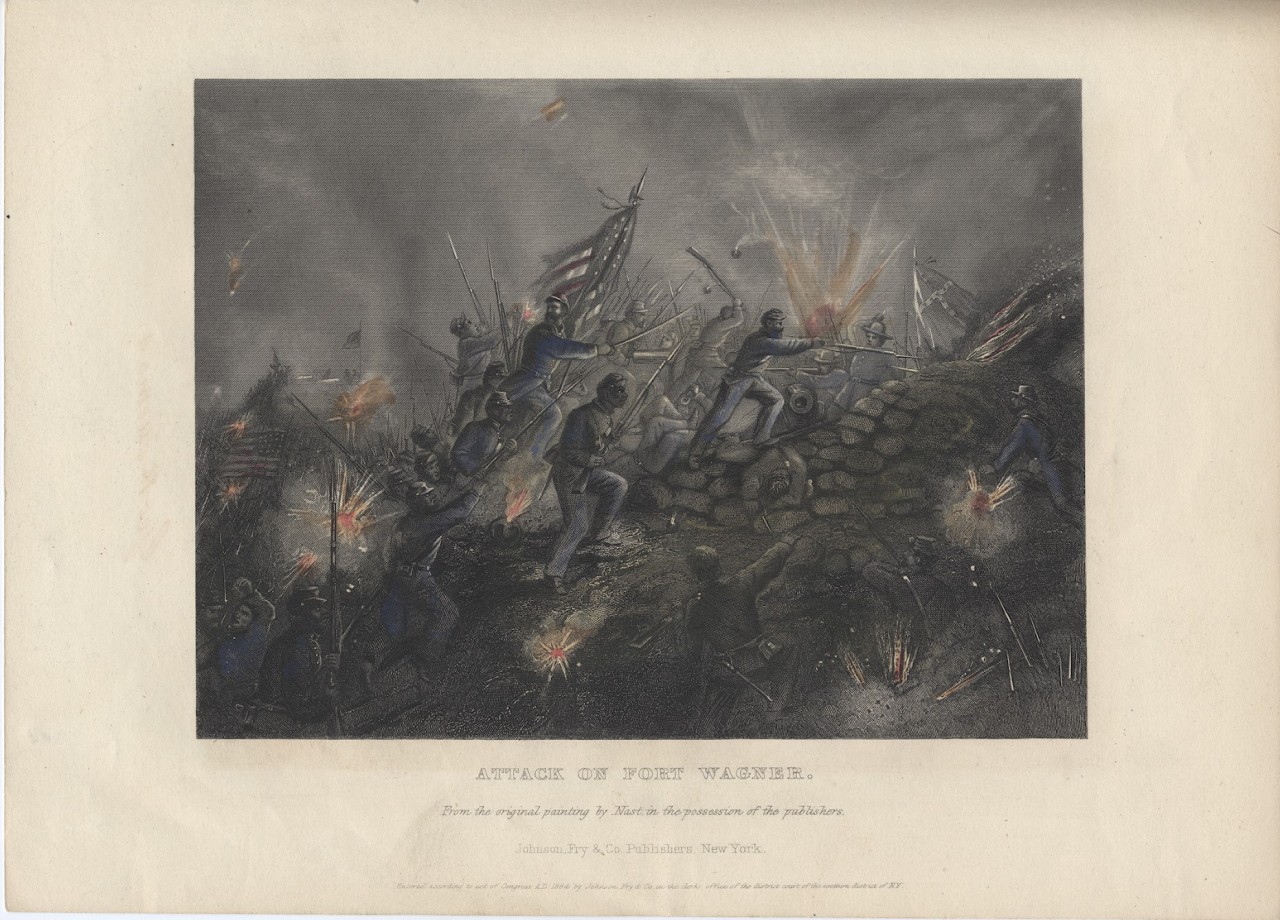
For today, several engraved representations of the battle over on the tumblr:


(details here


(details here)

Note the difference: Although both depict the assault, including a heroic bearer of the Union flag (the first bearer was hit, and then Sgt. William Harvey Carney seized it, the first Black to be awarded the Congressional Medal of Honor), the first was produced by a British reporter "embedded" with the Confederate troops, and thus views the attack from the inside. The second, based on a painting by Thomas Nast, presents the (to us) more familiar view of the assault seen from the perspective of the Union attackers.

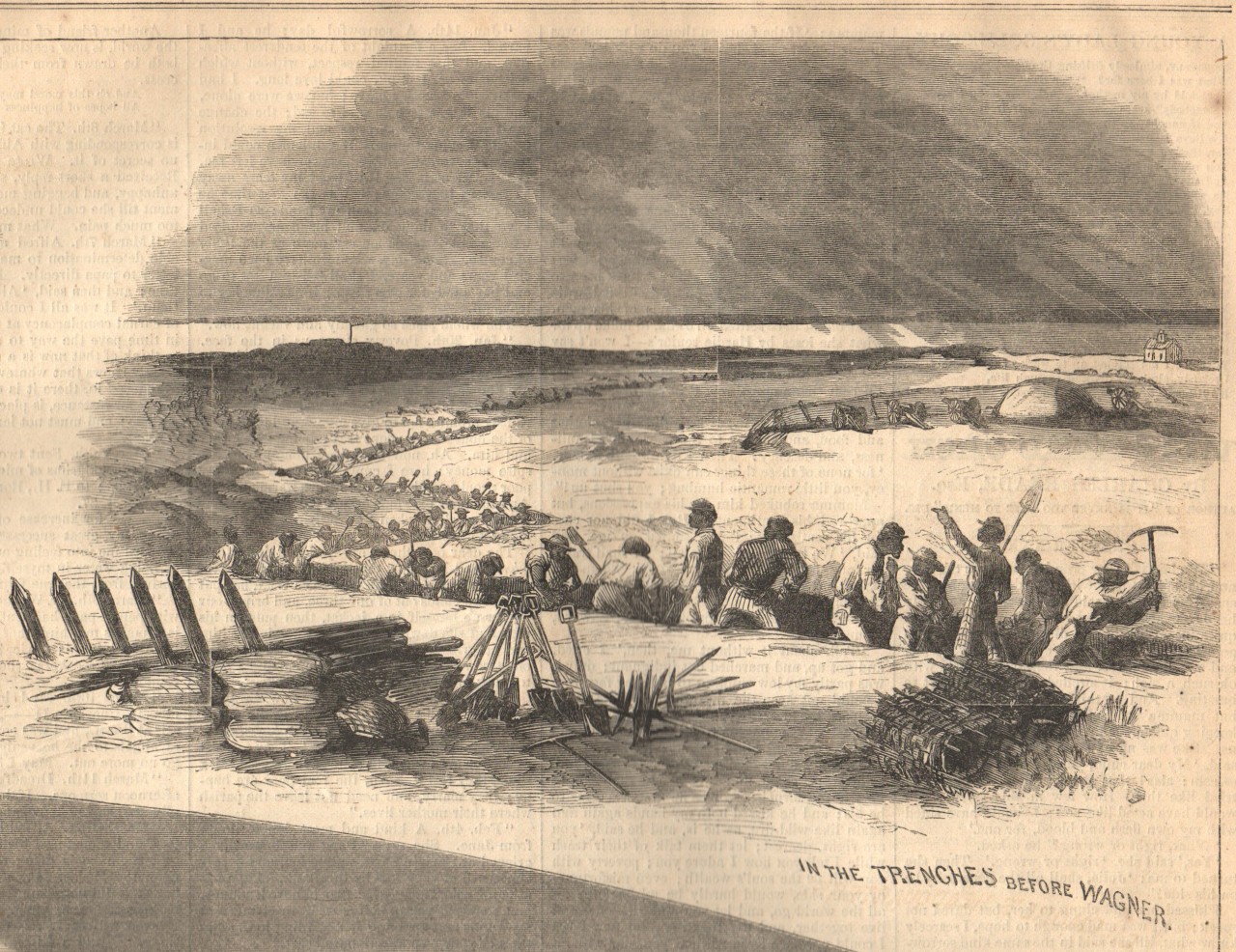
This piece, from an August 1863 issue of Harper's Weekly, depicts African-American troops digging fortifications as the siege of Fort Wagner continued


 (details here)

See all posts relating to the Mass 54th regiment (including the soldiers who came from Amherst).

Wednesday, February 18, 2015

Second Annual Amherst Black History Month Celebration, New Select Board Proclamation

For the second year in a row, the Town of Amherst, responding to the initiative of residents, has celebrated Black History Month with a ceremony in front of Town Hall.

Black History Month word cloud logo on Town website, 
designed by our skilled GIS guy and all-'round IT expert Mike Olkin (@MikeOlkin)


Over three dozen participants--an impressive figure given that the thermometer stood at a bitter 8 degrees Fahrenheit (-13 C) with a wind chill of around -1--braved the cold to signal their commitment to Black history and human rights.


Community activist and former Select Board member Judy Brooks in both years played a crucial role in making this event happen. My fellow Select Board member Alisa Brewer (@avbrewer) took the initiative in coordinating the Town involvement and working out the details of our 2015 ceremony.

This year, likewise in response to requests from the community, the Town for the first time issued an official proclamation marking the occasion and calling upon all residents to join in celebration. It made perfect sense: after all, we annually issue a proclamation for Puerto Rican Day and Tibet Day, and just two weeks ago, we marked the first Irish Day. It was but logical that we formally acknowledge an event that has been celebrated around the country for decades.


From Negro History Week to Black History Month

Many of us are familiar in general terms with "Black History Month," but not with its origins. In 1926, historian and journalist Carter G. Woodson initiated Negro History Week as a means of calling attention to the struggles and success of African Americans. He chose the second week of February because it included the birthdays of both Abraham Lincoln and Frederick Douglass fell. Within a few years, most states acknowledged the event. In 1969, in the context of the political upheavals of the Civil Rights and peace movements, members of the Black United Students at Kent State University urged the expansion of the celebration to a full month, which took place the following year, (only months before the University gained notoriety as the site of the notorious killing of antiwar protesters). In 1976, President Gerald Ford lent the authority of the federal government to the new month-long celebration, which entered into public law with the Congressional Resolution of February 11, 1986. Since 1978, the United States Postal Service has issued commemorative stamps for Black History Month. Although referred to as "National African American History Month" in more recent US proclamations, "Black History Month" remains the more common popular term.


Amherst Black History Month Proclamation, 2015

Whereas, since the Bicentennial year of 1976, Americans of all walks of life have come together during the month of February “to honor the too-often neglected accomplishments of black Americans in every area of endeavor throughout our history,”

Whereas these accomplishments are the more remarkable for having been won at the cost of great struggle and sacrifice by men and women who came to these shores in chains, and by their descendants,

Whereas the authors of these accomplishments in Massachusetts history include:
  • Phillis Wheatley, the first African American to publish a book of poetry in America; 
  • Crispus Attucks, the first causality of the American Revolution; 
  • Edward Jones of Amherst College, the second African American to earn a college degree; 
  • Edmonia Lewis, the first professional African American sculptor, who learned her craft in Boston; 
  • the members of the 54th Massachusetts Volunteer Infantry, the first and most famous unit of African American Union soldiers raised in the Civil War 
  • Jan Matzeliger, inventor who revolutionized the shoe manufacturing industry; 
  • W. E. B Du Bois, pioneering scholar and civil rights activist; 
  • Edward Brooke, the first African American senator elected by popular vote; 
  • Deval Patrick, the second elected African American governor in the nation 
Whereas captive Africans and free people of color were already part of the Amherst story in the Colonial era,

Whereas the African American residents of Amherst have fought for our collective defense and freedom from the Revolution and Civil War to the present,

Whereas the African American community—some of whose distinguished figures are depicted on the History Mural in West Cemetery—continues to contribute to the rich diversity and general welfare of both the Town of Amherst and the Commonwealth,

Whereas, to its shame, Massachusetts participated in the slave trade since 1638, but to its honor, in 1783 became the first state in the new nation to abolish slavery as “inconsistent with our own conduct and Constitution," thereby demonstrating our determination to live up to our historical ideals as we strive to build a better common future,

Whereas, as President Barack Obama has proclaimed, “Every American can draw strength from the story of hard-won progress, which not only defines the African-American experience, but also lies at the heart of our Nation as a whole,”

Now, therefore, we the Select Board of the Town of Amherst, do hereby proclaim February 2015 as Black History Month, and urge all residents to mark this occasion, and to participate fittingly in its observance, beginning with a flag-raising ceremony to be held in front of Town Hall on February 14.

Voted this 10th day of February, 2015

Amherst Select Board

Aaron Hayden, Chair
Andy Steinberg
James Wald
Alisa Brewer
Constance Kruger 


Let our rejoicing rise / High as the listening skies

In 2015 as in 2014, a central feature was the raising of the African American flag, and the singing of "Life Every Voice and Sing," often referred to as the "Black National Anthem."


A member of the Massachusetts 54th reeenactors from the Springfield area
salutes the flag. What further commentary could be needed?

We were sorry that the press did not show up to cover the event, but all the more grateful that reporter Scott Merzbach (@scottmerzbach) managed to rush out an advance story on Black History Month in the Gazette, which probably did a great deal to boost turnout. We hope that next year the Human Resources/Human Rights Department in Town Hall will take charge of the event to emphasize its status as a Town-sponsored and regular observance.

Note: because I was participating in the ceremony, I could not take as many photos as I wished, but Larry Kelley offers a selection on his blog. Unfortunately, his post generated some ugly comments. I am appalled at (by not surprised by) the venom and racism. It is a real shame: he tried to report objectively on a town event, and the talkbacks are dominated by hate speech (and rebuttals).

* * *


Amherst Proclamation on Black History Month: the names

I was tasked with crafting the document for the Town. One course of action that was suggested--and it would have been the easiest--would have been simply to duplicate either the current presidential or recent Massachusetts gubernatorial proclamations. However, the former dealt with both more general and more contemporary matters, and the latter seemed, frankly, rather perfunctory as regards Massachusetts history, as well as lacking the eloquence of the former.
 
Some topics or individuals appear virtually de rigueur, but at the same time, one hopes not simply to reinforce the commonplace. For example, it seemed obligatory to mention the soldiers of the famed Massachusetts 54th Volunteer Infantry--but, although they are among my personal historical favorites, the single-minded focus on this one regiment (an emphasis reinforced by the popularity of the Hollywood portrayal in "Glory") can tend to shortchange the Black soldiers who fought in other units: Of the 21 Amherst African Americans who bore arms for the Union, only 7 served in the 54th. Only 5 of the 21 identified by name are buried in West Cemetery, and only one of those is from the 54th. Our text therefore notes that the 54th was the first and most famous of these heroic units.

The 2014 Massachusetts proclamation listed only male politicians and military men, so I made sure to include figures from other fields--and women.

For example, many believe that the first Black US college graduate was from Oberlin--presumably because of the school's association with abolitionism--but the earliest Black college graduates were in fact all from New England: the first from Middlebury, in 1823; and the second, Edward Jones, from Amherst (1826). It seemed important to call attention to our local history, and to remind the public that innovation and inclusiveness at Amherst College have a long tradition. The inclusion of Jan Matzeliger, the self-taught inventor who solved the last and most difficult problem in the mechanization of the shoe trade, calls attention both to Black immigrants (he was from Dutch Guiana) and to the neglected but important role of African Americans in technology and industry. As Mass Moments explains, his invention made it "possible for working people to afford decent shoes" and "Today, all shoes manufactured by machine — more than 99% of the shoes in the world — use machines built on Matzeliger's model."

In the case of women in African American history, we often think of the political activists, such as famed abolitionist Sojourner Truth, who lived in nearby Florence. I chose to focus on the contributions to high culture: the eighteenth-century poet Phillis Wheatley is of course known to scholars of American history and literature but is not exactly a household name. Even less well known is Edmonia Lewis, the first professional African American sculptor. It was in Boston in the 1860s that she studied art and exhibited two sculptures of heroes of the Massachusetts 54th. Proceeds from sales of copies of her bust of Col. Shaw both supported Black soldiers and funded her relocation to Rome, where she won international acclaim.

Any short list is necessarily incomplete and subjective, but future proclamations can include further individuals and groups. One hopes that the proclamations and lists will provide an opportunity to educate our community about the African American contributions to our collective society and heritage. (See also the resources for further reading at the bottom of this page.)


A footnote:

After the ceremony, retired Amherst College physics professor and amateur historian Bob Romer buttonholed me to "quibble" with one aspect of the proclamation: The "abolition" of slavery, he said, hadn't actually eliminated the practice in Massachusetts. His research taught him that here, as elsewhere in New England, "slaves" continued to appear in lists of property and the like for some time afterward. That is true, but it's also irrelevant, and in two ways.

     First, although this fact may come as a revelation to some, it is not news to professional historians. As the Massachusetts Historical Society explains, "slavery did not disappear completely for some time. Slavery, often recast as indentured servitude . . . was not unheard of in Massachusetts through the end of the eighteenth century."

     Second, be that as it may, it in no wise diminishes the significance of the action, and to harp on it is therefore to misunderstand the nature of both historical action and contemporary commemoration.

The Massachusetts Constitution stated:
All men are born free and equal, and have certain natural, essential, and unalienable rights; among which may be reckoned the right of enjoying and defending their lives and liberties; that of acquiring, possessing, and protecting property; in fine, that of seeking and obtaining their safety and happiness.
Two legal cases in the 1780s used this text to argue that slavery was illegal in the Commonwealth, and the Chief Justice agreed, writing, "there can be no such thing as perpetual servitude of a rational Creature ..." 

The Massachusetts Historical Society concludes, "Together with the Mumbet decision, the Quock Walker trials effectively ended slavery as a legal practice in Massachusetts." It therefore calls the 1783 decision a "monumental ruling."

One could make a comparable point about the Emancipation Proclamation, whose anniversary we recently celebrated. It applied only to the territories of the Confederacy not yet under the control of the Union. Secretary of State William Seward observed with bitter but exquisite irony: "We show our sympathy with slavery by emancipating slaves where we cannot reach them and holding them in bondage where we can set them free." Nonetheless, as the National Archives says, "Although the Emancipation Proclamation did not immediately free a single slave, it captured the hearts and imagination of millions of African Americans, and fundamentally transformed the character of the war from a war for the Union into a war for freedom."

We can acknowledge the limitations of these two abolition measures and nonetheless hail them as landmarks.


Q.E.D.


Coming attractions:

Because I didn't manage to write at the time of last year's ceremony, I will now post some photos from that event.


Resources


The History of Black History Month

Historic Sites


Further reading on some of the figures and events mentioned in our proclamation:


Phillis Wheatley
Slavery and the Abolition of Slavery
Edward Jones
 54th Massachusetts Volunteers
Edmonia Lewis
 Jan Matzeliger
W. E. B. Du Bois
Edward Brooke


Saturday, August 18, 2012

History Channel Puts Western Massachusetts History on the Mobile App


A song of ascents:
I make fun of History Channel
For its Ancient Aliens crap,
But credit where credit is due:
I'm trying its History app.
As my followers on Twitter are aware, I have been known to poke gentle fun at the History Channel and its sibling H2 for their steady descent into banality or outright intellectual bankruptcy. Whereas they used to run real documentaries, nowadays there is hardly anything worth watching.

We all have our bugbears decide which burdens to assume for the sake of the common good. For me, it's about vigilance in the face of shows on Ancient Aliens and history—or shows that don't even pretend that they have to do with history: "Ice Road Truckers"? "Swamp People" "Shark Wranglers"? (wtf?)  For Gordon Belt, Director of Public Services for the Tennessee State Library & Archives, it's the never-ending battle against "History Buffs." We're all allies in this great war on behalf of civilization.

But one has to be fair. The Channel still does broadcast some history, and its website and Twitter feed likewise pay more attention to its supposed raison d'être. I was therefore pleased to see them announce their new "History Here" app for iPhone, described as "an interactive travel guide to thousands of historic locations across the United States."

So I decided to give it a try.

It's a fairly simple little thing, though serviceable enough in its way.

You get a Google road or satellite map with little pins that lead to descriptions of sites (with driving distance, contact information, and URLs; videos, in some cases).  One can search by location, view sites on both maps and lists, save "favorites," etc.

 Checking out those that appeared on the screen when I used my home location, I found:

Amherst
Northampton
Cummington
Springfield
Petersham
It's not always easy to tell why a given site was included or omitted.

In Amherst, of course, I expected to find the Dickinson Museum, as it has National Historic Landmark status and is our principal tourist attraction. I was pleasantly surprised to see a listing for the National Yiddish Book Center, on the campus of my own Hampshire College. But Amherst has, in addition to the 2 Dickinson houses, 5 other properties on the National Register of Historic Places, two of them open to the public: West Cemetery  (where Dickinson is buried, thus likewise one of our major tourist attractions—even a pilgrimage site), and the eighteenth-century Strong House, home of the Amherst Historical Society and Museum.

It's great that Northampton (or Florence, as the case may be) includes two sites associated with the Underground Railroad, but then one might assume it would also have included the David Ruggles Center for Early Florence History & Underground Railroad Studies. And any reason not to include Historic Northampton? Or perhaps the Sojourner Truth monument in Florence?

In the case of Springfield, the Connecticut Valley Historical Museum makes sense, not least because it is part of the larger, acclaimed five-museum Springfield Museums campus. But then why leave out the Springfield Armory National Historic Site

Looking to our west, it is eminently sensible to include Cummington's William Cullen Bryant Homestead but (unless I really missed something), Historic Deerfield, just down the road from Amherst, is absent. (To the east, Old Sturbridge Village made the cut). Delighted and relieved to find Arrowhead, home of Herman Melville—whose birthday and meeting with Hawthorne we marked this month—in Pittsfield, but then why not Hancock Shaker Village, located in the same town?

I was certainly glad to see the boyhood home of W.E.B. DuBois in Great Barrington, as well as Edith Wharton's The Mount in Lenox on the map. But then why not Chesterwood—home of Daniel Chester French, sculptor of the Lincoln Memorial and  Minuteman statues?

It seems that the National Park Service Heritage Travel Itinerary and National Register of Historic Places were the source for many of the listings, and that is as it should be. As the example of the Yiddish Book Center shows, there were obviously also other sources of information, and one hopes that the list will be broadened. The nice thing about apps versus books is that the latter can readily and continually grow in scope as well as robustness.


Summary: Given that the thing is two years old (the first incarnation for Windows, came out in 2010), one might expect more of it. Then again, given that the new app  is described as "free and ad-supported" (see also below), you get what you pay for. (The old one cost $ 2.99; this says something about our rising expectations of apps, among other things.)

In addition, there are sometimes practical limits to what sort of data one can conveniently collect and display in software designed for small handheld devices. I just took part in a workshop on digital mapping, so I am getting a better idea of what goes into the making of these things.

Balance sheet: It's simple and useful. I didn't find every historic site that I expected (to cover the entire country is after all quite ambitious), and I didn't find a great deal of technical sophistication or even information—but I also didn't find a single alien.

That's a start. Baby steps.


Update, 20 August 

History Here, a decent but no means distinguished app, just dropped another few notches in my estimation. When I first tried it out, the ads for some reason never appeared. Now, however, they're here. Annoying advertisements appeared at the bottom of the screen. One promoting an alleged iPad giveaway, was particularly annoying and intrusive flashing incessantly. As I said, you get what you pay for.

Friday, September 23, 2011

Honoring Amherst's African-American Civil War Soldiers: "Assault on Fort Wagner": "The Rush of the Garrison to the Parapet"

The following engraving (20 x 23.6 cm) appeared in The Illustrated London News of September 26, 1863:


The caption reads:  "The War in America: Assault on Fort Wagner, Charleston Harbour, on the Night of July 18—The Rush of the garrison to the Parapet. From a Sketch by Our Special Artist."

This was the dreadful assault made famous in our time by the 1989 film, "Glory." Although this engraving includes some iconic features in the evolving representation of the event such as the advance of the figure with the Union flag (cf., with variations, the lithographs by Currier and Ives [1863] or Kurz and Allison [1890]), it offers no indication that volunteers of the Mass. 54th—or, indeed, any African-American troops—took part.

The accompanying text on p. 317 (perhaps because written by reporters "embedded"—as we would nowadays say— on the Confederate side) speaks of the battle only in more general terms:

A Blockade-runner has brought us some sketches from our Special Artist in Charleston, two of which are engraved in the present Number. Respecting the Engraving on our first page--"The Assault on Fort Wagner on the night of July 18"—our Special Artist and Correspondent writes as follows:—"I returned from the south-west just in time to witness this most formidable of all attempts made by the enemy on the defences of Charleston. You are already doubtless aware that the Federals succeeded a fortnight since in effecting a lodgment of their forces on the islands forming the approaches to the city. A temporary success enabled them to throw up works in front of Fort Wagner, and to commence an advance on the last-named stronghold. In conjunction with their iron fleet, which took up an enfilading position seawards, they maintained a heavy fire of mortars.

Further reading on this site

Mass 54th
West Cemetery
African-American Amherst

Saturday, July 30, 2011

July Anniversaries: Second Union Assault on Fort Wagner, 18 July 1863

Most of us have seen the film, "Glory," depicting the heroic story of the African-American soldiers of the Massachusetts 54th Infantry in the American Civil War. It was on July 18 that the fateful nocturnal assault on Fort Wagner (Battery Wagner) outside Charleston took place.


Far fewer of us are aware that African-Americans from Amherst fought in the 54th and in the 5th Cavalry. For that matter, most of us know very little about the history of the Black community in this town. That has been changing for the better in recent years, and the Civil War anniversary promises to bring still further progress.

Most recently, a minor confusion about the honoring of our African-American Civil War graves in West Cemetery brought some salutary attention to the issue as well as the Town's larger plans for the historic site. A formal ceremony honoring these soldiers and their service will take place on September 18 (see the calendar, above).

Last week, it was my turn to make the opening remarks at the meeting of the Amherst Club. The custom has been to read a poem or recount a bit of the town's history. As I was asked to do the latter, I chose something not from the town, but from Massachusetts history with a connection to the town. After noting the role of Amherst's African-American soldiers, I read a letter from another member of the 54th, James Henry Gooding, of New Bedford. Writing from Morris Island, South Carolina, on 28 September 1863, he asked President Lincoln to redress an injustice and provide Black soldiers with the same pay as whites received (the policy was finally corrected in 1864).

It is a marvelously eloquent and revealing document. In this passage, he refers to the sacrifices of the unit in the battle for Fort Wagner:
Today, the Anglo Saxon Mother, Wife, or Sister, are not alone, in tears for departed Sons, Husbands, and Brothers. The patient Trusting Decendants of Africs Clime, have dyed the ground with blood, in defense of the Union, and Democracy. Men too your Excellency, who know in a measure, the cruelties of the Iron heel of oppression, which in years gone by, the very Power, their blood is now being spilled to maintain, ever ground them to the dust. But When the war trumpet sounded o'er the land, when men knew not the Friend from the Traitor, the Black man laid his life at the Altar of the Nation, -and he was refused. When the arms of the Union, were beaten, in the first year of the War, And the Executive called more food. for its ravaging maw, again the black man begged, the privelege of Aiding his Country in her need, to be again refused, And now, he is in the War: and how has he conducted himself? Let their dusky forms, rise up, out the mires of James Island, and give the answer. Let the rich mould around Wagners parapets be upturned, and there will be found an Eloquent answer. Obedient and patient, and Solid as a wall are they. all we lack, is a paler hue, and a better acquaintance with the Alphabet. Now Your Excellency, We have done a Soldiers Duty. Why cant we have a Soldiers pay?
(The full text is available here.)
The University of Massachusetts Press has published Gooding's collected letters in an edition by Virginia Adams as On the Altar of Freedom: A Black Soldier's Civil War Letters From the Front (1991). The New York Times named the volume a Notable Book of the Year.

Check these pages in the coming months for further stories on Amherst's African-American community and the Civil War.

Previous posts

• the 2009 anniversary post
African-American Amherst
• the Mass 54th


Focusing Attention on Amherst's African-American Civil War Heroes

Because I was away on our Prague program, I missed Memorial Day in Amherst and was unable to take part in the parade or other commemorations, as I did last year.

As chance would have it, the marking of veterans' graves has recently been associated with some controversy. Last year, the problem was an epidemic of thefts of bronze grave markers (there were relatively prompt arrests but there have been no convictions to date). This year, it was the accidental failure to place holiday flags on the graves of African-American Civil War veterans. Retired Amherst College scientist and amateur historian Bob Romer both discovered and rectified the omission. There was no deeper meaning to the error, but the embarrassing incident did highlight the real problem—lack of public knowledge—which Town bodies, such as the Planning Department and Historical Commission, as well as private individuals, such as Bob (whom I first got to know when we were both on the Historical Commission) have been trying to address.

Here's the story by Scott Merzbach from the Amherst Bulletin. Scott reports on the holiday mix-up and Bob's plans for a formal ceremony later this year. He goes on to discuss related issues, such as the restoration of our Civil War memorial tablets. Although I was away as Scott was working on the story, we connected via email just as I returned, and so I, along with Planning Director Jonathan Tucker, briefly explained the Historical Commission's plans for restoration of the the historic 1730 West Cemetery, including the African-American section. In essence, our tentative proposal entails a landscape restoration and improvement, with the addition of some subtle memorial features.
Friday, June 24, 2011
Professor spurs effort to honor black soldiers who fought slavery

While Robert Romer was taking a walk the day before Memorial Day, he noticed that small American flags had been placed next to gravestones in the West Cemetery in honor of those who had served their country.

Conspicuous by their absence, though, were flags at the gravestones marking the final resting places of four black men who were Union soldiers during the Civil War.

Romer deduced that it was likely an oversight, not a slight, and quickly purchased flags for them at Hastings. But the incident got him thinking about how the town can better recognize the contributions that Amherst's African-American community made toward ending slavery.

It's a topic that holds great interest for Romer, a retired Amherst College physics professor who wrote the book "Slavery in the Connecticut Valley of Massachusetts." Now he's working to organize a ceremony, coinciding with the sesquicentennial of the beginning of the Civil War, to honor the black residents of Amherst who served in either the 54th Massachusetts Infantry Regiment or the Massachusetts 5th Cavalry. More than 20 served; at least five lost their lives. Nearly 200,000 black soldiers and sailors participated in the Union's efforts overall.

"They were a large fraction of people who fought for the Union and this is a matter of how black men were willing to die for freedom," Romer said. "I think more people ought to be aware of it." (read the rest)
The newspaper story correctly notes that only four of our African-American Civil War veterans have marked graves. There is in addition a marker reading, "In Memoriam To Five Unknown Amherst Civil War Veterans."


One of the graves identified by name is that of Charles Finnemore, whose headstone, the report notes in passing, "was split in two, only recently being repaired." Finnemore, a Private in Company C of the Mass 54th, was wounded at the Battle of Olustee (or: Ocean Pond), the largest engagement fought in Florida (1, 2, 3).

When I made one of my periodic personal "inspections" of the Cemetery earlier this month—about two weeks after the news story appeared, and over 5 weeks after Memorial Day—I was pleased to see the flags still in place, here at Finnemore's grave.


The casual visitor will not be aware of how much work has already taken place in the cemetery, or what effort it took to get this single monument into this shape. Below is how it looked when I visited the section in April 2009, as we prepared to request funds for the aforementioned landscape improvements. (The Town had already authorized funding for headstone repairs, but the conservators had not yet reached this point on their priority list.)


Here, Civil War re-enactor Michael Coblyn stands next to the marker commemorating the unknown soldiers in the African-American section during a performance of "Conversations With the Past" for the Town's 250th anniversary celebrations, in May, 2009. The grave is honored with both bronze GAR markers and American flags, as is the custom in the spring, indicating that the absence of flags this year was indeed purely an oversight.


The Town secured the services of Monument Conservation Collaborative (MMC) of Norfolk, CT, which, using $ 145,000 in Community Preservation Act funds, was able to repair 249 of the most threatened stones in three sections of the oldest part of the Cemetery from 2008 through 2009. Cemetery conservation is a science, and one cannot casually clean or reconstruct historic funerary monuments. (Indeed, part of the work often consists in undoing the effects of bad earlier repairs.) Rather, one needs to take into account the material and integrity of the artifact, and the biological, chemical, and climatological threats to preservation. As MMC explains, contemporary practice has been "moving toward a 'conserve as found' approach," which seeks to to halt and mitigate any damage, but in the least intrusive way possible and without pretending to reverse all the effects of time. Accordingly, the Town's bid specifications were extremely detailed and of course included the requirement for appropriate documentation as well as treatment.

The case of Finnemore's gravestone nicely illustrates the process. The monument consists of a marble headstone (4 x 18 x 29 inches) and base. The conservators' first step had been to undertake a survey of the gravestones in the Cemetery, marking each on a grid map, assessing its current condition, and developing a conservation strategy.

Finnemore's grave is found at location Z.23, and assigned the index number 5.35 (representing Section 5, job number 35).


the blue arrow marks Finnemore's grave (in red)
the Finnemore gravesite seen from the air
The assessment, by MMC President Irving Slavid and Conservator and Partner Martin Johnson, classified the existing condition as category "2": "partial" damage (25-50%) in the form of separation from base, with breakage and some losses. The inscription was classified as "clear but worn." The conservation strategy consisted in reassembling and resetting the stone, and filling any gaps.

The inspection took place on July 7, 2008. Treatment, which comprised eight steps, began a year later, and took place over a full month, from June 2 through July 1, 2009.
1)  Conservators first removed old mortar and other debris from the setting surfaces of the headstone and base by hand and then treated them with "D/2 Biological Solution," a water-based biocidal cleaner intended to remove moss, algae, fungi, lichen, and other living organisms, and to prevent new growth. The stone is next "scrubbed with nylon brushes and water," and then "rinsed fully with water."
2) The setting surfaces are primed with Acryl 60 (diluted to 1:3), and "a relatively weak cement/lime-based grout (3/2/8) with fine aggregates (000)" is troweled on.
3) "Lower fragment is set plumb and level" on the base and braced for a minimum of 5 days.
4) The two broken (mating) edges of the headstone are treated with D/2 and rinsed.
5) The two halves are next attached to one another with Abatron A-5522 structural resin and "clamped and braced until cured." Any excess epoxy is then carefully removed by hand-chiseling.
6) In cases such as this, where the loss of some stone at the break could interfere with a proper fit and bonding, conservators fill cracks and gaps with color-matched RepliCal Marble filler.
7) The filled areas are misted with water to ensure a proper cure, and kept covered for a minimum of 3 days.
8) The partially cured filled surface areas are given a light acid washing (5% acetic acid or proprietary Limestone Afterwash, diluted to 1:4), and again thoroughly rinsed.
The result?

before
after


Resources

• The Town of Amherst website contains a page devoted to public cemeteries.  Entries include basic biographical information and a GIS map.

• As for Civil War veterans, the National Park Service has a wonderful resource in the form of the Civil War Soldiers and Sailors System. The database of 6.3 million entries can be searched by side, name, state, rank, and branch of service. Results include a reference to the microfilm role with the original record.

• For all the reasons indicated above, cleaning historic gravestones is not something that one should undertake without proper training; it is too easy to do more harm than good. Fortunately, many government and private organizations sponsor workshops and training, particularly in the summer.

And, as it happens, because many American veterans lie beneath government-issued marble headstones, which are subject to staining and corrosion, the National Center for Preservation Technology and Training (NCPTT) just last week issued new final guidelines on the best practices for the cleaning of these delicate monuments.  The new policies ban bleach-based cleaners and mandate the use of precisely the sort of gentle aqueous biocidal cleaners used in our West Cemetery conservation. A general explanation and downloadable guide (pdf) can be found here.


Thursday, January 13, 2011

Skip the Editorializing, Please (bo-ring!)

from the Evergreen Cemetery in sunny Gainesville, Florida


I've always preferred gravestones without that sort of editorial comment (don't speak ill of the dead, and all that).

Seriously, these were of course just two people with a last name that, in English-speaking lands, unfortunately lends itself to levity.  Still, as other examples show, gravestones—seemingly a most dignified and sober topic—can be a source of humor, intended or otherwise.

Historianizer (aka Sean Fagin) regularly provides us with interesting epitaphs, such as the following:
Stranger! Approach this spot with gravity!
John Brown is filling his last cavity.
—Epitaph Of A Dentist

Played five aces. Now playing the harp.
—Anonymous headstone in Dodge City, Kansas

Here lies Lester Moore.
Four slugs from a 44.
No Les. No more.
—Epitaph in Tombstone, Arizona

He has gone to the only place where his own works are excelled.
—Gravestone of a fireworks manufacturer

Returned — Unopened.
—Grave stone inscription of a spinster postmistress from North Carolina
Of course, cemetery and gravestone preservation is no laughing matter.  The sites and stones are an important cultural resource for historical, scientific, and genealogical information.

A Grave Matter offers a notable selection of images, inscriptions, and analysis. Meanwhile, at Symbolic Past, Marian Pierre-Louis, who writes regularly about genealogy, history, and cemeteries (among other things), reminds us this week of the toll that our New England winters take on historic gravestones (1, 2).  As chance would have it, over at ArchivesInfo, Melissa Mannon takes up a similar theme today.  Her post on Boston's historic Copp's Hill Burying Ground recounts the evolution of her interest in cemeteries and gravestones and details the threats to this particular site, last resting place of Cotton and Increase Mather, Prince Hall ("the 'father' of black freemasonry"), and Robert Newman, who hung the lamps in the North Church on the occasion of Paul Revere's famous ride.

Visitors to this blog will be familiar with our ongoing efforts to preserve Amherst's 1730 West Cemetery, which, just over a decade ago, was on the Commonwealth's list of most endangered historic resources. (And that reminds me that I owe you an update on our recent and continuing efforts.  All in good time.)

Enhanced by Zemanta

Sunday, December 19, 2010

Two December Amherst Literary Women's Birthdays: Emily Dickinson and Susan Huntington Gilbert Dickinson

Today is the birthday of Susan Huntington Gilbert Dickinson (Deerfield, 1830-Amherst, 1917). Susan married Emily Dickinson's brother Austin in 1856, and the couple lived and raised a family in the newly built Evergreens, next to the Dickinson family Homestead, where Emily resided for the remainder of her life.  Although an intellectual in her own right, and a central figure in Amherst cultural life (she played hostess to figures such as Ralph Waldo Emerson and Harriet Beecher Stowe), Susan has been overshadowed by the more dynamic and self-promoting Mabel Loomis Todd, with whom Austin carried on a notorious thirteen-year affair. 

One gets a sense of Susan's personality and style from the manuscript, "Annals of the Evergreens" (Harvard University Library), which Martha Nell Smith, who has written extensively on the author, has posted online.  Among my favorite passages are the descriptions of the difference in the rhythms and customs of life in mid-nineteenth-century Amherst and Northampton.

-----SOCIETY IN AMHERST FIFTY YEARS AGO-----

Turning over pages of The History of The Meadow City recently, I was freshly impressed with the chapter on their past social life written by Mrs Emerson of Amherst; who by her temperament, talent, ancestry and social gift was especially fitted to draw the fascinating picture. The social life of Amherst two generations ago was no less unique in grace and simplicity, although differing always from her rival of those days across the river quite markedly in certain usages social habits held contraband by piety and conscience in Amherst, -- usages rather more native to the larger town with its more courtly traditions; and as was natural to the "shire" town touching the world through more cosmopolitan channels than our own. The harmless bores of cards and dancing, common there according to Mrs Emerson, were not even so much as mentioned long after they were common in Amherst as suitable nay possible for ? beings ? ? ? ?

Bless Northampton! If there has been jealousy between us we all boast of her now when we get far enough away from home. Fifty years ago and more I could have shown you, dear moderns, in the small circle of Amherst, -- for there was but one then, -- as beautiful girls, -- or young ladies as they were then called, -- as ever graced any drawing room. As accomplished well poised matrons, as chivalric young men, -- men both old and young as full of high purpose and generous accomplishment as could be found in any town, either university or commercial.

Under President Humphrey and also under President Hitchcock society was one; the village being smaller than now, was represented at all the college "levees" as the receptions were then called, and entered warmly into all the college affairs, lectures and literary occasions. (1)

Northampton! How jealous we were of her as our men trooped to to her banks when for years we had none and the ladies pressed to her dress-makers & milliners or hung over the counter at Stoddard & Lathrops in hopes of some more distinctive elegance than Sweetser & Cutler could offer from their repertoires of sober merinos & good quality of black silk - we felt sure the college was more than bank or Court House and gradually forgave her smartness and praised her beauty. Oh, scimitar of Fate she has more colleges than she can manage to day but they are only womens and we are still amiable! (2)
The occasion of Susan's birthday provides me with a chance to make amends for an omission, as I was ill on the occasion of Emily's birthday, December 10, and thus fell behind in posting.

The Dickinson Museum celebrated the poet's birthday—the 180th, this time—with its traditional open house, though with a slight difference. By custom, the first guests up to the number of the anniversary year have received the gift of a rose sponsored by an anonymous donor. The custom ends this year, but we are compensated by learning the identity of the donor: it turns out that it is retired physicist James Fraser of Acton. As he told the Boston Globe, he happened upon Dickinson's poems almost by accident and eventually got hooked.  Already as a teenager, he found, "There was something about her poems that was a little different."  Much later, a biography pulled him in more deeply.
"My interest just sort of snowballed from there,” he said. He visited the Dickinson house, joined the Emily Dickinson International Society, and initiated the annual gift. This month’s open house and gift of roses was the last of its kind. Times change and so should birthday celebrations, Fraser said. Next year’s observance is a mystery for now.
Fraser in the Homestead with actress and Honorary Museum Board Chair Julie Harris (the Republican)
it is really entirely fitting. I've known Jim for a number of years, and he is the kind of supporter that all such cultural institutions need.  Literature and literary-historical sites remain alive when they speak not just to and for academics, but also to the general public.  One of the most fascinating things about Dickinson, to my mind, is that she is at once one of the most cerebral and difficult of poets, yet also the one who, more than almost any other in American literature, engages all readers on all levels. Somehow, her labyrinthine language and the mystery of her meaning draw people in rather than intimidate them and keep them beyond the threshold.  Fraser embodies the classic but endangered ideal of the humanist-scientist, equally at home in the library and the laboratory. His annual and anonymous gift has, these past thirteen years, quite literally helped to draw people—residents and tourists alike—into the world of Emily Dickinson.

The births of both Emily Dickinson and her friend, Helen Hunt Jackson (née Fiske; profile on this site here), in 1830 are recorded in one of the unassuming treasures of the Jones Library Special Collections here in Amherst.  One Dr. Isaac G. Cutler kept a record of the pregnancies—1276 births; 60 stillborn—at which he had assisted from 1805 to 1833, the year before his death.

Dr. Cutler's book, displayed in the gallery of Jones Library Special Collections
The two births appear on the same page:  Helen Fiske's entry is fourth from the top of the right-hand page, and Emily Dickinson's, tenth from the bottom.The title of the document—"List of Women Delivered by I.G.C."—notwithstanding, births were recorded only under the name of the father. 

As chance would also have it, the lives of the three women converged ever more closely toward the end of Dickinson's life.  In 1882, the poet wrote to Susan,"With the exception of Shakespeare, you have told me of more knowledge than any one living. To say that sincerely is strange praise." In late 1884, Jackson asked Dickinson to "make me your literary legatee & executor."  It was not to be.  She died in 1885, followed by Emily Dickinson in 1886.  As the Dickinson Museum explains, "After the poet's death, her sister Lavinia asked Susan to edit the poems for publication. Lavinia soon grew impatient with Susan's slow editorial pace, however, and transferred the poems into the hands of Mabel Loomis Todd, who published three volumes during the 1890s with the aid of Thomas Wentworth Higginson." The notoriously complex history of the publication and disposition of the manuscripts haunts scholars to this day.

Emily, Lavinia, and Susan Dickinson, as well as Helen Hunt Jackson and Mabel Loomis Todd, are depicted on the Amherst Community History Mural in the 1730 West Cemetery.

 Emily Dickinson (far left), Lavinia Dickinson (with cat),
Helen Hunt Jackson (in purple dress),
Mabel Loomis Todd (in light blue dress, with hat),
Susan Dickinson (right, in deep blue dress, holding son, Gilbert)
Enhanced by Zemanta

Sunday, May 2, 2010

Amherst Historical Commission Moves Ahead on Preservation Projects

Spring Town Meeting begins tomorrow night. It should be (famous last words) one of the less complex and contentious ones, because the recent tax override greatly simplifies the financial picture and obviates the need for agonizing choices. Controversy will probably center on only a few articles, one (# 16) involving a major economic-development initiative that could result in the creation of 500,000-square foot professional research park in North Amherst.

There are few historic preservation items, as such, on this year's warrant (# 17, CPA), and they should be uncontroversial (more on those in a later posting). The only one generating the slightest bit of heat so far is a proposal to purchase a piece of former farmland for multipurpose uses: mainly recreational grounds adjoining a school, but also conservation and, we hope a combined affordable housing and historic preservation use of the old residence. (There are also wetlands/conservation areas.) Although some people have questioned the wisdom of the measure, it should be a no-brainer. As the Conservation Director has explained, a chance to acquire a prime large piece of property close to the center of town is a rare, and perhaps today unique opportunity. It's not the sort of situation in which one wants to leave the development to the vagaries of the private market.

In the meantime, the real news for us on the Historical Commission is that we are moving steadily ahead on the record number of projects for which we secured funding last year, on the occasion of the Town's 250th anniversary. Updates will follow shortly.

In the meantime: let the games begin.

Thursday, December 17, 2009

Press Release: West Cemetery Headstone Restoration First Phase Completed

9 December 2009

West Cemetery Headstone Restoration First Phase Completed


Members of the Amherst Historical Commission recently inspected and approved headstone restoration work completed by Monument Conservation Collaborative (MCC) of Norfolk, Connecticut. In three older sections of this ancient burying grounds, 269 headstones were repaired, righted, and reinstalled using $145,000 in Community Preservation Act funding. MCC has provided before and after images of each of the stones and descriptions of the repairs performed; some of these will be posted on the Historical Commission’s website.
West Cemetery, Amherst’s oldest, includes not only the Dickinson family plot, a frequent destination for Emily Dickinson devotees, but also an early African-American burying area, and the graves of some of Amherst’s earliest settlers. New signs have been designed and will be fabricated and installed to introduce visitors to the cemetery.

Irving Slavid, President of MCC, said “I have worked in historic cemeteries for over 15 years and the West cemetery in Amherst has more visitors than any cemetery we have worked in. Apart from local visitors, we also met people from all over the country and some from Europe. I remember an Italian couple making the journey to see Emily without speaking English. These travelers were devoted. People coming in by car or parking in town and walking through the cemetery, mostly all coming to visit Emily. Some stayed for a fair amount of time.”

In 2006, muralist David Fichter and local artists created the Amherst Community History Mural, which depicts historical Amherst figures along the back wall of the Amherst Carriage Shops overlooking the cemetery. Additional signs will describe the mural for visitors to the cemetery, and brochures describing the images and personalities depicted in the mural are available at the site.

Restoration of the cemetery is still incomplete. Additional CPA funding has been approved for repairs to the town tomb, ironwork around several family plots, and for additional landscape restoration. This year, older areas of the cemetery were re-seeded with native plants including lupine and forget-me-not, and were left unmowed, to begin to recreate the meadow that would have been characteristic of the area in the 18th and early 19th centuries. These plantings are being installed with help from members of the Alpha Tau Gamma fraternity of the Stockbridge School at the University of Massachusetts, and generous contributions from the Hadley Garden Center.

Members of the Historical Commission expressed concern that a few of the restored headstones have already been the victims of new vandalism. Under normal conditions, repairs should last anywhere from twenty to fifty years. Members of the Historical Commission continue to discuss additional safety measures that might better protect the cemetery, the mural, and the headstones, both those already repaired and others that will be restored in an upcoming project.

For further information, please contact Jim Wald, Chair of the Amherst Historical Commission (jjwald at comcast.net) or Jonathan Tucker, Director of Planning (TuckerJ at amherstma.gov)

In the photo above: Jim Wald, Chairman of the Amherst Historical Commission and Jonathan Tucker, Director of Planning, examine the recently repaired headstone of Aaron Warner who died in 1774. The Aaron Warner House on West Street has been nominated for listing on the National Register of Historic Places.

Coming Attractions: Updates on Historic Preservation Work

At this hectic time of year, there are many competing demands in the worlds of work, family, and civic affairs alike. However, we have made considerable progress in the latter area. Updates on the status of historic preservation initiatives will follow soon.

As a first installment, a separate posting will include a new release on Historical Commission projects, focusing on our work in the West Cemetery.

Saturday, October 31, 2009

Halloween in a Colonial Cemetery


West Cemetery in Amherst, view from the western end of the 1730 Knoll

Saturday, July 18, 2009

18 July 1863: 54th Massachusetts Volunteer Infantry Launches Assault on Battery Wagner

On this day in 1863, African-American members of the 54th Massachusetts Volunteer Infantry took part in the bloody assault on Fort Wagner (also, or more strictly, known as Battery Wagner) outside Charleston.
Just as darkness began to close in upon the scene of the afternoon and the evening, General Strong rode to the front and ordered his brigade, consisting of the 54th Massachusetts, Colonel Shaw (colored regiment); the 6th Connecticut, Colonel Chatfield; the 48th New York, Colonel Barton; the 3d New Hampshire, Colonel Jackson; the 76th Pennsylvania, and the 9th Maine, Colonel Emery, to advance to the assault. At the instant the line was seen slowly advancing in the dusk toward the fort, and before a double-quick had been ordered, a tremendous fire from the barbette guns on Fort Sumter, from the batteries on Cummings’ Point, and from all the guns on Fort Wagner, opened upon it. The guns from Wagner swept the beach, and those from Sumter and Cummings’ Point enfiladed it on the left. In the midst of this terrible shower of shot and shell they pushed their way, reached the fort, portions of the 54th Massachusetts, the 6th Connecticut, and the 48th New York dashed through the ditches, gained the parapet, and engaged in a hand-to-hand fight with the enemy, and for nearly half an hour held their ground, and did not fall back until nearly every commissioned officer was shot down. As on the morning of the assault of the 11th inst., these brave men were exposed to a most galling fire of grape and canister, from howitzers, raking the ditches from the bastions of the fort, from hand-grenades and from almost every other modern implement of warfare. The rebels fought with the utmost desperation, and so did the larger portion of General Strong’s brigade, as long as there was an officer to command it.

When the brigade made the assault General Strong gallantly rode at its head. When it fell back, broken, torn, and bleeding, Major Plimpton of the 3d New Hampshire was the highest commissioned officer to command it. General Strong, Colonel Shaw, Colonel Chatfield, Colonel Barton, Colonel Green, Colonel Jackson, all had fallen. The 54th Massachusetts (negro), whom Copperhead officers would have called cowardly if they had stormed and carried the gates of hell, went boldly into battle, for the second time, commanded by their brave Colonel, but came out of it led by no higher officer than the boy, Lieutenant Higginson. (Harper's Weekly)
As noted in earlier postings, the 54th is very much present in our thoughts this year above all: Members of the current 54th, as well as re-enactors, marched in the inaugural parade of Barack Obama in January. Amherst residents fought and died with the Mass 54th. Some of these veterans are buried in the African-American section of West Cemetery. A soldier of the 54th is depicted on the Community History Mural, by artist David Fichter, in the Cemetery. And, finally, Amherst resident Sanford Jackson, who died of wounds suffered in the assault on Fort Wagner, was among the figures portrayed in "Conversations with the Past: The West Cemetery Walk," as part of our 250th anniversary celebrations in early May. A few days later, Town Meeting voted to appropriate Community Preservation Act funds to begin the restoration and installation in Town Hall of the antique marble tablets commemorating our Civil War veterans.

Further resources:

From the Civil War @ Charleston website:

"The Attack on Fort Wagner," Harper's Weekly, August 8 1863, p. 510 (from the American Antiquarian Society)