Showing posts with label Architecture. Show all posts

Wednesday, June 8, 2016

Ramadan Kareem


To my friends and readers:


Ramadan Kareem


"The Minarets at the Bab Zuweyleh, and entrance to the Mosque of the Metwalis, Cairo," by David Roberts (1856), from my collection. (details: from a previous post).


Roberts's view of the "Interior of the mosque of the Metwalys" (1846-49)
(New York Public Library Digital Collections)


• Last year's Ramadan post:
A Tale of Interfaith Cooperation and Historic Preservation from Old Jerusalem


Ramadan posts from all previous years

Friday, April 1, 2016

Amherst Officials Reveal Design for New Roundabout


As any Amherst resident or commuter knows, the intersection of East Pleasant and Triangle Streets is one of the worst in town. It is a vital link between downtown, North Amherst, Main Street, and UMass, but at rush hours, cars attempting to make turns across oncoming traffic lead to long delays as frustrated drivers bide their time in line.  Solving the problem has been made more difficult by the unusual geometry of the intersection, whose streets do not meet at neat right angles.

The Town considered all possibilities, from least to most intrusive. Resignalization would not solve the problem, and adding new turn lanes was ruled out because that would take green space from beloved Kendrick Park on Pleasant Street and would now become more difficult on Triangle Street due to the presence of the much-maligned Kendrick Place by Archipelago Investments. That left the roundabout as the most practical option: the smallest footprint, the smoothest traffic flow, and the greatest safety for automobiles, cyclists, and pedestrians. Both the Public Works Committee and Select Board endorsed the proposal last month.


Doubts remain

However, the public harbors strong doubts and reservations, even above and beyond general objections to any change. Despite reams of studies proving the greater safety of roundabouts, residents, in emails and personal appearances before the Public Works Committee and Select Board, expressed fears about the fate of pedestrians--particularly the elderly--trying to negotiate the intersection. Other residents worried that intoxicated UMass students stumbling home to their dormitories would be injured or killed. Concerns only grew when Town officials said the raised crosswalks that some requested were not practicable. Indeed, the system of crossings and islands does look intimidating and confusing.


A bold solution

As a result, Town engineers and planners made an accelerated push to revise the design in a way that maintained the integrity of the basic plan while taking these public concerns into account. This week, they finally revealed the conceptual design (so-called 50% stage), shown here in computer-assisted renderings:


The head of the Department of Public Works explained,  "We think this really kills, well, not just two, but a whole bunch of birds, with one stone."

The bold plan reserves the streets for automobiles, while giving bicyclists and pedestrians a separate, elevated roundabout. And because the elevated level is not bound by the awkward geometry of the existing streets, access angles for pedestrians and cyclists will be uniform. Another benefit is that the raised roundabout and access ramps eliminate the need to take any more green space for asphalt paving.

A final bonus would be the illumination of the roundabout at night. Beauty aside, the raised surface and extensive lighting would help UMass students to wend their way home safe and sound, alcoholic haze or not.


 "It's a win-win situation, he said." "The people spoke, we listened. That's why we call it 'Open government To the MAX.'"

Asked, "Don't you think this is out of scale with the surroundings?" "Will it work?" "Is it safe?" and "Isn't it too expensive?" he replied, "No. Yes. Yes. No."


Vox populi

Opinions heard from the public of course varied in the town "Where only the 'h' is silent."

The Public Art Commission was thrilled, calling it "a big kinetic sculpture."

A local developer, speaking off the record, called it "a major step forward." In fact, she said, it could be a model for the almost equally problematic North Amherst Center intersection, adding, however, that "it would be even better if we could let market forces rather than big government drive the project. These things are always better done with private funds (not mine, of course)."

A Hampshire College student said that he would now be inspired to design an intersection for his "Division III project" (senior thesis) next year.

A representative for the Chamber of Commerce said the roundabout would be like a beacon, showing that Amherst was no longer afraid of change. Meanwhile, a spokesperson for the Business Improvement District was already musing on ways to take advantage of the landmark: "West Springfield has "The Big E" [Eastern States Exposition]. Amherst could become the 'Big O.' Kids could decorate it for holidays. We could light it up in different colors like the Empire State Building whenever there's a holiday (or a terrorist bombing)."

However, negative comments were more common. One nearby resident called it "ghastly, like something out of 'The Jetsons.'" Another feared that all the UMass undergraduates residing at the nearby five-story Kendrick Place would attempt to throw or fire projectiles into the round target-like configuration. Another worried that the physical forces acting upon people traveling the circular route would cause cancer.

Meanwhile a representative of residents who live in neighborhoods declared: "This is what happens when you let the camel get his nose under the tent: first "The Refrigerator" and then 'The Cheese Wedge' [disparaging names for Boltwood Place and Kendrick Place, by Archipelago Investments], and now, this . . . this 'Cider Donut.' Yes, that's it." She continued, "I'm sure this is happening now because the anti-Town Meeting people won the referendum on creating a Charter Commission. This is why we need Town Meeting all the more."

Another member of the group added, "I live in a different part of town, but this is an affront to us all, completely out of keeping with the neighborhood character."

Her companion added,
I am just heartbroken and concerned for our future. It used to be so nice here, you know. We had that empty Chrysler dealership before they turned it into that noisy Bertucci's pizza restaurant. And where that awful Kendrick Place--that dormitory--now stands was a used furniture store in an old house, and then it became a vacant lot with bare soil and that rusty wire fence. We had historic rural charm and open space. You can never get that back.
However, yet another resident, while questioning the need to change the familiar intersection at all, did concede that it might have something to offer:
It offers a welcome relief from all the masculinist new architecture here in town, with those harsh angles and horrid tall walls, thrusting upward. Isn't it about time for something more nurturing, something we can embrace? And I like the idea of a circle because there's no front or back: it's democratic, egalitarian. Though there is that pole in the middle. I'm not too crazy about that. I find it threatening. They should fix that.
No matter which side people are on, the project isn't going to happen anytime soon, given that the funding is not available yet and the town has ruled out taking funding from other road projects. And so, the residents of Amherst will have plenty to ponder as they sit in their cars, stuck in traffic.


*Don't forget the dateline.

Thursday, July 16, 2015

A Tale of Interfaith Cooperation and Historic Preservation from Old Jerusalem

The seventh-century Dome of the Rock in Jerusalem is arguably the archetypical emblem of the city. And because it stands on the Temple Mount, it has since medieval times served as a representation of the Temple of Solomon in Christian art.


Scottish artist David Roberts depicts its dominant place on the skyline in "Jerusalem From the Mount of Olives" (color lithograph; London: Day & Son, 1855).

(late 19th-century engraving)


Because the month of Ramadan is traditionally a time of introspection and charity, it seems appropriate to relate an interesting tale of interfaith cooperation on the Temple Mount in the service of what we would nowadays call historic preservation or restoration.

Some years ago, Yehuda Litani recounted a fascinating discovery made in 1992-93, when a team of artisans from Northern Ireland was refurbishing the dome in a project funded by King Hussein of Jordan:

On a visit to the site during those renovations I discovered a story that wasn’t known until then, regarding the Jewish-Ottoman-Palestinian connection to the mosques on Temple Mount.


Story of the iron panel

The Dome of the Rock was surrounded with scaffolding, and before ascending one of them a friend of mine drew my attention to an iron panel that lay on the floor and was inscribed in French. The foreman of the Irish construction company said the panel had been found between the two halves of the crescents at on top of the mosque, and was temporarily dismantled so that the dome could be coated in gold.

The words in French revealed that the Mosque had been renovated in 1899 during Turkish rule, and that the works had been assisted by the Jewish community in Jerusalem led by a public figure called Avraham (Albert) Entebbe, who among his numerous other activities was also the principal of the city's "Kol Israel Haverim" school.

Entebbe, who was the undersigned on the French inscription, was known for his courageous ties with the heads of the Ottoman rule, and the inscription noted that for the purpose of renovating the mosques on the Temple Mount five acclaimed Jewish artists had been invited to Jerusalem. The Jewish stone carvers, wood carvers and iron mongers from various cities in the Mediterranean basin, shared their skills with their Muslim brothers during months of work.


Zenith of Jewish-Muslim cooperation

The inscription also noted that all the students at Entebbe's school were given a three-month leave in order to assist their Muslim brothers in the renovations works on Temple Mount. In the last lines of the inscription, Entebbe described the ideal cooperation and understanding that prevailed between Jews and Muslims in the Holy City, which reached its zenith when the Jews undertook renovations of the Temple Mount mosques in 1899.

Of course, not every story has a perfect happy ending.  When Litani returned to make a photograph, as he had requested, the foreman explained that the Waqf (Islamic trust that administers the holy sites) had taken the panel. When he went to the officials of the Waqf, they denied knowing anything about it.


As for the experience of visiting the site today: physician, scholar, and Muslim feminist activist Qanta Ahmed has written a moving four-part account of her pilgrimage:

The Dome of the Rock: A Muslim’s requiem
Part 2: Reaching the Dome
Part 3: Inside the Dome
Part 4: The farthest Muslims

Saturday, July 4, 2015

Commemorating Bunker Hill

June 17 marks the anniversary of the battle of Bunker Hill, which was a British victory yet accounted an American one, at least on the level of symbolism and morale. Because the Revolutionaries stood their ground through two assaults and fought bitterly to resist the third before being forced to withdraw, this first full-fledged battle of the conflict gave the Revolutionaries hope that the movement would endure.

This 2010 cover from the typically over-the-top (but also often witty) New York Post actually captured the spirit of the event as well as many a historical tome.


The cornerstone of the great monument was laid on the anniversary of the battle in 1825, with Lafayette and Daniel Webster in attendance, though the 221-foot obelisk was not completed until 1843, after a long struggle for funding.

Over on the Tumblr, I have posted a series of depictions of the Monument. Just start with this first one from Bartlett's American Scenery and then click through to the following ones (or look for Bunker Hill using the search bar at the upper left of the page).


Friday, November 7, 2014

What Would You Put On a New Historic Preservation Stamp?


October 29 is the anniversary of the US Historic Preservation Stamps. What Does Historic Preservation Mean to You Today?


On 15 October 1966, President Lyndon Johnson signed into law the National Historic Preservation Act,  (NHPA; Public Law 89-665; 16 U.S.C. 470 et seq.), the landmark legislation that, in the words of the National ParkService, “established the framework that focused local, state, and national efforts on a common goal – preserving the historic fabric of our nation."

Among the results was the creation of the Advisory Council on Historic Preservation, the National Register of Historic Places, and enabling legislation for preservation funding, as well as measures that facilitated the creation of local historic districts.

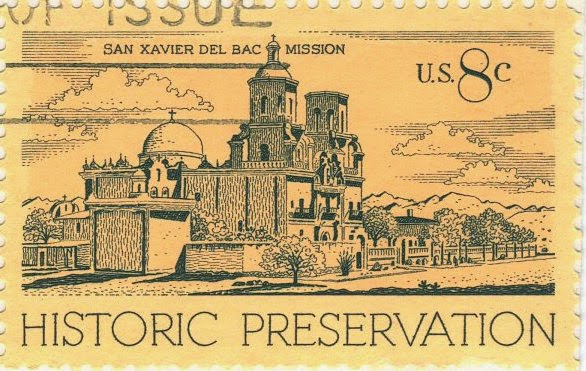
To mark the fifth anniversary, the US Postal Service issued a set of four postage stamps on October 29, 1971.


Designer: Melbourne Brindle
Printing: 150 million in sheets of 32
Decatur House (Washington, DC)

The 1818 building was a fitting choice in several ways. A private domicile, built for the famed American naval hero in the new national “Federal” style in the nation’s capital, it is one of only 3 extant houses by Benjamin Henry Latrobe, architect of the US Capitol. It may have been a more fitting choice than the designers realized: Given to the National Trust in 1956, it acquired landmark status in 1976. Today, as the National Center for White House History, it includes event space for rental as well as commemoration of the enslaved African-Americans who worked and lived here. We thus find here on one site the evolving spectrum of US preservation concerns: historical and architectural significance, cultural diversity and difficult histories, and adaptive reuse.


The last surviving wooden whaling ship, and a highlight of the historic ensemble of Mystic, CT. An icon of American economic development and technological achievement.

The iconic local transportation system, which began in 1873 as a creative response to the uniquely hilly terrain. After World War II, the city planned to eliminate them when the bus emerged as a more efficient alternative. Citizen activism saved them from destruction on the grounds of charm and historic resonance in 1947.


Reflecting a distinctive blend of aesthetic influences from Spain, New Spain, and indigenous traditions, it is the oldest preserved European structure (1783-97) in Arizona, granted landmark status in 1963. Today, we are more willing to acknowledge the exploitative nature and destructive consequences of the Spanish missionary work among the Native Americans (1, 2). More generally, we realize that our image of the old Spanish west derives more from the romanticzing impulses of the late nineteenth and early twentieth century than from history itself.


I always show these images at the start of my historic preservation class—not only as an ice-breaker or eye candy, but with a further purpose. I ask students to imagine why these images might have been chosen. That is: what do they tell us about what was valued then?

I have always been intrigued by the possible logic.  There are two sites each from the east and west coast—though nothing in between (not barn or a Sullivan skyscraper or a Prairie School house from my native Midwest). The inclusion of the mission broadens the customary scope of preservation concerns to include the Spanish Colonial heritage and moreover adds a religious structure to the mix. I have always found it noteworthy that, despite the common tendency to associate historic preservation with architecture, half of the images are not of buildings.

Preservation in the United States, as is well known, began with sites of historical importance to our civic-national narrative and grew to embrace exemplars of architectural distinction. The NHPA formalized the beginning of a greatly expanded, long-overdue notion of preservation going beyond major landmarks. As the amended law and practice have evolved, we have come to take a much broader view of resources and our mission. We preserve vernacular as well as exalted architecture, we preserve whole neighborhoods as well as individual structures. We preserve cultural landscapes as well as buildings. We save not only Civil War battlefields, but also once-“futuristic” 1960s gas stations and an early McDonald’s restaurant.

Sometimes (as in the past, no doubt), our efforts seem to outpace public understanding. We have begun to consider 1950s asphalt parking lots as cultural landscapes. Preservation of a chain link fence in Alexandria, VA became a source of outrage and the butt of jokes not long ago.

Indeed, as I noted in one of my earliest posts here, the preservation of the modern has become the most complex and controversial field. Traditionally, preservation regulations come into effect when a resource is at least 50 years old. However, given that the middle of the twentieth century witnessed a building boom and the proliferation of new architectural styles, a vast stock of modernist structures was or remains unprotected. The fact that many of these styles lack a popular constituency and that the structures themselves are anything but energy-efficient puts them in particular jeopardy. The National Park Service decided that restoration of the landscape of Gettysburg Battlefield trumped preservation of Richard Neutra’s modernist Cyclorama visitor center.  Protests of architects notwithstanding, the idiosyncratic Prentice Women’s Hospital in Chicago, too, came down.

On the other hand, whereas concerns over energy efficiency at times feed the urge for demolition, they now also contribute to a countervailing trend, as preservationists ally themselves with environmentalists and sustainability advocates under the mantra, “the greenest building is one that has already been built.” We have risen up to defend the much-maligned traditional window against the onslaught of the replacement window industry. The notion of “adaptive reuse” is saving many a building that might otherwise have fallen to the wrecking ball, even as it prompts us to let go of purist or absolutist notions of preservation and allow greater changes to structures. (One might perhaps discern a resemblance to the notion of "letting go" and "shared authority" now in vogue in the world of museums and public history.) Often as not, we now speak of “sustainable preservation" as well as “historic" preservation.

So here’s my question. The fortieth anniversary of the NHPA was cause for both celebration and deliberation. 2016 will mark the fiftieth anniversary. If we were to issue new preservation stamps two years from now, what iconic American subjects would you have them depict?


or ….?

Please post your answers in the comment section below. I’m eager to see what, collectively, we come up with.

Tuesday, July 29, 2014

Un-bombs (2)

Ever since Isaiah had a vision of men beating their swords into ploughshares, it has been pleasant to imagine or witness other examples of the tools or symbols of war being converted into those of peace. I've posted a couple of examples over on the Tumblr.


Ballet bomb

Un-bombs (1)

Ever since Isaiah had a vision of men beating their swords into ploughshares, it has been pleasant to imagine or witness other examples of the tools or symbols of war being converted into those of peace. I've posted a few examples over on the Tumblr.


Books, not bombs