Showing posts with label Embarrassing Amherst. Show all posts

Friday, December 16, 2016

Rally Against Veterans' Flag Convoy and in Support of Hampshire College.

As noted in the previous post, Hampshire College's decision to resume flying the American flag in the wake of the protest by a veterans' group led the organizers to cancel the  second demonstration scheduled for a week later. However, another group, the "American Flag and Thin Blue Line Convoy," decided to go ahead with their showing of the flag along a route running from UMass via Amherst College to Hampshire. In the meantime, a group of leftist Pioneer Valley activists hurriedly organized a counter-demonstration on the Amherst Common.


Raise our struggle! (We have markers)

Both events were small. The Convoy claimed just over 200 participants. The counter-demonstration was even smaller. When I arrived fewer than 10 minutes before the announced start time of 10:00, there were only three people there, just starting to make signs. "We have magic markers if you want to help," one of them told me ("and glitter," another helpfully added). Even when the event got going, between 10:15 and 10:30, there were only between about two and three dozen people present. By the end, the total was over 100, and perhaps around 150 by my count--still a far cry from the 1500 that the organizers claimed for their veterans' protest at Hampshire a week earlier.


Whereas the veterans' protest was sharply focused on a single issue and a  clear outcome --"Raise the Flag!"--the program of the present event, called "Raise Our Struggle," might best be called eclectic: a counter-demonstration against the convoy, combined with wide-ranging demands for social justice and denunciation of the bigotry and racism associated with the election campaign of Donald Trump, as well as a call for "hands off Hampshire College," in response to the abuse that the latter was suffering for its flag policy.

The event announcement epitomized the grab-bag approach and generalized, flailing, post-election anguish:
A rally and gathering in defense of our plural and diverse communities in Amherst and beyond.

In Amherst and communities across Western Massachusetts, some of us are proud of our country and the flag, and others are not, but all of us recognize that Hampshire College has been subject to an unprecedented attack on their community's autonomy and character as a progressive and critical space. Reactionary nationalist forces have invaded their community with direct racist and xenophobic threats to impose a political vision that erases the experiences, voices, and history of immigrants, people of color, women, LGBTQ communities, youth, Muslims, indigenous people, Jews, other marginalized and oppressed communities, and the working class. Elected officials and politicians, from local Democrats to Donald Trump have spurred on and defended this assault, more concerned about the American flag than the proliferation of hate crimes and open bigotry in our communities.

This is not about any symbol. This is about human beings. The assault will not stop at Hampshire College. The same forces want to lay siege to communities of color, college campuses, and progressive institutions of the marginalized and the working class. They fly the thin blue line and celebrate the police, not for their own safety or peace, but to shield police and the state from scrutiny, from checks on the violence daily inflicted on black, brown, and working class neighborhoods. Forces of reaction wish to wrench apart our communities , not in the name of freedom, liberty, or patriotism, but dominance, blind authority, vulgar power, and profit.

We humbly recognize that we are on stolen land, and we need to respond with stewardship in solidarity with indigenous peoples, not to reclaim territory for nationalism and imperialism. We must do our part in Amherst, but free our hearts, minds, and bodies to support the struggles of frontline communities across this country and the world. We will not forget our past, our history, our struggles for liberation and freedom.

An Injury to one is an injury to all!
The first remarks by a Springfield activist addressed the theme of social justice in the age of Trump.


"What do we want? Free speech!"


About 20 minutes later, demonstrators took up positions along the sidewalk and in the crosswalk at the intersection of Pleasant and Spring Streets as the convoy approached.


The convoy organizers had asked "that there only be american flags, thin blue line pro police flags, gadsen [sic] flags, or flags pertaining to any branch of military. No confederate flags."

Blocking the street (a violation of the law) in order to stop the convoy, they shouted, "What do we want? Free speech!" (Other chants included: "No Trump, no KKK, no fascist USA.")


A sheriff's car accompanying the convoy (a service the convoy organizers paid for) halted and prudently allowed the protest to go on for a few moments. Frustrated, the convoy participants made u-turns and found an alternate route. A moment later, an Amherst police vehicle arrived. The officer advised the demonstrators that they were not allowed to block a public way, and they returned to the Common.


"We're badass!"

Jubilantly proclaiming that they were "badass" for having briefly interrupted the progress of convoy, they continued with their program.

School Committee member Vira Douangmany Cage, the only Amherst elected official to participate (though in a private capacity), spoke of social justice, denounced the outside politicians who had taken part at the Hampshire College protest last week, and criticized Amherst's government for not intervening.

(The Business Improvement District had nothing to do with the rally.
The sign was presumably left over from the "Merry Maple" celebration.)


"Hands off Hampshire College"


Hampshire College professor Uditi Sen (my colleague in history) defended the institution's decision to remove the flag, offering what might be characterized as the predominant view among the faculty and administration.


Few outside the academy may share this view (or even understand the argument that she was trying to make), and that is their right--but the nature of that disagreement makes all the difference.

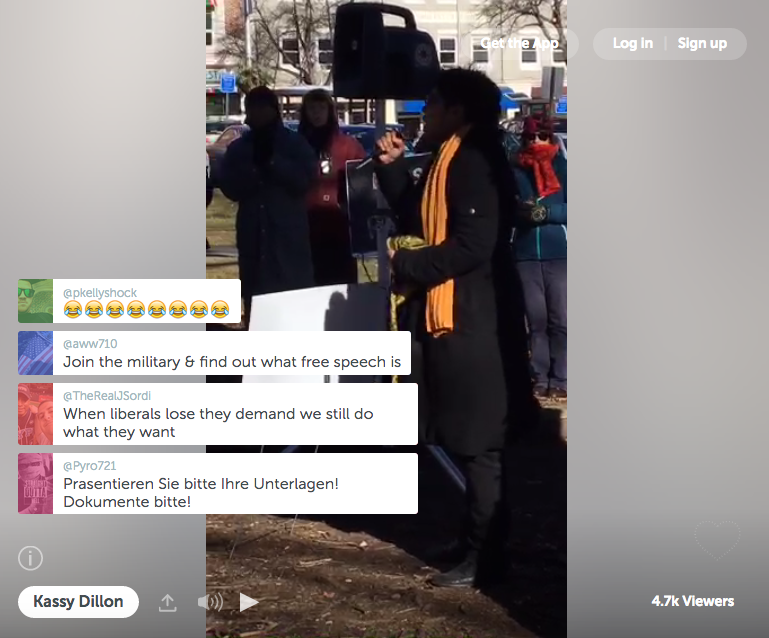
Mount Holyoke student and conservative activist Kassy Dillon covered the convoy and the demonstration on the Common on social media, mocking the College and the protesters. That, of course, is her right, as well. Part of her coverage included live commentary of the rally via Periscope.


Unfortunately, some of the respondents to the feed chose to offer particularly hateful responses (for which, it should be stressed, one cannot hold Ms. Dillon responsible). They ranged from the childish to the racist and full-blown neo-Nazi.


It was a perfect illustration of the toxic political landscape at the intersection of internet journalism and social media. Often it's not even so much the actual reports as the unmoderated responses and "talkbacks" that are the problem. Here, the problem is all too evident.

And 2017 is not even upon us.

* * *

Press coverage

In contrast to the brief and bland report on WLLP Channel 22, the Springfield Republican's Mary Serreze (@maryserreze) did a notably thorough job of covering the event from the standpoint of both parties.


From the Protest Rally Against the Hampshire College Flag Policy


In response to students' anger and fear in the wake of the presidential election and their protests that the American flag represented racism and oppression, Hampshire College controversially decided on a temporary removal of the national symbol in hopes of calming the situation and fostering dialogue.


The public reaction surprised the College (but hardly anyone else): incredulity and outrage.


"Peaceful Demonstration of Freedom--Stand With Old Glory"

Amherst’s Veterans of Foreign Wars Post 754 organized a mass protest on the Hampshire College campus for the Sunday after Thanksgiving (November 27). A large crowd from around New England--particularly but not exclusively veterans and their families--gathered at the entrance to the College on Route 116. Although the press put the size of the crowd at around 400, the organizers, who issued over 5,000 invitations via social media, estimated attendance at 1,500 to 2,000: which is to say, greater than the annual enrollment at the College.

I was present, along with a few other members of the faculty and student body.


 Veterans represented multiple generations and wars.


Not exactly the alt-right

In the wake of the presidential election and the tensions that it engendered, many in the Hampshire and wider Amherst community (who did not bother to attend or were scared to do so) leaped to the conclusion that the event was a gathering of right-wing extremists and hatemongers. On the contrary, the organizers took care to avoid giving the formal program any particular political slant. In fact, the most prominent speakers were centrist or left-liberal Democratic politicians: State Rep. John Velis (Westfield), Springfield Mayor Domenic Sarno and Councillor Kateri Walsh, and Northwestern District Attorney David Sullivan. Several of the speakers were non-white and immigrants. A member of the local veterans' color guard was transgender.

not exactly the "alt-right"

Outside interference?


The presence of the regional political figures caused no little consternation among the Hampshire faculty, who complained in high dudgeon that outsiders were interfering in our internal affairs and attempting to intimidate the College. It is an ironic argument. The politicians were simply exercising the same right of free speech about an issue of deep concern as the students who burned the flag and the President who banned it. (And, for the record: in my many years of working here, I had never known the College to bow to the wishes of any outside force, least of all, provincial politicos.)

Still, even neutral outsiders remarked on the unusual presence of these visitors. (Most expressions of surprise focused on the presence of Mayor Sarno, who, as a friend of mine from beyond the walls of the academy drily observed, "has never even come to pee in Amherst.") The most parsimonious explanation is, however, generally the most plausible. (It is possible to overthink an issue.) The cynical consensus among outside observers was that the aim was grandstanding rather than intimidation. Seeking to score easy points with their base is, after all, what politicians do. But politicians also have convictions. The idea that the flag had powerful emotional meaning for them, and that they therefore cared sincerely and deeply about its presence or absence, is a difficult one for the academic mind to grasp.

Rep. Velis is not just a politician from the Pioneer Valley, but also an Afghanistan veteran. As for DA Sullivan, he is a frequent attendee at events in Amherst, and he moreover has extensive professional experience in military affairs, having served as a civilian lawyer for service personnel and most recently, working to establish a new veterans' court providing treatment for trauma disorders and substance abuse. Mayor Sarno, too, paid tribute to the veterans, but he explained that the flag had further personal significance for him.


The flag of a nation of immigrants

Sarno was one of several speakers who highlighted the role of immigrants. The flag had special meaning for him as the son of Italian immigrants who had experienced Fascism and survived the Nazi occupation of Italy in hiding. To them it had been a symbol of hope and freedom.


Event organizer Victor A. Nunez Ortiz came to the United States when his family fled the Salvadoran civil war. He served in the Marines even before becoming a US citizen. He refers to this experience when introducing the next speaker.


Another veteran who had served in the US military as an immigrant non-citizen was Veasna Roeun of Connecticut: a survivor of the Cambodian genocide.


A Progressive Speaks


Here, well known local civic and political figure Bonnie MacCracken speaks. She read a poem about Blue Star Mothers. Bonnie, a candidate in the recent Democratic primary election for state representative from the third Hampshire district, is a member of the Democratic State Committee and has long been active on behalf of progressive social causes, among them racial and economic justice (especially housing issues) and early education.


And the right?


The red meat right-wing exception in this program was the brief address by Mount Holyoke student and conservative activist Kassy Dillon, who focused her remarks on a critique of the College and its students. She explained, "I wrote the first story" about the flag flap, adding that the Hampshire student who had passed on the news to her was now "being bullied by other students."


Racism and extremism?

Despite repeated assertions that Confederate flags and other racist symbols were on display, neither I nor anyone I subsequently spoke with saw them--and no one has to date produced any photographic proof. It does not seem unreasonable to conclude--given the nature of the controversy, and what I saw--that many in the crowd were to the right of center, but that is not the same thing as "alt-right" "white supremacists."

To be sure, there were a few displays that I could I could have done without: this anti-UN flag, for example (though without talking to the owner, it was impossible to tell whether it represented standard arch-conservative gripes about "anti-American" multilateralism or something notably more rancid).


I also spotted several "Don't Tread On Me" flags. The right-wing "Tea Party" movement adopted the Gadsden Flag (as it is more properly called) in 2010, though as everyone should know (and Mount Holyoke historian Joseph Ellis explains), it is a venerable emblem of the American Revolutionary era, appropriated in the meantime by various groups as a symbol of protest.


On the whole, the tone was respectful of the College. Of course, the organizers could not regulate who showed up, and a few of the signs were obnoxious and juvenile. One placard (referring to Vladimir Putin or just left over from the Cold War?) advised Hampshire students: if you don't like it here, go get an education in Russia. Another, in what the creators no doubt considered a masterpiece of wit, relied on hackneyed scatological imagery.


By contrast, this sign, playing on the Hampshire College motto, took a lighter approach, and was perhaps marginally more effective.


The organizers had stressed the need for civility prior to the event:
this a PEACEFUL DEMONSTRATION OF FREEDOM as citizens of our United States of America. . . Families will be present and order is to be expected.
At the rally itself, they reiterated this request and moreover made a point of thanking the College for allowing them to meet on campus property. Here, veteran and Purple Heart recipient Micah Welintukonis of Connecticut, who presided over much of the event, offers to provide microphone time to the President or any other administrators who might be present (none were) and then leads the crowd in the chant, "Raise that flag!"


A confrontation

At one point, though, one saw how things might have taken a more dangerous turn. Toward the end of the event, the organizers wanted the participants to assemble near the large Hampshire College sign for a group photo that they hoped would go viral. As they asked people to move away from the sign so that the wording would be visible, we saw a young man sitting on the ledge in front of it, giving people the finger with both hands. The organizers, at first thinking he was one of their own, mocking Hampshire College, chided him for his vulgarity. It turned out, however, that he was a Hampshire student flipping off the demonstrators rather than the College and seeking to spoil their photo op. The crowd became more agitated. Several people seemed prepared to remove him by force and others tried holding a flag in front of him to block him from view but the speaker urged them to remain peaceful and let the campus police provide order. The speaker engaged in some mild taunting of the hapless student but also offered him the microphone. After a few minutes of this standoff, things quieted down. Subsequent press reports described some uglier aspects of the confrontation, but from where I was standing at the time, near the podium, I could see and hear none of that.


Coming to a close

As the rally wound down, attendees sang "God Bless America."


In the low-key conclusion to the event, the speaker reminded attendees that "we are all Americans" and urged them to tell the College: "raise our flag!"


Postscript


The veterans had planned to return a week later for a second rally, but when the College suddenly announced on December 2 that the flag was going back up, they canceled the event as what they called an "act of faith":


Indeed, the best outcome of this sorry mess would be a dialogue between veterans and campus community, and there are some signs that this may in fact occur.

Hampshire Flag Watch: Going, going, . . .gone?! and . . . now back?


By now practically everyone in the country has heard the story, regardless of whether you read the New York Times or watch Fox News. It was with a mixture of fascination and horror that I watched the slow-motion political train wreck that was the Hampshire College flag controversy unfold over more than a month. 

Another metaphor that we use for a self-inflicted, completely avoidable disaster is: own goal.


For anyone who has been in a coma or perhaps just shell-shocked by the Trump victory and therefore unable to read a newspaper, watch TV, or surf the web, here's the elevator-speech version.


Take Down the Flag!

Hampshire student chalk protest: Take Down the Flag
The election of Donald Trump as President on November 8 prompted some Hampshire College students to express their opposition to the institution’s flying the US flag, which they denounced as a symbol of racism and oppression. College President Jonathan Lash listened politely but did not act on their demand. The next night, a group of students lowered the US flag to half-staff. On the night of 10 November, parties unknown burned the flag. It was the eve of Veterans Day. On November 12, the Trustees, having restored the flag, announced that they would fly it again at half-staff in deference to student concerns: “both to acknowledge the grief and pain experienced by so many and to enable the full complexity of voices and experiences to be heard.”

It was immediately clear to me it was an untenable policy: it simply could not last. I decided to watch what happened, for the historical record.

Day 3 (14 November)


For Day 4, the middle of the first week, I thought three shots were in order: 
general, close-up and night-time


Day 5 (16 November)


Day 6 (17 November)


Day 7 (18 November)


This is the only "dialogue" or "conversation" about the flag that I personally witnessed. (Evidently, the promised process happened in a series of "focus groups," but the vast majority of us were not involved. I certainly heard nothing.)


Negative space

Well, that didn't take long. The only thing more peculiar than the decision to fly the flag at half-staff for an extended period was the policy that soon replaced it. After only a week, on 18 November, the College announced, “we will not fly the U.S. flag or any other flags at Hampshire for the time being.” This, we were told, was so that we could discuss the meaning of the flag without the disturbing presence of (wait for it . . . ): the flag.


19 November: naked and alone


Raise the Flag!

A few days later, the press descended on the College.

November 22: filming an absence


When the outside world learned of the decision, the most common reaction was one of anger and incomprehension. The only surprising thing was that the College, with all its intellectual wattage, was, well . . . surprised. Any ordinary person would have seen this coming.

Amherst’s Veterans of Foreign Wars Post 754 organized a mass protest on the Hampshire College campus on 27 November, the Sunday after Thanksgiving. People from around New England--particularly but not exclusively veterans--gathered at the entrance to the College on Route 116. The organizers estimated attendance at over 1,500 to 2,000: which is to say, greater than the typical annual enrollment at the College.

The event was nonpartisan in intention (and largely in practice) and the speakers included several left-liberal Democrats. I attended the rally to observe for myself. Although some subsequent press reports described at least one confrontation involving aggressive or offensive behavior, what I saw was by and large respectful and disciplined. The organizers stressed the need for civility and made a point of thanking the College for allowing them to meet on campus property. They offered to provide microphone time to the President or any other administrators who might be present (none were).


Press coverage, both local and national, was heavy.


The College soon faced a torrent of abuse in the form of angry phone calls and emails, as well as far harsher talk on social media--much like what the Town itself has experienced in the wake of controversies over flying the 9-11 commemorative flags or other contentious debates.


November 29: I have no idea what these temporary fences near the flag were intended to accomplish.


Back to normal?

On 2 December, the the College suddenly announced that the flag was being returned to its customary position on the main campus flagpole. Crisis over, but no problems solved.


After I took my pictures, a woman passing by said, "a lot of people doing that today."


There is a well known political dictum: when you're explaining, you're losing. The College has created a dedicated web page to explain its recent flag policy to the public.


* * *


Coming attractions 

- photos of the protest rally against the College
- a more detailed look at the controversy


Tuesday, June 9, 2015

From the Vaults: Amherst Town Meeting: The View from 2011 (April 1--but no joke)


From the Vaults

As I mentioned in the previous post, I thought I would resurrect a few older pieces in order to provide some perspective on the new debate that seems to be shaping up around the issue of Town Meeting and Amherst's form of government.

This first piece, from four years ago, notes the popular frustrations with Town Meeting but strikes an overall optimistic stance. Some of the details were intended as historical background. The rest have now become such. Readers can decide for themselves to what extent any of this is still of interest or use.

Laughing to Keep From Crying

But there is also some humor, and that, at least, is enduring. One factor that can make politics so needlessly unpleasant is people who take themselves and the game too seriously.

Two lighter pieces on the foibles of traditional New England government in our small towns included in that old post:
1) "I Hate Town Meeting" from New Hampshire Magazine.

2) A segment from "All Hail the Councilman," an episode from the "Newhart" show (which some of you may remember--or have discovered through new media outlets), in which Bob Newhart plays the owner of a Vermont country inn.
Neither one represents our system of government--but I'd wager that Amherst residents could nonetheless spot some resemblances. See whether you can see yourself (or all of us) there.

* * *


From the Vaults.  Town Meeting: Do They Hate Us For What We Do or Who We Are?:

As I recently noted, the low turnout in Tuesday's local election gives one pause for thought. At a moment when protests against dictatorship and for participatory government (whatever the complexities of the specific political constellations and possible outcomes) are rocking the Middle East in a spectacle captivating the attention of the world, the vast majority of us here in the safety of Amherst did not bother to vote (a mere 8.47%).  Aside from the fact that there were few contested races or hot issues, it is of course more generally true that voter turnout tends to be lower in societies with long-established traditions of democracy and elections.

Still, one wonders about the lack of candidates as much as turnout. It could well be that what Select Board Chair Stephanie O'Keeffe said of that office and contest applies here too: "the lack of challengers either indicates" that the incumbents "are doing a good job or no one else wants to do the job." And yet, it seems more problematic when applied to a 240-person Town Meeting than a 5-person Select Board.

We Amherst residents have something of a love-hate relationship with Town Meeting and our larger political culture (which, if you study Amherst history, seems to have its own tradition [1, 2] ). Twice in recent years (the first time in 2003), voters attempted to scrap our current  charter, with its system of Town Meeting and Select Board, in favor of one based on a mayor and council (that's the difference between a "town" and a "city" in Massachusetts law). The second time, in 2005 (1, 2), it was only narrowly defeated in an election that brought out 35.2 percent of the electorate. The so-called Charter Reform attempts arose because of a frustration with Town Meeting: its tone, its slow pace, and its outcomes (or lack thereof).

And yet the issue was complicated. I always recall what one ardent Town Meeting supporter, a refugee from Nazi Germany, told me.  He compared the lack of civic spirit and willingness to stand up for justice and democracy (what Germans call Zivilcourage) in his native Germany with his adopted New England's tradition of active participation and debate.  He had no illusions about the flaws of Town Meeting but cautioned against abandoning it as earlier generations had overthrown "messy" democracy in the name of fascist "efficiency." Each step away from broad-based democracy, he warned, reduced the opportunities for public participation in government, and in the process, not just citizen involvement but also citizen interest in public affairs. We had already gone from an open town meeting—in principle embracing every adult resident—to an elected town meeting, restricted to 240 members (24 from each of ten precincts), plus the dozen-odd officials. Now to reduce the number of citizens making decisions about the fate of the town by some 96%, to a nine-member council and mayor (with veto power) seemed to him a regression that could not be justified. It was a powerful argument.

I have to say that I think the last Charter referendum squeaker turned out to have a salutary effect all-around. It made clear to Town Meeting diehards just how deep the popular dissatisfaction and even anger ran. It made clear to Town Meeting opponents that, despite considerable popular sympathy for their complaints about the political culture, residents were not prepared to abolish this venerable political institution. And it thus conveyed the message to all:  we have to live together, so we'd better get our act together.

On balance, I'd say, we have learned that lesson well:  Town Meeting has become more efficient. It manages to get its business done while occupying fewer days on the calendar, thus reducing the demand on members' time (an oft-cited obstacle to greater participation, especially for families with young children). The tone is generally civil, the debate more focused and productive. There has of late been at least hypothetical talk of reducing the size of town meeting, so as to increase competitiveness and thus the actual representativeness of the representatives (empty seats and unopposed candidacies were among the issues that motivated Charter reform supporters), but for the time being that remains just talk.  For now, we work with what we have.

This is not to say that Town Meeting form of government (any more than Congress) cannot still be the source of silliness and frustration.  The piece from New Hampshire Magazine that I recently cited on the history of the hog reeve happened to be entitled, "I Hate Town Meeting":

I hate town meeting.

Town meeting is a laboratory sink for psychologists.

Every dreadful facet of human nature reveals itself at these gatherings. One must have the emotions of a sociopath to escape town meeting with one's soul intact.

I remember a town meeting in Temple years ago where the Police Chief, Russ Tyler, was attacked for using his cruiser too much. Poor Chief Tyler used his own car as the cruiser. He saved the town a lot of money using his own car.

But the mob at the meeting was sure he was getting away with something.

I remember thinking, "You people are crazy to be yelling at the Chief like this. He has a gun."

But Chief Tyler also had great heart. He was a straight shooter and a nice guy (although he did look like that sheriff in the old TV ad who says, "Boy, you're in a heap of trouble.")

In the end, the meeting vented itself and the Chief got his budget. But what heroic self-restraint that man showed.

Towns are made up of people who do not trust one another. It is and has always been "us and them."

The "new" people settle here with an idyllic view of living in a small town. They come from places where no one knows each other. Here they expected to find love.

What they find, of course, is resentment. The old Yankees don't trust the newcomers. Usually the newcomers are Democrats.

Some newcomer always stands up at the meeting and says something like, "My name is Ralph Lumpman and Loraine and I moved up here last fall from Darien. We bought the old Cosgrove place on Swamp Road. And I'd like to say that our moderator tonight is doing a bang-up job and I think we should give him a round of applause."

Then all the people, who recently moved to town, clap.

And there is always someone who informs the moderator that the flag is on the wrong side of the stage.

Town meeting gives people license. No one is expected to practice restraint.

Everyone is there to tell it like it is.

For 24 years of my life I was a small-town newspaper reporter and did news on the radio station in Peterborough.

I have attended over three hundred town meetings.

In my 50-plus years of going to town meetings I've seen a lot of changes. Years ago most towns were controlled by the families who owned the mills. In Milford it was Charlie Emerson; in Jaffrey it was D.D. Bean; in Wilton it was the Abbots; in Dublin, Robb Sagendorph.

If you didn't work for these men, someone in your family did. I used to watch D. D. Bean sit in the front of the hall at the Jaffrey Town Meeting.

Mr. Bean owned the match factory, in Jaffrey. When an article important to him came up he would turn and look back over his seat and note who voted "for" and who voted "against" the article.

Robb Sagendorph was the publisher of Yankee magazine and the Old Farmer's Almanac up in Dublin and he had double clout. Robb Sagendorph was also the moderator. If he didn't like an article he would close down discussion.

"We have had enough jawing about this matter," he'd say. "It's time to vote."
Of course, the system of mayor and town council is hardly perfect, either. The following episode of the old "Newhart" show seems somewhat confused in that it speaks in places of both "town council" and town meeting, but seems to depict the workings of the latter (perhaps the author was not familiar with the intricacies of New England government). In any case, no matter: the dilemmas and foibles can be universally appreciated. In episode 3 (full video here) newly arrived innkeeper Dick Loudon (Bob Newhart) complains about a dangerous intersection in front of his establishment and wants the town to install a stop sign.  Local political honchos persuade Dick that, as a man of civic spirit who does not only complain but also proposes solutions, he should run for Town Council. In the clip below, he attends the first meeting:


It's nice to be reminded that things could always be worse.

Town Meeting: Pinnacle of Participatory Politics--or The Terror of Tiny Towns?

the light at the end of the tunnel--or just someone's headlights?

Yes, we made it again, as the sign at the High Horse brewery congratulated us Town Meeting diehards. Or did we?

That is, we got through another annual Town Meeting, and it didn't go on for an inordinate amount of time: 22.5 hours vs. 27 last spring, so I am told (though by most reckoning, it could have been at least a day shorter). Admittedly, we were not dealing with multiple complex pieces of zoning legislation, as in some past years, so the increase in "efficiency" might in part just reflect the fact that our tasks were more modest.

But one has to wonder about the fate of the institution. As Amherst residents know, complaints about Town Meeting arise as regularly as the spring flowers and then fade with the same regularity--and yet this year somehow feels different.

One item at last night's Select Board agenda was the annual Town Meeting debriefing: a chance to reflect on our performance and the overall tenor and success of the endeavor.


Our main concerns--above all, wasted time and "incivility"--were not new, but they seemed to acquire new urgency.  The coming adoption of an electronic voting system might do a good deal to alleviate the former. The cure for the latter is less obvious. We expressed our regret that, both in formal remarks on warrant articles and in audible background chatter, Town Meeting members repeatedly, and often without reprimand from the Moderator, violated the rules of the body (Section V D, pp. 17-18 [33-34]) by imputing motives to individuals and in particular impugning Town staff, elected officials, and members of citizen boards. At Town Meeting, we heard the repeated insinuation that Town boards and staff were somehow colluding with developers at the expense of the common weal. Only slightly more subtle was the implication that those "at the front tables" (i.e. Select Board, Finance Committee, Planning Board) were somehow the adversaries of Town Meeting rather than partners in a system.

Town Meeting: attendance and attention uneven
It is a shame. A mere four years ago (see the next post), I thought the various factions, having survived a contentious "charter" referendum that sought to eliminate Town Meeting, had accommodated themselves to political coexistence. I am no longer so sure. The discontent expressed by some members as well as citizens at large is the highest that I can recall since that last Charter vote in 2005. Again, it may dissipate, but it is a worrisome sign.

The division of opinion over the merits of Town Meeting was amply expressed in two recent editorials.  I won't try to analyze the arguments here and will instead just offer excerpts with links to the full pieces. Read and judge for yourselves.

In the first, longtime Town Meeting member Jim Oldham defended the institution against the charge of inefficiency and obstructionism:

The wisdom of democracy borne out at Amherst’s Annual Town Meeting

excerpt:
This year’s Annual Town Meeting is a great example of effective democratic government. . . . While many individual members have maintained either pro- or anti-Town Hall positions, the body as a whole produced more complex outcomes, neither acquiescing to, nor rejecting out of hand, all proposals placed before it. . . .

Motions to end debate rarely contribute to better decisions . . .

Worst are suggestions, such as heard early on from a member of the Finance Committee (an appointed body intended to serve Town Meeting), that members shouldn’t second-guess the work of staff and committees. That actually is exactly the job Town Meeting is charged to do. Fortunately the majority of members continue to embrace that responsibility, as recent sessions demonstrate.
(full text: Amherst Bulletin, 20 May 2015)


In response, Professor Ray La Raja and graduate student Wouter Van Erve of the UMass Political Science Department urge residents,

Don’t romanticize Town Meeting democracy in Amherst

excerpt:
Thin deliberative democracy. Oldham argues that Town Meetings should have lengthy debate. He argues further that it is the job of members to “second guess” the work of policy committees. Both these views are contradicted by what research says about effective representational bodies. The most deliberative American legislatures are highly “institutionalized.” That is to say, when dealing with complex issues — especially those that divide a community — legislative bodies tend to divide the labor and defer to the expertise of policy committees. It is here where dialogue and compromise take place before a bill is sent for a full vote. Most of the time, the “debates” that ensue before a full legislative vote are purely symbolic because a winning coalition has taken shape beforehand.

Debates in Town Meeting appear largely symbolic rather than deliberative. Persuasion and compromise need to come earlier in the process. Otherwise, Town Meeting is simply a forum to affirm individual preferences and make sure allies outnumber the other side.
(full text: Amherst Bulletin, 3 June 2015)


Funny thing is: these pieces were in many ways a reprise of a similar exchange a year ago:


Ray La Raja and Wouter Van Erve:

How representative, really, is Amherst Town Meeting? 

excerpt:
Our data suggests that Town Meeting in Amherst is fairly unrepresentative both descriptively and substantively.

This would be less disconcerting if we had confidence that residents could effectively hold their Town Meeting members accountable. . . .

. . .Town Meeting elections lack even the most basic information that would help voters hold members accountable. Most residents don’t know who is running, what they stand for, or how they voted in previous sessions. So how does the voter make a decision? . . . .

In Amherst, those who vote tend to know those who are running for office. Our analysis shows, not surprisingly, that these voters share the same demographic and preference profile of Town Meeting members. In other words, the voters and members run in the same social circles, while non-voters do not.
(full text: Amherst Bulletin,  9 June 2014)


Jim Oldham:

Amherst Town Meeting is independent, not unrepresentative

excerpt:
The Around Town column in the June 13 Bulletin reported on the Select Board discussion of concerns about the length of time Town Meeting took this year and the supposed “level of incivility.” They seem to have overlooked that they themselves instigated the most inefficient use of time and the most uncivil behavior at Town Meeting this spring.

Faced with two citizen zoning petitions that could not be acted on for technical legal reasons, and which Town Meeting would have voted to refer to the Planning Board with little discussion, the Select Board chose instead to advocate for dismissal, an action with no practical benefit but more pejorative to the petitioners, thereby triggering close to an hour of unnecessary debate and several counted votes.

But rather then review the wisdom of that choice, they focus instead on raising general concerns about Town Meeting.

Meanwhile, University of Massachusetts professor Ray La Raja and grad student Wouter Van Erve assert that Town Meeting is unrepresentative (see essay, Page A5), based largely on the claim that Town Meeting members do not reflect the population at large.
 (full text: Amherst Bulletin, 20 June 2014)


The debate is not over. You can be sure that the topic will be back in the news--and maybe even the election booth.

In order to provide some perspective, I thought I would resurrect a few older snapshots of our Town Meeting experience in coming posts.

Friday, February 27, 2015

When a Minstrel Show in Amherst "was considered a success"


To be precise, "considered a success both in its performance and numbers, as shown by about 350 in attendance."

The date: 1951. A few years before Brown v. Board of Education but well after supposedly decent and educated people should have known better.

Not even 65 years ago, but the distance between that time and this seems much greater.


ICYMI: Read the full story.

And afterwards, be sure to fill out the Amherst Together survey so that we can "advanc[e] community, collaboration, equity and inclusion."


Update (19 March)
Of course, it could be worse:

Belgium minister sparks scorn by 'blacking up' (CNN, 19 March 2015)

Monday, November 17, 2014

Back When Amherst Was Not So "Progressive": Color Lines and Blackface


Amherst is today engaged in a new process of dialogue regarding the problem of racism, in the schools and in our community at large. (e.g. 1, 2, 3, 4, 5)

In the course of some research on other topics in Amherst history, I stumbled upon this 1951 photo from the local paper, depicting a minstrel show, with performers in blackface:


It is reproduced in Leave the Light Burning: South Amherst, Massachusetts, by W. H. Atkins (1871-1952), ed. Marjorie Atkins Elliott (McFarland, WI: Community Publications, 1973).

Evidently the members of the "Deep South Amherst Minstrels" considered their name very clever: they are from the southern end of the town--get it? (Did geography or just good sense prevent residents of my neighborhood in the utter nothernmost end of town from descending to such depths?)

Among the participants in the show are many notables of South Amherst, some deeply involved with the South Congregational Church--including the Minister, Rev. Arnold Kenseth (Chaplain and later Instructor in English at the University of Massachusetts) and his wife Betty--and members of the Atkins family, founders of the popular agricultural enterprise and grocery market. It was also Howard Atkins who donated land for the site of the Munson Library, next to the Church.

Rev. Kenseth has the distinction of being one of only 14 Amherst authors, past and present, to have one of the Town's "Literary Trails" named in his honor.


As for Howard Atkins, he is quoted as advocating change in the late 1970s:
I plan to build a planned unit development for 750 people. Amherst still has great potential for growth. This is certainly not a small town now, and we can't go back in time. . . . The town consists of a highly variegated population with conflicting thought, and it is difficult to arrive at a consensus on any subject which challenges one of these groups who are vocal. What I mean by vocal is that people talk up a lot more than ten years ago. . . .
     I have lived in Amherst all my life, as did my ancestors. I am selling some land to those who want to buy, blacks or whites. This is a growing town, it wants to grow. Now I have sold some land my family has farmed for a couple of generations, and it is not a happy occasion when I consider what this land has symbolized for quite a time. But you must remember that events and demands change rapidly, and very few things remain the same year after year after year.
--cited in Essays on Amherst's History (Amherst: The Vista Trust, 1978), 286
(attributed to an anonymous town leader who, by the description can be no one else)
It is, I suppose, encouraging to see that the man who put on blackface in the 1950s would, a generation later, announce his willingness to sell his land to blacks as well as whites (though why one would at this late date speak of what was both right and legally required as if it were some kind of grand gesture is a subject for another conversation).


A different world?

To see the of the minstrel show today is be thrown back into a very different world. No doubt the participants thought what they were doing was all in good fun, or even some kind of tribute to another culture--perhaps much the way some people still think of the images of Native Americans appropriated as emblems of sports teams. Times have changed. Thankfully.

The minstrel show remains shocking but becomes less surprising when one recalls that it was only around this time that  the Lord Jeffery Inn, associated with Amherst College, finally and reluctantly began to admit African Americans as guests. Times have changed. Thankfully.

The latter episode, which appears in Essays on Amherst's History (Amherst: The Vista Trust, 1978), draws upon an Amherst College senior thesis by David Chaplin on "Amherst's Negroes" (1953). As the essay summarizes (p. 297):
Chaplin also found that most whites in Amherst refused to believe that any real discrimination existed; as one citizen explained, 'I don't know anything about the Negroes here, but I do know that there isn't any discrimination'
On second thought, maybe the times have not changed so much, after all.


The point of mentioning the minstrel show is not for the sake of scoring easy moral points and feeling superior to our predecessors. Quite the contrary. Presumably decent enough people in other regards, the participants were unable to see that their action was deeply offensive. How will we and our attitudes and behaviors fare in some 60 years?

The Town of Amherst, under the guidance of Media & Climate Communications Specialist Carol Ross, has launched its "Amherst Together" project, in order to begin a conversation intended to "advanc[e] community, collaboration, equity and inclusion." As a first step, it is asking residents to take a survey about attitudes toward the community and one another.


{updated II.15}